
Disability Living Allowance for Children: How to Apply and Win Your Claim in 2026
Applying for Disability Living Allowance (DLA) for your child can feel overwhelming. The form is long, the questions can seem repetitive, and many parents struggle to know how much detail they should provide.
One of the biggest difficulties is that the support you give your child may have become completely normal within your family.
You may automatically:
- prompt them to wash, dress or eat;
- supervise them closely because of poor danger awareness;
- help them regulate when overwhelmed;
- repeatedly remind them what they need to do;
- accompany them to the toilet;
- monitor them during the night;
- help them communicate;
- prevent them running into danger;
- prepare food differently because of sensory needs; or
- provide far more support outdoors than another child of the same age would need.
When this happens every day, it is easy to underestimate how much additional care you are actually providing.
A successful DLA application therefore needs to do more than list diagnoses. It needs to help the decision maker understand what your child’s life is actually like and how much extra help they require compared with another child of the same age.
This guide explains how DLA for children works in 2026, what the DWP is looking for, how to approach the claim form and how to give your application the strongest possible evidence.
What Is Disability Living Allowance for Children?
Disability Living Allowance is a benefit designed to help with the additional costs of caring for a disabled child.
For children in England and Wales, DLA is generally available for children under 16 who either have difficulties walking or need substantially more looking after than a child of the same age who does not have a disability.
DLA is not means-tested in the usual sense. A parent’s employment, income or savings do not determine whether the child’s additional care or mobility needs meet the DLA criteria.
If your child lives in Scotland, the equivalent benefit is Child Disability Payment, rather than a new DLA for children claim.
Does My Child Need a Diagnosis to Claim DLA?
A diagnosis can provide useful supporting evidence, but DLA is fundamentally concerned with the child’s needs rather than simply the name of their condition.
Two children with the same diagnosis can require very different levels of support.
If you are unsure whether your child’s diagnosis or difficulties could potentially meet the DLA criteria, read our guide to What Conditions Qualify for Disability Living Allowance for Children?.
What Does DLA Compare Your Child With?
One of the most important principles to understand is the same-age comparison.
The question is not simply:
Does my child need help?
Children naturally need support from adults.
The more useful question is:
Does my child need substantially more care, attention, supervision or support than another child of the same age who does not have a disability?
This is why age matters.
A four-year-old needing help dressing may be entirely ordinary.
A 14-year-old who requires an adult to supervise and physically assist every stage of dressing presents a very different picture.
Similarly, closely supervising a young child near roads is normal parenting. Having to physically hold or restrain an older child because they may suddenly run into traffic may indicate a substantially different level of supervision.
The DWP’s eligibility guidance specifically uses the comparison with a child of the same age without a disability.
The Two Parts of DLA
DLA has two components:
Care Component
The care component relates to the extra care, attention or supervision your child needs.
There are three rates:
- lowest;
- middle; and
- highest.
The appropriate rate depends on the nature, amount and timing of the child’s care or supervision needs.
Mobility Component
The mobility component relates to additional difficulties or support requirements when getting around.
There are two rates:
- lower; and
- higher.
Different qualifying conditions and minimum ages apply to the two mobility rates. Lower-rate mobility can be payable from age five, while higher-rate mobility can be payable from age three where the relevant criteria are satisfied.
See our current guide:
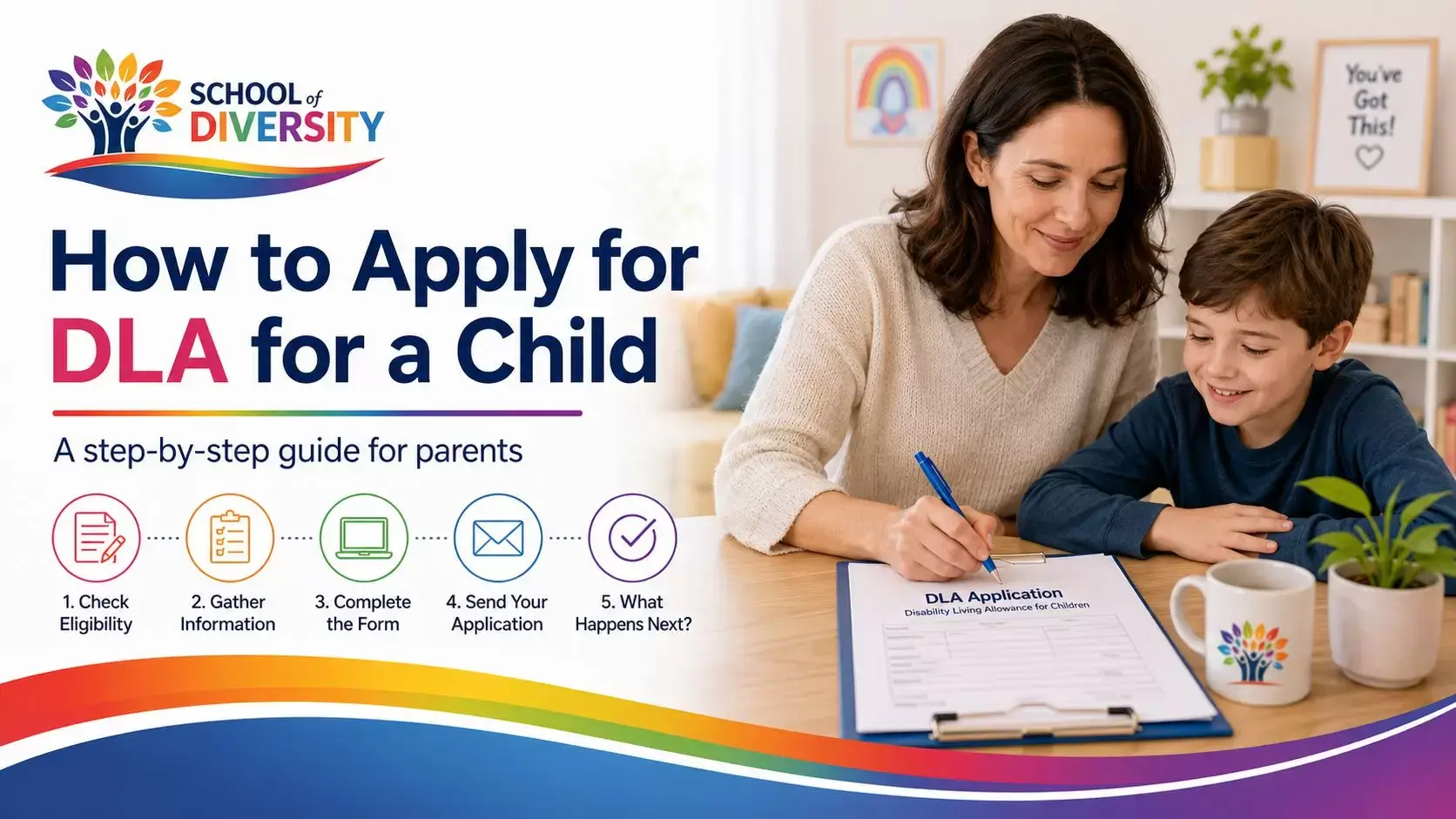
How to Apply for DLA for a Child
For a child living in England or Wales, you can currently claim by obtaining and completing the DLA child claim form.
You can either download the claim form or contact the DLA helpline and request a paper claim pack.
There can be an advantage to requesting the form by telephone.
DLA cannot normally be backdated. However, if you telephone for a claim pack and return it within the required six-week period, the claim can normally start from the date you called. If you simply download the form, the claim generally starts when the completed form is received.
That makes the date you start the claim important.
For a full step-by-step explanation, read:
Before You Start the DLA Form
Do not begin by trying to complete every question immediately.
First, gather information about your child’s needs.
Useful material may include:
- diagnostic assessments;
- paediatric reports;
- occupational therapy reports;
- speech and language therapy reports;
- psychological reports;
- EHCPs;
- school reports;
- SEN Support plans;
- behaviour or incident records;
- medication information;
- care plans;
- sleep records;
- continence information; and
- your own diary of the support your child needs.
DWP guidance recommends sending relevant supporting information where available and specifically identifies examples including medical evidence, treatment information and educational documentation. Copies should be sent rather than original documents.
But evidence does not replace the form.
A professional report might say:
“Child displays significant executive functioning difficulties.”
Your form still needs to explain what this means at home.
For example:
“Without repeated adult prompting, he does not complete basic routines such as dressing, brushing his teeth or preparing for school. Each morning I normally have to give approximately 15–20 separate prompts and remain nearby throughout the routine.”
That turns clinical terminology into everyday functional evidence.
The Most Important Rule: Describe the Help Your Child Needs
One of the most common mistakes parents make is writing primarily about what their child finds difficult.
DLA also needs to understand what somebody has to do about those difficulties.
Consider the difference.
Too vague
“She struggles with bathing.”
More useful
“She experiences significant sensory distress around bathing. I prepare the bathroom in advance, check the water temperature, talk her through each stage and remain beside her throughout. Without this support she becomes distressed and will usually refuse to wash. Bathing normally takes approximately 30 minutes and requires direct adult support throughout.”
The second example gives the decision maker much more information.
Use This Five-Part Formula
For most DLA questions, try to explain:
1. What is the difficulty?
What can your child not do, or what causes difficulty?
2. What help is required?
Do they need:
- physical assistance;
- verbal prompting;
- encouragement;
- reassurance;
- supervision;
- monitoring;
- intervention; or
- somebody to communicate for them?
3. How often?
Try to quantify it:
- three times every morning;
- approximately eight prompts per meal;
- four nights each week;
- throughout every outdoor journey.
4. How long?
For example:
- 10 minutes;
- 30–45 minutes;
- two hours;
- throughout the activity.
5. What happens without support?
This is often the missing piece.
Would your child:
- not complete the task;
- become distressed;
- have an accident;
- stop eating;
- run into danger;
- hurt themselves;
- become dysregulated;
- leave the house;
- fail to take medication; or
- remain awake for several hours?
The consequence helps explain why the support is necessary.
Think Through a Complete Day
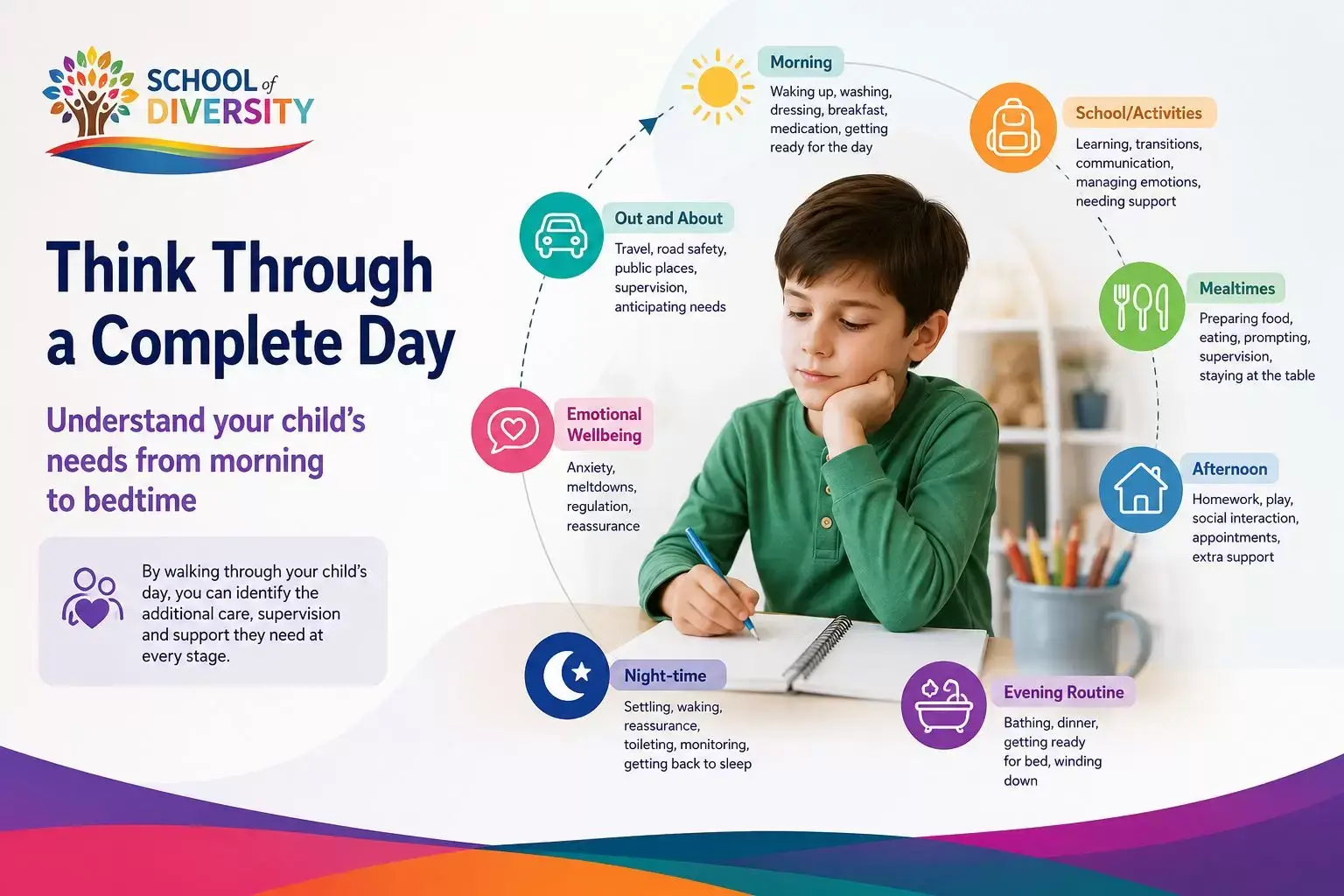
An effective way to identify your child’s care needs is to imagine an ordinary day from waking until bedtime.
Waking and Morning Routine
Consider whether your child needs additional help with:
- waking;
- getting out of bed;
- toileting;
- washing;
- brushing teeth;
- hair care;
- dressing;
- selecting appropriate clothes;
- medication;
- eating breakfast;
- packing belongings;
- understanding the day’s routine;
- leaving the house; or
- coping with transitions.
Something that looks like a simple morning routine may actually require an hour of continuous prompting and supervision.
Write that down.
Washing, Bathing and Personal Care
Consider:
- Can your child wash effectively?
- Do they understand which body parts need washing?
- Can they tolerate water?
- Do sensory sensitivities cause distress?
- Can they regulate water temperature safely?
- Do they need physical assistance?
- Do they require repeated prompting?
- Can they wash their hair?
- Can they dry themselves adequately?
- Do they need supervision throughout?
Do not assume that because a child is physically capable of holding a toothbrush or flannel they are therefore independent.
Being physically capable of a task and being able to complete it safely, appropriately and reliably are different things.
Dressing
Explain whether your child needs help:
- selecting clothing;
- recognising front and back;
- managing fastenings;
- choosing weather-appropriate clothes;
- tolerating particular fabrics;
- completing each stage;
- remaining focused;
- changing clothes following accidents; or
- managing school uniform.
Quantify the support.
For example:
“Although she can physically put clothes on, she needs an adult beside her giving step-by-step prompts. Without this she becomes distracted and does not finish dressing.”
Eating and Drinking
Parents often underestimate support around food.
Consider whether your child needs:
- reminders to eat;
- prompting to continue;
- supervision;
- specially prepared food;
- food separated because of sensory sensitivities;
- encouragement to drink;
- assistance using cutlery;
- monitoring for choking;
- help recognising hunger or thirst; or
- prolonged support to remain at the table.
Explain how long meals take and how much adult intervention is required.
Toileting and Continence
Include relevant difficulties such as:
- not recognising the need to use the toilet;
- needing reminders;
- refusing to go alone;
- needing somebody to accompany them;
- wiping difficulties;
- continence accidents;
- bedwetting;
- changing clothing;
- cleaning following accidents;
- constipation management;
- continence products; or
- support with menstruation.
These needs can be uncomfortable to describe, but if they require additional adult assistance, they are relevant to the overall picture of your child’s care.
Medication and Treatment
Explain whether you have to:
- administer medication;
- remind your child;
- persuade them to take it;
- supervise them taking it;
- monitor side effects;
- perform treatments;
- attend appointments; or
- provide support before and afterwards.
Do not simply list medication.
Explain what you have to do.
Communication
Some children need considerable adult assistance to communicate or understand communication.
This might involve:
- simplifying language;
- repeating instructions;
- visual supports;
- interpreting gestures;
- helping your child communicate needs;
- preparing them for changes;
- explaining social situations;
- recognising non-verbal signs of distress; or
- communicating with other people on their behalf.
Again, translate the difficulty into adult support required.
Emotional Regulation and Meltdowns
If your child experiences significant distress, shutdowns or meltdowns, avoid writing only:
“Has meltdowns.”
Describe:
Trigger → behaviour → risk → intervention → recovery time.
For example:
“Unexpected changes can lead to severe dysregulation approximately three or four times each week. She may scream, hit herself and become unable to communicate. I must remove demands, take her to a quiet area, prevent injury and remain with her until she is regulated. Episodes normally require 30–60 minutes of direct adult support.”
This gives the decision maker something measurable.
Supervision and Danger Awareness
Supervision can be extremely important in DLA claims.
Consider whether your child must be monitored because of:
- impulsivity;
- running away;
- climbing;
- poor road awareness;
- water danger;
- fire;
- cooking;
- electrical equipment;
- self-injury;
- aggression;
- swallowing inappropriate objects;
- approaching strangers;
- leaving the home;
- vulnerability online; or
- inability to recognise dangerous situations.
Do not merely write:
“Needs constant supervision.”
Explain why.
For example:
“An adult must remain within sight when he is awake because he has previously left the house without telling anyone and does not reliably recognise traffic danger.”
Night-Time Needs
Do not forget what happens after your child goes to bed.
Night-time care can be particularly important because the care-component rules distinguish between help required during the day, during the night, and in some cases during both.
Consider:
- difficulty settling;
- repeated waking;
- reassurance;
- toileting;
- bedwetting;
- changing bedding;
- medication;
- seizures;
- wandering;
- distress;
- repositioning;
- monitoring; and
- needing an adult to remain awake.
Instead of:
“Sleeps badly.”
say:
“He wakes approximately three nights each week, usually twice each night. Each time I must stay with him for around 20–30 minutes to prevent him wandering downstairs and to help him settle.”
Frequency and duration matter.
Completing the Mobility Section
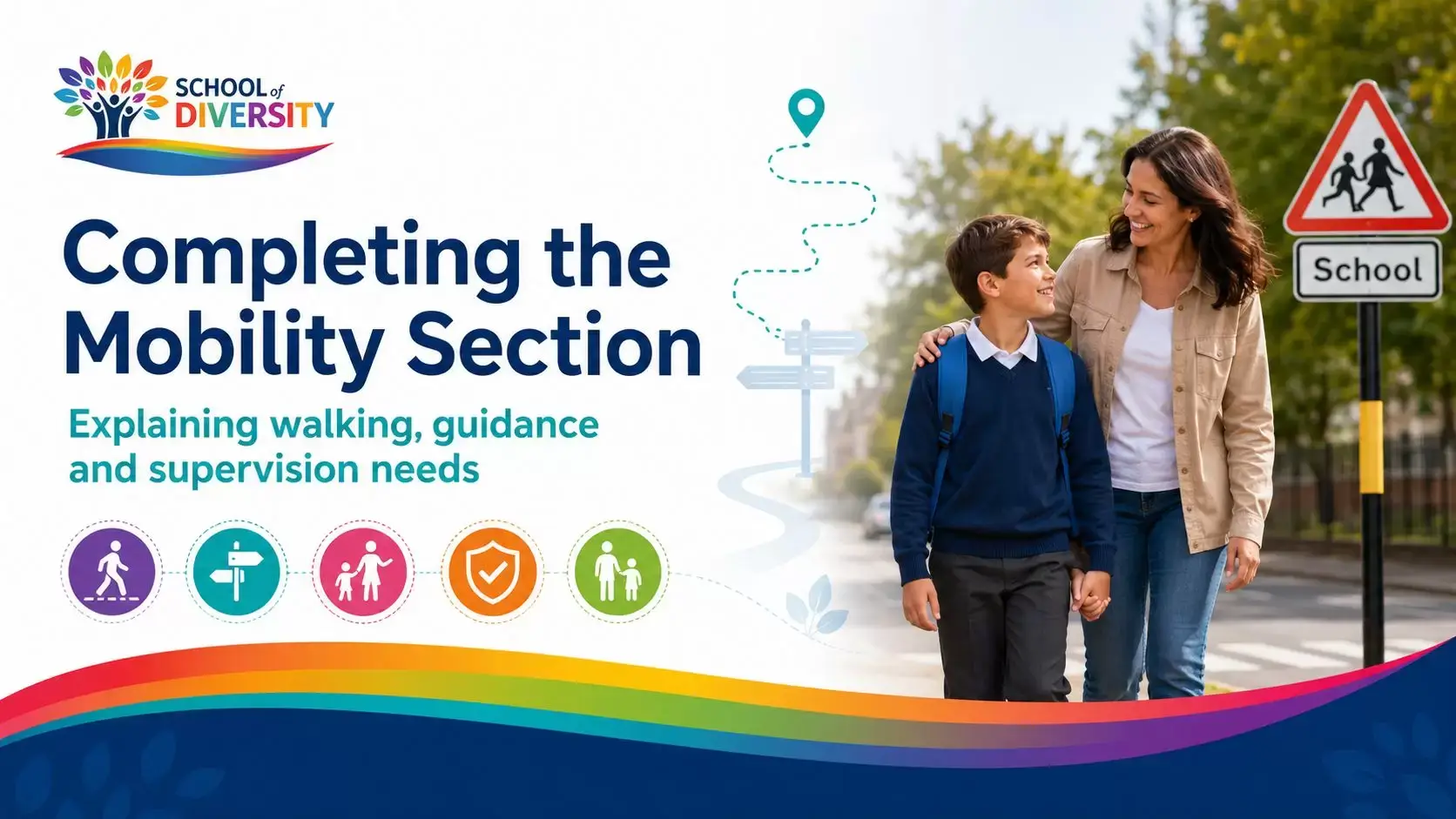
Do not assume mobility only applies to children who use wheelchairs or have physical disabilities.
The mobility component has separate qualifying rules, and lower-rate mobility can involve children who can physically walk but require additional guidance or supervision outdoors.
Consider:
- physical walking ability;
- distance;
- speed;
- pain;
- fatigue;
- breathlessness;
- gait;
- need for mobility equipment;
- road awareness;
- running away;
- understanding directions;
- ability to follow a route;
- sensory overload outdoors;
- distress;
- unpredictable behaviour; and
- level of adult supervision required.
Read our detailed guide:
DLA Claim Forms: How to Fill in the Care and Mobility Sections
What If My Child Can Walk?
Do not stop your explanation at:
“Yes, my child can walk.”
Physical ability to walk does not necessarily tell the whole story.
For example:
“He can physically walk, but cannot safely walk outdoors without one-to-one adult supervision. He has very poor traffic awareness and may suddenly run across a road when distracted. I therefore need to remain beside him throughout every outdoor journey and frequently hold his hand.”
That gives the decision maker a much clearer picture of the actual support needed.
Describe Variability Accurately
Many children have fluctuating needs.
Do not describe only their best day.
But equally, do not present their worst day as though it happens every day if that is not accurate.
Explain the pattern.
For example:
“Approximately four days each week she requires full adult support with dressing. On better days she can complete some stages following verbal prompting.”
That is credible and measurable.
Use Real-Life Examples
Examples are often more powerful than labels.
Instead of:
“Poor danger awareness.”
write:
“Last month he ran from the pavement towards the road after seeing a dog. I had to grab his coat to prevent him stepping into traffic.”
Instead of:
“Needs help with food.”
write:
“Yesterday she refused all food because two items touched on her plate. I prepared a second meal and spent approximately 25 minutes encouraging her to eat.”
Examples demonstrate what the problem actually looks like.
Keep a DLA Diary
Before completing the form, keeping a diary for a week or two can reveal just how much support you provide.
Record:
- activity;
- difficulty;
- help provided;
- frequency;
- duration;
- safety issue;
- night-time waking; and
- what happened without intervention.
Parents frequently discover they are giving far more support than they initially realised.

Supporting Evidence for a DLA Claim
Supporting evidence should reinforce the picture you describe on the form.
Potential evidence may include:
- diagnostic reports;
- paediatric reports;
- GP information;
- occupational therapy assessments;
- speech and language reports;
- psychology reports;
- physiotherapy evidence;
- EHCPs;
- school SEN records;
- support plans;
- medication lists;
- sleep or continence evidence; and
- supporting statements from people who know the child well.
The current DWP guidance encourages claimants to send relevant supporting evidence where available and to send copies rather than originals.
You may also find our guide useful:
How to Write Supporting Statements for DLA: A Parent’s Guide
What Evidence Is Less Useful?
Do not overwhelm the DWP with documents that add little information.
A generic leaflet explaining autism does not demonstrate your child’s autism-related needs.
Likewise, an appointment letter simply showing that your child attended a clinic says very little about the support they need.
DWP guidance specifically indicates that general information about a condition and routine appointment letters are not normally the type of supporting information required.
Relevant, child-specific evidence is much more useful.
Common DLA Application Mistakes
Some recurring weaknesses include:
- concentrating on diagnosis rather than needs;
- writing very short answers;
- using phrases such as “often” and “a lot” without numbers;
- forgetting prompting;
- forgetting supervision;
- underestimating night-time care;
- failing to explain mobility because the child can physically walk;
- not explaining consequences;
- describing only the child’s best days;
- failing to compare needs with another child of the same age;
- contradicting information elsewhere on the form;
- failing to provide real examples; and
- assuming professional reports will explain everything.
Read:
Accuracy Matters
Your DLA application should be detailed, but it must also be accurate.
Do not exaggerate.
Do not describe occasional events as daily events.
Do not say your child “cannot” do something if they sometimes can.
Instead, explain the reality.
For example:
“She can sometimes dress herself, but approximately five mornings each week she requires repeated prompting and adult supervision throughout.”
Nuanced information can actually make an application stronger because it shows that you are giving a realistic account rather than trying to present every day as the worst day.
Don't Minimise Either
Accuracy works both ways.
Parents often minimise support because they think:
“I’m their parent — of course I do that.”
But the issue is not whether a caring parent would help their child.
The relevant question is whether your child requires substantially more support than another child of the same age.
If you spend 45 minutes every morning regulating, prompting and supervising an activity that another 12-year-old would normally complete independently, make that visible.
What Happens After You Apply?
After the DWP receives your application, it may consider the form and supporting evidence and may seek further information where necessary.
GOV.UK currently says applicants should receive a letter within around three weeks confirming the application has been received. Once a decision has been made, a further decision letter is issued.
Keep:
- a complete copy of your form;
- copies of evidence;
- proof of posting where appropriate; and
- the decision letter when it arrives.
This becomes particularly useful if you later need to challenge the decision.

What If DLA Is Refused or the Award Seems Too Low?
A refusal is not necessarily the end of the process.
If you disagree with the DWP decision, you can ask for it to be looked at again through Mandatory Reconsideration. GOV.UK identifies this as the mechanism for challenging a DLA decision.
Before challenging the decision, compare:
- what you actually wrote on the application;
- the evidence you supplied;
- the DWP’s stated reasons; and
- the DLA criteria you believe apply.
Read our guide:
A Final DLA Claim Checklist
Before sending your application, check that you have:
explained the help your child needs rather than just their diagnosis;
compared their needs with another child of the same age;
included prompting and encouragement;
included supervision and safety risks;
explained personal care;
described eating and drinking support;
included toileting needs where relevant;
explained communication support;
described emotional regulation needs;
included night-time support;
completed the mobility section carefully;
quantified frequency wherever possible;
included duration;
explained what happens without help;
used real-life examples;
described variability accurately;
included relevant supporting evidence;
checked the whole form for consistency;
kept a complete copy before sending it.
Final Thoughts
A strong DLA application is not about finding special phrases or making your child’s difficulties sound as severe as possible.
It is about making invisible care visible.
The decision maker needs to understand what happens in your child’s everyday life, what additional help you provide, how frequently you provide it, how long it takes and why that help is necessary.
Diagnosis provides context.
Detailed evidence of additional care and mobility needs provides the substance of the claim.
If you take one principle from this guide, use this:
Need → Help → Frequency → Duration → Consequence
Apply that structure throughout the form and you will give the decision maker a much clearer picture of your child’s actual support needs
Continue Reading
[What Conditions Qualify for Disability Living Allowance for Children?]
Understand why DLA eligibility depends on additional care and mobility needs rather than diagnosis alone.
How to Apply for DLA for Your Child
Follow the DLA application process step by step.
DLA Claim Forms: How to Fill in the Care and Mobility Sections
Learn how to explain care, supervision, prompting and mobility needs clearly.
How to Write Supporting Statements for DLA: A Parent’s Guide
Learn how to write clear supporting information using real-life examples.
Understand the different care and mobility components and current award levels.
Common DLA Claim Mistakes for Children with ADHD or Autism
Identify common weaknesses that can make a DLA claim less persuasive.
Common Reasons DLA Claims Are Refused and How to Appeal
Understand what to do if the DWP refuses your child’s claim or awards less than expected.
Need Help With Your Child's DLA Application?
Completing a DLA application can be difficult, especially when you are trying to translate years of everyday parenting into the language of care, supervision and mobility needs.
School of Diversity can help you review the information you have provided, identify areas that may need more detail and make sure your child’s needs are presented clearly, accurately and comprehensively.
One Response