

How to Apply for Disability Living Allowance Online: Step-by-Step for Parents
Applying for Disability Living Allowance (DLA) for your child can feel complicated, particularly when you are trying to explain needs that have simply become part of everyday family life.
Parents often search for how to apply for DLA online, expecting there to be a complete online application process. For children living in England or Wales, however, DLA is not currently a fully online claim.
You can download the official DLA form, complete it electronically on a desktop or laptop, save your answers, print the completed form and then post it to the Department for Work and Pensions (DWP). Alternatively, you can telephone DWP and ask for a paper claim pack.
This guide takes you through the process step by step and explains what to think about when describing your child’s care, supervision, prompting, safety and mobility needs.
If you are completely new to the process, you may also want to start with our main DLA Support for Parents hub or our wider DLA for Children 2026 guide
Can You Apply for DLA Online for a Child?
Not completely.
For a child in England or Wales, you can download the official claim form and complete it electronically, but the completed claim must still be printed and posted to DWP.
That means an “online DLA application” is currently better understood as electronically completing the downloadable DLA form, rather than submitting the entire claim through an online account.
Completing the form electronically can still be useful because it allows you to:
- type rather than handwrite lengthy answers;
- save your work;
- return to sections later;
- correct mistakes more easily;
- review your answers for consistency before printing.
If you would prefer professional help preparing the claim, our DLA Application Support service supports parents with explaining the child’s needs and organising relevant evidence
Step 1: Consider Whether Your Child May Qualify for DLA
DLA is intended to help with the additional costs associated with caring for a disabled child.
The decision is not based simply on whether your child has a diagnosis.
The key issue is generally whether your child needs substantially more care, attention, supervision, prompting, guidance or help getting around than another child of the same age.
This is an important distinction.
A diagnosis of autism, ADHD, cerebral palsy, a learning disability or another condition does not automatically determine the award. DWP needs to understand what that condition means for your child’s everyday life.
For a broader explanation of the benefit and the different areas DWP considers, read our DLA for Children 2026 guide
Step 2: Decide How You Want to Start the Claim
You can either:
- download the child DLA claim form; or
- telephone DWP and request a printed claim pack.
There can be an important difference between the two routes because DLA cannot normally simply be backdated to when your child’s difficulties started.
If you request a form by telephone and return it within the permitted period, the claim may be treated as starting from the date you telephoned. If you download the form yourself, the claim generally starts from the date DWP receives it.
That means parents who intend to claim may want to avoid unnecessary delay.
Step 3: Prepare Before You Start Filling In the Form
Before starting the form, gather the information you are likely to need.
This can include:
- diagnostic or assessment reports;
- paediatric or medical evidence;
- occupational therapy reports;
- speech and language therapy reports;
- psychology reports;
- SEN Support plans;
- EHCP documents;
- school correspondence;
- attendance information;
- behaviour or incident records;
- medication details;
- sleep information;
- notes about daily care;
- evidence of supervision or safety needs.
Do not assume that the strongest application is simply the one containing the largest number of documents.
The evidence should help the decision maker understand the additional support your child actually needs.
Our detailed DLA Evidence & Supporting Statements guide explains how professional reports, school records and parent evidence can be organised around care and mobility needs.
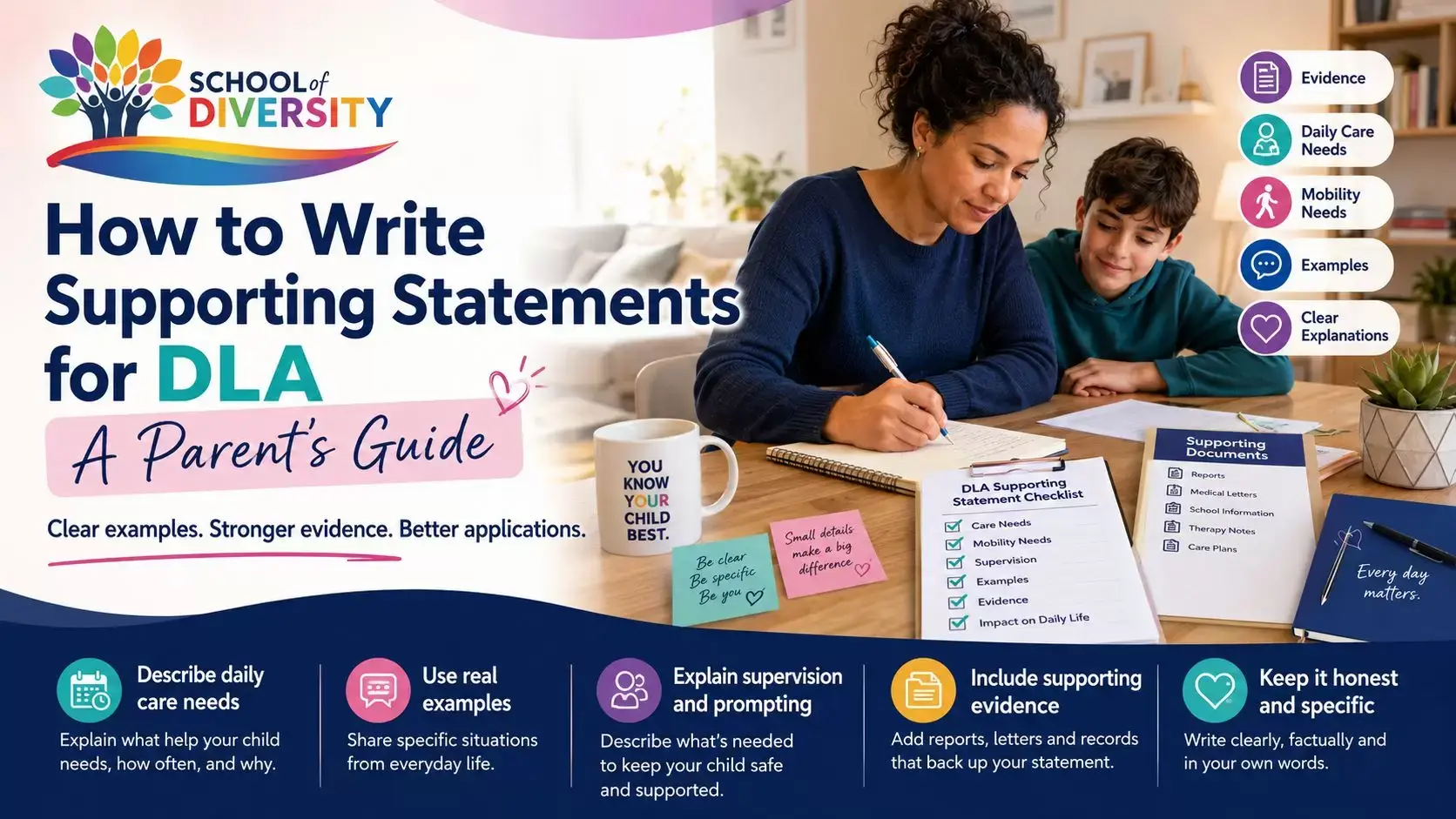
You may also find our guide on How to Write Supporting Statements for DLA useful if you want to provide a fuller parent account alongside the form.
Step 4: Think Through an Entire Day
One of the most useful exercises before completing a DLA application is to think through your child’s day from waking in the morning until the following morning.
Parents often underestimate how much support they provide because the routines have become completely normal.
Start with waking.
Does your child wake independently?
Do you have to:
- repeatedly prompt them to get out of bed;
- reassure them;
- supervise dressing;
- physically assist with dressing;
- select appropriate clothing;
- manage sensory difficulties;
- supervise washing or teeth brushing;
- prompt medication;
- supervise eating?
Then move through the rest of the day.
Think about getting out of the house, travelling, school, meals, toileting, communication, play, social interaction, emotional regulation, personal care, bedtime and overnight needs.
The question is not simply:
“What can my child do?”
A more useful question is:
“What adult input is required for my child to do it safely, reliably and within a reasonable time?”

Step 5: Compare Your Child With Another Child of the Same Age
This is one of the central principles in a child DLA claim.
Children naturally need care and supervision simply because they are children.
You therefore need to explain what is additional or substantially greater about the support your child requires.
For example:
“My eight-year-old needs help getting dressed.”
does not necessarily tell the decision maker enough.
A stronger explanation might describe:
- why dressing is difficult;
- whether repeated prompting is required;
- whether sensory distress occurs;
- whether clothes are put on incorrectly;
- whether the child becomes distracted;
- how much adult supervision is necessary;
- how long the process usually takes.
Throughout the form, keep asking:
Would another child of the same age ordinarily need this level of help?
Step 6: Describe Need Rather Than Diagnosis
One of the most common weaknesses in DLA applications is spending too much time describing the diagnosis and not enough time explaining the practical impact.
For example:
Diagnosis-focused wording:
“My child has ADHD and struggles with concentration.”
That does not explain what additional care is needed.
A more useful explanation would describe whether the child:
- requires repeated prompting;
- needs close supervision because of impulsivity;
- has limited awareness of danger;
- cannot complete personal-care routines independently;
- becomes dysregulated during transitions;
- needs an adult to regulate or reassure them;
- cannot safely manage outside without supervision.
The structure I would use throughout the form is:
Need → Help required → Frequency → Duration → What happens without the help
That gives the decision maker much more usable information.
Step 7: Be Specific About Frequency
Avoid relying too heavily on words such as:
“sometimes”
“often”
“regularly”
“frequently”
They are difficult to quantify.
Where possible, describe what genuinely happens.
For example:
“This happens approximately four mornings each school week.”
or:
“She requires approximately 15–20 minutes of direct prompting and supervision to complete dressing.”
or:
“He wakes around three nights each week and usually requires an adult to stay with him for approximately 20 minutes before he settles again.”
You should never manufacture precision where it does not exist, but realistic frequency and duration can make the level of support much clearer.
Step 8: Explain What Happens Without Support
This is particularly important.
Do not simply tell DWP that you supervise your child.
Explain why.
For example:
“An adult remains nearby when he is outside.”
is less informative than:
“An adult must remain within close supervision outside because he may run towards roads without checking for traffic and does not reliably respond to verbal warnings.”
The second version explains both the need and the consequence.
The same principle applies to:
- medication;
- eating;
- bathing;
- dressing;
- toileting;
- behaviour;
- communication;
- sleep;
- travel;
- safety.
Step 9: Explain Variability
Many children do not have exactly the same level of difficulty every day.
Autistic children, children with ADHD and children with fluctuating conditions may cope better in some circumstances than others.
Avoid describing only the best day.
Equally, do not describe the most difficult day as though it happens every day if that is not accurate.
Instead, explain the pattern.
Useful wording might include:
“On most school mornings…”
“Approximately three or four times each week…”
“When dysregulated…”
“In unfamiliar environments…”
“During periods of sensory overload…”
“On more difficult days…”
This often gives a much more credible and accurate picture.
Step 10: Complete the Care Section Carefully
The care component of DLA considers the level of additional care, attention and supervision the child requires.
Think broadly.
Relevant needs may involve:
- washing;
- bathing;
- dressing;
- toileting;
- eating;
- drinking;
- medication;
- communication;
- emotional regulation;
- behavioural support;
- prompting;
- supervision;
- safety;
- settling to sleep;
- waking overnight.
Parents sometimes overlook prompting and supervision because they do not see them as “care”.
They can be highly relevant where the child would not complete an activity or remain safe without that adult input.
Step 11: Do Not Overlook Night-Time Needs
Night-time care can be particularly important.
Ask yourself whether your child:
- struggles to settle;
- wakes repeatedly;
- needs reassurance;
- needs toileting support;
- requires medication;
- becomes distressed;
- wanders;
- needs monitoring;
- needs repositioning or physical assistance;
- requires an adult to remain awake.
Record frequency and duration as accurately as possible.
A brief diary over one or two weeks can sometimes help you recognise patterns you had not previously quantified.
Step 12: Complete the Mobility Section Properly
DLA mobility is not simply about whether a child can physically walk.
Depending on the part of the mobility component being considered, issues may include walking ability and the level of guidance or supervision required outdoors.
For some children, relevant difficulties can include:
- very limited danger awareness;
- bolting or running away;
- inability to follow directions safely;
- severe distress outdoors;
- difficulties navigating unfamiliar places;
- behavioural or cognitive difficulties affecting safe mobility.
The legal tests differ depending on which mobility rate is being considered, so avoid assuming that all outdoor supervision automatically results in a mobility award.
If you want a broader explanation of care and mobility within DLA, our DLA for Children 2026 guide provides a useful starting point.
Step 13: Use Real-Life Examples
Real examples often communicate need better than general statements.
Instead of:
“She has no road safety awareness.”
explain what has actually happened.
For example:
“She has attempted to cross the road without checking for traffic and requires an adult to hold her hand near roads because verbal reminders alone do not reliably prevent her from stepping into the road.”
The purpose is not to dramatise.
It is to make an abstract statement understandable.
This is also where your supporting evidence can help confirm the picture described in the application. Our DLA Evidence & Supporting Statements page explains how different evidence can support specific areas of a claim

Step 14: Check the Application for Consistency
When you have finished, read the entire form from beginning to end.
Different parts of the application should tell a coherent story.
For example, check for inconsistencies around:
- independence;
- road safety;
- communication;
- toileting;
- supervision;
- school support;
- behaviour;
- sleep;
- mobility.
If one answer explains that your child requires constant outdoor supervision, another answer should not inadvertently imply that they travel independently unless there is a genuine explanation for that difference.
Consistency makes the application easier for a decision maker to understand.
Step 15: Save a Complete Copy
Before printing the application, save a final version.
Keep copies of:
- the completed form;
- continuation sheets;
- parent statements;
- professional evidence;
- school evidence;
- anything else included in the claim.
Also consider keeping a simple list of the documents you sent.
This becomes particularly useful if DWP later asks questions or if you need to challenge the decision.
Step 16: Print, Sign and Post the Claim
Once the form is complete, it needs to be printed.
Check carefully that:
- every relevant section has been completed;
- continuation pages are attached;
- supporting documents are included;
- declarations are completed;
- signatures have been added where required.
Then send it using the instructions provided with the official DLA form or claim pack.
What Happens After You Apply?
DWP will consider the application and may use the information you have supplied alongside evidence from professionals.
Eventually you will receive a decision telling you whether DLA has been awarded and, if so:
- which component has been awarded;
- what rate has been awarded;
- when the award starts;
- when payments will begin.
If you want to understand the current amounts, our DLA Payments 2026 guide is also worth linking from this section once the page is live.
What If Your Child Does Not Have a Diagnosis?
Do not automatically assume you have to wait.
DLA entitlement is focused on additional care and mobility needs, rather than diagnosis alone.
A child waiting for an ADHD or autism assessment may already require significant additional:
- supervision;
- prompting;
- emotional regulation support;
- sensory support;
- help with routines;
- safety monitoring;
- communication support.
The important question is whether you have sufficient information to explain those needs accurately.

What If the Claim Is Refused?
A DLA refusal is not necessarily the end of the process.
First, read the decision carefully and identify what DWP has actually decided.
It may be that:
- the whole claim was refused;
- the care component was refused;
- the mobility component was refused;
- DLA was awarded at a lower rate than expected.
Our guide to Common Reasons DLA Claims Are Refused and How to Appeal explains some of the issues that can arise and what parents should look for in the decision.
The first formal stage of challenging most DLA decisions is a Mandatory Reconsideration.
Our DLA Mandatory Reconsideration for Children guide explains how to ask DWP to reconsider the decision and how to focus the challenge on the care or mobility needs that may not have been properly understood.
If the decision remains unchanged after Mandatory Reconsideration, it may then be possible to appeal to an independent tribunal. School of Diversity also provides DLA Tribunal Support for parents who need help reviewing the decision, organising evidence and preparing the appeal.
Common Mistakes When Applying for Child DLA
Some of the most common problems occur when parents:
- concentrate on diagnosis rather than additional need;
- understate care because it has become normal;
- fail to compare the child with another child of the same age;
- use vague descriptions;
- do not quantify frequency or duration;
- describe difficulty without explaining the adult help required;
- overlook prompting;
- overlook supervision;
- forget night-time needs;
- misunderstand mobility;
- provide evidence without linking it to the application;
- give inconsistent answers across different sections.
The purpose of a DLA form is not to make your child’s situation sound worse than it is.
It is to make sure the decision maker understands what everyday life actually requires.
Need Help With Your Child's DLA Application?
If you are finding it difficult to translate your child’s everyday needs into the language used on the DLA form, School of Diversity can help.
Our DLA Application Support can help parents identify important areas of need, organise their information and explain additional care, supervision, prompting, safety and mobility needs clearly.
If evidence is the main difficulty, visit our DLA Evidence & Supporting Statements page for help understanding which documents may support the claim and where important gaps may exist.
Continue Your DLA Journey
Your DLA journey may look different depending on whether you are considering an application, completing the form, gathering evidence or challenging a decision.
Start with our main DLA Support for Parents hub if you are unsure which stage applies to you. It brings together School of Diversity’s application, evidence, reconsideration and appeal support in one place.
If you are still deciding whether to apply, read our DLA for Children 2026 guide. If you are preparing evidence, visit DLA Evidence & Supporting Statements or our Supporting Statements for DLA guide.
If your application has already been refused or the award does not appear to reflect your child’s needs, read Common Reasons DLA Claims Are Refused and How to Appeal and our DLA Mandatory Reconsideration for Children guide.
If your case has progressed beyond Mandatory Reconsideration, you can also explore our DLA Tribunal Support for Parents.
Whichever stage you are at, the central principle remains the same: a strong DLA claim should help the decision maker understand what additional support your child needs, why they need it, how often it is required and how those needs differ from those of another child of the same age.