
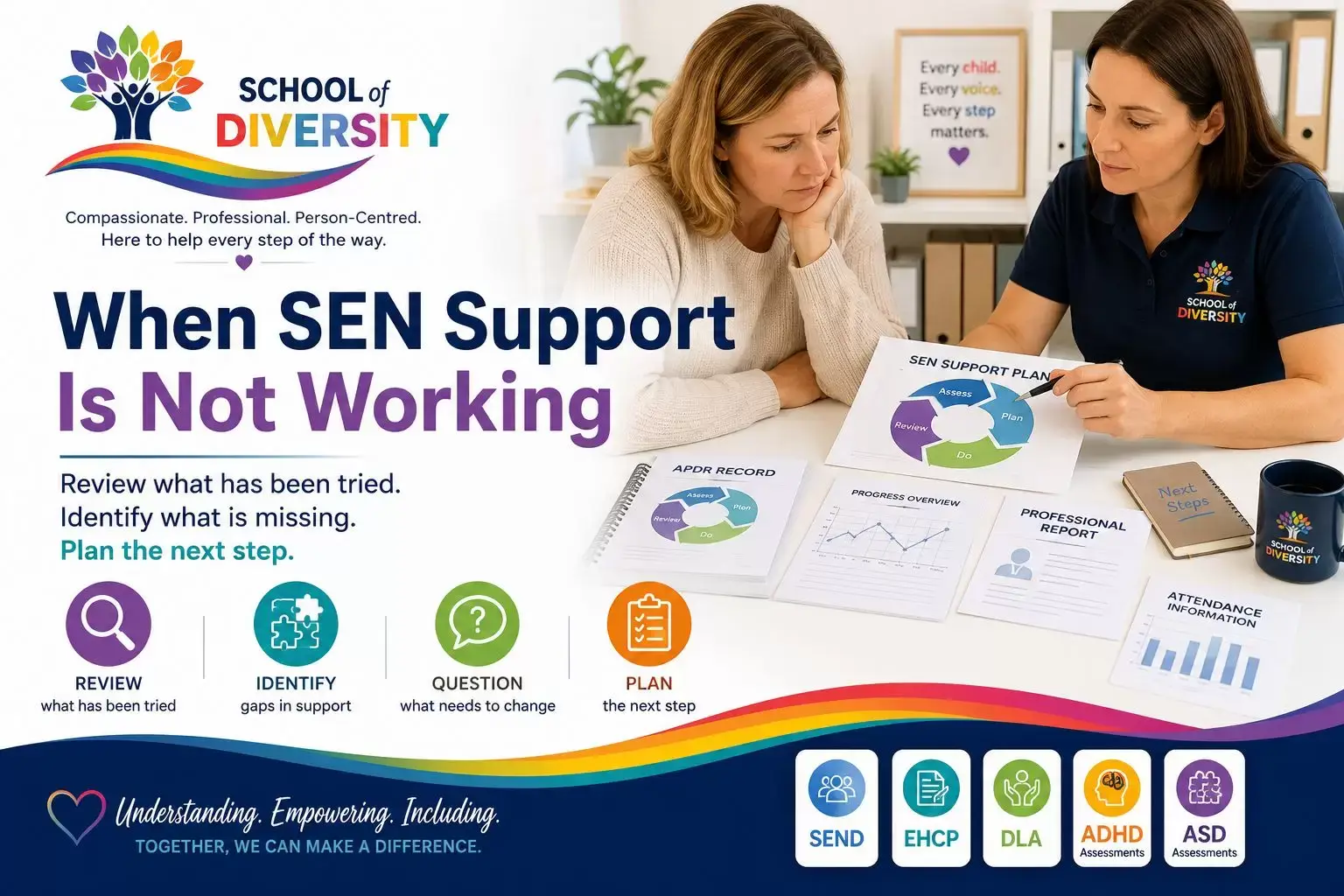
Support is in place. Your child is still struggling. What next?
Review what has been tried, identify where the gaps may be and prepare a clearer plan with school.
If the same concerns return each term, repeating the same approach may not be enough. Start by checking the needs identified, the provision agreed, what was delivered and the difference it made.
Parent guidance for England · Evidence, practical questions and next steps.
What signs should prompt a closer look?
These concerns do not automatically mean school is failing. They do suggest that the current support needs a careful review.
Limited change
Little progress, the same difficulties each term, repeated targets or interventions with no clear evidence of impact.
Inconsistent support
Provision depends on staffing, adjustments vary between lessons or recommendations have not been implemented.
Greater dependence
Your child needs increasing adult input, prompting or reassurance to access learning.
Growing distress
Anxiety, dysregulation, exhaustion or distress after school are increasing.
Attendance concerns
Lateness, partial attendance, school avoidance or difficulty entering school are becoming more frequent.
Unclear next steps
Meetings happen, but you still do not know what will change or how progress will be checked.
Need. Provision. Delivery. Impact.
Working through these four checks helps distinguish an unsuitable approach from support that has not been implemented as agreed.
Need
What difficulties and barriers have been identified? Does the evidence explain what happens for your child?
Provision
What was supposed to be provided? Does it directly address the need, with a clear intended outcome?
Delivery
Was the support actually delivered? How consistently, how often and by whom?
Impact
What changed? What evidence shows progress, remaining difficulty and the support still required?
Important distinction: an intervention that was cancelled or delivered inconsistently has not been tested in the same way as one delivered as planned. Check implementation before drawing conclusions about its effectiveness.
Where could the support be breaking down?
Select a question to explore the evidence and discussion points.
Have the underlying barriers been understood?
“Distracted” or “refusing work” describes what someone sees, but not necessarily why it happens. Language processing, working memory, sensory overload, anxiety, task difficulty, literacy or planning needs may contribute.
Ask what evidence supports the current understanding and whether more information is needed. Avoid assuming that one behaviour proves a particular diagnosis.
Does the provision match the difficulty?
A child who cannot retain verbal instructions may need smaller steps, visual prompts, written reinforcement, processing time and checks of understanding. General adult supervision may not address that barrier on its own.
Ask how each intervention or adjustment connects to the identified need.
Is the provision clear enough to evaluate?
Descriptions such as “adult support”, “regular check-ins” or “help when needed” leave important questions unanswered.
Clarify what happens, when, for how long, how often, who delivers it and what it should achieve.
Has support been delivered consistently?
Explore cancelled sessions, staff changes, missing adjustments and whether all teachers know the plan.
Also ask whether your child is expected to request support they cannot reliably request, or whether help only happens after distress escalates.
Are the outcomes meaningful and reviewable?
“Improve attention” or “improve confidence” needs a clearer description of the change being sought.
Agree a relevant starting point, the circumstances, support provided and a way to observe progress. Targets should be suitable for the individual child, rather than copied from a generic template.
Has the APDR cycle changed the approach?
Each review should use what has been learnt. Ask why the previous approach did not help, whether it was delivered, and what will be different next time.
The answer might involve changed provision, adjustments, specialist advice or further assessment.
Explore SEN Support Plans and APDR →Are professional recommendations being considered?
Check relevant psychology, therapy, diagnostic, specialist teacher or other reports against the support plan.
Ask which recommendations are being used, where they are recorded, who is responsible and how their impact is reviewed. Sharing a report does not itself demonstrate implementation.
Have adjustments been fully explored?
Sometimes repeated interventions overlook barriers in ordinary routines, teaching methods or the school environment.
Individual changes worth discussing may include:
- Visual instructions and additional processing time
- Sensory changes, movement and planned regulation breaks
- Quieter working options or reduced copying
- Alternative recording methods and adapted homework
- Predictable transitions, change warnings and named-adult support
- Support during break times, lunch or arrival
Link each proposed change to the barrier your child experiences and agree how it will be reviewed.
Explore reasonable adjustments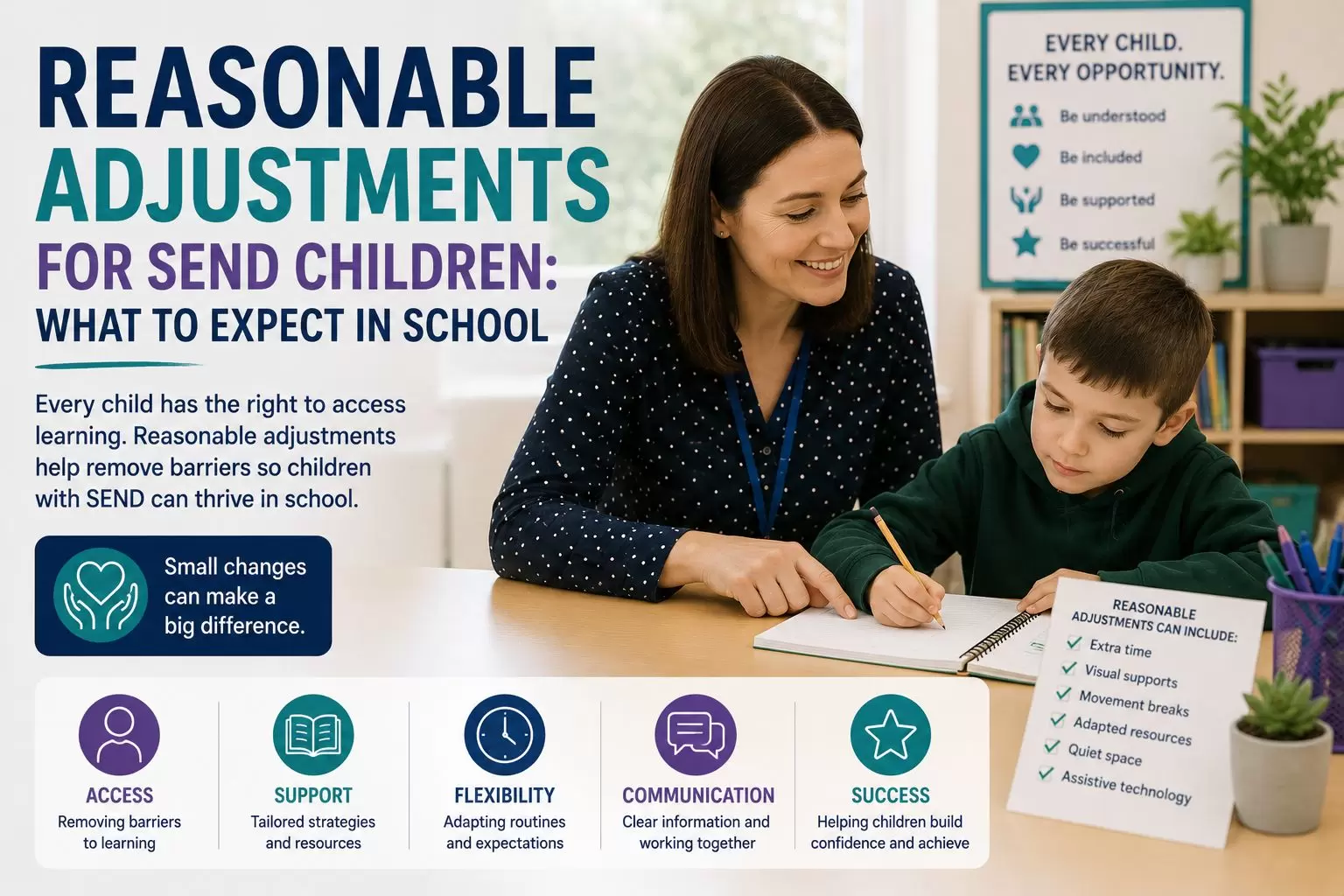
Consider support, independence and sustainability.
“School says they are making progress.”
Academic progress can coexist with difficulties in communication, organisation, sensory tolerance, wellbeing or attendance.
Record the prompting, task breakdown, reassurance and adult input needed. That support may be appropriate, but its level is important evidence.
Ask: what can your child do, with what support, and at what cost to wellbeing?
“We do not see that in school.”
Some children mask, rely heavily on structure, suppress distress or avoid asking for help. Parents may see exhaustion, meltdowns, shutdowns, homework difficulties or anxiety about returning.
Bring home and school observations together, alongside professional evidence and your child’s views. Neither perspective should automatically cancel out the other.
Working with your child’s school →Explore why attendance has become difficult.
Repeated lateness, distress before school, partial attendance or failed returns can be important information about barriers and unmet needs.
Consider sensory overload, anxiety, bullying, social demands, academic pressure, communication, transitions and whether the current environment is suitable.
Look at patterns across lessons, days and transitions. Discuss the barriers alongside support and attendance planning, rather than focusing only on the attendance figure.
Explore attendance supportIf school is becoming inaccessible
Prolonged absence, severe distress, repeated failed returns or very limited education need a wider review of provision and placement.
Where an EHCP is relevant, EOTAS may be one route to explore in appropriate circumstances. It is not an automatic outcome of attendance difficulties.
Explore EOTAS support →Build a clearer evidence-based plan.
You can begin gathering information and requesting a review now. If difficulties are worsening, explain why an earlier discussion is needed.
Bring the records together
Collect the current plan, APDR records, intervention information, progress evidence, reports, attendance and parent observations.
Request a focused review
Set out your main concerns and ask the SENCo to review needs, provision, delivery and impact.
Agree what will change
Record actions, responsibilities, support details, progress measures and a review date.
Identify missing information
Discuss whether specialist advice, assessment or better delivery records would clarify the situation.
Review the new approach
Check implementation and whether barriers reduce. Avoid repeating an ineffective approach without examining why.
Consider wider next steps
Discuss senior leadership involvement, changed provision, placement concerns or an EHC needs assessment where appropriate.
These steps are a practical guide, not a compulsory sequence. A parent does not need to wait for every possible intervention to fail before requesting an EHC needs assessment.
Questions that help move the review forward.
Understand what has happened
- What needs are identified, and what evidence supports them?
- What provision was delivered, and how consistently?
- What outcomes were expected?
- What evidence shows whether support helped?
- Which recommendations and adjustments are being used?
Agree what happens next
- What has changed since the previous review?
- Does the support plan need rewriting?
- Is specialist advice or assessment required?
- What will be different in the next APDR cycle?
- What happens if the revised support is still insufficient?
Could your child need a different level of provision?
Many children receive support through school-based SEN Support. Complex needs, limited progress, specialist provision, substantial assistance or worsening access to education may justify exploring an EHC needs assessment.
School plans, APDR records, progress data, professional reports, attendance and parent evidence can explain what has been tried and what difficulties remain. These indicators do not guarantee an assessment or a plan.
Separate the issues and identify your next step.
We can review agreed school and professional evidence to identify what is working, what is unclear, possible gaps and practical questions for school.
SEND Review & Action Plan
£195
A structured written review of agreed information, which can include support plans, APDR records, interventions, adjustments, recommendations and attendance evidence.
- Unmet or unclear needs and provision gaps
- Possible adjustments to discuss
- Evidence priorities and questions for school
- Written practical next-step recommendations
SENCo Meeting Support
Prepare your priorities, evidence points, questions, requested outcomes and meeting action sheet.
Continued support, including agreed online meeting attendance and follow-up, can be discussed through Supported SEND Casework.
Supported casework from £425. Scope, availability and the final fee are confirmed before work begins.
Explore meeting supportWhen support is not working: your questions answered.
How long should I wait before asking for a review?
There is no single fixed timeframe. Consider whether the support has been delivered for long enough to evaluate its impact and whether concerns are improving or worsening. Explain increased difficulties rather than waiting automatically for the next routine meeting.
What if school keeps using the same intervention?
Ask what evidence shows its impact, whether it was delivered as intended and what will change if progress remains limited.
What if provision is recorded but not delivered?
Ask the SENCo what happened, when, by whom and how consistently. Request a plan to address any gaps and agree how implementation will be checked.
Can I ask school to change the support plan?
Yes. Set out why you believe needs, provision, outcomes or review arrangements need updating, using relevant examples and evidence.
Does SEN Support have to fail before I request an EHC needs assessment?
No. There is no requirement for every possible intervention to fail first. The assessment test considers whether a child has or may have SEN and whether provision through an EHCP may be necessary.
What if home and school disagree?
Ask for both perspectives to be recorded and considered alongside your child’s views, professional reports, progress evidence and the level of assistance required.
Can School of Diversity review our current support?
Yes. Our SEND Review & Action Plan examines the agreed evidence and identifies possible gaps, questions and next steps. It does not guarantee a school, local-authority or tribunal decision.
Further reading: SEND Code of Practice for England.
You do not have to keep going round in circles.
Bring the evidence together, clarify the gaps and decide what to raise with school next.
Tell us what has been tried.
Explain the support in place, your main concerns and whether a school meeting or other deadline is approaching.
office@schoolofdiversity.com
0333 577 1179