

EHCP Advocacy Support for Families Across England
Clear, practical and evidence-led support with EHCP applications, draft plans, annual reviews, refusals, appeals and SEND Tribunal preparation.
Navigating the Education, Health and Care Plan process can feel overwhelming. Parents are often expected to understand legal procedures, professional reports and local-authority decisions while also supporting a child whose needs may not be fully recognised.
School of Diversity provides structured EHCP advocacy and practical parental support. We help you understand what is happening, identify what may be missing and present your child’s needs and required provision as clearly as possible.
EHCP Help at Every Stage
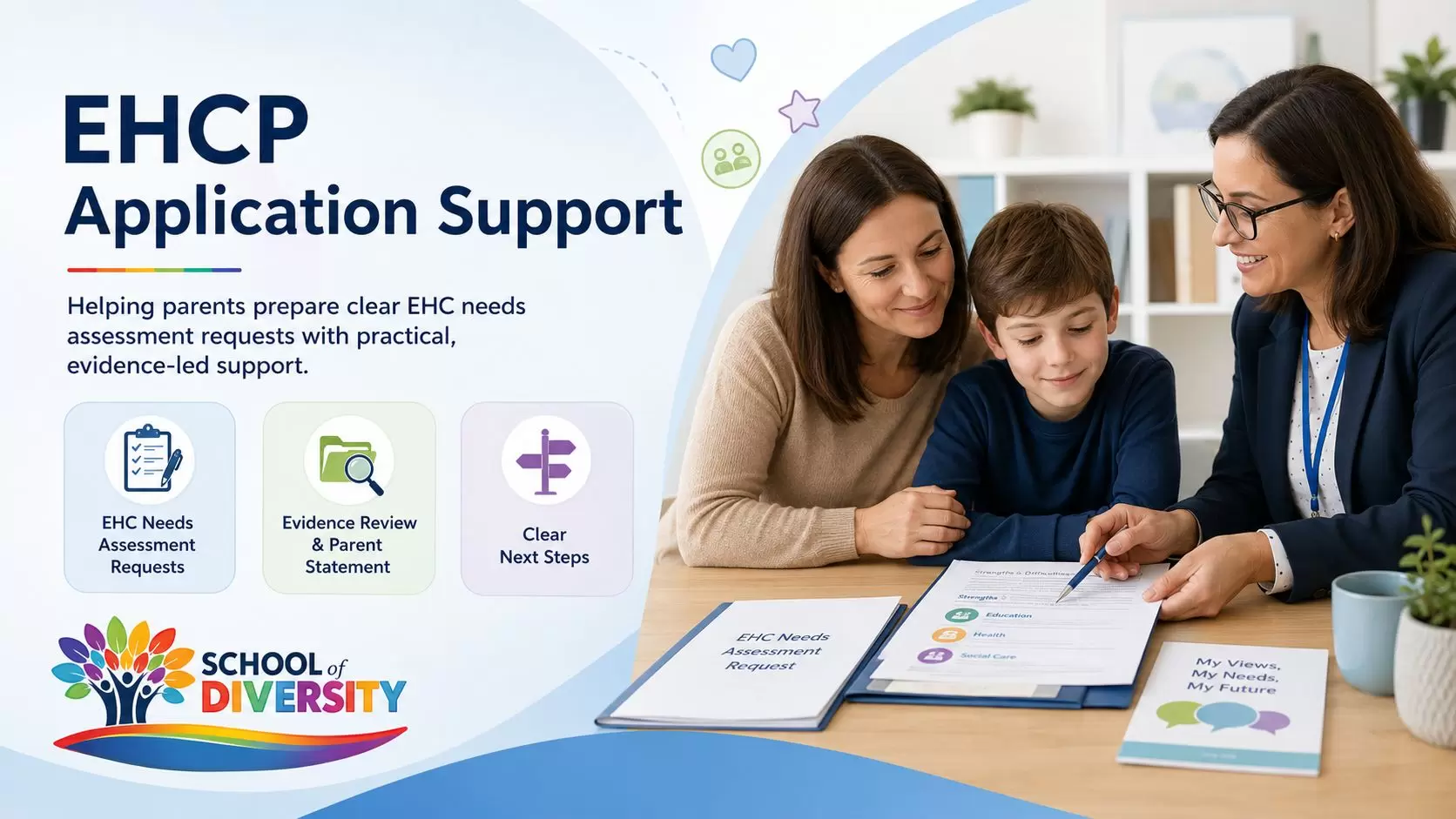
You may be applying for an EHCP for the first time, reviewing a draft plan or preparing to challenge a local-authority decision.
Our support can be tailored to the stage you have reached.
EHCP Applications and EHC Needs Assessment Requests
We can help you prepare a clear and evidence-based request for an Education, Health and Care needs assessment.
This may include:
- reviewing the difficulties your child is experiencing;
- identifying evidence from school and professionals;
- explaining your child’s special educational needs;
- describing the support already attempted;
- showing why existing SEN Support may not be sufficient;
- preparing parental representations;
- organising evidence into a clear submission;
- helping you respond to requests for further information.
A diagnosis is not necessarily required before an EHC needs assessment can be requested. The central question is whether your child may have special educational needs and may require provision through an EHC plan.
Refusal to Assess Support
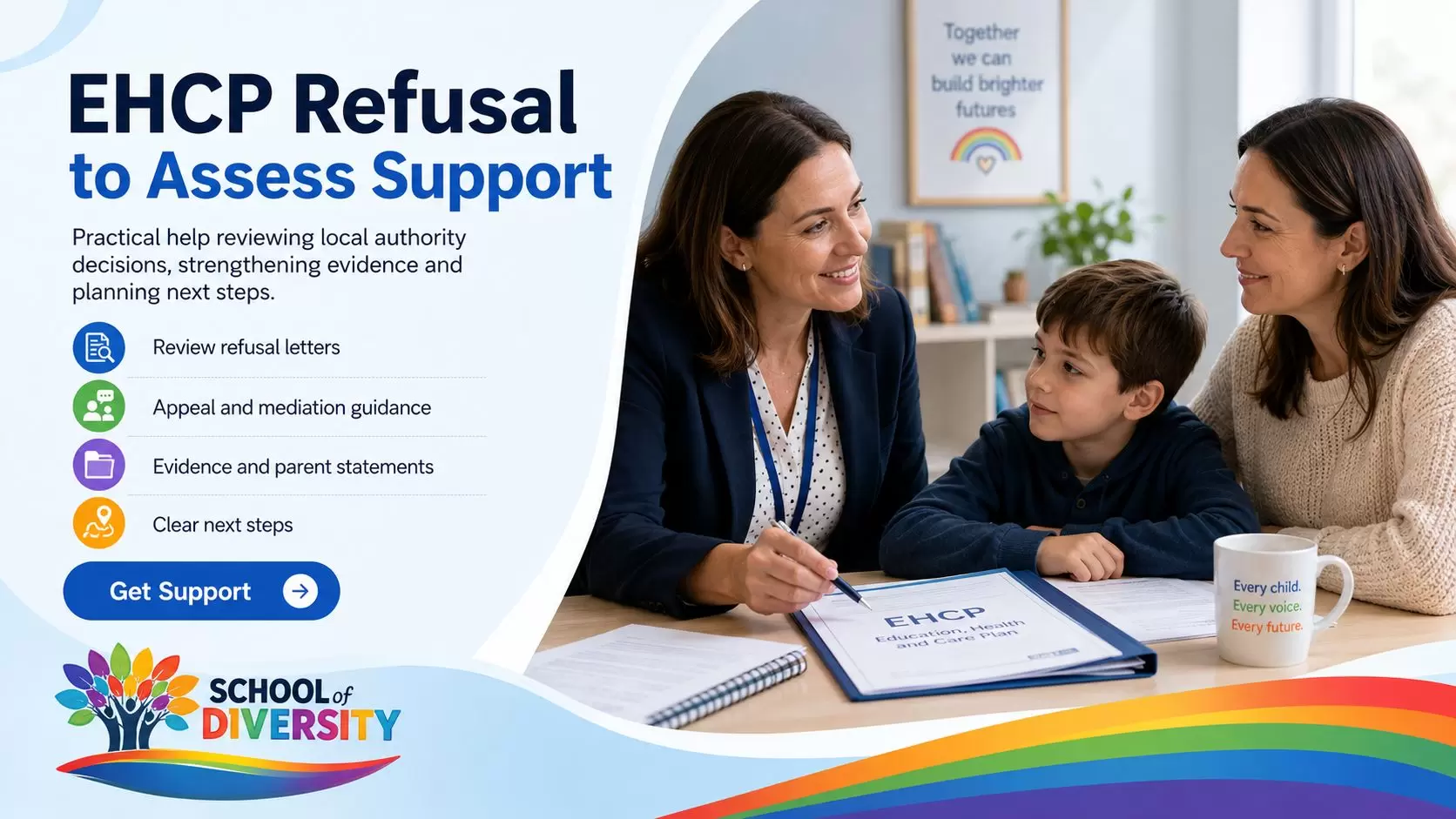
A local authority may decide not to carry out an EHC needs assessment. This does not always mean that the process has ended.
We can help you:
- understand the reasons given for the refusal;
- review the evidence considered by the local authority;
- identify weaknesses or gaps in the decision;
- prepare grounds of appeal;
- organise relevant supporting evidence;
- understand mediation and tribunal procedures;
- prepare your parental case clearly and logically.
Support When the Local Authority Refuses to Issue an EHCP
Following an assessment, the local authority may decide that an EHC plan is not necessary.
We can review the decision and help you consider whether the available evidence indicates that your child requires special educational provision through an EHC plan.
Support may include:
- reviewing professional advice obtained during the assessment;
- identifying unmet or insufficiently addressed needs;
- comparing identified needs with existing provision;
- preparing clear appeal grounds;
- helping you organise evidence for mediation or tribunal;
- supporting the preparation of your parental statement.
Draft EHCP Review and Amendments
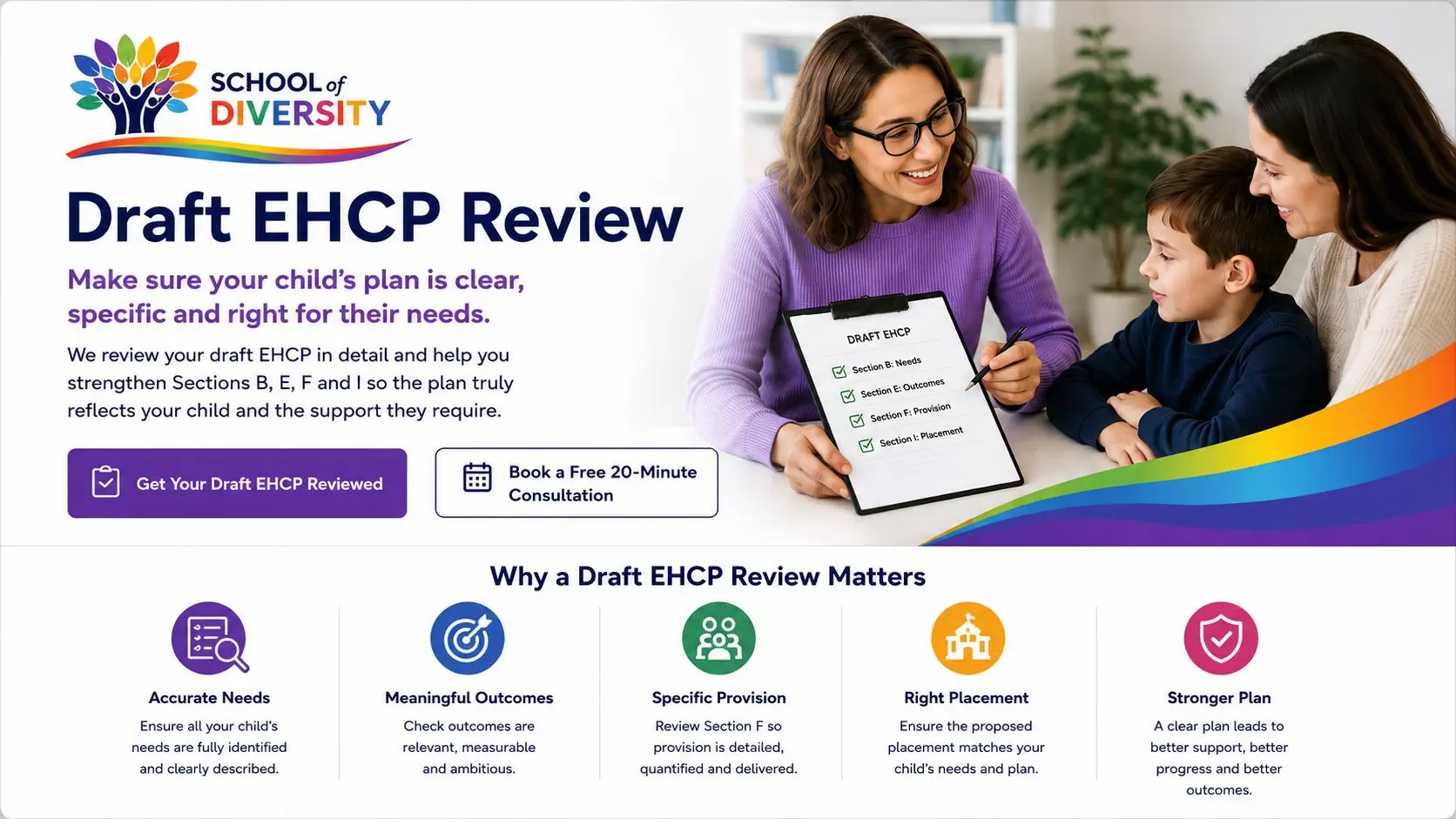
Receiving a draft EHCP is an important stage, but the draft should not be accepted automatically.
A plan may describe some of your child’s difficulties while failing to specify the provision required to meet them. It may also contain vague wording that makes support difficult to measure or enforce.
We provide detailed draft EHCP reviews covering the relevant sections of the plan.
Section A: Views, Interests and Aspirations
We consider whether the plan properly reflects:
- your child’s voice;
- parental views;
- strengths and interests;
- hopes for the future;
- the impact of your child’s needs on daily life and education.
Section B: Special Educational Needs
Section B should identify all of your child’s special educational needs.
We check whether needs relating to the following areas have been fully described:
- communication and interaction;
- cognition and learning;
- social, emotional and mental health;
- sensory and physical development;
- attention and executive functioning;
- emotional regulation;
- independence and self-care;
- preparation for adulthood where relevant.
Section E: Outcomes
We review whether the outcomes are:
- relevant to your child’s identified needs;
- specific and understandable;
- measurable;
- realistically timed;
- focused on meaningful progress;
- linked to the provision in Section F.
Section F: Special Educational Provision
Section F is one of the most important parts of an EHCP.
We check whether provision is sufficiently specific about:
- what support will be provided;
- who will deliver it;
- how often it will be delivered;
- how long each session or intervention will last;
- whether support will be individual or group-based;
- the qualifications or training required;
- how progress will be monitored;
- how provision will be reviewed;
- what should happen during periods of distress, absence or transition.
We help replace wording such as:
- “access to support”;
- “regular opportunities”;
- “as required”;
- “when necessary”;
- “adult support where appropriate”;
- “small-group work”;
- “staff will be aware”;
with wording that is clearer, quantified and capable of being monitored.
Section I: Educational Placement
We can help parents present their views about:
- mainstream education;
- specialist provision;
- resource bases;
- independent or non-maintained special schools;
- further education placements;
- education otherwise than at school where relevant.
The suitability of a placement should be considered in relation to the child’s identified needs and the provision they require.
Annual Review Support
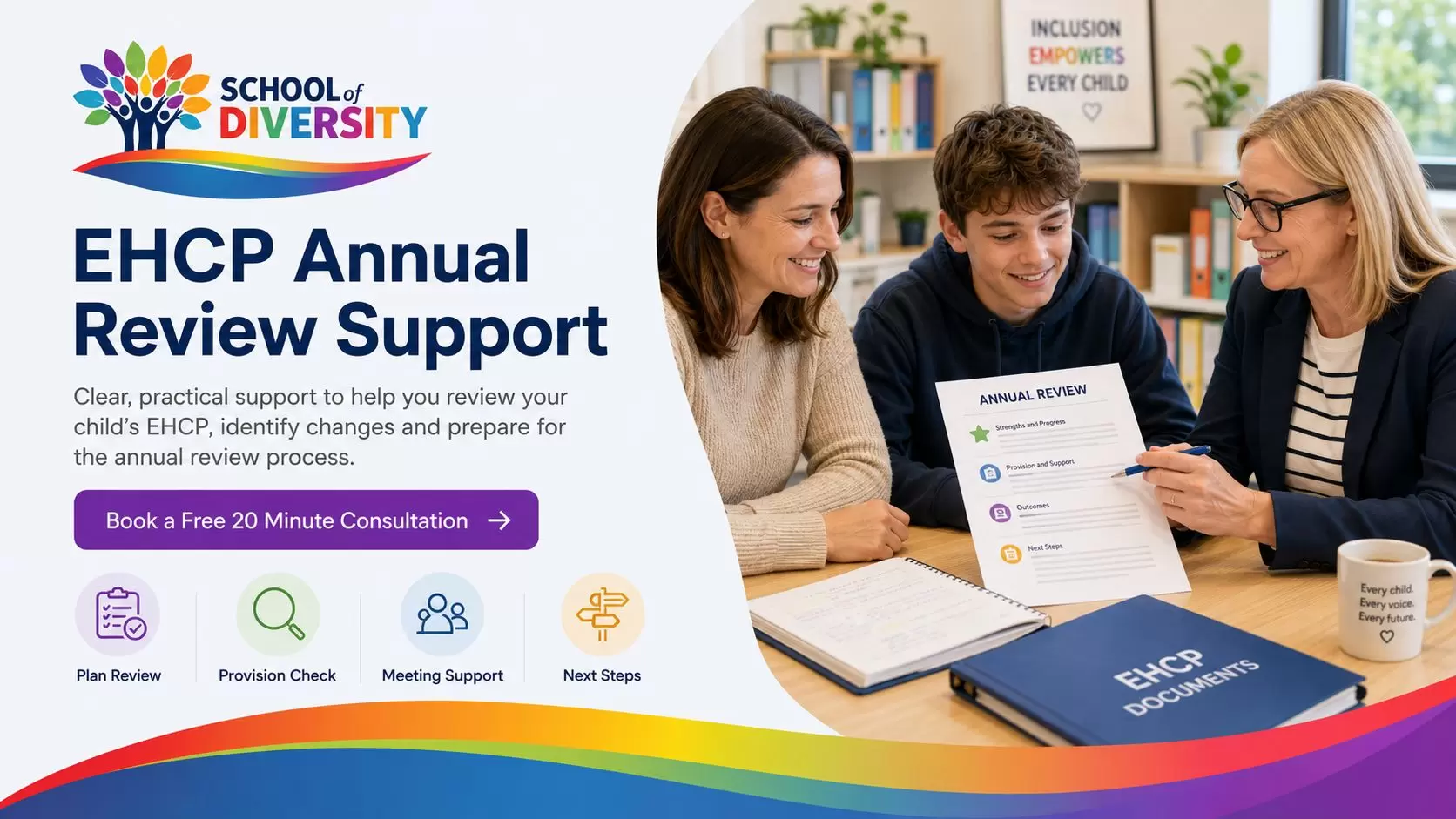
An annual review is more than a routine meeting. It is an opportunity to consider whether the EHCP remains accurate, whether provision is being delivered and whether changes are required.
We can support you before and after the review.
Before the Annual Review
We can help you:
- review the existing EHCP;
- identify outdated or missing needs;
- examine whether Section F provision is being delivered;
- compare current progress with the outcomes;
- prepare parental comments;
- organise supporting evidence;
- identify amendments to request;
- prepare questions for the meeting.
After the Annual Review
We can help you understand and respond to a local-authority decision to:
- maintain the EHCP without amendment;
- amend the EHCP;
- cease the EHCP.
Where an amended draft is issued, we can review the revised wording and help you prepare a response.
EHCP Appeal and SEND Tribunal Support
Parents and young people may have a right of appeal when they disagree with certain local-authority decisions about an EHC needs assessment or plan.
Appeals may concern:
- a refusal to carry out an EHC needs assessment;
- a refusal to issue an EHC plan;
- the description of special educational needs in Section B;
- the special educational provision in Section F;
- the school or educational placement in Section I;
- a decision not to amend an EHCP following review or reassessment;
- a decision to cease maintaining an EHCP.
Our role is to help you understand the issues in dispute, prepare clear evidence and manage the practical stages of the appeal.
Tribunal Preparation May Include
- reviewing the local-authority decision;
- identifying the appealable issues;
- preparing or refining grounds of appeal;
- reviewing Sections B, F and I;
- preparing a parental statement;
- organising evidence;
- identifying missing professional evidence;
- preparing a chronology;
- helping with the case review process;
- reviewing the local authority’s response;
- assisting with the working document;
- preparing questions and key points for the hearing;
- helping identify appropriate witnesses;
- supporting preparation for a paper or oral hearing.
Mediation Support
In many EHCP appeals, parents or young people must contact a mediation adviser before registering the appeal, although different requirements can apply where the appeal concerns placement only.
Mediation may provide an opportunity to resolve some or all of the disagreement without proceeding to a final tribunal hearing.
We can help you:
- understand the issues that remain in dispute;
- prepare a concise mediation position;
- identify the amendments or decisions you are seeking;
- organise evidence;
- prepare questions;
- record any agreements reached;
- consider whether unresolved matters still require an appeal.
Mediation should not be treated as an informal conversation without preparation. Any proposed resolution should be considered carefully and recorded clearly.
Working Document Support
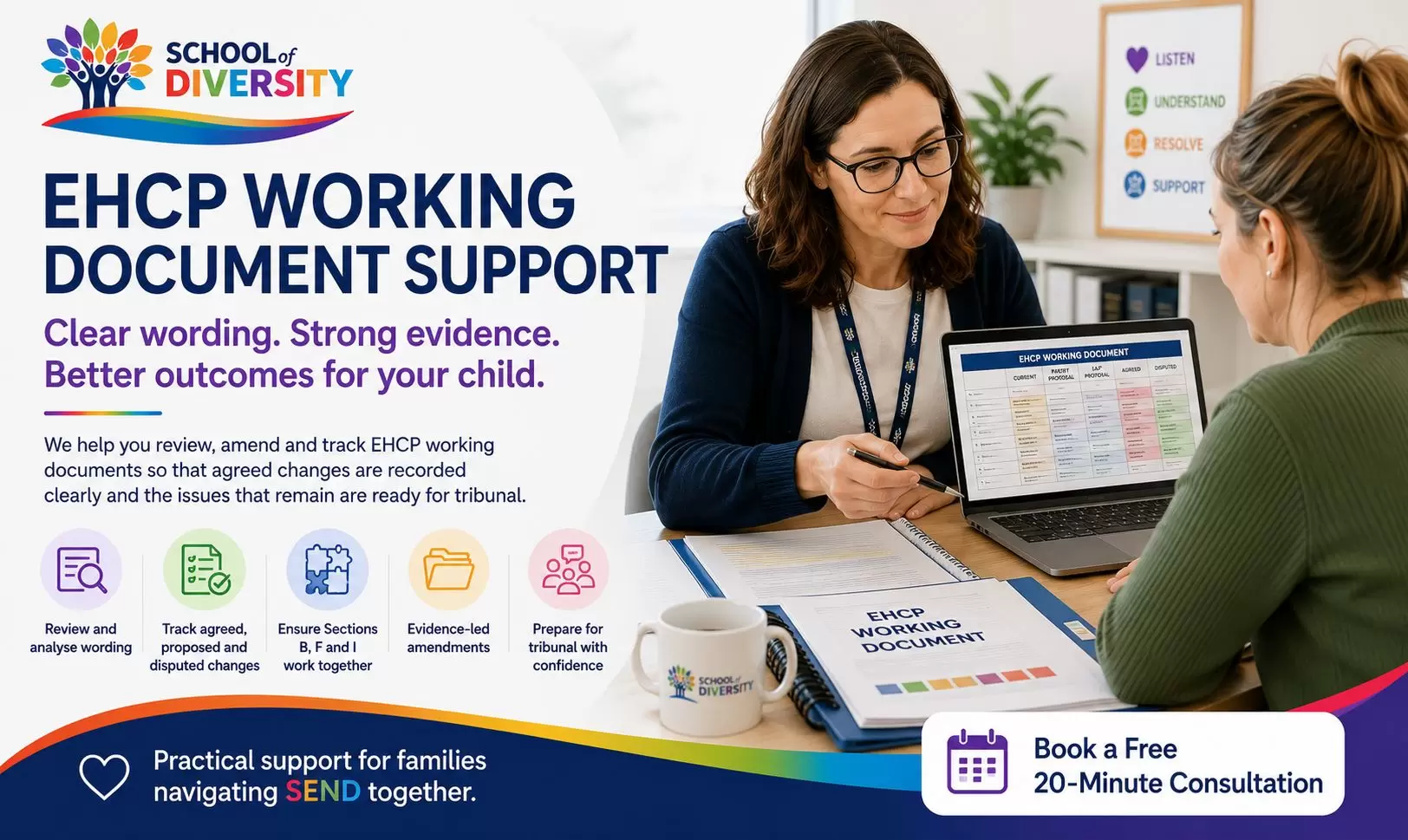
In appeals about the contents of an EHCP, the parties will usually work through proposed amendments to the plan using a working document.
This document records:
- wording agreed by both parties;
- wording proposed by the parent or young person;
- wording proposed by the local authority;
- matters that remain disputed.
We can help you review and manage the working document so that:
- each identified need is accurately described;
- provision corresponds with the relevant need;
- vague wording is challenged;
- amendments are supported by evidence;
- placement-specific wording is located appropriately;
- unresolved issues remain clearly visible.
Evidence Review and Case Preparation
A strong EHCP case is not created by submitting the greatest possible number of documents. The evidence should be relevant, organised and connected to the amendments or decisions being sought.
We can review evidence such as:
- educational psychology reports;
- autism and ADHD assessment reports;
- speech and language therapy advice;
- occupational therapy reports;
- school reports;
- SEN Support plans;
- assess, plan, do and review records;
- attendance information;
- behaviour or incident records;
- exclusion records;
- medical evidence;
- correspondence with the school or local authority;
- parental evidence;
- the child or young person’s views.
We help identify:
- what the evidence establishes;
- which part of the EHCP it relates to;
- whether further clarification may be needed;
- how it supports the changes being requested.
What Our EHCP Advocacy Support Can Include
Depending on the package selected and your stage in the process, support may include:
- an initial case review;
- a SEND Clarity Session;
- EHCP application preparation;
- parental statement drafting;
- child or young person’s views;
- evidence review and organisation;
- draft EHCP amendments;
- Section B and Section F revisions;
- annual review preparation;
- refusal decision review;
- mediation preparation;
- tribunal appeal preparation;
- working document support;
- hearing preparation;
- witness preparation;
- post-decision guidance.
The exact scope, deliverables and fees will be confirmed in writing before work begins.

Who Is This Service For?
Our EHCP advocacy service may be suitable where:
- your child is struggling despite SEN Support;
- school support is inconsistent or insufficient;
- you are unsure whether to request an EHC needs assessment;
- the local authority has refused to assess;
- the local authority has refused to issue an EHCP;
- you have received a vague or incomplete draft plan;
- important needs are missing from Section B;
- provision in Section F is not specific or quantified;
- you disagree with the placement named in Section I;
- an annual review has not resulted in necessary amendments;
- the local authority proposes to cease the EHCP;
- you are preparing for mediation or a SEND Tribunal appeal;
- you feel overwhelmed by evidence, forms or deadlines.
Why Choose School of Diversity?
Practical Parent Support
We understand that parents need more than general information. Our support focuses on your documents, your concerns and the stage your family has reached.
Evidence-Led Guidance
We connect the recommendations being requested to the available professional, educational and parental evidence.
Detailed EHCP Reviews
We examine whether needs, outcomes and provision are properly connected rather than reviewing sections in isolation.
Clear Communication
Complex SEND procedures are explained in direct, parent-friendly language.
Integrated Professional Insight
Our wider work includes SEND advocacy and Chartered Psychologist-led assessment services, helping families understand the relationship between identified needs, professional evidence and educational provision.
Support Across England
EHCP consultations and document-based advocacy support can be provided remotely to families across England
How the EHCP Support Process Works
1. Tell Us What Is Happening
Complete the enquiry form and provide a brief summary of your child’s circumstances, the decision or plan received and any relevant deadline.
2. Initial Review
We establish the stage you have reached, the documents available and the type of support required.
3. Written Scope and Fee
You receive confirmation of:
- the work included;
- the documents required;
- expected timescales;
- the fee;
- any limitations to the service.
4. Evidence and Document Review
We review the agreed documentation and identify the main needs, gaps, disputed issues and recommended next steps.
5. Preparation and Support
We prepare the agreed documents or recommendations and explain how they should be used.
6. Next Steps
Where further action is required, we explain the next procedural stage and any important deadlines that you should confirm.
Start With a SEND Clarity Session

You may not yet know whether you need a full EHCP review, application package or tribunal support.
A SEND Clarity Session provides an opportunity to:
- explain your current situation;
- identify the stage of the EHCP process;
- discuss your principal concerns;
- consider the available evidence;
- identify immediate priorities;
- determine the most suitable support option.
Frequently Asked Questions About EHCP Advocacy
What is an EHCP advocate?
An EHCP advocate supports parents or young people in understanding the EHCP process, reviewing evidence, preparing documents and presenting their position to a school, local authority, mediator or tribunal.
The exact role depends on the service agreed. An advocate is not automatically acting as a solicitor or providing regulated legal representation.
Can you guarantee that my child will receive an EHCP?
No responsible professional can guarantee the outcome of an EHC needs assessment request, EHCP application or appeal.
We can help you present the relevant needs, evidence and arguments as clearly and thoroughly as possible, but the decision remains with the local authority or tribunal.
Does my child need a diagnosis to apply for an EHCP?
An EHCP is based on special educational needs and the provision required, rather than on diagnosis alone.
A diagnosis may provide useful evidence, but children without a confirmed diagnosis may still have identifiable special educational needs requiring assessment and support.
Can parents request an EHC needs assessment directly?
Yes. A parent, a young person over compulsory school age or certain other parties can ask the local authority to carry out an EHC needs assessment.
You do not necessarily have to wait for the school to make the request.
What parts of an EHCP can be appealed?
Depending on the local-authority decision, an appeal may involve:
- Section B: special educational needs;
- Section F: special educational provision;
- Section I: educational placement;
- a refusal to assess;
- a refusal to issue a plan;
- a refusal to amend;
- a decision to cease the plan.
Requests can also be made for tribunal recommendations concerning certain health and social-care matters when there is an educational appeal.
Can you help improve Section F?
Yes. We can review whether Section F clearly specifies and quantifies the provision required.
This includes examining the type, frequency, duration, staffing, group size, professional oversight, monitoring and review of support.
Can you help challenge the school named in Section I?
We can help you organise evidence and present your reasons for seeking a different school or type of placement.
Placement disputes can involve detailed legal and evidential issues. Additional legal advice may be appropriate in complex cases.
Can you attend a SEND Tribunal hearing?
Hearing attendance or witness support must be expressly included in the agreed service package.
Document review or tribunal preparation does not automatically include attendance or formal representation.
What is the deadline for appealing?
Appeal deadlines are strict and depend on the decision and mediation position.
For many EHCP appeals, the appeal must generally be received within two months of the date of the local-authority decision letter or within one month of the mediation certificate, whichever gives the later deadline.
Parents should always check the current government guidance and the specific date on their decision documents immediately.
Do I have to attend mediation?
For many appeals, you must contact a mediation adviser and obtain the appropriate certificate before registering the appeal.
You can then decide whether to take part in mediation. Different rules can apply where the appeal concerns Section I placement only.
Will the local authority have a representative?
The local authority may have a case officer, presenting officer, legal representative or witnesses involved in the appeal.
Parents are permitted to conduct their own appeal, obtain independent support or arrange representation.
Can you review an EHCP that is already final?
Yes. We can review a final EHCP to identify missing needs, vague provision and potential appeal issues.
You should contact us promptly because appeal deadlines may already be running.
Is your service available throughout the UK?
This page concerns EHCPs and the legal framework in England.
Wales uses the Additional Learning Needs system and Individual Development Plans. Scotland and Northern Ireland operate under different legal and educational frameworks.
Get Clear EHCP Support
You do not have to navigate applications, plans, reviews and appeals without structured support.
Tell us what stage you have reached and provide the date of any decision letter or upcoming deadline. We will explain the information required and the support options available.
Important Information
School of Diversity provides SEND advocacy, practical case support, document preparation and assessment-related services.
Unless specifically confirmed otherwise in writing, our service does not constitute representation by a solicitor or barrister and should not be treated as a substitute for regulated legal advice.
The scope of support will be set out in the client agreement. Outcomes cannot be guaranteed, and parents remain responsible for checking and meeting tribunal, mediation and local-authority deadlines.