
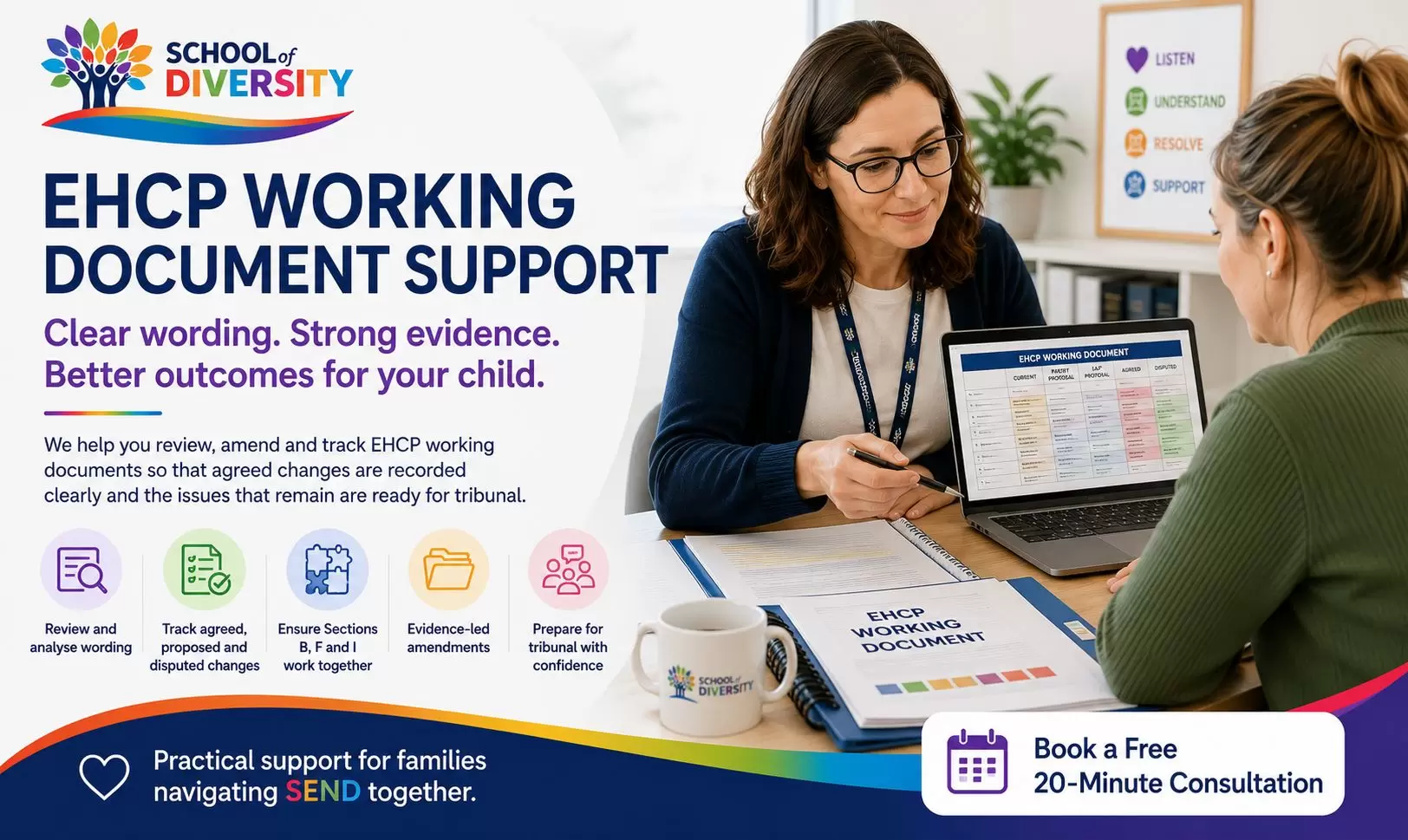
EHCP Working Document Support
Clear, structured help reviewing proposed EHCP amendments, recording agreements and identifying the wording that remains disputed.
During an appeal about the contents of an Education, Health and Care Plan, the working document becomes one of the most important documents in the case.
It shows:
- the wording currently contained in the EHCP;
- amendments requested by the parent or young person;
- amendments proposed by the local authority;
- wording agreed between the parties;
- issues that remain for the SEND Tribunal to decide.
School of Diversity can help you review the working document, connect the proposed wording to your evidence and manage amendments through the agreed stage of the appeal.
What Is an EHCP Working Document?
An EHCP working document is an editable version of the plan used during an appeal about its contents.
It allows the parent or young person and the local authority to show:
- which wording is agreed;
- which wording has been proposed;
- which amendments are accepted;
- which points remain disputed.
The completed working document is provided to the Tribunal before the hearing so that the panel can identify the precise wording it may need to determine.
It is not simply a general list of parental concerns. It is a detailed version of the EHCP showing the proposed wording within the relevant sections of the plan
When Is a Working Document Used?
A working document is generally used where an appeal concerns the contents of an existing EHCP.
This may include disputes about:
- Section B: special educational needs;
- Section F: special educational provision;
- Section I: educational placement;
- associated amendments required for consistency elsewhere in the plan.
It may also record agreed changes to Sections A or E where those changes help the plan remain coherent.
A working document is not normally required for a refusal-to-assess appeal because there is no existing plan to amend.
The tribunal’s case directions will usually explain when the working document must be prepared and submitted.
Why the Working Document Matters
The working document helps narrow the appeal.
As discussions progress, some wording may be agreed while other issues remain unresolved.
A well-managed working document allows:
- the parent to see exactly what the local authority has accepted;
- agreed changes to be recorded clearly;
- disputed wording to remain visible;
- each proposed provision to be connected to an identified need;
- the Tribunal to focus on the issues that genuinely require a decision.
It can also reduce unnecessary hearing time because agreed matters do not need to be argued agai
Who Usually Starts the Working Document?
The local authority will commonly provide the editable working document, based on the final EHCP under appeal.
It should be provided in a format that allows proposed amendments to be entered and tracked.
If the working document has not been provided by the date stated in the tribunal directions, the parent should contact the local authority’s tribunal representative promptly.
Keep all correspondence and copy the Tribunal into procedural communications where required by the case directions.
Understanding the Working Document Key
The working document should use a consistent key so that everyone can identify who proposed each change and whether it has been agreed.
The exact colour or formatting system may be set out in the tribunal guidance or directions.
The document may distinguish between:
- original wording;
- parent or young person’s proposed amendments;
- local-authority amendments;
- agreed wording;
- wording that remains disputed;
- text the parties agree should be deleted.
Do not change the agreed formatting key midway through the process.
Every version should be clearly numbered and dated.
What Should Be Included in the Working Document?
The document should focus on the wording of the EHCP.
It may contain proposed changes to:
Section A: Views, Interests and Aspirations
This may require amendment where:
- the child or young person’s views are outdated;
- parental views are incomplete;
- aspirations have changed;
- significant daily impact has been omitted.
Section A provides context, but it should not be relied upon as a substitute for identifying needs in Section B or provision in Section F.
Section B: Special Educational Needs
Section B should accurately identify all special educational needs.
Proposed amendments may address:
- omitted needs;
- inaccurate wording;
- functional impact;
- communication and interaction;
- cognition and learning;
- social, emotional and mental health needs;
- sensory and physical needs;
- attention and executive functioning;
- independence and preparation for adulthood.
Section E: Outcomes
Outcome amendments may be needed where outcomes are:
- too vague;
- not measurable;
- outdated;
- unrelated to the identified needs;
- being used instead of clearly specified provision.
Section F: Special Educational Provision
Section F should specify the provision required to meet every need in Section B.
Proposed wording may need to clarify:
- the type of intervention;
- frequency;
- duration;
- staffing;
- professional oversight;
- group size;
- training requirements;
- environmental adjustments;
- monitoring and review arrangements.
Section I: Educational Placement
Where placement is appealed, the document may show:
- the setting currently named;
- the setting or type of setting sought;
- wording proposed by the authority;
- placement wording that remains disputed.
Linking Section B and Section F
One of the most important checks is whether every identified need in Section B has corresponding provision in Section F.
A useful review method is:
| Section B need | Evidence | Required Section F provision | Status |
|---|---|---|---|
| Receptive-language difficulty | Speech and language report | Individual language programme delivered three times weekly | Disputed |
| Sensory regulation needs | Occupational therapy report | Daily sensory regulation programme and access to specified equipment | Partially agreed |
| Difficulty with transitions | School and parental evidence | Individual transition plan with advance preparation and named adult support | Agreed |
The working document itself should still follow the correct EHCP format. A separate mapping table can be used as an internal review tool.
.
How Evidence Should Be Used
Each substantial amendment should be supported by relevant evidence.
This may include:
- educational psychology reports;
- speech and language therapy reports;
- occupational therapy reports;
- autism or ADHD assessment reports;
- school records;
- progress evidence;
- attendance information;
- incident or exclusion records;
- parent statements;
- child or young person’s views;
- placement evidence.
Avoid inserting wording that cannot be supported by the existing evidence or a clear factual basis.
Where evidence is incomplete, identify whether:
- clarification from the professional is required;
- further evidence should be submitted;
- a witness may need to explain the recommendation;
- the issue should remain disputed for the Tribunal.
Making Section F Specific
Provision should be sufficiently clear for the reader to understand what must actually be delivered.
Wording such as the following may remain too uncertain:
- access to adult support;
- regular opportunities;
- support as required;
- intervention when appropriate;
- sensory breaks when needed;
- staff will be aware;
- opportunities for small-group work.
Where supported by evidence, stronger wording should identify:
- who will deliver the support;
- how often;
- for how long;
- whether it is individual or group-based;
- the maximum group size;
- required qualifications or training;
- who will monitor the provision;
- when it will be reviewed.
The purpose is not to add arbitrary numbers. The wording should reflect the child’s needs and the available professional evidence.
Agreed, Partially Agreed and Disputed Wording
Each amendment should be considered carefully.
Agreed Wording
Where both parties agree, the wording should be clearly marked as agreed.
Check that:
- the complete amendment is recorded;
- no qualifiers have weakened it;
- the wording remains consistent with other sections;
- linked provision has also been amended.
Partially Agreed Wording
Sometimes the authority accepts the need but disputes the level of provision.
For example:
- the authority agrees that language therapy is required;
- the parent seeks three individual sessions weekly;
- the authority proposes one group session.
The working document should show the precise difference rather than simply stating that the issue is “partially agreed.”
Disputed Wording
Where no agreement is reached, both positions should remain visible.
Do not remove the parent’s proposed wording merely because the local authority has rejected it.
The unresolved issue may need to be determined by the Tribunal.
Do Not Lose Agreed Amendments
As versions pass between the parties, agreed wording can occasionally be changed, removed or reformatted incorrectly.
Before returning each version:
- compare it with the previous version;
- check every agreed amendment;
- check that no wording has disappeared;
- verify the colour or formatting key;
- confirm the version number and date;
- retain a copy of every version.
A simple version log can help:
| Version | Date received | Date returned | Main changes | Issues outstanding |
| WD1 | 5 May | 8 May | Initial parent amendments | Sections B, F and I |
| WD2 | 15 May | 18 May | Authority accepted communication needs | Frequency of SALT disputed |
| WD3 | 28 May | 30 May | Further Section F agreement | Placement remains disputed |
Avoid Rewriting the Entire Plan Without Purpose
A working document should remain focused and manageable.
Not every sentence needs to be rewritten.
Prioritise wording that affects:
- identification of need;
- entitlement to provision;
- frequency and duration;
- professional involvement;
- staffing;
- monitoring;
- placement;
- the child or young person’s access to education.
Minor stylistic changes can distract from the substantive issues.
The official guidance states that the working document is intended to show the wording each party wants or can agree and the issues that remain for the Tribunal.
Keep the Document Internally Consistent
Changes in one section may require amendments elsewhere.
For example:
- a new need added to Section B may require new Section F provision;
- revised provision may require an amended outcome in Section E;
- placement wording in Section I must be consistent with the needs and provision;
- deleted needs may affect existing provision;
- professional recommendations listed in Section K may need to appear in Sections B or F.
Read the plan as a whole after every substantial revision.
Our Two Levels of Working Document Support
Parents can choose a focused review and amendment service or continued support while the working document is exchanged with the local authority.
Compare Working Document Packages
| Feature | Working Document Review and Amendments | Supported Working Document Casework |
| Price | From £395 | From £750 |
| Best for | Parents who want clear proposed wording to manage themselves | Parents wanting continued support through working-document negotiations |
| Current working document reviewed | ✓ | ✓ |
| Final EHCP reviewed | ✓ | ✓ |
| Agreed evidence reviewed | ✓ | ✓ |
| Sections B and F cross-checked | ✓ | ✓ |
| Section I reviewed where relevant | ✓ | ✓ |
| Missing needs identified | ✓ | ✓ |
| Vague provision identified | ✓ | ✓ |
| Proposed amendments drafted | ✓ | ✓ |
| Agreed and disputed wording checked | ✓ | ✓ |
| Review consultation | ✓ | ✓ |
| Local-authority revisions reviewed | — | ✓ |
| Version comparison | — | ✓ |
| Further amendment rounds | — | Up to two agreed rounds |
| Procedural correspondence support | — | Limited and defined |
| Final pre-hearing review | — | ✓ |
| Case Review Form support | — | Where included |
| Hearing attendance | — | Quoted separately |
Working Document Review and Amendments — From £395
Suitable where you have received a working document and want help preparing clear proposed amendments but will manage later exchanges yourself.
The package may include:
- review of the current working document;
- review of the final EHCP;
- review of an agreed evidence allowance;
- comparison of Sections B and F;
- review of Section I where relevant;
- identification of missing needs;
- identification of vague or insufficient provision;
- proposed wording for disputed sections;
- review of the working-document formatting;
- written priority recommendations;
- one consultation;
- one agreed revision.
The final fee will depend on:
- the length of the EHCP;
- the number of sections under appeal;
- the extent of the proposed changes;
- whether placement is disputed;
- the evidence volume.
Supported Working Document Casework — From £750
Suitable where you want continued practical support while the working document is exchanged and negotiated.
It may include everything in the review package, plus:
- review of local-authority amendments;
- comparison between document versions;
- checking agreed wording has been retained;
- preparation of up to two further agreed amendment rounds;
- identifying issues that remain disputed;
- limited procedural correspondence relating to the document;
- evidence cross-referencing;
- final pre-hearing working-document review;
- preparation of a concise outstanding-issues summary;
- Case Review Form input where expressly included.
This package covers the agreed working-document stage only.
Wider tribunal case management, witness preparation or hearing attendance must be included in a separate package or written quotation.
What We Need From You
To review the working document, we will normally request:
- the most recent working-document version;
- the final EHCP under appeal;
- the local-authority response;
- the tribunal case directions;
- your grounds of appeal;
- the principal professional reports;
- previous amendment representations;
- correspondence about agreed changes;
- details of any approaching deadline.
Always send the editable Word version where available.
A PDF may be useful for reference but is not suitable for tracking detailed amendments.
How Our Working Document Support Works
1. Book a Free Consultation
Tell us:
- which sections are under appeal;
- whether a working document has been received;
- its current version number;
- the next tribunal deadline;
- whether placement is disputed;
- the main unresolved issues.
2. Send the Documents
We review the working document, final plan, directions and agreed evidence.
3. Confirm the Service Scope
You receive a written service schedule setting out:
- sections included;
- evidence allowance;
- amendment rounds;
- consultation;
- correspondence included;
- deadline;
- fee and exclusions.
4. Review and Amend the Document
We identify missing needs, vague provision and inconsistent wording and prepare the agreed proposed changes.
5. Parent Approval
You review the amendments and confirm that they accurately reflect your child and the outcome sought.
6. Return or Continue the Working Document
Under the review package, you manage later exchanges.
Under supported casework, we review the authority’s response and continue through the agreed amendment rounds.
What Happens if the Local Authority Agrees?
Agreed amendments should be marked clearly in the working document.
Check that:
- the wording has been accepted in full;
- related sections have also been updated;
- the provision has not been weakened elsewhere;
- the agreement is reflected in the latest version;
- the issue can be removed from the list of disputed matters.
Continue to retain the evidence supporting the agreement because the Tribunal may still need to understand the plan as a whole.
What Happens if the Local Authority Disagrees?
Where the authority rejects an amendment:
- request or identify its alternative wording;
- compare both versions with the evidence;
- clarify the precise point of disagreement;
- keep the parent’s wording visible;
- avoid replacing specific wording with vague compromise language;
- record the issue as unresolved.
The Tribunal can then consider the competing wording and supporting evidence at the hearing.
Can the Working Document Settle the Appeal?
Sometimes the working-document process leads to full agreement.
Where all educational issues are resolved:
- obtain the final agreed wording;
- confirm how and when the amended EHCP will be issued;
- consider whether the appeal should be withdrawn;
- do not rely solely on verbal assurances;
- ensure any remaining health or social care issues are understood.
Do not withdraw an appeal until the written position and practical consequences are clear.
The Working Document and the Case Review Form
The Case Review Form asks the parties to confirm the issues remaining in dispute and whether the case is ready to proceed.
In an EHCP contents appeal, it may ask whether a working document exists.
The answers should be consistent with the latest working document.
Check that:
- agreed issues are not incorrectly listed as disputed;
- unresolved wording is still identified;
- placement issues are accurately recorded;
- witness requirements match the outstanding issues;
- any procedural difficulties have been raised.
Preparing the Final Working Document
The local authority normally has responsibility for providing the final working document to the Tribunal in accordance with the case directions.
Before the final version is submitted:
- confirm the correct version is being used;
- check the key;
- check every agreed amendment;
- identify every remaining dispute;
- remove resolved drafting comments where appropriate;
- make sure the document is readable;
- confirm it has been sent to both parties and the Tribunal.
The precise submission deadline must be taken from the directions issued in the individual appeal.
Working Document Support and Placement Appeals
Where Section I is disputed, the document should not be considered separately from Sections B and F.
The evidence should explain:
- the child or young person’s needs;
- the required provision;
- the environment in which it must be delivered;
- why the existing or proposed setting is unsuitable;
- why the requested setting or type of placement is appropriate.
A placement name alone does not explain why the placement is required.
Common Working Document Problems
Needs Are Added Without Provision
A new need may appear in Section B without corresponding Section F support.
Provision Is Added Without Sufficient Detail
The authority may accept an intervention but omit frequency, duration or staffing.
Agreed Wording Is Later Changed
Always compare each version with the previous version.
Different Issues Are Combined
Separate communication, sensory, emotional and learning provision so each can be considered clearly.
Professional Recommendations Are Weakened
Compare proposed wording directly with the complete professional report.
The Document Becomes Too Long or Confusing
Keep amendments relevant and avoid duplicating the same information across multiple sections.
Parent Wording Is Removed After Rejection
Disputed wording should remain visible so that the Tribunal can identify the issue.
Placement Is Discussed Without Clear Sections B and F
Needs and provision must support the placement case.
Who Is This Service For?
Working Document Support may be suitable where:
- you are appealing Sections B, F or I;
- the local authority has sent an editable working document;
- you are unsure how to use the amendment key;
- important needs remain missing;
- Section F remains vague;
- local-authority wording differs from professional recommendations;
- amendments are being lost between versions;
- you are unsure which wording is agreed;
- the document has become difficult to follow;
- placement remains disputed;
- the working-document deadline is approaching;
- you want help preparing the final outstanding issues.
Why Choose School of Diversity?
Detailed Wording Review
We examine what the proposed wording means in practice rather than simply correcting presentation.
Needs and Provision Mapping
We check that each Section B need has corresponding Section F provision.
Evidence-Led Amendments
Proposed changes are linked to professional, educational and parental evidence.
Clear Version Management
Supported casework includes careful comparison of agreed, changed and disputed wording.
Two Levels of Support
Choose a focused amendment service or continued help through the working-document stage.
Transparent Scope and Fees
Sections, evidence limits, amendment rounds and deadlines are confirmed before work begins.
Frequently Asked Questions
Is the Working Document the Same as the Evidence Bundle?
No.
The working document records proposed EHCP wording. The tribunal bundle contains the documentary evidence in the appeal.
Who Prepares the First Version?
The local authority will commonly prepare and circulate the editable version of the final EHCP.
Check the individual tribunal directions.
Can I Change Sections That Are Not Under Appeal?
The working document should remain focused on the appeal and any consequential amendments needed for consistency.
Seek advice before substantially expanding the issues.
Should Agreed Wording Be Removed?
No. It should normally remain clearly marked as agreed in accordance with the document key.
Can I Add Provision Not Recommended by a Professional?
Proposed provision should have a sound evidential basis.
Where professional advice is incomplete, further clarification may be required.
What if the Authority Will Not Agree?
Keep the disputed wording visible and connect it to the supporting evidence so that the Tribunal can decide.
Does Working Document Support Include the Hearing?
No. Hearing preparation or attendance is included only where expressly stated in a separate quotation or tribunal-support package.
Can I Upgrade to Supported Casework?
Where capacity allows, yes. The earlier payment may be credited where the case remains within scope and no substantial duplication is required.
Is This Service Available Across the UK?
This service relates to EHCP appeals before the SEND Tribunal in England.
Get Help With Your EHCP Working Document
The working document determines how the disputed EHCP wording is presented to the Tribunal.
Send us the latest editable version, the final EHCP, tribunal directions and principal evidence. We will help you identify what has been agreed, what remains disputed and what wording should be considered next.
Important Information
School of Diversity provides practical SEND guidance, evidence review, document preparation and parent advocacy support.
We do not guarantee that the local authority will accept proposed amendments or that the Tribunal will adopt particular wording.
Unless expressly confirmed otherwise, we do not act as solicitors or barristers and do not provide regulated legal representation.
Parents and young people remain responsible for forwarding correspondence promptly, checking tribunal directions and confirming that procedural deadlines are met.
The precise sections, evidence allowance, amendment rounds, deadlines, responsibilities and exclusions will be set out in the client agreement.