
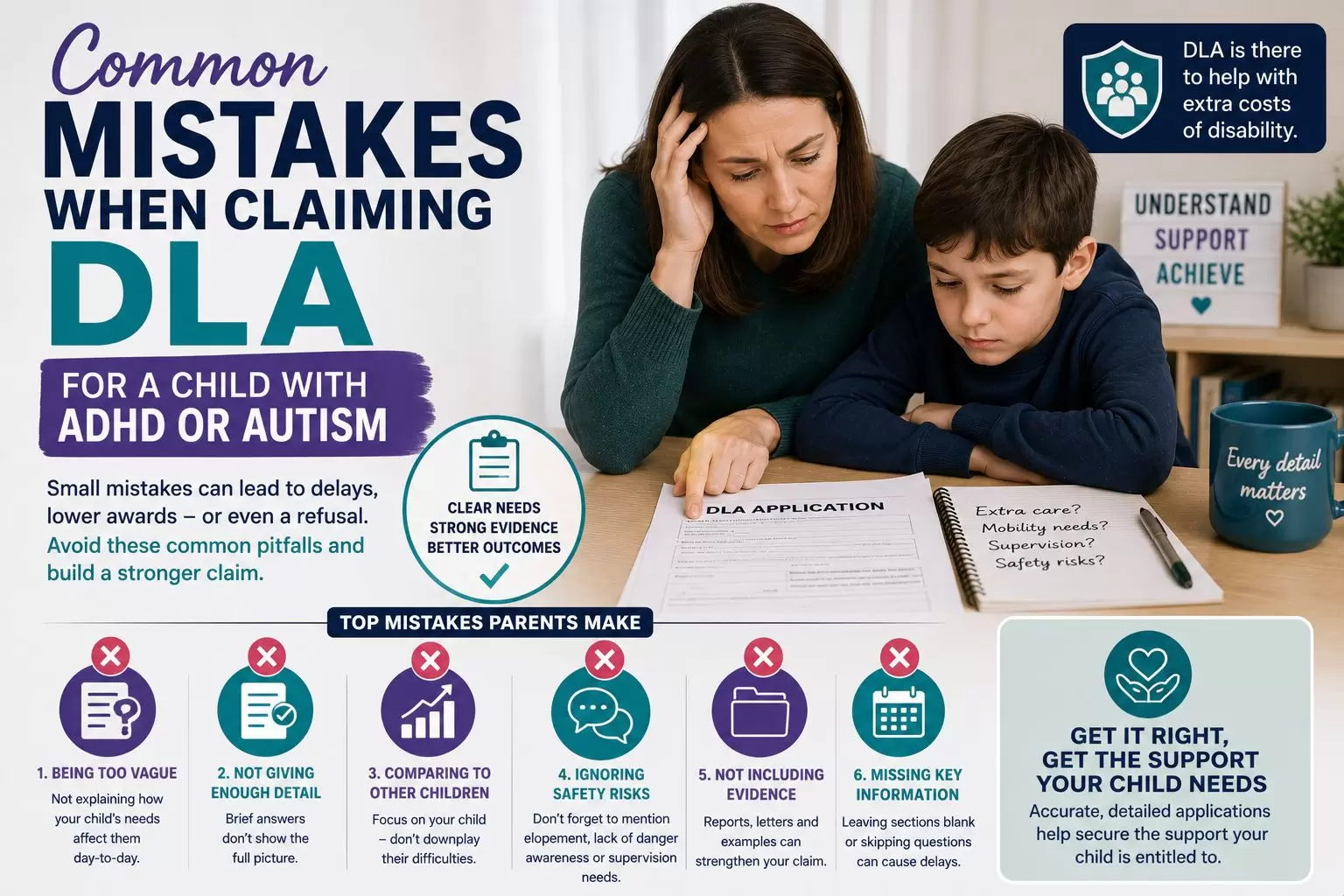
Common DLA claim mistakes for children with ADHD or autism
Make less visible support needs clear without exaggerating them.
The form needs an accurate account of the additional help your child requires. A diagnosis provides context, but everyday examples explain what an adult actually has to do.
Describe the pattern, not only the worst day
Explain easier and harder periods, their frequency and the support needed during each. Do not present occasional events as daily occurrences or minimise help that has become familiar.
The aim is a representative account of qualifying needs. ADHD or autism does not automatically establish entitlement to DLA.
Six mistakes—and what to do instead
1. Focusing on the diagnosis instead of daily support
“Has ADHD” or “is autistic” does not explain the help required. Describe relevant attention, prompting, supervision, communication, personal care or mobility needs.
Schoolwork or routine difficulties need a clear link to additional help and the applicable benefit criteria. Explain what happens, what you do and why.
2. Leaving out differences between school and home
Some children’s difficulties are less apparent in certain settings. Describe the support at school and what happens before or after attendance, including recovery, distress or extra care where relevant.
Masking may help explain some presentations, but do not assume every difference is masking. Use observations, records and professional advice where available, and explain context rather than dismissing school evidence.
3. Treating physical ability as independence
A child may be able to put on clothes but need help selecting them, managing sensory discomfort, completing fastenings or staying on task.
Describe the prompts and assistance actually required, how often and for how long. Avoid an unexplained yes/no answer where the question allows further detail.
4. Using generic or unexplained clinical language
Translate terms such as “executive-function difficulty” into practical examples: an adult gives step-by-step instructions, checks each stage and remains nearby.
Describe behaviours only where relevant to a support need. Stimming itself is not proof of a care need; explain any assistance or supervision required rather than treating a trait as inherently problematic.
5. Giving an unrepresentative account of variation
Do not describe only a calm day or only the most difficult day. Explain the frequency of each pattern and how support changes.
For example, distinguish mornings requiring repeated prompts from occasions requiring physical help or longer regulation support. A short diary can help you estimate accurately.
6. Omitting interacting needs or overstating a suspected diagnosis
Describe the full range of observed difficulties, including relevant sensory, communication, attention, health or sleep needs. Explain how they interact and affect adult support.
Clearly distinguish confirmed diagnoses, assessments in progress and your own observations. You do not need to present suspected autism or ADHD as confirmed to describe genuine needs.
Use a clear structure in your answers
Need → help → frequency → duration → consequence.
Less informative
“My child has executive-function difficulties and cannot get ready.”
More informative
“During the morning routine I give repeated prompts for each stage of dressing and stay alongside to keep the task moving. Without this, my child stops part-way through. Most school mornings require around 25 minutes of support.”
Illustrative wording only. Use your child’s circumstances and accurate estimates.
For care, explain how the support differs from that normally required by a child of the same age without a disability. Mobility has separate qualifying rules, including minimum ages.
Check the support you may have overlooked
Prompting and personal care
Dressing, washing, eating, toileting, medication, understanding instructions and managing routines.
Supervision and regulation
Safety risks, impulsive actions, communication support and adult intervention during distress.
Night and mobility
Relevant waking or night-time intervention, walking difficulties and guidance or supervision outdoors.
Make supporting evidence relevant
Use reports, school information, care diaries and statements that explain the help required. A diagnostic report alone may not describe everyday support.
Check consistency and explain different dates, settings or levels of assistance. Retain original reports unchanged and reference useful passages in context.
Final review before sending
- Have you explained actual help rather than only the diagnosis?
- Are prompting and supervision visible?
- Are frequency, duration and consequences clear?
- Have you considered relevant day, night and outdoor needs?
- Does the account show accurate variation?
- Are observations and confirmed diagnoses distinguished?
- Does the evidence support the account?
- Have you checked instructions, signatures and the return date?
Not every refusal is caused by a form mistake. A claim may not meet the criteria, evidence may be interpreted differently or a decision may need challenging. Clear preparation helps explain the case but cannot guarantee an award.
Frequently asked questions
Is DLA based on diagnosis or support needs?
The award depends on qualifying care or mobility needs and other eligibility conditions. Diagnosis is relevant context, not automatic entitlement.
How should I explain possible masking?
Describe observed differences, support in each setting and what happens outside school. Use relevant examples and advice. Avoid presenting an interpretation as an established fact without supporting information.
Can I describe needs without a second diagnosis?
Yes. Explain the difficulties and help required, while identifying which diagnoses are confirmed and which concerns are being assessed.
Should I focus on the hardest days?
Include them, but explain how often they occur alongside easier periods. Give a representative account of the pattern.
What if the claim has already been refused?
Compare the decision reasons with the form, evidence and relevant criteria. Seek advice promptly and check challenge deadlines.
Refusal reasons and next stepsFurther information: DLA parent guide, eligibility explained and official form and notes.
This guide mainly concerns child DLA in England and Wales. Scotland uses Child Disability Payment; Northern Ireland has separate administration. General guidance cannot determine individual entitlement.
Need help reviewing your answers?
We can help identify gaps, explain everyday support and organise relevant evidence. Scope and fees are agreed before work begins; an award cannot be guaranteed.
2 Responses