
Specialist SEND Support
Practical support focused specifically on SEND, EHCPs and education.
Evidence-Led
We look at what the evidence actually establishes — and what may still be missing.
Neurodiversity-Informed
Experienced in autism, ADHD, sensory needs, masking, anxiety and complex educational profiles.
Support Across England
Document review, consultation and case preparation can be provided remotely.
EOTAS Support for Parents: EHCP, Evidence and Advocacy
If your child cannot access a school or college setting successfully, you may be considering Education Otherwise Than At School (EOTAS) or already trying to secure the right EOTAS provision through their EHCP.
School of Diversity provides specialist, evidence-led support to parents navigating EOTAS.
We can help you understand the strength of your case, review the evidence, identify weaknesses in the EHCP, prepare representations to the Local Authority and support you where EOTAS is being considered, disputed or appealed.
We can support you with:
- Reviewing your child’s EHCP and professional evidence
- Identifying whether the evidence supports an EOTAS argument
- Strengthening Sections B and F
- Preparing a clear EOTAS proposal
- Identifying gaps in professional evidence
- Preparing for annual or emergency reviews
- Responding to Local Authority objections
- Mediation preparation
- SEND Tribunal preparation where required
Remote support available to families across England.
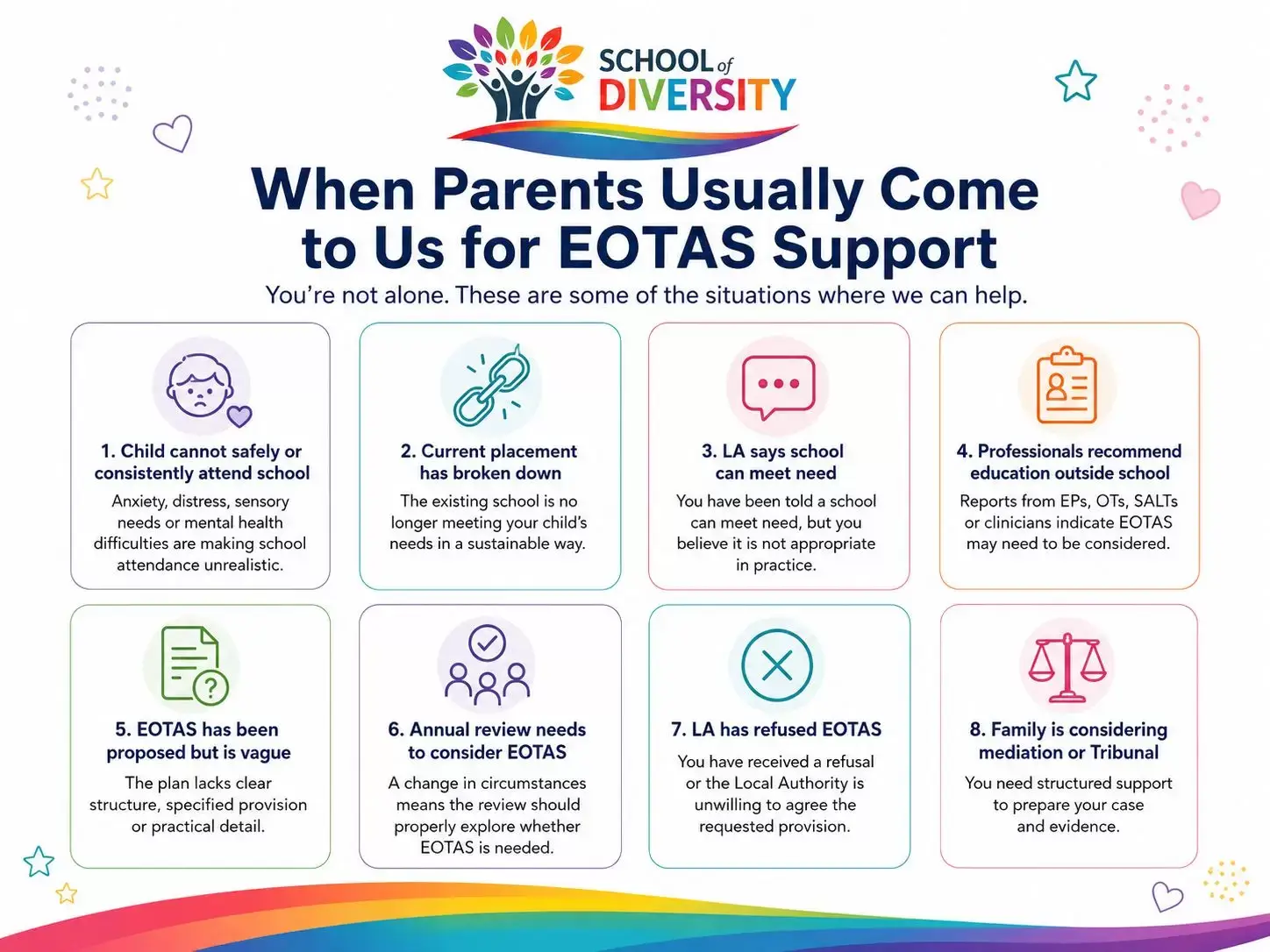
When Parents Usually Come to Us for EOTAS Support
Parents rarely contact us because everything is going smoothly.
Usually, something has reached a point where their child’s existing educational arrangements are no longer working.
You may recognise some of these situations.
Your Child Cannot Safely or Consistently Attend School
Your child may be experiencing severe anxiety, distress, sensory overload, shutdown, dysregulation, burnout or other difficulties that make accessing their current setting increasingly difficult.
Attendance alone does not tell the whole story.
We look at why education has become inaccessible, what has already been tried and what the evidence says about your child’s needs
Your Child’s Placement Has Broken Down
Sometimes a child remains formally on a school roll while, in reality, they are accessing little or no meaningful education.
There may have been:
- repeated failed returns;
- reduced timetables;
- prolonged absence;
- significant distress;
- deteriorating mental health;
- repeated exclusions or suspensions;
- increasing difficulty leaving home;
- unsuccessful reasonable adjustments;
- an inability to access the environment despite additional support.
If the existing placement is no longer realistically meeting your child’s needs, the EHCP and available evidence need to reflect that clearly.
The Local Authority Says a School Can Meet Need
One of the most important issues in an EOTAS case is often the difference between:
a school technically being able to offer provision
and
your child actually being able to access that provision within a school environment.
We help you examine this distinction carefully.
A strong case usually needs to connect the child’s identified needs with the characteristics of the educational environment and explain why proposed adjustments, staffing or alternative placements do or do not overcome the identified barriers.
Professionals Have Recommended Education Outside School
You may already have evidence from:
- an Educational Psychologist;
- Occupational Therapist;
- Speech and Language Therapist;
- psychiatrist;
- paediatrician;
- CAMHS professional;
- psychologist;
- specialist teacher;
- school;
- other relevant professionals.
We review those reports carefully to identify what they actually recommend and whether those recommendations properly support the case you are asking the Local Authority to consider.
The EOTAS Package Being Proposed Is Too Vague
Securing agreement in principle to EOTAS is only part of the issue.
The provision itself also needs careful attention.
Statements such as:
- “access to tuition”;
- “therapeutic support as required”;
- “opportunities for community activities”;
- “regular input”;
- “support when appropriate”
may leave important questions unanswered.
We look at whether the proposed provision identifies:
- what will be delivered;
- by whom;
- how often;
- for how long;
- at what level;
- for what purpose;
- and how the different elements work together.
Your Annual Review Needs to Consider EOTAS
If circumstances have changed substantially since the EHCP was written, waiting passively for the existing arrangements to improve may not be appropriate.
We can help parents prepare for an annual review or request that changed circumstances are properly considered.
The Local Authority Has Refused EOTAS
A refusal does not necessarily end the matter.
What happens next depends on the decision made, the wording of the EHCP, the evidence and the parent’s appeal rights.
Where appropriate, we can help parents consider:
- further representations;
- mediation;
- amendments to the EHCP;
- additional evidence;
- a SEND Tribunal appeal.

Unsure Whether Your Evidence Is Strong Enough for EOTAS?
You do not need to know the answer before speaking to us. We can review where your case currently stands, identify the strongest evidence, highlight weaknesses and explain the practical next steps.
What Does EOTAS Actually Mean?
EOTAS means Education Otherwise Than At School.
Under the current legal framework in England, a Local Authority may arrange special educational provision outside a school or post-16 institution where it is satisfied that it would be inappropriate for the provision to be made in such a setting.
EOTAS can therefore involve education being arranged in other environments, potentially through a combination of different providers and services depending on the child’s individually identified needs.
It is not simply another name for home education.
Under EOTAS, the Local Authority remains involved in arranging the special educational provision identified through the child’s EHCP.
Important: every case is individual. The question is not simply whether a child would prefer to learn at home. The evidence needs to address why provision in a school or college setting would be inappropriate for that particular child.
EOTAS Is Not the Same as Elective Home Education
This distinction is extremely important.
EOTAS
The Local Authority arranges special educational provision outside school through the statutory SEND framework because of the child’s needs.
Elective Home Education
The parent takes responsibility for arranging the child’s education.
Parents should therefore be cautious about withdrawing a child from school simply because the current placement has become impossible to access.
If you believe your child may require EOTAS, we can help you understand the difference before important decisions are made.
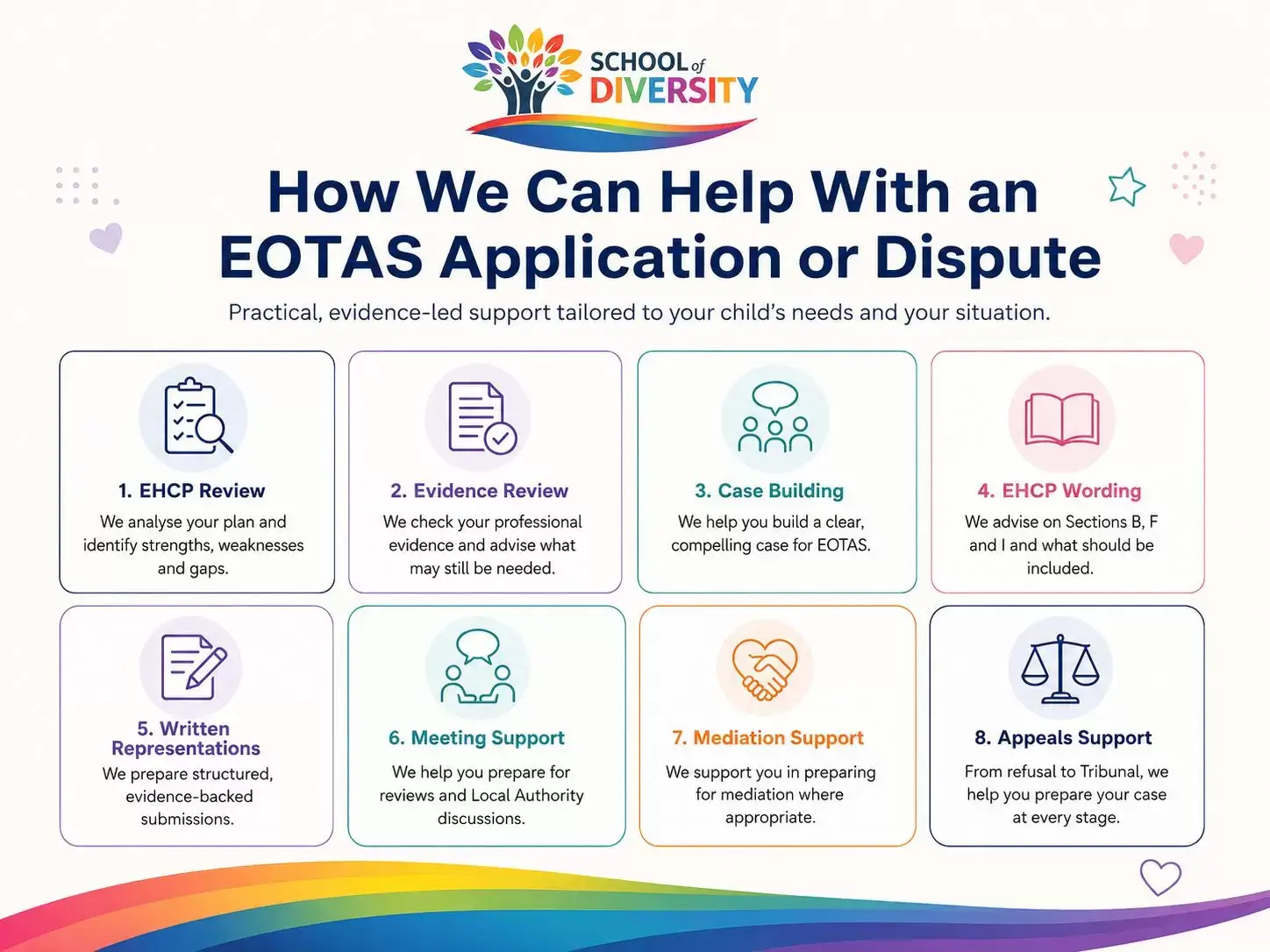
How We Can Help With an EOTAS Application or Dispute
EOTAS cases can involve much more than completing one form or sending one letter.
Our role is to help turn a large amount of information into a clear, evidence-based case.
Depending on the support you choose, this can include:
EHCP Review
We review the relevant sections of your child’s EHCP to identify:
- missing needs;
- outdated information;
- vague provision;
- contradictions;
- unsuitable assumptions about placement;
- provision that does not reflect professional advice;
- areas requiring clarification.
Particular attention will often be given to the relationship between Section B and Section F.
Professional Evidence Review
We examine the reports already available and identify:
- what supports your case;
- what is ambiguous;
- where recommendations are missing;
- where reports contradict one another;
- where additional evidence may be helpful.
More paperwork is not automatically better.
The objective is relevant evidence that clearly establishes your child’s needs and required provision.
EOTAS Case Strategy
We help identify the central argument in the case.
That may include:
- why the current placement is inaccessible;
- why alternatives already attempted have failed;
- which aspects of a school environment create barriers;
- what provision your child requires;
- why proposed school-based alternatives may not overcome those barriers;
- what evidence supports those conclusions.
Parent Representations
Parents often understand their child’s day-to-day difficulties better than anyone but struggle to translate those experiences into concise written evidence.
We can help structure parental representations around:
Need → impact → support attempted → outcome → provision required.
EHCP Wording
A successful EOTAS arrangement still needs an EHCP that clearly reflects the child’s needs and special educational provision.
We can help identify where wording needs to become more:
- specific;
- measurable;
- quantified where appropriate;
- linked to need;
- consistent with professional recommendations.
Evidence Gap Analysis
Sometimes the key issue is not how much evidence you have but what the available evidence does not yet establish.
We can identify questions such as:
- Has a professional considered the impact of the school environment?
- Are sensory needs properly assessed?
- Has emotional or mental-health impact been documented?
- Have previous interventions been evaluated?
- Is there evidence of attendance deterioration?
- Has a professional described what provision is required?
- Is the proposed EOTAS package properly costed and structured?
Local Authority Correspondence
Where included in the agreed package, we can help prepare structured correspondence responding to:
- refusal;
- proposed amendments;
- requests for further evidence;
- unsuitable placement proposals;
- annual-review decisions;
- challenges to existing provision.
Meeting Preparation and Advocacy
We can help parents prepare for relevant meetings by identifying:
- key objectives;
- evidence to reference;
- questions to ask;
- points that should be recorded;
- matters that should not be overlooked.
Where agreed as part of the service, advocacy support may also be available.
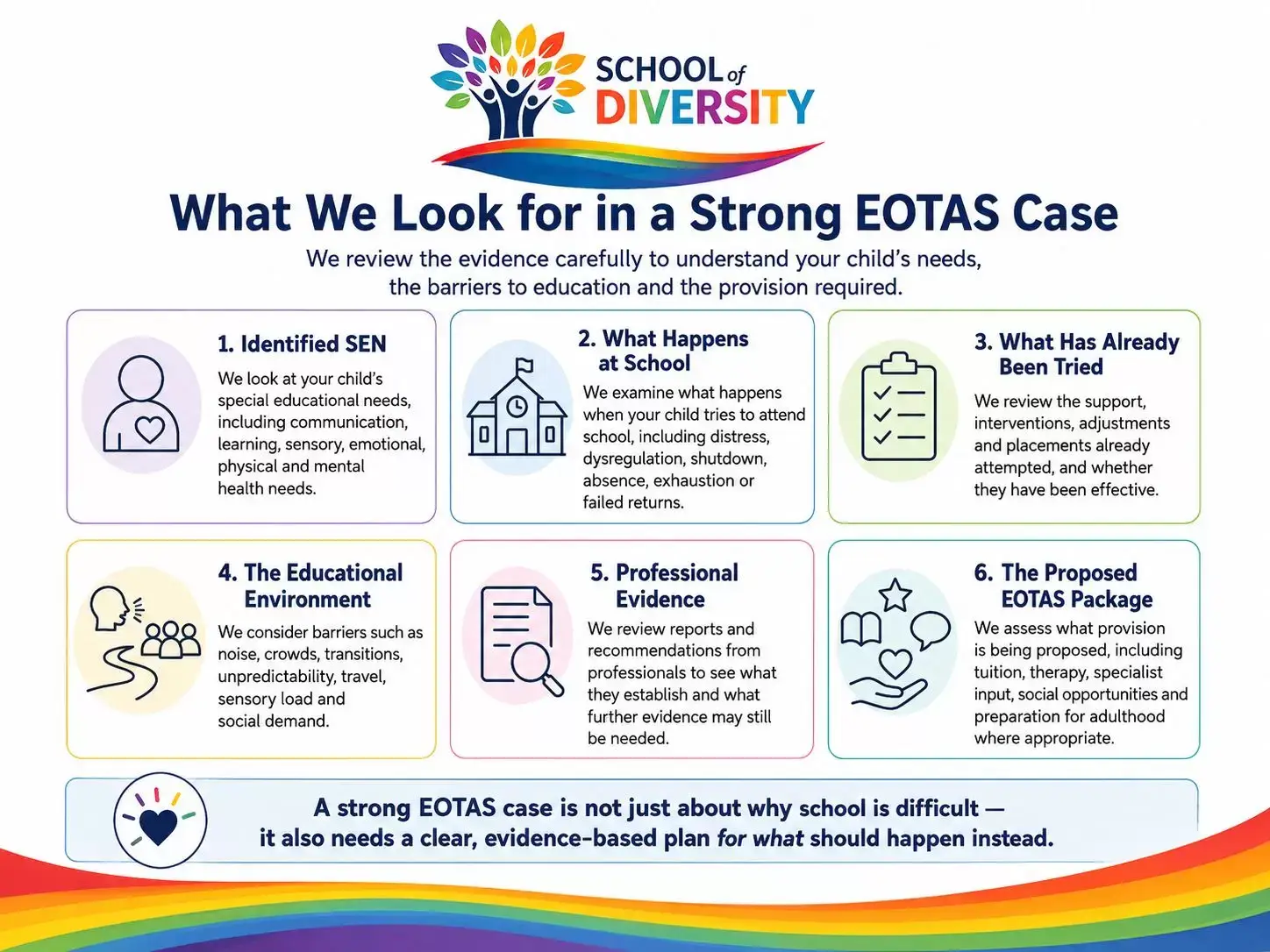
What We Look for in a Strong EOTAS Case
There is no single document that automatically establishes that EOTAS is appropriate.
We look at the case as a whole.
1. Your Child’s Identified Special Educational Needs
The starting point is the child, not the preferred educational arrangement.
The EHCP and evidence should accurately explain needs relating, where relevant, to:
- communication;
- cognition and learning;
- sensory processing;
- emotional regulation;
- executive functioning;
- social interaction;
- anxiety;
- physical needs;
- mental health;
- independence;
- safety.
2. What Happens When Your Child Attempts to Access School
Evidence may include:
- attendance records;
- distress before or after school;
- shutdowns;
- meltdowns;
- reduced engagement;
- self-injurious behaviour;
- physical symptoms of anxiety;
- inability to enter the building;
- exhaustion;
- prolonged recovery;
- repeated failed returns;
- changes in sleep or eating;
- increasing isolation.
The important issue is the educational impact and the support required.
3. What Has Already Been Tried
We consider previous efforts such as:
- SEN Support;
- reasonable adjustments;
- reduced timetables;
- quieter environments;
- key adults;
- modified transitions;
- different teaching arrangements;
- specialist interventions;
- therapeutic support;
- alternative placements;
- phased returns.
What matters is not merely listing the intervention.
The case should explain whether it worked and what happened next.
4. The Impact of the Educational Environment
For some children, difficulties arise not simply from the lesson content but from the cumulative demands of the environment.
This might include:
- noise;
- crowds;
- transitions;
- unpredictability;
- social demand;
- sensory load;
- large groups;
- travel;
- constant changes of staff;
- demand intensity;
- limited recovery time.
Where these factors are central to the case, they should be supported by evidence rather than treated as general preferences.
5. Professional Recommendations
Strong recommendations explain not only that a child is struggling but:
- what the child’s needs are;
- what provision is required;
- how frequently it is required;
- what environment is required;
- why previous arrangements have failed;
- what the likely impact would be if unsuitable arrangements continued.
6. The Proposed EOTAS Package
It is not enough to argue against school.
There also needs to be a credible answer to:
What should education look like instead?
A proposed package may need to consider appropriate:
- academic tuition;
- therapeutic provision;
- communication support;
- occupational therapy;
- mentoring;
- community-based learning;
- physical activity;
- life-skills development;
- social opportunities;
- examination preparation;
- preparation for adulthood;
- specialist teaching.
Every package should respond to the individual child rather than following a standard template.
What Can an EOTAS Package Include?
An EOTAS package should be built around the provision necessary to meet the individual child’s special educational needs.
Depending on the evidence and circumstances, parents may be considering combinations of:
Individual Tuition
Structured teaching appropriate to the child’s ability, needs and current access to learning.
Specialist Teaching
Support for specific learning needs, communication difficulties or other identified SEN.
Occupational Therapy
Where OT provision is identified as special educational provision required to support access to education.
Speech and Language Therapy
Where communication needs require specialist provision.
Therapeutic Input
Where evidence identifies therapeutic provision necessary for educational access and progress.
Community-Based Learning
Appropriate structured activities linked to educational outcomes.
Social Development
Individualised opportunities to develop interaction, communication and confidence without simply reproducing an unsuitable school environment.
Physical Activity
Where relevant to regulation, physical development, wellbeing or EHCP outcomes.
Qualifications and Examination Support
Provision should remain appropriately ambitious and consider the child’s longer-term educational pathway.
Preparing for Adulthood
For older children and young people, EOTAS provision may also need to support:
- independence;
- further education;
- employment;
- community participation;
- communication;
- daily living.
The correct package will depend on the EHCP and evidence.
Why Section F Matters So Much in an EOTAS EHCP
Section F describes the special educational provision required to meet the special educational needs identified in Section B.
For an EOTAS arrangement, vague wording can create significant practical problems.
Compare:
Weak
“Access to therapeutic support.”
with:
Stronger
A properly drafted provision might instead identify:
- the type of therapy;
- who provides it;
- frequency;
- session duration;
- individual or group delivery;
- staff qualifications where relevant;
- review arrangements.
The exact wording must always reflect the evidence in the individual case.
Our EHCP review looks for the gap between what professionals recommend and what the EHCP actually guarantees.
EOTAS Support Before You Reach Tribunal
Tribunal should not automatically be the first step in every disagreement.
Sometimes careful preparation before escalation can materially improve the position.
We can help you:
- identify weaknesses in the Local Authority’s reasoning;
- distinguish emotional arguments from evidential arguments;
- identify missing professional evidence;
- prepare amendments;
- structure an EOTAS proposal;
- prepare for an annual review;
- make focused representations;
- identify which issues genuinely remain disputed.
Even where an appeal later becomes necessary, doing this work early means the case begins from a clearer and more organised position.
EOTAS Support for Mediation and SEND Tribunal Appeals
Sometimes the Local Authority and parent simply do not agree.
This may involve disagreement about:
- whether school-based provision remains appropriate;
- whether EOTAS is necessary;
- the description of needs in Section B;
- the special educational provision in Section F;
- placement;
- professional recommendations;
- the contents of a proposed EOTAS package.
Parents can appeal certain Local Authority decisions concerning an EHC plan to the SEND Tribunal, including decisions concerning Sections B, F and I. The appropriate route depends on the precise decision that has been made.
We can help you examine:
What Exactly Is Being Appealed?
A clear appeal identifies the actual disputed issues rather than trying to challenge everything.
What Evidence Supports Each Requested Change?
We help map evidence to the EHCP amendments being sought.
What Evidence Is Still Missing?
Where appropriate, we identify areas that may need further professional evidence.
What Should Be Prioritised?
Not every disagreement has equal significance.
We help distinguish essential issues from lower-priority wording disputes.
How Should the Case Be Presented?
The objective is a structured case that can be understood by the Local Authority and, where necessary, the Tribunal.
Already Facing an EOTAS Refusal or Appeal?
Deadlines can apply to EHCP appeals.
Already Have EOTAS? We Can Help Protect the Provision
Securing EOTAS is not necessarily the end of the process.
Parents may later experience:
- provision not starting;
- providers withdrawing;
- delays in funding;
- vague Section F wording;
- difficulty coordinating tuition and therapy;
- annual reviews proposing reductions;
- pressure to return to school;
- Local Authority challenges to the existing arrangements;
- changes to provision without adequate evidence.
We can review the EHCP and current arrangements to help identify what is happening and what should be addressed next.
Preparing for an EOTAS Annual Review
An annual review should look carefully at whether the EHCP remains accurate and appropriate.
Before the meeting, we can help you review:
- current Sections B and F;
- progress;
- attendance and engagement;
- professional reports;
- provider reports;
- therapeutic input;
- child or young person’s views;
- parental views;
- changing needs;
- missing provision;
- future outcomes.
Where the existing EOTAS arrangement is working, evidence of progress can be particularly important.
Where it is not working, the review should identify what needs to change.
What You Receive From School of Diversity
We do not simply tell you that an EHCP is “good” or “bad”.
Our work is designed to help you understand:
what the evidence says, what is missing and what needs to happen next.
Depending on the agreed package, your support may include:
- review of the current EHCP;
- review of agreed professional reports;
- identification of strengths and weaknesses;
- evidence-gap analysis;
- needs-to-provision mapping;
- suggested EHCP amendments;
- structured written recommendations;
- parent representations;
- EOTAS proposal development;
- Local Authority correspondence;
- meeting preparation;
- mediation preparation;
- Tribunal preparation;
- ongoing advocacy where agreed.
Before work begins, we confirm the scope, documents required and fee.
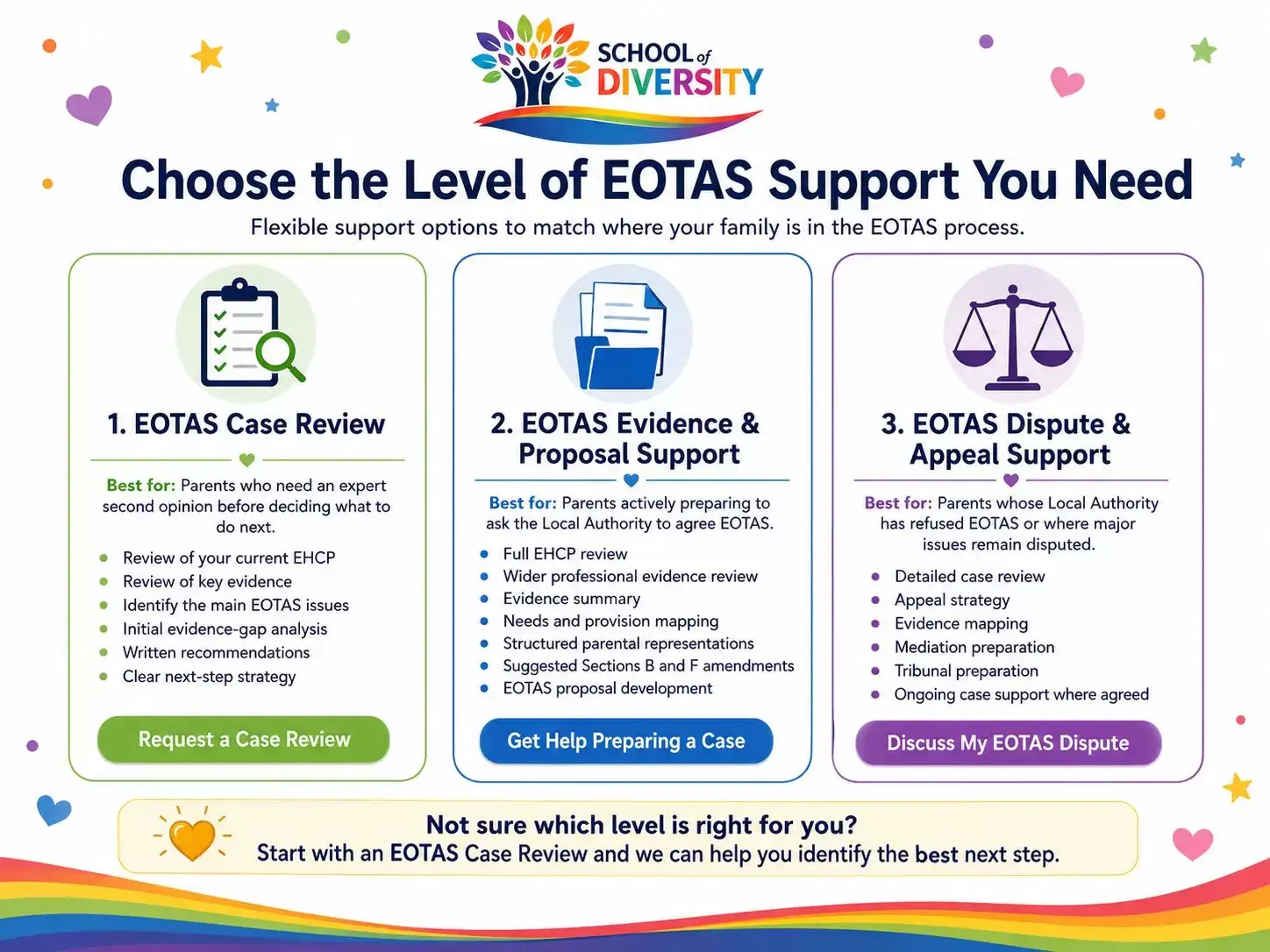
Choose the Level of EOTAS Support You Need
EOTAS Case Review
Best for:
Parents who need an expert second opinion before deciding what to do next.
Includes
- Review of your current EHCP
- Review of selected key evidence
- Identification of the main EOTAS issues
- Initial evidence-gap analysis
- Written recommendations
- Clear next-step strategy
- Consultation to discuss findings
Price: £195
EOTAS Evidence & Proposal Support
Best for:
Parents actively preparing to ask the Local Authority to agree EOTAS.
May Include
- Full relevant EHCP review
- Wider professional evidence review
- Evidence summary
- Evidence-gap analysis
- Needs and provision mapping
- Structured parental representations
- Development of the proposed EOTAS package
- Suggested amendments to Sections B and F
- Preparation for Local Authority discussions
- Follow-up consultation
Price: from £450
From £[confirmed amount], depending on document volume and scope.
EOTAS Dispute & Appeal Support
Best for:
Parents whose Local Authority has refused EOTAS or where substantial EHCP issues remain disputed.
May Include
- Detailed case review
- Appeal strategy
- Evidence mapping
- EHCP amendments
- Mediation preparation
- Working-document support where relevant
- Tribunal evidence preparation
- Hearing preparation
- Ongoing case support as agreed
Price: From £950
Quoted according to the stage, complexity and work required.
Why Parents Choose School of Diversity for EOTAS Support
Parents comparing professional SEND support should ask more than:
“Does this person know what EOTAS means?”
The important question is what they will actually do with your child’s evidence.
SEND-Focused Support
Our work focuses on children and young people with additional needs and the education systems surrounding them.
Detailed EHCP Analysis
We look closely at the relationship between:
identified need → professional evidence → required provision → EHCP wording.
Evidence Before Assertion
A strong case should not rely on repeatedly saying that a child “needs EOTAS”.
It should demonstrate why.
We focus on building that evidential connection.
Understanding of Neurodivergent Presentation
Our wider work includes autism, ADHD and psychological assessment services.
This helps us recognise issues including:
- masking;
- sensory overload;
- autistic burnout;
- executive-function difficulties;
- demand avoidance;
- communication differences;
- anxiety;
- emotional regulation;
- differences between presentation at home and school.
Parent-Friendly Communication
SEND law and EHCP processes can become extremely technical.
We explain what matters in clear language while keeping the case focused on the evidence.
Flexible Support
Some parents only need a professional review.
Others need ongoing help through Local Authority negotiations, mediation or Tribunal preparation.
You can choose the level of support appropriate to your case.
Support Across England
Our document review, consultations and case preparation can be provided remotely to families across England.
What to Ask When Comparing EOTAS Support Providers
Before choosing an advocate or consultant, ask:
- Will they actually review the professional evidence?
- How many reports are included in the quoted fee?
- Will they review the full EHCP?
- Will they suggest specific amendments?
- Will you receive written recommendations?
- Can they help build the proposed EOTAS package?
- Can they support you if the Local Authority refuses?
- Is mediation support available?
- Is Tribunal preparation available?
- Are additional document-review fees clearly explained?
- Will you know exactly what is included before paying?
Our Approach
Before beginning substantive work, we agree the scope of the service so you know what documents will be reviewed and what outputs you will receive.
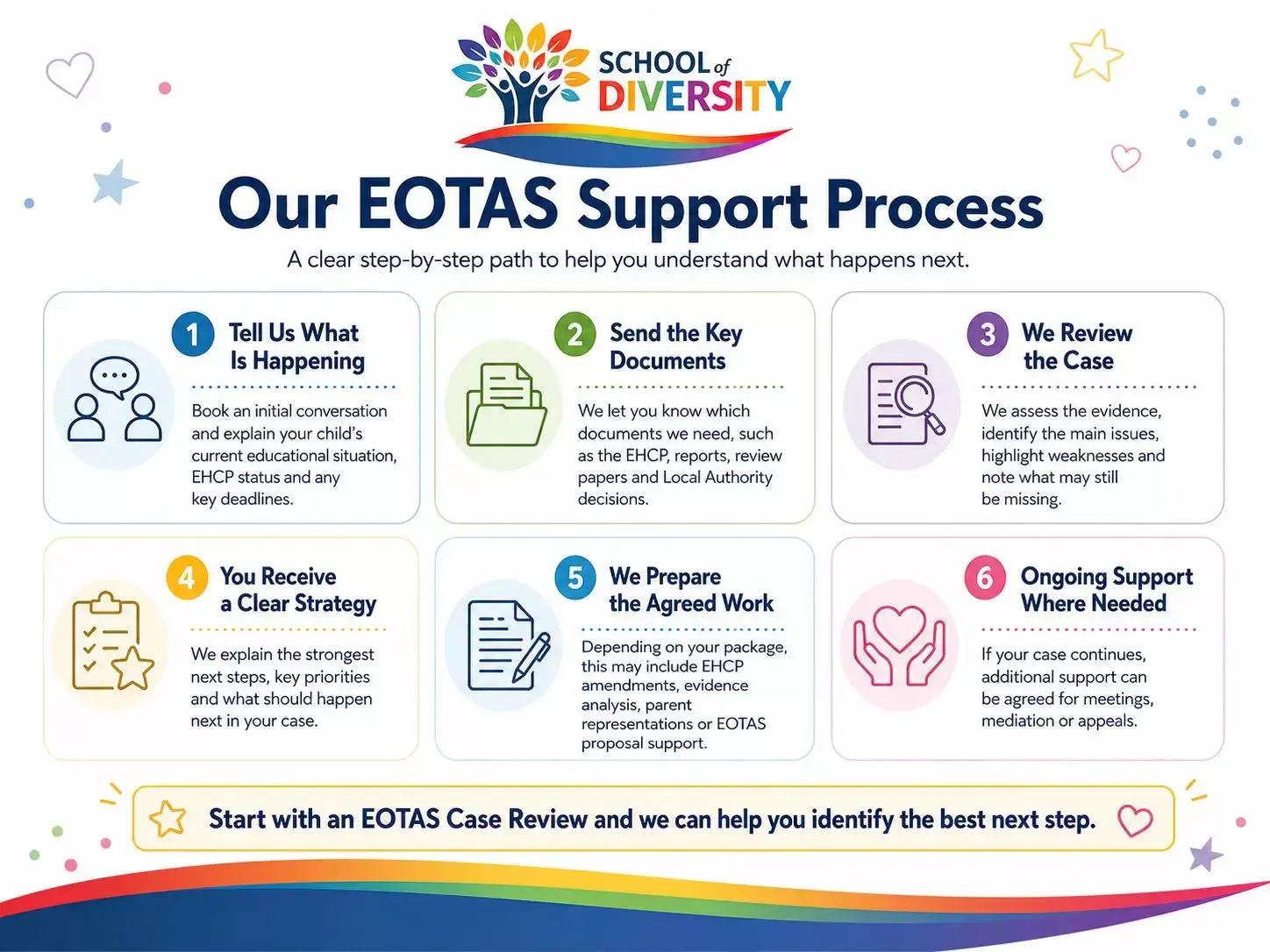
Current EOTAS Law and the 2026 SEND Reforms
Last reviewed: August 2026
EOTAS is currently provided within the existing statutory SEND framework.
The government opened a specific consultation on EOTAS in July 2026 as part of wider SEND reform proposals.
The consultation is considering areas including:
- how EOTAS should operate;
- responsibilities for provision;
- quality assurance;
- outcomes;
- accountability;
- support for children unable to attend school;
- online provision.
The Department for Education has expressly stated that no decisions have yet been made.
For that reason, parents should be cautious about online claims suggesting that EOTAS has already been abolished or that the current legal test has already changed.
We will keep this page reviewed as the reforms develop.
Frequently Asked Questions About EOTAS Support
Does My Child Need an EHCP for EOTAS?
Section 61 EOTAS sits within the statutory SEND framework and is ordinarily considered through an EHC plan.
If your child does not currently have an EHCP, the first issue may therefore be whether an EHC needs assessment should be requested.
Does My Child Need an Autism or ADHD Diagnosis?
The central issue is your child’s special educational needs and the provision required to meet those needs.
A diagnostic report can provide useful evidence, but the analysis should focus on actual educational needs and barriers rather than a diagnostic label alone.
Can EOTAS Be Used for an Autistic Child Experiencing Burnout?
Potentially, but autism or burnout does not automatically establish entitlement to EOTAS.
The evidence would need to address your child’s individual needs, educational access, the impact of the environment and why provision within an educational institution would be inappropriate.
Is EOTAS Just Online School?
No.
An individual EOTAS package can potentially involve different forms of provision depending on need.
It should not automatically be reduced to an online-learning subscription.
Can EOTAS Include Therapy?
Potentially.
Where therapeutic input educates or trains a child or young person and constitutes special educational provision, it may be relevant to Section F.
The correct provision depends on the individual evidence.
Can the Local Authority Refuse EOTAS?
Yes.
The Local Authority may disagree that the statutory test is met or may argue that appropriate provision can be delivered within an educational institution.
That is why the evidence behind the request is so important.
What If the Local Authority Says There Is Another School Available?
The existence of another school does not end the analysis.
The relevant question is whether suitable special educational provision can appropriately be made in an educational institution for the individual child.
The proposed setting, provision and the child’s needs should therefore be considered carefully.
Can I Appeal If the Local Authority Refuses to Change the EHCP?
Parents and young people can appeal certain Local Authority decisions concerning EHC plans, including decisions involving Sections B, F and I. The precise appeal route depends on the decision made.
If you have received a final decision, act promptly because appeal deadlines can apply.
Do I Have to Use a Solicitor for an EOTAS Case?
No.
Parents can navigate EHCP processes and SEND Tribunal appeals themselves and can choose different forms of professional support.
Some families use a solicitor; others use SEND advocates or consultants; others represent themselves with targeted document and strategy support.
We can explain what our service includes so you can decide what level of support is appropriate.
Can You Guarantee That We Will Secure EOTAS?
No reputable professional should guarantee the outcome of an EOTAS request or SEND Tribunal appeal.
Decisions are made by the Local Authority or Tribunal based on the circumstances and evidence.
Our role is to help ensure that your case is clear, properly evidenced, strategically prepared and accurately presented.
Can You Help If We Already Have EOTAS?
Yes.
We can help review:
- existing provision;
- EHCP wording;
- annual-review proposals;
- reductions in provision;
- missing provision;
- evidence for continuing need;
- Local Authority concerns or proposed changes.
Do You Work With Families Outside Shropshire?
Yes.
Our EOTAS document review, consultations and case-preparation services can support families across England remotely.
Your Child's Education Should Be Built Around Their Identified Needs
If school is no longer working, you may already have spent months trying adjustments, attending meetings, gathering reports and explaining the same concerns repeatedly.
You do not need to work out the entire EOTAS process before asking for professional support.
We can review where your case stands now, help you understand what the evidence says and identify the strongest next step.