
ADHD assessment • Understanding your options
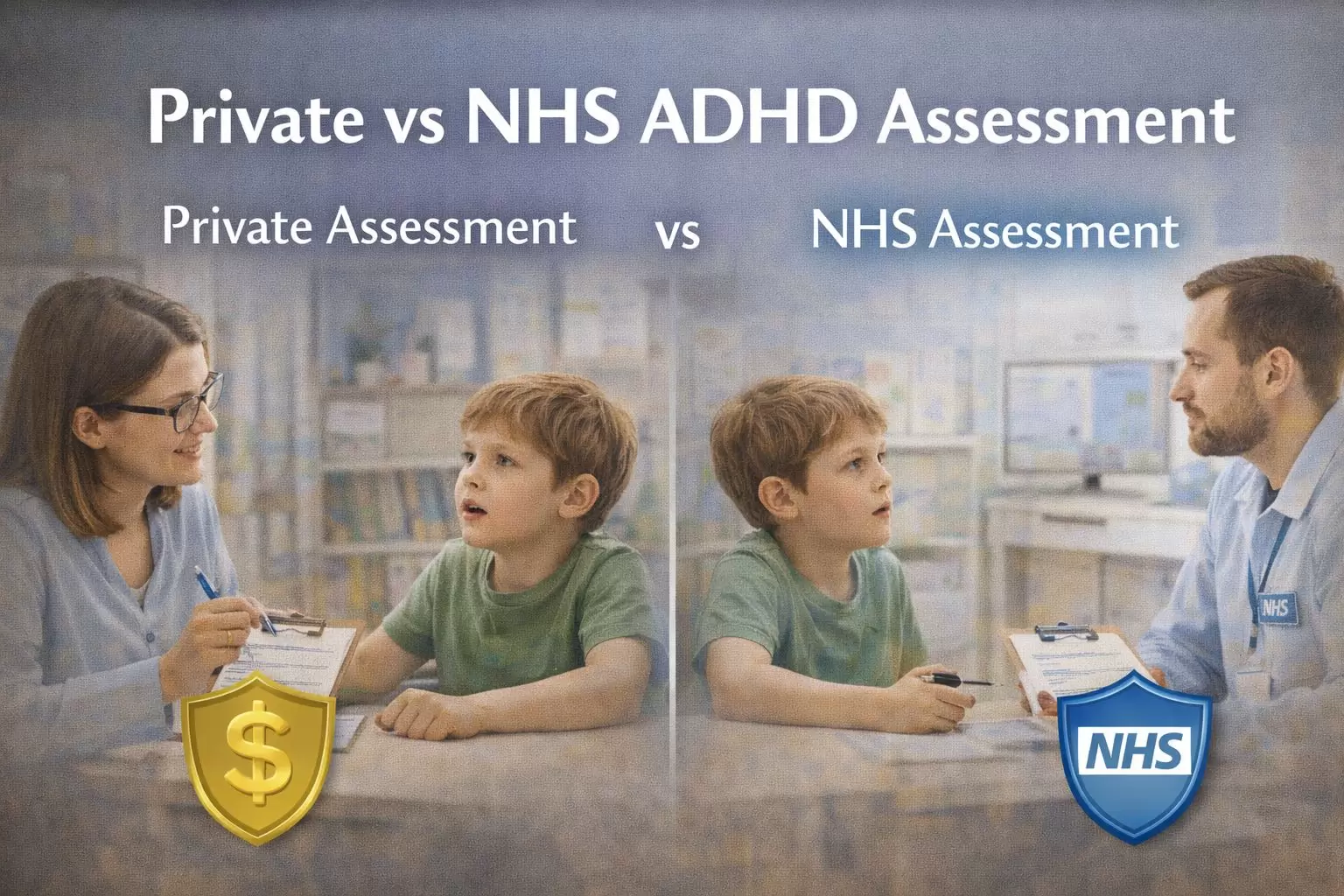
Private vs NHS ADHD assessment
Compare access, costs and follow-up care so you can make an informed decision for your child.
Look beyond the first available appointment. The assessment approach and support afterwards matter too.
Start with your child’s needs
Which pathway is right for your family?
Consider suitability, availability, affordability and what will happen after the assessment.
NHS assessments are free at the point of use. Self-funded private assessments involve fees. Private appointments may be available sooner, but check current availability rather than assuming either route has a fixed waiting time.
At a glance
NHS-funded and self-funded assessment
Use this comparison to guide questions to individual services.
| Consideration | NHS-funded pathway | Self-funded private pathway |
|---|---|---|
| Access | Ask your GP or local service about referral criteria and arrangements. | Direct enquiries may be accepted; check referral requirements. |
| Cost | Assessment is free at the point of use. | Ask for an itemised fee and any additional charges. |
| Waiting time | Varies by area, provider and service capacity. | May be shorter; confirm the full timescale through to feedback and report. |
| Assessment | Ask how developmental history, family and school information are gathered. | Ask the same questions about methods, clinical expertise and suitability. |
| Follow-up | Clarify the treatment and review pathway and any further waits. | Check what is included, who provides ongoing care and continuing fees. |
Before you commit
Ask the same core questions of every provider
Clinical suitability
- Who will assess my child, and what are their qualifications and professional registration?
- What ADHD assessment training and experience do they have with children?
- How are other possible explanations and additional needs considered?
- What adjustments can you offer for my child?
Process and practicalities
- How are my child’s views, developmental history and school information included?
- How many appointments are expected?
- When will we receive feedback and a written report?
- What happens if further information is needed or ADHD is not diagnosed?
For self-funded care, request a full cost breakdown
Check assessment and report fees, extra appointments, follow-up reviews and cancellation terms. If medication is relevant, ask separately about specialist appointments, monitoring, prescription charges and medicine costs. A headline assessment fee may not cover these.
Think beyond diagnosis
Check how ongoing care will work
A diagnostic report and a treatment pathway are different parts of care. Clarify both before choosing a service.
Medication and monitoring
If medication is being considered, ask who can start treatment, review its effect and provide ongoing monitoring. Not every assessment provider offers prescribing.
Check how care continues if a clinician leaves or your child’s needs change.
GP and NHS arrangements
A private diagnosis does not automatically transfer treatment to the NHS. Ask the relevant NHS service and your GP about their arrangements before relying on a transfer.
GP prescribing under shared care requires agreement; it is not guaranteed.
Support alongside assessment
Keep the conversation with school moving
Share relevant findings and discuss how recommendations relate to your child’s everyday needs. Ask what support will be tried, who will provide it and when it will be reviewed.
School support can be discussed before a diagnosis. A report can contribute evidence, but neither an NHS nor a private diagnosis automatically leads to an EHCP in England. Education systems differ across the UK.
Diagnosis and school
Turn assessment findings into a practical discussion.
ADHD and school support →EHCP for ADHD
Explore when more detailed assessment and provision may be needed.
Read the EHCP guide →Understanding provision
Learn about the support an EHCP can set out.
What support does an EHCP provide? →Common questions
Making an informed choice
Is a private assessment better than an NHS assessment?
Funding alone does not tell you whether an assessment is suitable or thorough. Compare clinical expertise, assessment methods, accessibility and follow-up arrangements.
Are private assessments always faster?
No. Availability varies. Ask about the time to the first appointment, completion, feedback and report, as well as any wait for treatment.
Will school accept a private diagnosis?
Share the report and ask how its findings will inform support. If there are concerns about recommendations, ask school to explain them and agree how needs will be addressed. A report does not automatically determine particular provision.
Will my GP prescribe after a private assessment?
Do not assume this. Discuss the proposed care pathway with the provider and GP before booking if prescribing is important to your decision. Shared care requires agreement.
Is Right to Choose the same as paying privately?
No. An eligible referral under NHS Right to Choose in England is NHS-funded, even when the provider also offers private services. Confirm that the referral is on the NHS-funded pathway and what services it includes.
What if we cannot afford private assessment?
Ask about the NHS referral route and support available while waiting. Continue discussing practical help with school; paying for an assessment is not a prerequisite for raising your child’s needs.
Further information: NHS ADHD guidance, including assessment and prescribing and NICE ADHD guidance. Check current arrangements directly with the services involved.
Related guidance
Continue exploring assessment options
School of Diversity
Need help understanding your options?
Contact us to ask about assessment options or support with your child’s educational needs.