
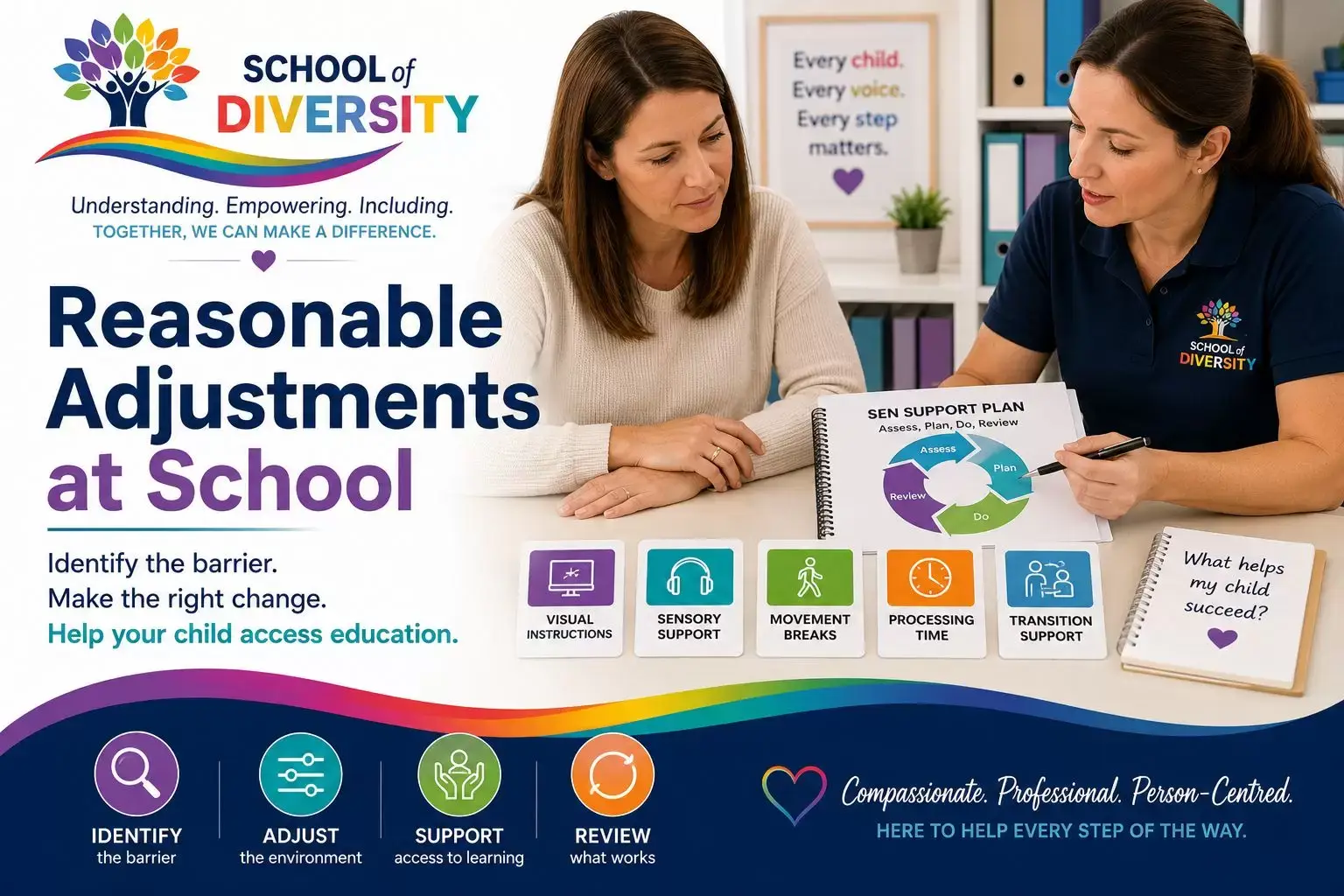
Reduce the barriers. Make school more accessible.
Practical changes to help your child access learning, routines and everyday school life.
Sometimes a child needs a change to instructions, the sensory environment or the way the school day works. Start with the barrier your child experiences, then explore what could reduce it.
Parent guidance for England · Individual needs, practical changes and clear review arrangements.
What are reasonable adjustments?
Changes to school arrangements, or relevant aids and services, that help reduce disadvantage for a disabled pupil.
Start with the individual barrier
Look at what makes learning or participation difficult: instructions, noise, pace, transitions, homework, communication, social demands or classroom routines.
Ask: “What is happening for this child, and what change could help?”
Understand the duty
Under the Equality Act 2010, schools must make reasonable adjustments where disabled pupils would otherwise experience a substantial disadvantage.
A diagnosis, SEN Support status or an EHCP is not itself the deciding factor. The disability definition and disadvantage matter; not every requested change will be reasonable in every situation.
Physical access has a separate framework. Schools’ reasonable-adjustment duty does not require alterations to physical features such as installing ramps. Schools also have accessibility-planning duties. Changes to classroom layout and seating can still be useful practical discussion points.
Read the GOV.UK education rights guidance for the wider context.
Adjustments and interventions can work together.
An intervention provides targeted teaching or support. An adjustment changes how a child accesses ordinary activities or arrangements. There can be overlap, and both may be needed.
Targeted intervention
A literacy programme, targeted maths teaching, speech and language work or emotional-regulation support.
Access adjustment
Written instructions, a visual task list, less copying, sensory changes, processing time or a predictable transition routine.
| Barrier | Possible adjustment | What to review |
|---|---|---|
| Long verbal instructions are hard to retain. | Smaller steps with written or visual reinforcement. | Does your child understand and begin tasks more easily? |
| A busy classroom becomes overwhelming. | Reduced distractions, adapted seating and agreed quieter working options. | Is distress reduced while participation is maintained? |
| Planning and organising work is difficult. | A visual checklist, task chunking and prompts. | Can your child start and complete tasks with appropriate support? |
What could change during the school day?
These are discussion points, not an automatic entitlement to every item. Choose changes that address your child’s barriers and review their impact.
Communication and processing
- Shorter instructions, one step at a time
- Written instructions, symbols, visual prompts and timetables
- Time to process information before responding
- Checking understanding without putting the child on the spot
- Pre-teaching vocabulary and using clear language
- Appropriate alternative communication methods
Attention, planning and organisation
- Clear task structure and work broken into smaller steps
- Visual task lists, timers and organisational checklists
- Reduced distractions and individually suitable seating
- Equipment reminders and task-start prompts
- Discreet check-ins and help prioritising tasks
- Movement opportunities and time for transitions
Sensory needs and the classroom environment
- Quieter seating and reduced visual clutter
- Suitable noise-reduction options or adjusted lighting where practicable
- Agreed access to a quieter area
- Reduced exposure to crowded spaces and staggered transitions
- Appropriate sensory tools and planned regulation opportunities
- Predictable routines and advance warning of changes
The aim is to reduce barriers while supporting participation, rather than unnecessarily isolating your child.
Recording work and accessing lesson materials
- Reduced copying from the board
- Printed notes or lesson materials
- Alternative recording methods
- A laptop or suitable assistive technology
- An adjusted written workload where appropriate
- Clear starts, finishes and expectations
Movement and emotional regulation
- Planned movement or regulation breaks
- Classroom jobs involving movement
- Standing options or suitable flexible seating
- An agreed regulation area and trusted-adult support
- Discreet sensory tools and prompts
- Calm, private feedback rather than unnecessary public correction
Plan how the child can access and return from breaks so support is predictable.
Transitions between lessons or settings
- Advance warnings, countdowns and visual schedules
- Agreed ways to avoid the busiest corridors
- Support from a familiar adult
- Preparation for staff or timetable changes
- Familiarisation visits before major transitions
- Clear transition plans between lessons or schools
Homework
- Written instructions and clear expectations
- Adjusted quantity or an agreed time limit
- Extended deadlines or alternative formats
- Flexibility after unusually demanding school days
- Reviewing responses to incomplete work where disability-related barriers are relevant
The aim is to make learning expectations accessible, rather than automatically removing them.
Assessments and examinations
Depending on the assessment and individual needs, options may include rest breaks, additional time, a smaller room, a word processor, a reader, a scribe, modified papers or assistive technology.
Formal exam access arrangements follow specific rules. Ask the SENCo or exams officer about the relevant evidence, normal way of working, approval process and deadlines. A diagnosis or a classroom adjustment does not automatically qualify a pupil for a particular exam arrangement.
Read government exam guidance →Break times and lunch times
- A quieter space or structured activities
- Trusted-adult or social support
- Agreed early access to lunch or reduced queueing
- A way to leave an overwhelming situation safely
- Predictable routines during unstructured time
Use the diagnosis as information, not a fixed list.
Children with the same diagnosis may experience very different barriers. Discuss what is helpful for your child.
ADHD
Task chunking, movement, reduced distractions, written reminders, start prompts and organisational scaffolding may help.
Autism
Predictable routines, clear language, visual schedules, sensory changes and transition support may help.
Dyslexia
Less copying, printed notes, accessible formatting, audio support, spelling tools and alternative recording may help. Overlays should be considered only where individually useful.
Anxiety and regulation
A named adult, calm entry, private feedback, planned breaks, predictable changes and flexible participation may help.
Start with the barrier. Agree a change. Check the impact.
Bring parent observations, your child’s views, school information and relevant professional recommendations together.
Describe what happens
When does the difficulty occur? What makes it worse? What helps? How does it affect learning or participation?
Discuss a practical change
Explain how the proposed adjustment addresses the barrier. Ask school what it can implement and whether an alternative would work better.
Agree delivery and review
Record the change, who will arrange it, when it will be used and how you will assess whether it helps.
Example: overwhelmed during whole-class teaching
Explore noise, pace, language load and visual clutter. Possible changes could include adapted seating, fewer distractions, visual support, written instructions and processing time.
Agree which changes will be tried and how engagement, distress and independence will be reviewed.
Record it clearly and make sure staff know.
Important adjustments should be easy for the relevant staff to find and use consistently.
Where to record adjustments
A SEN Support plan, pupil passport, one-page profile, adjustment plan, medical plan, pastoral plan or APDR record may be appropriate.
Use clear wording about when and how the adjustment applies, rather than simply “support as needed”.
Questions about implementation
- How will teachers and support staff be informed?
- Who checks consistent delivery?
- What happens with a supply teacher?
- How can my child access the adjustment?
- What should we do if it is not being used?
Keep the discussion focused on reducing the disadvantage.
If school says it is not possible
Ask which barrier has been recognised, why the requested change is not considered reasonable and what alternative is proposed.
Request an explanation of how the alternative would address the disadvantage and agree a review point.
If the adjustment is not working
Check whether it was actually used, how consistently and what evidence shows its impact.
It may need modifying, a different barrier may need exploring, or additional provision and professional advice may be required.
Adjustments may be one part of the response. Continuing difficulties may call for targeted interventions, specialist assessment, stronger SEN Support or consideration of an EHC needs assessment.
When SEN Support is not working →Prepare for a SENCo meeting →
Identify the questions and changes worth discussing.
We can review agreed school information, support plans, professional reports, parent observations, attendance information and existing adjustments.
SEND Review & Action Plan
£195
A written review of agreed evidence, current provision and adjustments, potential gaps and practical next-step recommendations.
- Identify the barriers described in the evidence
- Consider relevant professional recommendations
- Highlight possible adjustments and areas to clarify
- Prepare questions and next steps for school
SENCo Meeting Support
Prepare the priorities, questions and outcomes for a discussion about adjustments.
Continued support, including agreed online meeting attendance and follow-up, can be discussed through Supported SEND Casework.
Supported casework from £425. Scope, availability and the final fee are confirmed before work begins.
Explore meeting supportReasonable adjustments: your questions answered.
Does my child need a diagnosis?
Not necessarily. The duty depends on disability under the Equality Act and substantial disadvantage, rather than a particular diagnostic label. Explain the difficulties, impact and available evidence to school.
Are adjustments only for children receiving SEN Support?
No. A disabled pupil may need adjustments whether or not they are on the SEN register or have an EHCP. SEN and disability overlap, but they are not identical.
Can I suggest specific adjustments?
Yes. Explain the barrier and why the proposed change could help. The school should consider what is reasonable in the circumstances, including effective alternatives.
Should adjustments be written down?
Clear recording is good practice, particularly when several staff need to deliver an adjustment consistently. Ask where it will be recorded and how implementation will be checked.
What if something helps at home but school refuses it?
Discuss whether the same barrier occurs in school, how the proposed adjustment could help and what alternative school suggests. A home strategy may need adapting to the classroom context.
Can attendance arrangements be adjusted?
Changes to arrival routines, transitions or the environment may help address disability-related barriers. Attendance planning needs individual consideration. A reduced timetable is not an automatic adjustment or a substitute for suitable provision.
Explore attendance support →What if adjustments are not working?
Check delivery and consistency first, then review whether the change addresses the right barrier. Further assessment or additional provision may be needed.
Further reading: GOV.UK: disability rights in education and EHRC guidance on reasonable adjustments for disabled pupils.
Not sure what to ask school to change?
We can help you make sense of the evidence, identify barriers and prepare a focused discussion.
Tell us what is difficult.
Explain when your child struggles, what school currently provides and what has already been tried. Include any approaching meeting date.
office@schoolofdiversity.com
0333 577 1179