
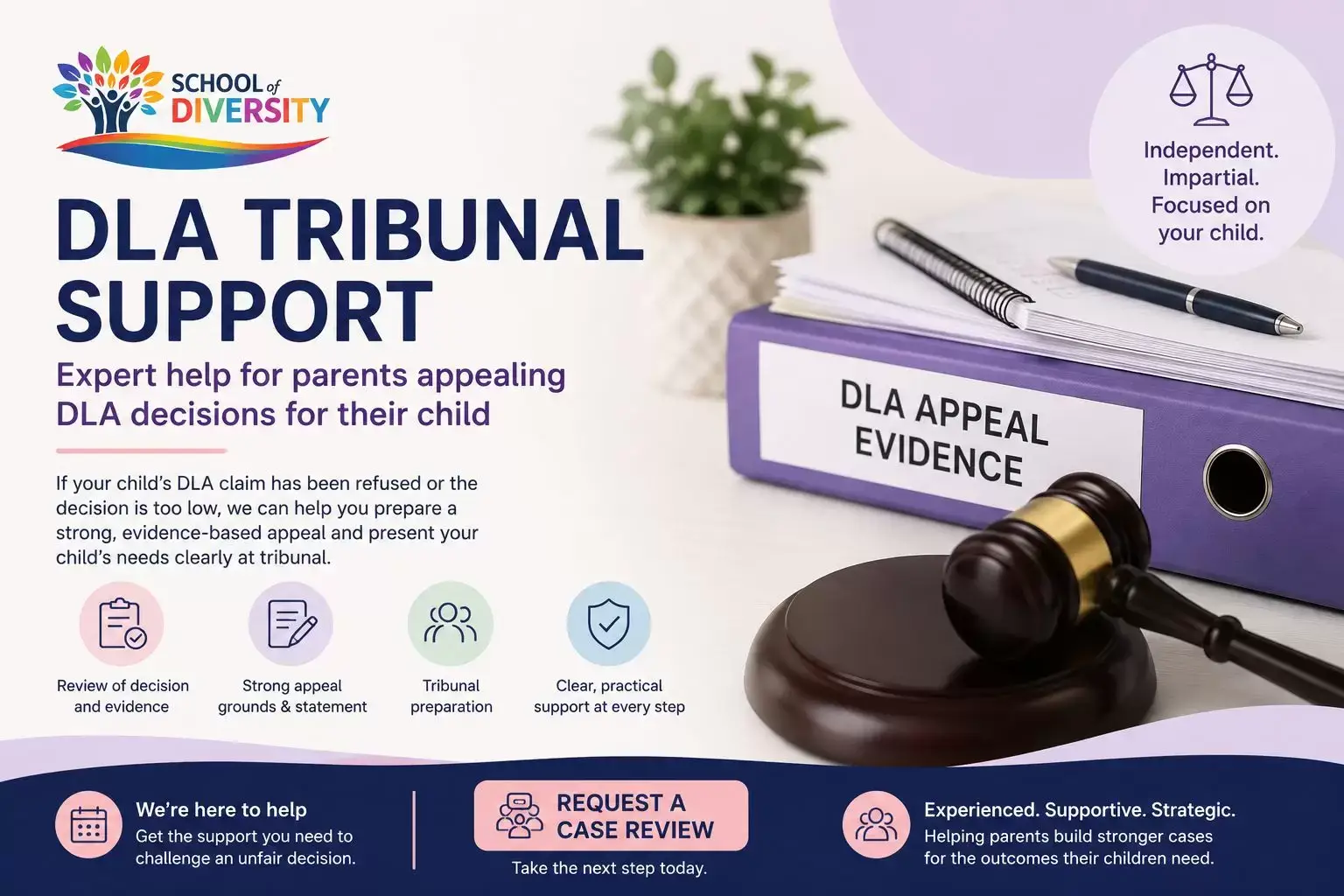
DLA Tribunal Support for Parents
Appealing a Disability Living Allowance (DLA) decision can feel daunting, particularly when you are already managing your child’s additional care, supervision and mobility needs.
If your child’s DLA decision has not been changed following Mandatory Reconsideration, you may be able to appeal to the Social Security and Child Support Tribunal.
At School of Diversity, we provide practical DLA tribunal support for parents who need help understanding the decision, preparing their appeal case, organising evidence and presenting their child’s needs clearly.
Our support is designed to help you identify exactly what is being disputed, what evidence matters and how to explain why the DWP decision should be changed.
When Parents Come to Us for DLA Appeal Support
Parents often contact us after receiving a Mandatory Reconsideration Notice confirming that the original DLA decision has been maintained.
You may need support if:
- your child’s DLA claim has been refused;
- your child has received a lower rate than you believe reflects their needs;
- the care component has been awarded but the mobility component has been refused;
- the mobility component has been awarded at a lower rate;
- important evidence appears to have been overlooked;
- the decision does not accurately reflect your child’s everyday support needs;
- the DWP has misunderstood the level of supervision required;
- the decision appears to focus heavily on diagnosis rather than functional needs;
- or you are unsure how to prepare for a tribunal hearing.
If you have not yet completed Mandatory Reconsideration, visit our DLA Mandatory Reconsideration Support page first.
What Is a DLA Tribunal Appeal?
A DLA tribunal appeal asks an independent tribunal to consider whether the decision made about your child’s Disability Living Allowance was correct.
The tribunal is separate from the DWP.
The panel will consider the evidence relevant to your child’s needs and the decision under appeal.
Depending on the circumstances, the appeal may concern:
- whether your child qualifies for the care component;
- which rate of care should apply;
- whether your child qualifies for the mobility component;
- which rate of mobility should apply;
- or more than one part of the award.
The focus should remain on your child’s additional care, attention, supervision, guidance and mobility needs.
Our DLA Tribunal Support
Our tribunal support is designed to help parents prepare a clearer, more organised and evidence-based appeal.
Depending on the circumstances of the case, support can include:
- reviewing the original DLA application;
- reviewing the DWP decision;
- reviewing the Mandatory Reconsideration Notice;
- identifying the parts of the decision being challenged;
- identifying weaknesses or gaps in the original claim;
- reviewing existing supporting evidence;
- identifying additional evidence that may strengthen the appeal;
- preparing structured appeal grounds;
- preparing a parent statement;
- organising the evidence;
- preparing an evidence index;
- preparing a chronology where appropriate;
- identifying the strongest care and mobility arguments;
- helping parents prepare for questions that may arise at the hearing;
- and helping parents present the child’s needs clearly and consistently.
Understanding What the Tribunal Needs to Know
A tribunal does not simply need to know your child’s diagnosis.
It needs to understand the practical consequences of your child’s needs.
This may include the additional support your child requires with:
- personal care;
- toileting;
- dressing;
- eating and drinking;
- communication;
- understanding;
- medication;
- emotional regulation;
- behaviour;
- safety;
- danger awareness;
- supervision;
- transitions;
- night-time needs;
- walking;
- and guidance or supervision outdoors.
The strongest appeal cases usually explain these needs using specific examples rather than broad descriptions.
For example, rather than saying:
“My child needs constant supervision.”
it is more useful to explain:
- why supervision is needed;
- how close the adult must remain;
- how frequently intervention is required;
- what risks arise without supervision;
- and how this differs from what would normally be expected for another child of the same age.
For more information about explaining these needs, see our guide to the DLA Care and Mobility Sections.
Reviewing the Original DLA Decision
efore preparing an appeal, it is important to understand why the decision was made.
A refusal or lower award may result from issues such as:
- insufficient detail in the original form;
- needs being described too generally;
- limited supporting evidence;
- the frequency of care needs being unclear;
- night-time needs not being explained sufficiently;
- supervision being underestimated;
- difficulties being attributed to normal childhood behaviour;
- mobility needs being misunderstood;
- or professional reports not being linked clearly to the DLA criteria.
Our first task is therefore usually to compare:
what the parent said, what the evidence says, and what the DWP appears to have concluded.
That helps identify the areas that need to be addressed more directly in the appeal.
You can also read our guide to Common Reasons DLA Claims Are Refused and How to Appeal.
Building Stronger DLA Appeal Evidence
Evidence should support the issues being challenged.
Potential evidence may include:
- diagnostic assessments;
- paediatric reports;
- GP correspondence;
- occupational therapy reports;
- speech and language therapy reports;
- school and SENCO evidence;
- support plans;
- behaviour records;
- risk assessments;
- continence evidence;
- sleep records;
- care diaries;
- mobility evidence;
- and parent supporting statements.
The aim is not to submit as much paperwork as possible.
The aim is to identify the evidence that demonstrates the additional level of support your child requires.
For more guidance, visit our DLA Evidence & Supporting Statements page.
Preparing a Parent Statement for the Tribunal
A parent statement can be a particularly important part of a DLA appeal.
It gives you an opportunity to explain your child’s needs in a structured way and connect those needs to the decision being challenged.
A strong statement may cover:
Your Child’s Background
A brief explanation of relevant diagnoses, difficulties and current support.
Daytime Care Needs
What help, prompting and supervision your child requires throughout the day.
Night-Time Needs
How often your child wakes, what intervention is required and how long that support takes.
Safety and Supervision
Why additional adult supervision is necessary and what could happen without it.
Mobility
Any physical walking difficulties or need for guidance and supervision outdoors.
Why You Disagree With the Decision
A clear explanation of the parts of the DWP decision you believe do not reflect your child’s actual needs.
A statement should be specific, factual and consistent with the evidence.
Preparing for a DLA Tribunal Hearing
Many parents feel anxious about attending a tribunal.
Preparation can make the process more manageable.
We can help you understand:
- what documents to have available;
- the main issues likely to be discussed;
- how to explain your child’s typical needs;
- how to answer questions clearly;
- how to distinguish between good days and more difficult days;
- how to explain fluctuating needs;
- how to discuss support you provide automatically;
- and how to avoid unintentionally minimising your child’s needs.
Parents often underestimate what they do because routines have become normal.
Preparing beforehand can help identify those hidden forms of care and supervision.
DLA Appeals for Autism and ADHD
Appeals involving autism or ADHD can require particularly careful explanation.
A child may not require substantial physical assistance but may still require significantly more:
- prompting;
- supervision;
- reassurance;
- redirection;
- emotional regulation support;
- monitoring;
- structure;
- preparation;
- and guidance
than another child of the same age.
Relevant difficulties may include:
- impulsivity;
- poor danger awareness;
- executive-functioning difficulties;
- emotional dysregulation;
- sensory needs;
- masking;
- anxiety;
- sleep difficulties;
- toileting;
- communication;
- and difficulties navigating the community safely.
Our guide to Common DLA Claim Mistakes for Children With ADHD or Autism explains some of these issues in more detail.
Why Use Professional DLA Tribunal Support?
A tribunal appeal involves more than simply saying that the DWP decision is wrong.
A stronger case identifies:
- what part of the decision is being challenged;
- what the evidence shows;
- what the child actually needs;
- how those needs compare with another child of the same age;
- and why the original decision does not accurately reflect those needs.
Professional support can help make the appeal more focused and easier for the tribunal to follow.
DLA Tribunal Support Fees
Our Supported DLA Appeal Casework starts from £650, depending on the complexity of the case and the level of support required.
Support can include:
- case review;
- appeal grounds;
- parent statement;
- evidence organisation;
- evidence index;
- chronology;
- and tribunal preparation.
Where additional work is required, this will be discussed before work begins.
What We Will Need From You
To assess your case, we will usually ask for:
- the original DLA application;
- the DWP decision letter;
- the Mandatory Reconsideration request;
- the Mandatory Reconsideration Notice;
- relevant supporting evidence;
- and any additional information that has become available since the original decision.
This allows us to review the case as a whole rather than looking at the tribunal appeal in isolation.
Start With a DLA Tribunal Case Review
If your child’s DLA decision has been maintained following Mandatory Reconsideration, we can help you assess the strengths of the case and identify the next steps.
We will look at:
- the decision being appealed;
- the original evidence;
- the child’s care and mobility needs;
- any gaps in the existing case;
- and what additional preparation may be helpful.