

Specialist SEND Support
Practical support focused specifically on SEND, EHCPs and education.
Evidence-Led
We look at what the evidence actually establishes — and what may still be missing.
Neurodiversity-Informed
Experienced in autism, ADHD, sensory needs, masking, anxiety and complex educational profiles.
Support Across England
Document review, consultation and case preparation can be provided remotely.
EHCP Placement Support
Unsure which school can meet your child’s needs — or disagree with the placement being proposed? We help parents evaluate school suitability, understand Section I and build an evidence-led case for the educational environment their child requires..
Independent • Evidence-Led • Parent-Focused EHCP Support
Help Choosing, Requesting or Challenging an EHCP School or College Placement
Finding the right educational placement for a child or young person with an Education, Health and Care Plan can be one of the most important — and difficult — parts of the EHCP process.
You may know that your child needs a different environment but be unsure what type of setting would genuinely meet their needs.
You may have identified a preferred school, only to be told that the school cannot meet need, has no spaces or is too expensive.
Or the local authority may be proposing a placement that you do not believe can deliver the provision your child requires.
School of Diversity provides EHCP Placement Support to help parents understand the evidence, assess placement suitability and present a clear, evidence-led case for the educational setting their child needs.
When Might You Need EHCP Placement Support?
Our placement support may be helpful if:
- you have received a draft EHCP and need to express a school preference;
- you are unsure whether mainstream or specialist provision is appropriate;
- your child’s current placement is breaking down;
- your child is experiencing significant school-related distress;
- attendance has substantially reduced;
- your child is approaching a phase transfer;
- you are choosing a secondary school;
- your young person is moving into post-16 education;
- the local authority has rejected your preferred placement;
- a school has said that it cannot meet your child’s needs;
- the local authority is proposing a school you believe is unsuitable;
- you are considering a specialist school;
- you are considering an independent specialist setting;
- consultations with schools are producing conflicting responses;
- or placement is becoming part of an EHCP mediation or Tribunal dispute.
The key question should not simply be:
“Which schools have spaces?”
It should be:
“What educational environment does this child need in order to access education and receive the provision specified in their EHCP?”
EHCP Placement Decisions Should Start With Your Child's Needs
Placement should not be considered in isolation from the rest of the EHCP.
A strong placement case usually begins with three sections:
Section B – Special Educational Needs
What are the child or young person’s actual needs?
This may include:
- communication and interaction;
- cognition and learning;
- sensory processing;
- emotional regulation;
- anxiety;
- executive-function difficulties;
- social vulnerability;
- physical or medical needs;
- independence;
- literacy or numeracy difficulties;
- demand avoidance;
- difficulty managing transitions;
- or the impact of environmental demands.
Section F – Special Educational Provision
What support must be delivered to meet those needs?
For example:
- level of adult support;
- specialist teaching;
- Speech and Language Therapy;
- Occupational Therapy;
- sensory provision;
- structured interventions;
- access to regulation space;
- specialist staff;
- reduced-group teaching;
- assistive technology;
- transition support;
- supervision;
- or specialist therapeutic input.
Section I – Placement
Only once the child’s needs and provision are properly understood can the suitability of a school or college be assessed meaningfully.
The central question becomes:
Can this setting realistically deliver the provision your child requires in an environment they can access successfully?
What Does Section I of an EHCP Mean?
Section I records the educational placement.
Depending on the stage of the EHCP process, it may identify:
- the name of the school;
- the name of the college;
- another educational institution;
- or, in some circumstances, the type of educational setting.
The placement named in Section I is therefore not simply an administrative detail.
It determines where the child or young person is expected to receive their education.
Can Parents Choose the School Named in an EHCP?
Parents and eligible young people have significant rights regarding educational placement.
For certain types of school, college and institution, you can make a formal request for the setting to be named in the EHCP.
These can include:
- maintained schools;
- maintained nursery schools;
- academies;
- free schools;
- non-maintained special schools;
- further education colleges;
- sixth-form colleges;
- and certain approved independent special schools.
The local authority must consider the request and, under the statutory framework, is generally required to name the requested setting unless one of the relevant statutory exceptions applies.
These principally concern whether:
- the setting is unsuitable for the child or young person’s age, ability, aptitude or special educational needs;
- attendance would be incompatible with the efficient education of others and reasonable steps could not resolve that incompatibility;
- or attendance would be incompatible with the efficient use of resources.
That does not mean a local authority can simply reject a parental preference because another school is cheaper or closer.
The evidence and statutory tests matter.
What About Independent Schools?
The legal position can be different depending on the type of independent school involved.
Some independent special schools and colleges are approved under the relevant statutory framework, while others are not.
Where a parent is seeking a setting outside the categories carrying the stronger statutory request rights, the legal test and evidential arguments can differ.
This makes it particularly important to establish:
- the legal status of the proposed setting;
- whether it is approved for EHCP placements;
- the provision it can deliver;
- its cost;
- whether the local authority has proposed an alternative;
- and whether the evidence demonstrates why the requested placement is necessary.
We can help you identify these issues before you make representations or enter into a placement dispute.

Mainstream or Specialist School?
One of the most common questions parents face is whether their child needs:
mainstream provision
or
specialist provision.
There is no single diagnosis or threshold that automatically determines the answer.
An autistic child, for example, may thrive in mainstream education with appropriate specialist provision.
Another autistic child may require a specialist environment because the combined impact of sensory, communication, learning, regulation or anxiety needs makes ordinary mainstream conditions inaccessible.
The same applies to ADHD, dyslexia, speech and language needs, SEMH, physical disabilities and other forms of SEND.
The decision should therefore be driven by needs and provision, not simply by diagnosis.
What Makes a Placement Suitable?
A placement can look appropriate on paper but still be unsuitable for an individual child. We can help you examine factors such as:
Class Size
Can your child function within the normal class size? Would smaller teaching groups be required?
Sensory Environment
Consider: noise levels; crowded corridors; lighting; movement; open-plan spaces; dining halls; playgrounds; assemblies; and general sensory load.
Number of Pupils
For some children, overall school size can materially affect their ability to cope. A child may manage in a small primary school but find a significantly larger secondary school overwhelming.
Transitions
How frequently must pupils: move classrooms; change teachers; change buildings; navigate crowded corridors; or independently manage equipment and timetables?
Predictability and Routine
Does your child require: consistent adults; predictable routines; advance preparation; visual schedules; reduced unexpected change; or structured transitions?
Access to Regulation Space
Is there a genuinely accessible quiet or regulation space? And importantly: Can the child access it before reaching crisis point? A breakout room that is only available after significant dysregulation may not meet the same need as proactive environmental regulation.
Staff Expertise
Do staff have appropriate knowledge of the child's needs? This might include experience with: autism; ADHD; demand avoidance; speech and language needs; sensory processing; dyslexia; trauma; emotional regulation; or complex learning needs.
Therapy Provision
Can the setting deliver or facilitate provision such as: Speech and Language Therapy; Occupational Therapy; physiotherapy; specialist teaching; therapeutic interventions; or specialist professional oversight?
Peer Environment
The peer group can also be relevant. For some children, exposure to particular behavioural, social or communication environments can significantly increase anxiety or dysregulation. The question is not whether one setting is generally “better” than another. It is whether the environment is appropriate for this child.
A School Says “We Cannot Meet Need” — What Happens Now?
A school consultation response can be important evidence, but it does not automatically determine the final placement decision.
The local authority remains responsible for deciding what placement is named in the EHCP.
Where a school says it cannot meet need, it is important to examine why.
For example:
- Which needs does it say it cannot meet?
- Which provision cannot be delivered?
- Is the issue staffing?
- Is the concern environmental?
- Is it class size?
- Is specialist expertise unavailable?
- Is the objection based primarily on capacity?
- Does the response accurately reflect the EHCP?
- Has the school seen all relevant professional evidence?
A short statement saying:
“We cannot meet need.”
does not necessarily explain the underlying issue.
We can help parents analyse consultation responses and identify whether further clarification or evidence is needed.
What If a School Says It Is Full?
Parents are often told that a school has:
“no places.”
For a child with an EHCP, the placement process is not always identical to ordinary school admissions.
Capacity can be relevant, but a statement that a school is full should not automatically end the discussion.
The local authority must still consider the applicable legal tests, the child’s individual needs and whether the requested placement can lawfully and appropriately be named.
Where capacity is being relied upon, it may be necessary to examine:
- the school’s actual concerns;
- pupil numbers;
- class organisation;
- the individual impact of admitting the child;
- whether reasonable steps could address any claimed incompatibility;
- and whether the local authority’s proposed alternative is genuinely suitable.
What If the Local Authority Says My Preferred School Is Too Expensive?
Cost can be relevant to an EHCP placement decision.
However, the question is not simply:
“Which school costs less?”
The comparison must consider what provision the child actually requires and the true cost of providing it in each setting.
For example, a mainstream placement may initially appear cheaper but could require:
- additional staffing;
- specialist therapy;
- transport;
- external professional input;
- individual interventions;
- equipment;
- specialist training;
- or substantial additional support.
A meaningful cost comparison should therefore examine the complete package.
We can help parents identify the evidence and issues that may be relevant where efficient use of resources is being relied upon.
Your Preferred School Must Be Able to Meet Need
It is important to approach placement disputes realistically.
A parental preference alone does not prove that a school is suitable.
Evidence should ideally demonstrate:
- what your child’s needs are;
- what provision is required;
- what educational environment is required;
- how the preferred school can deliver that provision;
- why the local authority’s proposed setting may be unsuitable;
- and, where relevant, how competing resource arguments should be considered.
This is why we build placement cases around evidence rather than simply stating:
“This is the school we want.”
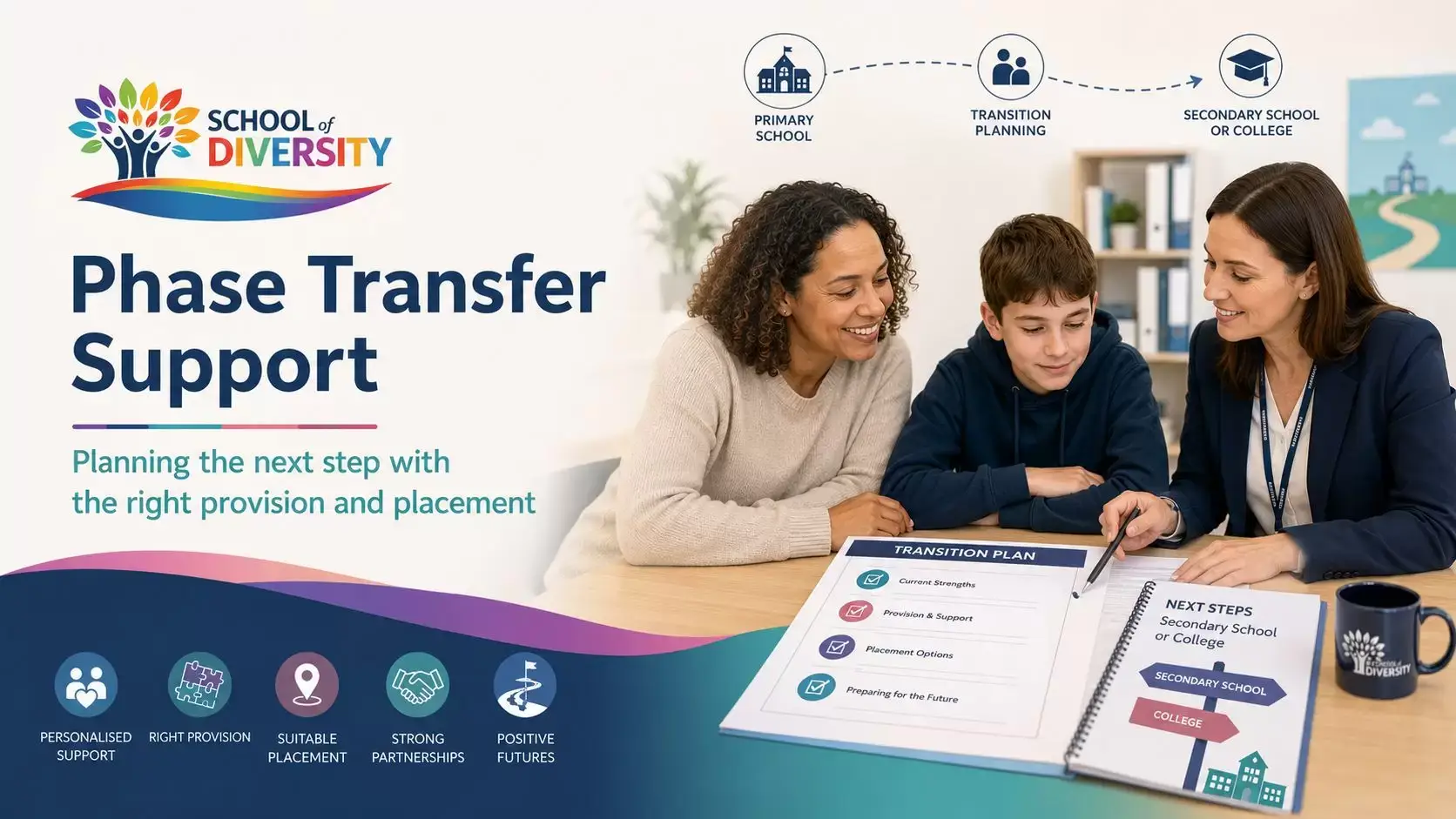
EHCP Placement Support for Phase Transfer
Placement becomes particularly important when a child or young person is moving between phases of education.
This can include:
- early years to primary;
- infant to junior;
- primary to secondary;
- middle to secondary;
- secondary to sixth form;
- secondary to further education;
- or another significant transfer between educational phases.
A phase-transfer review should not simply update the school name.
It provides an important opportunity to consider whether the existing EHCP still accurately describes:
- current needs;
- required provision;
- independence;
- communication;
- sensory requirements;
- curriculum access;
- therapy needs;
- transition requirements;
- and the type of educational environment needed next.
Secondary School Placement
The move from primary to secondary education can significantly increase demands.
A child may face:
- a much larger school;
- substantially more pupils;
- more teachers;
- classroom changes;
- busy corridors;
- increased homework;
- reduced adult prompting;
- greater organisational demands;
- complex social environments;
- increased sensory demands;
- and expectations of greater independence.
This means that evidence showing a child currently manages in primary school does not automatically prove that every secondary environment will be suitable.
The relevant question is whether the proposed secondary setting can meet the child’s future needs in that environment.
Post-16 EHCP Placement Support
Placement decisions can also become complex when a young person approaches further education.
Questions may include:
- Which college can meet need?
- Does the young person require specialist provision?
- What level of learning support is required?
- What therapies or specialist input are necessary?
- How will travel and independence affect access?
- Does the course support the young person’s aspirations?
- What preparation-for-adulthood provision is required?
- Can the college make appropriate adjustments and provide the special educational provision in the EHCP?
Placement should support both the young person’s current educational needs and their longer-term outcomes.
When a Current Placement Is Breaking Down
Sometimes the issue is not selecting a future school.
The existing placement is no longer working.
Signs of placement breakdown may include:
- substantially reduced attendance;
- persistent distress around school;
- repeated suspensions;
- informal exclusions;
- frequent early collections;
- increasing dysregulation;
- deterioration in mental wellbeing;
- persistent inability to access lessons;
- unmet sensory needs;
- repeated incidents;
- increasing reliance on reduced timetables;
- significant masking followed by distress at home;
- inability to deliver Section F provision;
- or professionals expressing concern that the placement is no longer suitable.
In these circumstances, the focus should be on building a clear evidence base explaining why the placement is failing and what needs to change.
What Evidence Can Support an EHCP Placement Request?
The evidence required will depend on the individual case.
It may include:
- the current EHCP;
- draft EHCPs;
- Educational Psychologist reports;
- Speech and Language Therapy reports;
- Occupational Therapy reports;
- autism or ADHD assessments;
- specialist teacher reports;
- school reports;
- SEN Support records;
- progress data;
- attendance records;
- behaviour records;
- suspension records;
- reduced timetable evidence;
- incident logs;
- correspondence with school;
- consultation responses;
- parental evidence;
- the child or young person’s views;
- transition evidence;
- professional observations;
- evidence from prospective schools;
- and information about the proposed placement.
A strong placement case is not necessarily the one with the largest evidence bundle.
It is the one where the evidence clearly demonstrates:
Need → Provision → Environment → Placement

How Our EHCP Placement Support Works
Step 1 – Initial Placement Consultation
We discuss:
- your child’s current position;
- the EHCP stage;
- current or proposed placement;
- your preferred placement;
- the local authority’s position;
- existing evidence;
- and the main areas of disagreement.
Step 2 – EHCP and Evidence Review
Where appropriate, we review relevant sections of the EHCP and supporting evidence.
Particular attention may be given to:
- Section B;
- Section F;
- Section I;
- professional recommendations;
- environmental requirements;
- consultation responses;
- and placement evidence.
Step 3 – Identify the Placement Requirements
We help identify the features the evidence suggests the child or young person needs.
For example:
- smaller classes;
- reduced sensory load;
- specialist teaching;
- consistent adults;
- therapeutic provision;
- enhanced transition support;
- specialist communication support;
- lower-arousal environments;
- or particular staffing expertise.
Step 4 – Compare the Proposed Placements
Where appropriate, we can help structure a comparison between:
the parent’s preferred placement
and
the local authority’s proposed placement.
The comparison should be evidence-led rather than based on general impressions.
Step 5 – Prepare Your Position
Depending on the stage of the process, we can help you prepare:
- parental representations;
- a placement preference statement;
- evidence summaries;
- questions for prospective schools;
- consultation-response challenges;
- annual review representations;
- phase-transfer representations;
- mediation preparation;
- or preparation for a placement appeal.
What You May Receive
Depending on the agreed service, EHCP Placement Support may include:
EHCP Placement Analysis
An examination of the relationship between needs, provision and placement.
Evidence Review
Identification of evidence that supports or weakens the proposed placement position.
Placement Requirements
A structured summary of the educational environment and provision your child appears to require.
Consultation Review
Analysis of school consultation responses and areas requiring clarification.
Preferred Placement Statement
Support preparing a clear written explanation of why the requested placement is appropriate.
Proposed Placement Comparison
A structured comparison between different educational settings where sufficient evidence is available.
Next-Step Strategy
Clear guidance on the next appropriate stage — whether further evidence, representations, mediation or appeal should be considered.
EHCP Placement Support Before Tribunal
Not every placement disagreement needs to proceed to the SEND Tribunal.
Depending on the stage, issues may sometimes be resolved through:
- stronger evidence;
- further consultations;
- parental representations;
- discussion with the local authority;
- an annual review;
- phase-transfer representations;
- clarification from schools;
- or mediation.
Our aim is to help identify the actual issues in dispute and determine what evidence may resolve them.
What If the Placement Dispute Cannot Be Resolved?
If a final EHCP names a placement that you consider unsuitable, you may have a right of appeal to the SEND Tribunal.
Placement disputes commonly involve Section I.
However, Sections B and F may also need to be considered.
This is because it can be difficult to establish which placement is suitable if the EHCP does not first accurately describe:
- the child’s needs;
- and the provision required to meet those needs.
Where the case has reached the appeal stage, our separate EHCP Appeal and SEND Tribunal Support service may be more appropriate.
Placement-Only Appeals
Where an appeal is genuinely limited to the educational placement in Section I, different mediation requirements may apply compared with appeals concerning Sections B or F.
It is therefore important to establish exactly which parts of the EHCP are disputed before deciding how to proceed.
If the placement problem actually arises because Sections B and F do not properly describe need and provision, appealing Section I alone may not address the underlying problem.
Common EHCP Placement Mistakes
Parents can understandably become focused on obtaining a particular school.
However, common weaknesses in placement cases include:
- relying on preference without supporting evidence;
- discussing placement before Section F is sufficiently clear;
- failing to identify environmental needs;
- concentrating solely on diagnosis;
- assuming specialist automatically means suitable;
- assuming mainstream automatically means unsuitable;
- accepting “the school is full” without understanding the actual objection;
- failing to examine consultation responses;
- comparing school fees without comparing total provision costs;
- relying entirely on school websites;
- failing to obtain the child’s views;
- failing to consider future demands at phase transfer;
- or waiting until the EHCP is finalised before gathering placement evidence.
The strongest approach is normally to establish the child’s requirements first and then assess settings against them.
Questions to Ask When Visiting a School
When considering a possible EHCP placement, useful questions can include:
Provision
- How would the school deliver the provision in Section F?
- What specialist interventions are available?
- How are interventions monitored?
Staffing
- What staff-to-pupil ratios operate?
- How consistent are key adults?
- What specialist SEND training do staff receive?
Environment
- What are typical class sizes?
- How large is the school?
- How busy are transitions?
- What quieter areas are available?
Regulation
- Where can a child go before becoming overwhelmed?
- Is regulation support proactive or only offered following crisis?
Communication
- How does the school communicate with parents?
- How are difficulties escalated?
Therapies
- How are SALT, OT or other therapies delivered?
- Are therapists employed directly or externally?
Learning
- How is curriculum access adapted?
- What happens where a child is academically able but cannot access the normal environment?
Transition
- What transition arrangements can be provided before admission?
The answers should then be considered against your child’s actual EHCP and professional evidence.
EHCP Placement Support FAQs
Can I choose my child’s school if they have an EHCP?
You have significant rights to request certain schools, colleges and institutions to be named in an EHCP.
The local authority must consider the request and statutory tests apply when deciding whether the requested placement should be named.
The precise legal position can depend on the type of setting requested.
Can the local authority name a school I do not want?
Potentially, yes.
If the local authority considers another placement appropriate, it may name that setting in the final EHCP.
However, if you disagree with the final Section I placement, you may have a right of appeal.
Can a school refuse a child with an EHCP?
A school’s consultation response is relevant, but it does not by itself determine the placement.
The local authority is responsible for the EHCP placement decision and must apply the relevant legal framework.
What if the school says it cannot meet my child’s needs?
Ask for the reasons.
A useful consultation response should identify which needs or provision create the difficulty.
This information can help establish whether:
- the EHCP is insufficiently detailed;
- the school is genuinely unsuitable;
- further clarification is required;
- or another placement should be considered.
Does a school being full mean it cannot be named?
Not necessarily.
Capacity can be relevant, but the EHCP placement framework is not simply the ordinary admissions process.
The particular facts and applicable statutory tests need to be considered.
Can my child have a specialist school without having severe learning difficulties?
Potentially.
Specialist placement decisions should be based on the child’s individual special educational needs and required provision.
Children may require specialist environments for a range of reasons, including communication, sensory, emotional-regulation, physical or other complex needs.
Does an autism diagnosis mean my child needs specialist school?
No.
Diagnosis alone does not determine placement.
Some autistic children are appropriately educated in mainstream settings, while others require specialist provision.
The question is what environment and provision the individual child requires.
Can you recommend a particular school?
Our role is to help you evaluate suitability against your child’s needs and evidence.
We do not simply recommend a school because it has a particular label or reputation.
The question is whether the setting can meet your child’s individual needs and deliver the required provision.
Can you help if the local authority has already named the wrong school?
Yes.
The next step will depend on whether the EHCP is still in draft, has been finalised, or has recently been reviewed.
Where a final appealable decision has been issued, SEND Tribunal support may need to be considered.
Get Help With Your Child's EHCP Placement
Choosing or challenging an EHCP placement can become complicated very quickly.
You may be dealing with:
- conflicting school responses;
- questions about mainstream versus specialist provision;
- a local authority proposing a different school;
- phase transfer;
- placement breakdown;
- environmental concerns;
- cost arguments;
- or a final EHCP naming a school you believe cannot meet need.
We can help you bring the evidence together and focus on the central question:
What does your child need — and which placement can realistically provide it?
Our EHCP Placement Support can help with:
- reviewing Sections B, F and I;
- identifying placement requirements;
- evaluating school suitability;
- reviewing consultation responses;
- preparing parental preference representations;
- comparing proposed settings;
- phase-transfer planning;
- placement breakdown;
- mediation preparation;
- and deciding whether Tribunal support may be required.