
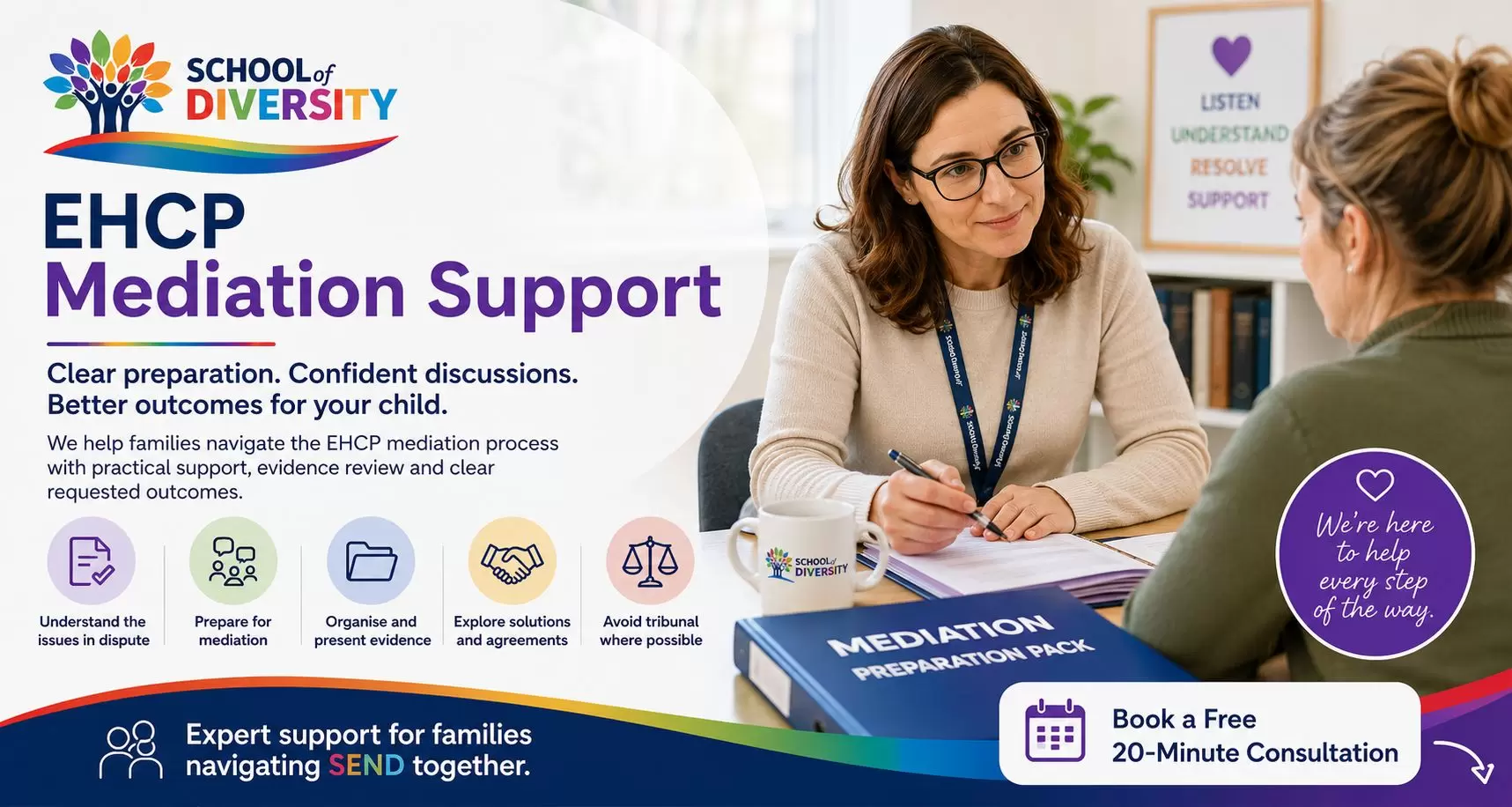
EHCP mediation support
Know what is disputed, which evidence supports you and what you want to change.
Mediation can be an opportunity to resolve a disagreement with the local authority. Clear preparation helps you explain complex concerns and requested amendments without trying to remember everything under pressure.
We help parents and young people organise the case, prepare a focused position and choose the level of support they need.
Keep the appeal deadline in view
The tribunal must normally receive an appeal by the later of two months from the decision-letter date or one month from the mediation-certificate date.
Informal discussions or booking support do not automatically suspend that deadline. Tell us the decision date, mediation date and certificate date, if available, when you enquire.
What is EHCP mediation?
An independent mediator facilitates a discussion between the parent or young person and the local authority. The aim is to clarify the disagreement and explore agreement on some or all of the issues.
The mediator helps the conversation; they do not impose a tribunal-style decision. Our role is separate: we provide independent support preparing and presenting your position.
Clarify the disagreement
Identify the decision, relevant EHCP sections and specific points that remain unresolved.
Discuss the evidence
Explain what the reports and records establish and ask about the authority’s alternative position.
Explore clear outcomes
Seek precise amendments, decisions or actions rather than general assurances.
Is mediation free? The statutory SEND mediation service is provided without charge to parents and young people. Our fees cover optional independent professional preparation and support.
Prepare independently or agree supported casework
We confirm the documents, evidence allowance, work and fee before starting.
Mediation Preparation
£295
For parents who will attend independently and want a clear, organised case.
- Review of the decision letter and relevant EHCP sections.
- Review of agreed relevant evidence.
- Identification of principal disputed issues.
- Clear requested outcomes.
- Mediation position statement.
- Concise evidence summary.
- Questions for the local authority.
- One preparation consultation.
- One agreed revision.
Supported Mediation Casework
From £475
For families needing preparation and practical support through the mediation stage.
Preparation support, with additional work agreed for your case:
- Fuller review of disputed evidence and authority responses.
- Refining amendment wording and requested outcomes.
- Additional preparation and support presenting the case.
- Attendance at one online mediation meeting where permitted and expressly agreed.
- Review of a proposed agreement.
- One agreed written clarification response.
- Initial post-mediation advice.
Scope and exclusions: Supported casework is quoted according to complexity and the work required. Confirm attendance arrangements with the mediation provider in advance. Tribunal appeal preparation, detailed later amended-plan review and further casework are additional unless expressly included.
Issue → evidence → requested change
Bring the discussion back to the decisions needed now. A concise position statement should identify the decision, disputed sections, supporting evidence, requested outcomes and key questions.
What is wrong or missing?
For example: Section F does not specify the Occupational Therapy input recommended in the report.
What evidence supports it?
Identify the report, date and relevant passage. Explain the recommendation and how the plan differs.
What should change?
Set out the requested direct and indirect provision, with the detail supported by the professional advice.
Illustrative example only. Requested provision and wording must reflect the individual child or young person’s evidence.
Which issues may be suitable for mediation?
Refusal to assess, issue a plan or reassess
Prepare around the specific decision and applicable test. Explain the needs, educational impact and evidence supporting the assessment or provision requested.
Refusal-to-assess supportSection B: missing or inaccurately described needs
Compare the plan with professional findings. Identify omitted or minimised communication, sensory, learning, executive-function, regulation or other special educational needs and their educational impact.
Section F: unclear or insufficient provision
Check what will be delivered, frequency, duration, staffing, group size, training and specialist oversight where relevant. Wording such as “access to”, “as required” or “up to” may leave important questions unanswered.
Identify recommendations that have been omitted or weakened and the specific amendments sought.
EHCP wording and review supportSection I: school or college placement
Connect needs, provision and environmental requirements to the proposed settings. Consider consultation responses, suitability and the authority’s reasons for rejecting your preference.
Explore placement supportAnnual-review decisions or ceasing a plan
Review changed needs, continuing provision, review recommendations and why amendments or continuation are requested. Progress should be considered alongside the support enabling it.
Annual review supportMediation advice is different from attending mediation
For many EHCP appeals, you must first contact a mediation adviser and obtain a certificate. You can decide whether to take part in a mediation meeting or obtain the certificate after advice without attending.
The Section I-only exception
If the appeal is solely about the setting named, its type or no setting being named in Section I, mediation advice and a certificate are not normally required. If Sections B or F are also disputed, the usual requirements apply.
Identify exactly what you need to challenge before choosing your route.
Mediation may help where
The disagreement is focused, evidence may clarify the issue, the authority is willing to reconsider or a small number of important amendments remain.
A tribunal appeal may be needed where
Substantial disagreement remains about needs, provision or placement. Mediation can resolve all, some or none of the issues, and does not guarantee agreement.
Prepare evidence that is easy to find
The meeting has limited time. Use a concise issue summary with references to relevant documents, while keeping the complete reports available so recommendations remain in context.
Decision and plan
Decision letter, final EHCP, relevant drafts, amendment requests and annual-review documentation.
Professional and school evidence
Educational Psychology, SALT, OT, health and assessment reports; support records, provision maps, progress, attendance and incidents.
Placement and family evidence
Consultation responses, setting information, relevant correspondence, parent evidence and the child or young person’s views.
Useful questions for the local authority
- Which professional recommendation do you disagree with, and why?
- What evidence supports the alternative provision?
- Who will deliver it, how often and for how long?
- Can the proposed setting deliver every relevant part of Section F?
- Which statutory reason is relied on to reject the requested placement?
- What evidence supports ceasing the plan?
- What further information would help resolve the issue?
During and after the meeting
Discuss the priority issues
The mediator usually introduces the process, clarifies the dispute, invites each position and helps explore possible solutions.
Record agreement precisely
Check the exact wording, EHCP section, action, responsible person and timescale. Distinguish an agreed change from a promise merely to consider it.
Track unresolved issues
Record what has been agreed, what remains disputed and what happens next. Partial agreement can narrow the issues for an appeal.
Follow up the written record. Check it reflects the agreement, ask for clarification where needed and track implementation. Retain the mediation certificate and check any remaining appeal deadline.
If disagreement remains, your evidence summary and requested amendments can help prepare the next stage.
Explore SEND Tribunal supportHow our support works
- Share the decision and dates. Tell us the disputed issues, mediation arrangements and appeal timetable.
- Agree the package. We confirm the evidence allowance, outputs, consultations, any attendance and fee.
- Prepare the position. We review the agreed evidence and organise issues, requested changes and questions.
- Approach the meeting clearly. Attend independently or with the support expressly agreed.
- Check the next steps. Where included, we review the proposed agreement and provide initial follow-up advice.
Preparation may suit defined issues where you feel confident speaking for yourself. Supported casework may help with multiple sections, conflicting reports, placement disputes, rejected amendments or substantial correspondence.
Frequently asked questions
Will the mediator decide whether the EHCP is legally adequate?
No. The mediator facilitates discussion and agreement; they do not make a tribunal-style determination.
Can I bring someone to support me?
Check support and attendance arrangements with the mediation provider in advance. Our online attendance is available only where permitted and expressly agreed within the service scope.
Can mediation lead to Section F changes?
Yes, where the parties agree amendments or further action. Ensure the written agreement identifies the provision and wording clearly.
Do I have to take part in mediation?
Taking part is your choice. For many appeals, obtaining mediation advice and a certificate is still required, even if you decide not to attend a meeting.
Can you review the plan before mediation?
Yes. We review the relevant agreed sections and evidence to identify the issues, recommendations and amendments to discuss.
What if only some issues are resolved?
Keep separate records of agreed and outstanding issues. You may still need an appeal about the unresolved points, within the applicable deadline.
Can you help after unsuccessful mediation?
Yes. Appeal preparation is a separate service unless expressly included. We can discuss the next stage and scope.
What do your fees cover if mediation is free?
They cover our independent document review, preparation, agreed advocacy and casework. The statutory mediation service itself is free to parents and young people.
Important service information
School of Diversity provides SEND advocacy, evidence review, document preparation and practical mediation support. We are not the independent mediation provider and cannot guarantee agreement or an appeal outcome.
Unless expressly agreed otherwise, this is not representation by a solicitor or barrister or a substitute for regulated legal advice where required. Your agreement confirms scope. Parents and young people remain responsible for checking deadlines and forwarding correspondence promptly.
Further information: GOV.UK: mediation before an appeal and appeal deadlines and procedure.
Go into mediation knowing what needs to change
Tell us the decision you disagree with, the meeting date and your main concerns. We can help you turn the evidence into a focused position.