
DLA rates for children in 2026
Understand weekly rates, four-week payments and what determines an award.
Disability Living Allowance has care and mobility components. A child may qualify for one or both, depending on their needs and the relevant criteria.
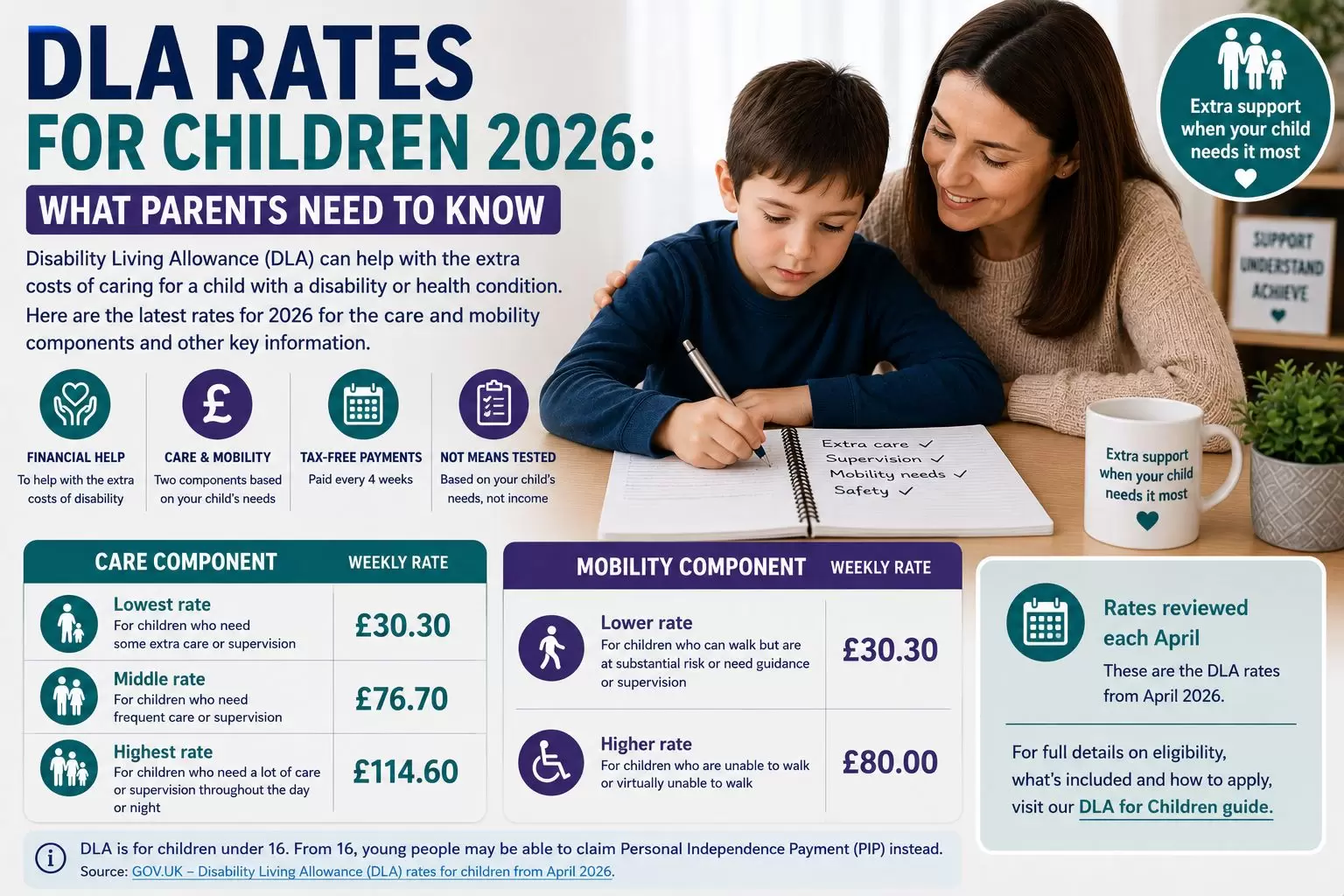
Care component rates
The care component has three rates. The level awarded depends on qualifying attention or supervision needs, including their timing during the day or night.
| Rate | Weekly | Four weeks |
|---|---|---|
| Lowest | £30.30 | £121.20 |
| Middle | £76.70 | £306.80 |
| Highest | £114.60 | £458.40 |
Mobility component rates
The lower and higher mobility rates have different qualifying tests and minimum ages.
| Rate | Weekly | Four weeks |
|---|---|---|
| Lower | £30.30 | £121.20 |
| Higher | £80.00 | £320.00 |
About these amounts: Weekly figures are from GOV.UK. Four-week figures are calculated by multiplying by four and assume the same rate applies throughout. First payments, arrears, adjustments or rate changes may differ. Check your award letter.
If both components are awarded
Add the awarded care rate to the awarded mobility rate. These examples show the arithmetic, not an entitlement prediction.
Middle care + lower mobility
£107.00 a week
£428.00 over four weeks.
Highest care + lower mobility
£144.90 a week
£579.60 over four weeks.
Highest care + higher mobility
£194.60 a week
£778.40 over four weeks.
Four-weekly is different from monthly
DLA is usually paid every four weeks on a Tuesday into a bank or building society account. A four-week cycle means 13 payment periods across 52 weeks, rather than 12 calendar-month payments.
If a payment date falls on a bank holiday, it is usually paid beforehand. Use your award letter and actual payment schedule when budgeting.
A budgeting example: Middle-rate care alone is £306.80 per full four-week period at the listed rate. This should not be described as a £306.80 monthly payment.
What determines the rate?
Qualifying care needs
Explain the additional attention, prompting, assistance or supervision required, including relevant daytime and night-time needs and the same-age comparison.
Qualifying mobility needs
Describe walking difficulties or outdoor guidance and supervision relevant to the applicable test. Lower-rate mobility starts from age five and higher-rate mobility from age three if eligible.
A diagnosis does not automatically determine entitlement. DLA for children is generally for eligible children under 16. Duration, residence and other conditions apply, with special rules in some circumstances.
DLA and other financial support
DLA is tax-free and not means-tested. Parental earnings and savings do not determine the award. It may also lead to additional support, but each scheme has separate rules.
Carer’s Allowance
You may qualify if your child gets middle or highest care and you provide at least 35 hours of care a week. Earnings, education and other conditions apply.
It can affect other benefits. Check current rules before claiming.
Official Carer’s Allowance guidanceOther benefits and schemes
A child’s DLA award may affect additional amounts within benefits such as Universal Credit. Blue Badge, vehicle-tax and motoring arrangements have their own qualifying rules.
Ask a welfare-rights adviser for a benefits check rather than assuming every scheme follows automatically.
Which system applies where you live?
This guide focuses on DWP DLA for children in England and Wales. Northern Ireland administers DLA separately. Scotland uses Child Disability Payment.
Preparing an application
Explain the additional help, frequency, duration and consequences without support. Use accurate examples and relevant child-specific evidence; more documents do not automatically make a stronger claim.
Frequently asked questions
Do autism or ADHD automatically qualify a child?
No. The award depends on qualifying care or mobility needs and the other eligibility conditions. Describe the additional help your child actually requires.
Can a child under three receive DLA?
They may qualify for care subject to the applicable rules. Mobility cannot be paid before age three for the higher rate or age five for the lower rate.
How long does a claim take?
Processing times vary. An acknowledgement is not the award decision. Use current DWP information and contact the helpline if you need to check a claim rather than relying on a fixed processing estimate.
What if my child’s needs change?
Follow the official change-reporting rules. A review can increase, reduce or end an award depending on eligibility. Seek advice if unsure what needs reporting.
Changes to reportWhat if the award seems too low?
Review the decision reasons and evidence and seek advice promptly about Mandatory Reconsideration. Check the decision date and deadline; a challenge does not guarantee an increase.
Reconsideration supportAre the four-week figures guaranteed payment amounts?
No. They are calculations for a full four-week period at one unchanged rate. Your letter sets out the actual award and payments.
Further reading: DLA parent guide. General information cannot determine individual entitlement.
Need help explaining your child’s needs?
We can help with the application and relevant evidence. Scope and fees are agreed before starting; an award or rate cannot be guaranteed.
2 Responses