
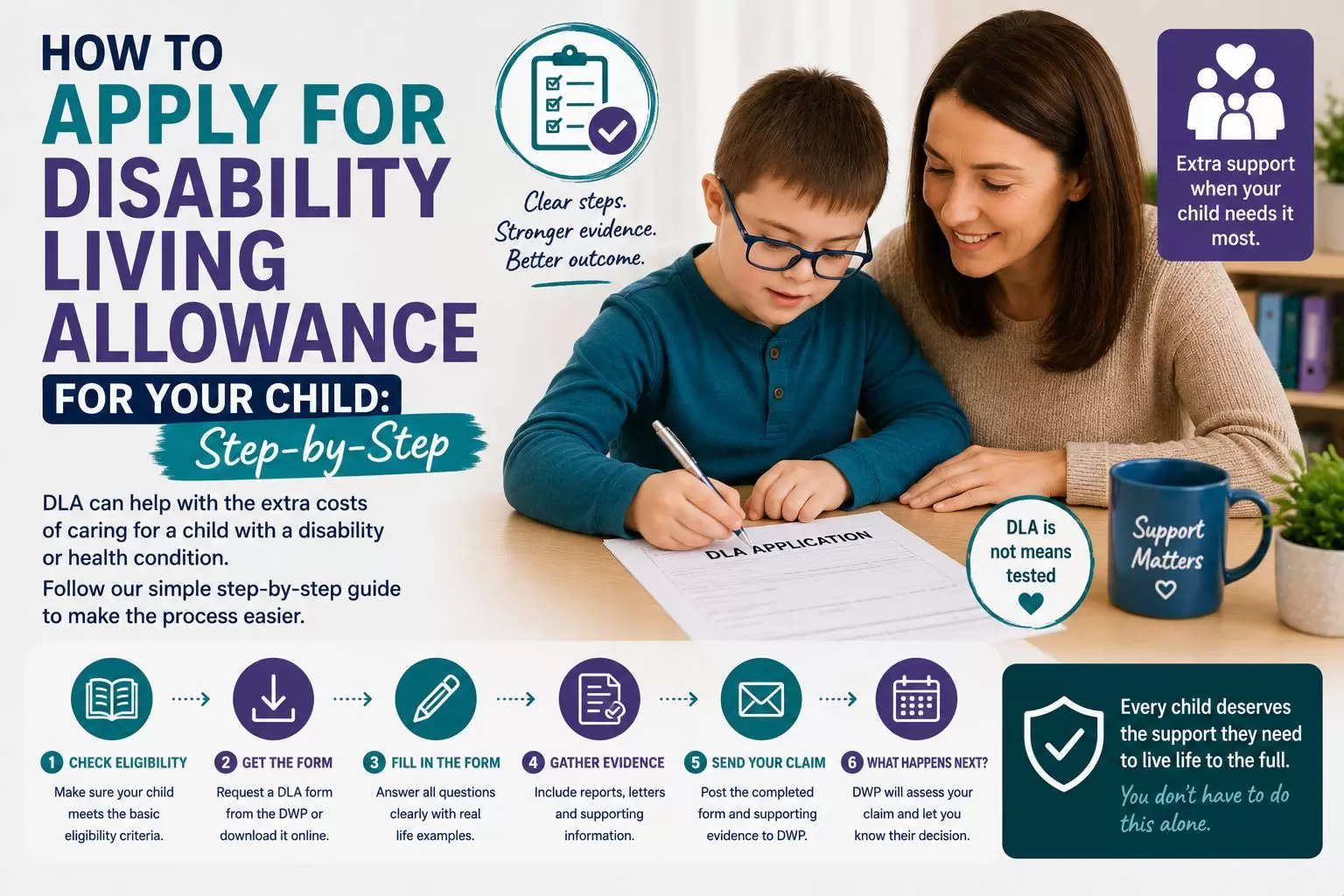
How to Apply for Disability Living Allowance for Your Child: Step-by-Step
Disability Living Allowance (DLA) for children is a benefit that helps parents meet the extra costs of raising a child with a health condition or disability. The process to apply can feel daunting, but with the right preparation you can complete the form with confidence. This guide walks you through each stage, from checking eligibility to posting the finished form.
Check Whether Your Child Is Eligible for DLA
Before you begin the application, confirm that your child meets the basic conditions. You must be the child’s parent or someone who looks after them as if you were their parent – this includes step-parents, guardians, grandparents, foster-parents, or older siblings. The child must be under 16 years old and have a health condition or disability. They must have needed extra help or had difficulty moving for at least three months, and their difficulties must be expected to last for at least another six months.
Know Which Benefit Applies in Your Nation
DLA for children is claimed differently depending on where you live in the UK. The table below summarises the correct route for your location.
| Location | What to apply for |
|---|---|
| England or Wales | Disability Living Allowance for children (use the DLA claim form from GOV.UK) |
| Scotland | Child Disability Payment (not DLA) |
| Northern Ireland | Apply via nidirect.gov.uk |
Get the DLA Claim Form
You cannot complete the DLA claim form online. The form must be downloaded and printed from GOV.UK, or you can request a paper copy by phone. Call the Disability Living Allowance helpline on 0800 121 4600, Monday to Friday, 9am to 5pm. If you use a desktop or laptop computer, you can print the form at home. The form cannot be filled in on a mobile phone or tablet, so do not attempt to use those devices.
Gather the Information You Need Before You Start
Before printing the form, collect the following details about your child: full name, address, telephone number, date of birth, and National Insurance number. Having this information ready saves time and prevents mistakes. You may also find it helpful to keep a diary of your child’s care needs for a week before you fill in the form, as recommended by the charity Contact. This diary will give you concrete examples to include on the form.
Complete the Form: Step by Step
Step 1: Read the Guidance Notes
The claim form includes guidance notes. Read them carefully before writing anything. They explain what each question is asking and what kind of information the Department for Work and Pensions (DWP) needs to make a decision.
Step 2: Fill in Your Child’s Details
Write your child’s name, address, date of birth, and National Insurance number in the sections provided. If you are unsure about the National Insurance number, you can find it on any official letters from the DWP or HM Revenue and Customs. If your child does not have one, contact the helpline for advice.
Step 3: Describe the Help Your Child Needs
This is the most important part of the form. Use the extra text boxes to describe your child’s needs in your own words. The charity Contact advises giving examples rather than just ticking boxes. For instance, if your child needs help with washing, describe exactly what you do, how long it takes, and how your child reacts. The more detail you provide, the better the DWP can understand your situation.
Step 4: Explain the Difficulties Your Child Has with Moving
The form asks about your child’s ability to walk and move around. If your child has difficulty moving, describe the support they need. Focus on how their condition affects them on a typical day, not just on bad days. Be honest and avoid downplaying the challenges.
Step 5: Check and Sign the Declaration
Review every section to make sure you have answered all the questions. Sign and date the declaration. Remember that you are confirming the information is true and complete to the best of your knowledge.
Post the Form to the DWP
Once the form is complete, send it to the address: Freepost DWP DLA Child. Write only the words “Freepost DWP DLA Child” on the envelope. You do not need to add a postcode or a stamp – the freepost address ensures it reaches the DWP without postage cost. Do not write anything else on the envelope. The claim cannot be backdated; your claim starts on the date the form is received or the date you called the helpline, provided you return the claim pack within six weeks.
What Happens After You Apply
You will receive a letter within three weeks confirming that your application has been received. Once the DWP has made a decision on your claim, another letter will tell you when you will get your first payment. If you need help or have questions while waiting, you can call the Disability Living Allowance helpline on 0800 121 4600.
Useful Resources and Charity Support
Several charities offer free guidance to help you through the process. Contact provides a free helpline on 0808 808 3555, as well as step-by-step guides and video walkthroughs with tips for completing the DLA form. Mencap also offers a digital step-by-step guide and an Easy Read version of the application process. Both organisations recommend keeping a diary of care needs before you fill in the form and using the extra text boxes to give examples rather than just ticking boxes.
.
Frequently Asked Questions
Can I apply for DLA for my child if we live in Scotland?
No. If your child lives in Scotland, you should apply for Child Disability Payment instead of DLA. For children in England or Wales, use the DLA claim form. Those in Northern Ireland apply via nidirect.gov.uk.
How long does it take to get a decision on a DLA claim?
The DWP sends a letter within three weeks confirming that your application has been received. The total time to reach a decision is not specified in official guidance, so contact the helpline if you have not heard anything after several weeks.
What should I do if I make a mistake on the form?
If you catch the mistake before posting, print a fresh page or cross it out clearly and initial the correction. If you have already posted the form, call the Disability Living Allowance helpline on 0800 121 4600 and explain what needs to be changed.
Does my child need a specific diagnosis to qualify for DLA?
The criteria focus on the level of care or supervision your child needs, not on a specific condition. Your child must have had difficulties for at least three months and be expected to have them for at least another six months. A formal diagnosis can help, but it is not essential.
Final Thoughts
Applying for Disability Living Allowance is easier when the form clearly explains the extra care, supervision, prompting and mobility support your child needs compared with another child of the same age. Use detailed everyday examples, describe both good and difficult days, and include evidence that supports what you have written. For a wider overview of eligibility and the care and mobility components, read our DLA for Children guide. You may also find our article on common mistakes when claiming DLA for a child with ADHD or autism helpful before submitting the form. For personalised help reviewing your evidence and completing a stronger claim, explore our DLA Application Support for Children service.
One Response