

How to Write a Parent Statement for an EHCP
A parent statement is your opportunity to explain your child’s needs, strengths, difficulties and day-to-day experiences in your own words.
Professional reports and school records are important, but they do not always show what happens before school, after school, at home or when your child no longer has the energy to mask their difficulties.
A strong parent statement helps the local authority understand your child as a whole person. It can be submitted with a request for an EHC needs assessment, during the assessment process, when commenting on a draft EHCP or as part of an annual review.
Key takeaways
- Focus on your child’s individual needs rather than relying only on diagnoses.
- Explain how those needs affect education, attendance, communication, wellbeing and independence.
- Include clear examples from everyday life.
- Describe the support already tried and whether it has worked.
- Explain what provision your child needs to access education safely and consistently.
- Keep your statement factual, specific and centred on your child.
What is an EHCP parent statement?
An EHCP parent statement is a written account of your child’s strengths, needs, difficulties, daily experiences and support requirements.
It is sometimes described as:
- parental views;
- parent contribution;
- parent evidence;
- family views;
- parental representation; or
- a Section A contribution.
Section A of an EHC plan records the views, interests and aspirations of the child and their parents, or of the young person. Parents should also have an opportunity to express their views and submit evidence during the EHC needs assessment process.
Your statement may be used to help:
- decide whether an EHC needs assessment is required;
- identify your child’s educational, health and social care needs;
- understand the impact of those needs;
- determine suitable outcomes;
- identify special educational provision;
- review a draft EHCP;
- prepare for an annual review; or
- support an appeal.
Why is the parent statement important?
Parents often see aspects of a child’s needs that may not be visible during a lesson or professional appointment.
For example, school records may not fully describe:
- the preparation required before school;
- distress before leaving home;
- difficulties with transport;
- exhaustion after school;
- masking;
- emotional outbursts at home;
- sleep disruption;
- eating difficulties;
- sensory overload;
- recovery time;
- homework difficulties;
- dependence on adult support;
- refusal or inability to attend;
- difficulties during weekends and holidays; or
- the effect on family life.
Your statement can connect information from several reports and explain what those findings mean in everyday life.
Your knowledge matters
You do not need to write like a professional.
Your role is to explain what you observe, what support your child requires and what happens when that support is not available.
Specific examples are usually more helpful than formal or technical language.
When should I submit a parent statement?
A parent statement can be submitted at several stages.
With an EHC needs assessment request
A statement can help explain why your child has or may have special educational needs and why a full assessment may be necessary.
Parents can request an EHC needs assessment directly from their local authority. An EHC needs assessment considers a child or young person’s educational, health and social care needs.
During the EHC needs assessment
You may be asked to provide your views, evidence and aspirations for your child.
This is an opportunity to update your original statement and respond to any professional advice gathered during the assessment.
When reviewing a draft EHCP
Compare your statement with the draft plan.
Check whether:
- your child’s needs have been included;
- the impact of those needs is accurately described;
- the outcomes reflect your child’s priorities;
- the provision responds to the identified needs; and
- your views have been represented accurately.
Draft EHCP Review Checklist for Parents
At an annual review
A parent statement can explain:
- what has changed;
- what progress has been made;
- which needs remain;
- whether provision has been delivered;
- whether the placement remains suitable; and
- what amendments are required.
What to Include in an EHCP Parent Statement
1. Introduce your child
Begin with a short description of your child as a person.
Include:
- their name and age;
- current school or setting;
- year group;
- interests;
- strengths;
- personality;
- achievements;
- relationships;
- activities they enjoy; and
- what makes them happy.
This section should help the reader see your child as more than a list of difficulties.
Example
Daniel is a thoughtful and creative 10-year-old who enjoys drawing, animals and building detailed models. He has a strong memory for subjects that interest him and is particularly engaged by science. He is affectionate with close family members and enjoys spending time with adults he trusts.
2. Explain your child’s needs
Describe each area of need clearly.
You may find it helpful to organise this section under the four broad areas of special educational need.
Communication and interaction
This may include difficulties with:
- understanding spoken language;
- expressing needs;
- processing instructions;
- social communication;
- interpreting facial expressions;
- understanding implied meaning;
- maintaining conversations;
- communicating distress;
- forming friendships; or
- coping with group situations.
Cognition and learning
This may include difficulties with:
- literacy;
- numeracy;
- working memory;
- processing speed;
- attention;
- organisation;
- executive functioning;
- starting tasks;
- completing work;
- retaining learning;
- applying skills in new situations; or
- working independently.
Social, emotional and mental health
This may include:
- anxiety;
- emotional dysregulation;
- low self-esteem;
- school-related distress;
- withdrawal;
- avoidance;
- shutdowns;
- distressed behaviour;
- difficulty managing demands;
- self-injurious behaviour; or
- fear of making mistakes.
Sensory and physical needs
This may include:
- sensitivity to noise;
- sensitivity to light;
- touch sensitivity;
- sensory-seeking behaviour;
- coordination difficulties;
- fatigue;
- mobility;
- toileting;
- eating;
- fine-motor difficulties;
- physical health needs; or
- difficulty accessing busy environments.
Avoid writing only:
My child has autism and ADHD.
Instead, explain how those needs present.
Stronger example
Daniel finds it difficult to process several verbal instructions at once. In a busy classroom he may appear not to listen, but he is often overwhelmed by background noise and cannot identify which information is important. He needs instructions to be broken down, supported visually and checked individually.
3. Describe the impact on education
Explain what your child’s needs mean in practice.
Consider:
- learning;
- progress;
- attendance;
- participation;
- communication;
- friendships;
- independence;
- emotional wellbeing;
- behaviour;
- safety;
- access to lessons;
- unstructured times;
- school trips;
- homework;
- transitions; and
- preparation for adulthood.
Questions to answer
- Can your child enter school and remain there?
- Can they access the classroom?
- Can they understand instructions?
- Can they start work independently?
- Can they complete tasks?
- Can they ask for help?
- Can they cope with changes?
- Can they manage breaktimes and lunchtimes?
- Can they regulate without adult support?
- Can they attend consistently?
- Can they recover after school?
- Can they access the full curriculum?
Example
Although Daniel is academically able, he cannot consistently demonstrate his knowledge in the classroom. He becomes overwhelmed by noise and unpredictable changes and often stops communicating when anxious. He requires an adult to help him understand the task, organise his materials and return to learning after becoming distressed.

4. Explain what happens at home
Home evidence is particularly important where a child masks at school.
Describe:
- preparation before school;
- distress in the morning;
- refusal or inability to attend;
- exhaustion after school;
- emotional release;
- shutdowns;
- sleep;
- eating;
- personal care;
- homework;
- anxiety about the following day;
- recovery time;
- family activities; and
- the level of parental support required.
Example
Daniel often appears calm when leaving school, but he becomes distressed shortly after arriving home. He may cry, shout or withdraw for several hours. He is usually unable to complete homework or participate in family activities on school evenings. He frequently asks repeated questions about the next school day and struggles to sleep.
Do not assume that professionals will understand what “masking” means for your child. Describe the observable behaviour and its consequences.
How autism masking can affect children at school and at home
5. Describe your child’s strengths
A parent statement should not be wholly negative.
Include strengths such as:
- creativity;
- humour;
- kindness;
- specialist knowledge;
- problem-solving;
- memory;
- practical skills;
- resilience;
- honesty;
- attention to detail;
- musical ability;
- artistic ability;
- sporting interests; or
- strong relationships.
Then explain what helps your child use those strengths.
Example
Daniel has excellent factual recall and learns well when information is presented visually and connected to his interests. He is more confident when he knows what to expect and when tasks are broken into clear stages.
6. Explain what support has already been tried
List the support currently or previously provided.
This could include:
- SEN Support;
- one-to-one assistance;
- small-group teaching;
- visual timetables;
- sensory breaks;
- quiet spaces;
- emotional-literacy support;
- speech and language programmes;
- occupational therapy strategies;
- literacy intervention;
- pastoral support;
- reduced timetables;
- transition support;
- home-school communication;
- behaviour plans; or
- attendance support.
For each intervention, explain:
- what was provided;
- how often it was provided;
- how consistently it was delivered;
- how long it was tried;
- what difference it made; and
- what difficulties remain.
Example
Daniel has access to a quiet room, but this is not always available when he becomes overwhelmed. He is expected to request it himself, which he cannot reliably do when anxious. The strategy therefore does not consistently prevent escalation or loss of learning.
7. Explain what helps your child
Describe the conditions and strategies that support successful participation.
This may include:
- predictable routines;
- visual information;
- advance warning of change;
- reduced language;
- smaller groups;
- individual teaching;
- movement breaks;
- sensory regulation;
- access to a quiet space;
- trusted adults;
- specialist teaching;
- additional processing time;
- alternative communication;
- task breakdown;
- reassurance;
- low-arousal approaches; or
- structured transitions.
Be specific about why the support works.
Example
Daniel is better able to engage when instructions are given individually, supported visually and limited to one or two steps. He also needs additional processing time before being expected to respond.

8. Explain what does not help
This section can prevent ineffective strategies from being repeated.
Examples may include:
- repeated verbal instructions;
- public correction;
- sanctions for distress-based behaviour;
- removal of support without preparation;
- unplanned changes;
- busy intervention groups;
- reward systems;
- pressure to communicate;
- asking the child to request help when distressed;
- increasing demands during overload; or
- interpreting shutdown as defiance.
Use factual and neutral wording.
Example
Reward charts have not improved Daniel’s attendance because his difficulty entering school is caused by anxiety and sensory overload rather than a lack of motivation.
9. Describe the support your child needs
Explain what you believe is required.
This might include:
- assessment by an educational psychologist;
- speech and language therapy;
- occupational therapy;
- specialist teaching;
- individual adult support;
- a low-arousal environment;
- a smaller teaching group;
- sensory provision;
- support for communication;
- structured transitions;
- preparation for change;
- staff training;
- support at unstructured times;
- modified teaching approaches;
- attendance support; or
- a different type of placement.
Focus on provision rather than only stating that your child “needs an EHCP”.
Example
Daniel requires a consistent adult who understands his communication and sensory needs, checks his understanding and helps him regulate before difficulties escalate. He also requires a low-arousal working space that is available whenever needed rather than only when another room happens to be free.
10. Include your child’s views
Your child’s views should be represented in an appropriate way.
They may communicate through:
- conversation;
- writing;
- drawings;
- photographs;
- symbols;
- a communication device;
- observed preferences; or
- a trusted adult.
Include:
- what they enjoy;
- what they dislike;
- what makes school easier;
- what causes distress;
- what they want adults to understand;
- what they hope to achieve; and
- their aspirations.
Do not pressure your child to answer questions where doing so causes distress.
[INTERNAL LINK: How to Write a Child or Young Person’s EHCP Statement]
11. Explain your aspirations for your child
Describe your hopes for:
- education;
- communication;
- independence;
- relationships;
- emotional wellbeing;
- qualifications;
- employment;
- community participation; and
- adult life.
Keep aspirations positive but realistic.
Example
We want Daniel to feel safe in education, develop confidence in communicating his needs and make progress that reflects his academic ability. Over time, we want him to become more independent without support being removed before he is ready.
12. End with your main concerns and requested action
Finish with a concise summary.
Include:
- the most significant needs;
- why current support is insufficient;
- the main risks if needs remain unmet;
- what assessment or provision is required; and
- what you are asking the local authority to do.
Example
We are concerned that Daniel’s current educational arrangements are not sustainable. Although he has strengths and academic potential, anxiety, sensory overload and communication difficulties are preventing consistent access to education. We believe that a coordinated assessment is required to identify his needs fully and specify the provision necessary for him to attend, participate and make progress.
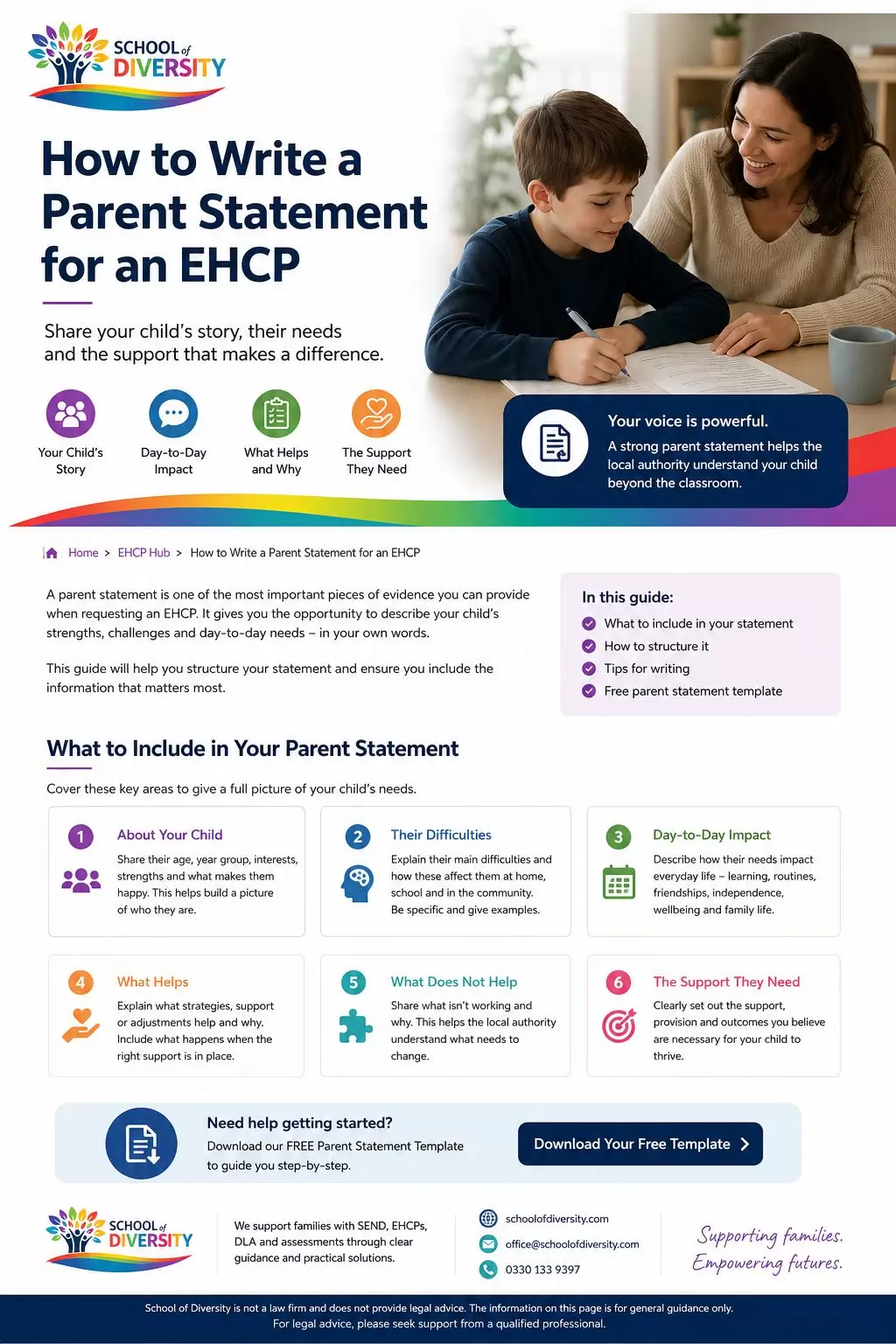
A Recommended Parent Statement Structure
Use the following headings in your own statement:
- About my child
- My child’s strengths and interests
- My child’s special educational needs
- The impact on education
- The impact at home
- Communication and interaction
- Learning and independence
- Emotional wellbeing and regulation
- Sensory and physical needs
- Attendance and access to school
- Support already tried
- What helps
- What does not help
- My child’s views
- Our aspirations
- The support we believe is required
- Our main concerns
- Summary and requested action
Example Opening for an EHCP Parent Statement
My name is [parent’s name], and I am the parent of [child’s name], who is [age] and currently attends [school or setting].
This statement explains our child’s strengths, needs and day-to-day experiences. It also describes the support already provided, the difficulties that remain and the provision we believe is required.
[Child’s name] is a [brief description of personality, interests and strengths]. They enjoy [interests] and are particularly successful when [describe helpful conditions].
However, they experience significant difficulties with [briefly identify the main areas of need]. These difficulties affect their ability to [describe the main educational impact].
Strong and Weak Parent Statement Examples
Weak wording
My child struggles a lot and needs more help.
Stronger wording
My child cannot begin independent written work without individual prompting. When the classroom is noisy, they are unable to process verbal instructions and may sit without starting the task for 20 minutes or more.
Weak wording
School makes my child anxious.
Stronger wording
On school mornings, my child repeatedly asks whether there will be changes to staff or lessons. They often report stomach pain, cry before leaving home and require up to an hour of adult reassurance before they can enter school.
Weak wording
The current support does not work.
Stronger wording
A visual timetable has reduced anxiety when it is updated consistently. However, changes are not always added in advance, and my child becomes distressed when the timetable does not match what happens during the day.
Common Parent Statement Mistakes
Relying only on diagnosis
A diagnosis may help explain your child’s profile, but the statement should describe functional needs and educational impact.
Writing only about difficulties
Include strengths, interests and successful strategies.
Using vague language
Replace words such as “often”, “regularly” or “struggles” with examples, frequency and impact where possible.
Minimising the support provided at home
Explain what you do to prepare, regulate, reassure, prompt, supervise and support your child.
Focusing only on academic attainment
Include communication, sensory needs, anxiety, attendance, social interaction, independence and wellbeing.
Attacking professionals
Keep the tone factual. Concentrate on the evidence, the unmet needs and the required provision.
Making the statement too long without structure
Use clear headings, short paragraphs and specific examples.
Forgetting to update the statement
Review it before each major stage of the EHCP process.

Parent Statement Checklist
Before submitting your statement, check that it:
- Introduces your child as a person.
- Describes strengths and interests.
- Identifies all areas of special educational need.
- Explains the impact on learning.
- Explains the impact on attendance.
- Explains the impact at home.
- Describes masking where relevant.
- Includes specific examples.
- Describes support already tried.
- Explains what has and has not worked.
- Includes your child’s views.
- Identifies your aspirations.
- Describes the provision required.
- Explains why current arrangements are insufficient.
- Uses factual and respectful language.
- Includes a date and parent’s name.
- Is supported by relevant evidence.
- Has been saved before submission.
Frequently Asked Questions
How long should an EHCP parent statement be?
There is no fixed length. It should be long enough to explain your child’s needs clearly without repeating the same information. Many effective statements are several pages long and use headings to make them easy to follow.
Should I write in the first person?
Yes. Writing in the first person usually makes the statement clear and authentic. Phrases such as “we have observed” or “our child requires” are appropriate.
Should I include diagnoses?
Yes, where relevant, but do not rely on diagnoses alone. Explain how each need affects your child’s education and daily functioning.
Can I include information about home?
Yes. Home evidence can demonstrate masking, exhaustion, anxiety, sleep difficulties and the level of support required outside school.
Can I disagree with the school?
Yes. Set out your observations and explain the evidence supporting your view. Keep the language factual and avoid personal criticism.
Can I attach documents?
Yes. You may attach professional reports, school records, diaries, correspondence and other relevant evidence. Number the attachments and refer to them clearly.
Should I include the support I want?
Yes. Explain the type of provision you believe your child requires and why. Link each requested support to an identified need.
Can I update my statement later?
Yes. You can provide updated parental views during the assessment, when commenting on a draft plan and during annual reviews.
Does the parent statement go in Section A?
Parent and child views, interests and aspirations are recorded in Section A, although information from your statement may also help identify needs, outcomes and provision elsewhere in the plan.
Do I need professional help to write it?
No. Parents can prepare their own statements. Professional assistance may be helpful where the case is complex, evidence conflicts or the statement will be used as part of an appeal.
How School of Diversity Can Help
School of Diversity supports parents with:
- reviewing existing evidence;
- identifying missing information;
- preparing parent statements;
- organising evidence packs;
- requesting EHC needs assessments;
- reviewing draft EHCPs;
- strengthening Sections B and F;
- annual review preparation;
- mediation;
- working documents; and
- SEND Tribunal support.
We can help you present your child’s strengths, needs and required provision clearly and coherently.
Final Thoughts
Your parent statement is not simply a history of difficulties.
It is an opportunity to help the local authority understand:
- who your child is;
- what they can do;
- what prevents them from accessing education;
- what support has already been tried;
- what happens outside school;
- what provision is needed; and
- what you hope your child will achieve.
The strongest statements are specific, balanced and supported by examples.
You know your child’s daily experience in a way that no single report can capture. Use that knowledge to create a clear and accurate picture of the support your child needs.
Related EHCP Guidance
- How to Apply for an EHCP
- What Evidence Do I Need for an EHCP?
- EHCP Without a Diagnosis
- [INTERNAL LINK: How to Write a Child or Young Person’s Statement]
- EHC Needs Assessment Process Explained
- EHCP Sections Explained
- Draft EHCP Review Checklist
- How to Strengthen Section F
- EHCP Evidence Review and Preparation
- Common Mistakes that weaken an EHCP
- SEND Tribunal Support
Sources and important information
This guide relates to the EHCP system in England. The principal statutory framework includes the Children and Families Act 2014 and the SEND Code of Practice: 0 to 25 years.
This page provides general SEND information and does not constitute legal advice.