

What Evidence Do I Need for an EHCP?
A practical guide to gathering clear, relevant evidence for an Education, Health and Care needs assessment request.
Parents often know that their child is struggling but feel unsure which documents will help the local authority understand the full situation.
A strong evidence submission should show:
- your child’s special educational needs;
- how those needs affect their education and daily functioning;
- what support has already been provided;
- whether that support has resulted in sufficient progress;
- what additional or specialist provision may be required.
You do not need to wait until you have every possible professional report before requesting an EHC needs assessment. The evidence should be relevant, organised and connected to the legal question the local authority must consider.
What Is the Evidence Trying to Show?
When considering an EHC needs assessment request, the local authority must decide whether:
- the child or young person has or may have special educational needs; and
- it may be necessary for special educational provision to be made through an EHC plan.
Your evidence does not have to prove in advance that an EHCP must definitely be issued.
It should help demonstrate that your child may require a formal, coordinated assessment of their education, health and social care needs.
The strongest evidence usually creates a clear connection between:
- the child’s needs;
- the educational impact;
- the support already attempted;
- the progress or continuing difficulty;
- the provision that may now be required.
Do I Need Professional Reports Before Applying?
No. A parent can request an EHC needs assessment without already having every professional report.
The statutory assessment process exists partly so that relevant professional advice can be obtained and considered.
However, existing professional evidence can strengthen a request where it clearly identifies:
- the child’s needs;
- the effect of those needs;
- recommended provision;
- required frequency or intensity of support;
- the need for further assessment;
- risks if support is not provided.
Do not delay an urgent request solely because you are waiting for a diagnosis or professional appointment.
School Evidence for an EHCP Request
School evidence is often important because it shows how your child functions in an educational environment and what support has already been attempted.
SEN Support Plans
Include current and previous SEN Support plans where available.
These may show:
- identified needs;
- targets;
- interventions;
- reasonable adjustments;
- staff responsibilities;
- review dates;
- progress;
- continuing concerns.
Look for evidence that targets have been reviewed and changed in response to your child’s progress.
Assess, Plan, Do and Review Records
Assess, plan, do and review records can demonstrate:
- how needs were identified;
- which support was planned;
- whether the support was delivered;
- what difference it made;
- whether further action was required.
There is no fixed legal number of cycles that must be completed before an assessment can be requested. However, well-documented cycles can help show what the school has attempted and why it has not been sufficient.
Provision Maps
A provision map may list the support available or delivered.
Check whether it clearly states:
- the intervention;
- frequency;
- duration;
- group size;
- staff member responsible;
- start and review dates;
- intended outcome;
- actual impact.
A list of interventions is less useful if it does not show whether your child received them consistently or whether they worked.
School Reports
School reports may provide evidence of:
- attainment;
- effort;
- participation;
- concentration;
- independence;
- social interaction;
- emotional wellbeing;
- areas of strength;
- persistent difficulty.
Do not rely only on positive summary comments. Compare them with attendance, support records and detailed teacher observations.
Progress and Attainment Data
Relevant information may include:
- reading and spelling ages;
- curriculum levels;
- standardised scores;
- progress over time;
- working-below-age expectations;
- uneven attainment;
- progress achieved only with substantial support.
A child does not need to be academically behind to have significant special educational needs.
Evidence may also show difficulties with:
- communication;
- sensory processing;
- emotional regulation;
- attention;
- attendance;
- independence;
- social interaction;
- accessing the school environment.
Teacher and SENCO Evidence
Useful evidence may include:
- written observations;
- meeting notes;
- emails;
- SENCO assessments;
- teacher questionnaires;
- descriptions of support required;
- evidence of difficulties across different lessons or settings.
The most useful statements are specific.
For example:
“Needs regular support”
is less informative than:
“Requires adult prompting at the start of each task, instructions broken into individual steps and checking every five to ten minutes to remain engaged.”
Attendance Evidence
Attendance information can be important where SEND contributes to:
- school avoidance;
- emotionally based non-attendance;
- lateness;
- reduced timetables;
- frequent absence;
- difficulty returning after weekends or holidays;
- exhaustion after attending.
Include:
- attendance percentages;
- absence records;
- late marks;
- reduced timetable arrangements;
- reintegration plans;
- correspondence explaining the reasons for absence.
Behaviour, Incident and Exclusion Records
These records may help show patterns involving:
- distress;
- sensory overload;
- shutdowns;
- meltdowns;
- dysregulation;
- conflict;
- absconding;
- restraint;
- internal exclusion;
- suspension;
- risk of permanent exclusion.
Behaviour records should be considered alongside the child’s needs and the circumstances leading to the incident.
Professional Evidence for an EHCP
Professional evidence can help clarify needs and specify provision.
Educational Psychology Reports
An educational psychologist may provide evidence concerning:
- cognitive profile;
- learning needs;
- working memory;
- processing;
- emotional wellbeing;
- engagement;
- school environment;
- recommended teaching approaches;
- specialist provision;
- staffing and review arrangements.
Check whether recommendations are specific enough to show what should be delivered.
Speech and Language Therapy Reports
Speech and language evidence may address:
- receptive language;
- expressive language;
- social communication;
- speech production;
- vocabulary;
- processing verbal information;
- interaction;
- communication during distress;
- recommended therapy or programmes.
Occupational Therapy Reports
Occupational therapy evidence may address:
- sensory processing;
- motor coordination;
- handwriting;
- personal care;
- fatigue;
- posture;
- equipment;
- environmental adjustments;
- sensory regulation programmes.
ADHD and Autism Assessment Reports
Diagnostic reports may provide important evidence about:
- neurodevelopmental profile;
- observed difficulties;
- developmental history;
- functional impact;
- recommendations for home and school;
- reasonable adjustments;
- further referrals.
A diagnosis alone does not specify all educational provision. The report should be considered alongside evidence of how the child functions in school.
Medical and Mental Health Evidence
Relevant evidence may come from:
- paediatricians;
- CAMHS;
- GPs;
- neurologists;
- psychiatrists;
- nurses;
- physiotherapists;
- other clinicians.
This may be useful where health needs affect:
- attendance;
- concentration;
- stamina;
- emotional wellbeing;
- mobility;
- medication;
- personal care;
- access to education.
Social Care Evidence
Social care evidence may be relevant where the child or family receives:
- an assessment;
- short breaks;
- direct payments;
- family support;
- personal care assistance;
- safeguarding support;
- transition support.
It can help show the wider impact of the child’s needs and the need for coordinated planning.
Parental Evidence for an EHCP
Parents hold important evidence about their child’s needs, history and everyday functioning.
Your evidence should not be dismissed simply because you are not a professional.
Parent Statement
A parent statement can describe:
- your child’s strengths and interests;
- developmental history;
- current needs;
- educational difficulties;
- support required at home;
- the effect of school on emotional wellbeing;
- preparation needed before school;
- recovery required after school;
- sleep;
- personal care;
- safety and supervision;
- communication;
- sensory needs;
- independence;
- your concerns for the future.
Use specific examples rather than broad statements.
Instead of:
“School makes my child very anxious.”
consider:
“On school mornings, my child frequently cries, hides and requires approximately 45 minutes of reassurance and step-by-step prompting to get dressed and leave the house.”
Home Records and Diaries
A diary can help identify patterns relating to:
- school refusal;
- anxiety;
- sleep;
- meltdowns;
- shutdowns;
- physical symptoms;
- recovery after school;
- homework;
- personal care;
- sensory distress;
- appointments.
Record dates, duration, triggers, support required and the impact on the child.
Correspondence
Keep relevant:
- emails to and from school;
- letters;
- meeting invitations;
- complaints;
- local-authority correspondence;
- requests for support;
- responses showing delay or disagreement.
Correspondence can demonstrate how long concerns have existed and what action has been requested.
Photographs or Video Evidence
Photographs or short recordings may occasionally help demonstrate equipment, environmental needs or a specific functional difficulty.
Use them carefully and protect your child’s dignity and privacy. Written descriptions and professional evidence will usually remain central.
The Child or Young Person’s Views
The child or young person’s voice should be included wherever possible.
Their views may be gathered through:
- a written statement;
- a questionnaire;
- drawings;
- symbols;
- photographs;
- recorded views;
- observations;
- trusted-adult support.
The evidence might explain:
- what they enjoy;
- what they find difficult;
- what makes them feel safe;
- what causes distress;
- how they experience school;
- what support helps;
- what they want for the future.
Where a child cannot express their views directly, explain how their preferences and responses have been observed.
Evidence From Outside School
A child’s difficulties may also be visible in other settings.
Relevant evidence may come from:
- tutors;
- clubs;
- childcare providers;
- respite services;
- youth groups;
- therapists;
- family support workers;
- transport providers;
- previous schools;
- early years settings.
This evidence can help show whether needs occur across settings or whether the child masks in one environment and releases distress elsewhere.
Evidence of Support Already Tried
The local authority may consider what the educational setting has already done to identify and meet the child’s needs.
Your evidence should explain:
- what was provided;
- when it began;
- how often it occurred;
- how long it lasted;
- who delivered it;
- whether staff had appropriate training;
- whether it was consistently delivered;
- how progress was measured;
- what happened at review;
- why it remains insufficient.
Avoid stating only that “support has not worked.”
Explain what was attempted and what the outcome was.
Evidence of Educational Impact
Needs should be connected to their practical effect on education.
Evidence may show difficulty with:
- accessing whole-class teaching;
- following instructions;
- completing work;
- remembering learning;
- moving between lessons;
- attending school;
- participating in group work;
- coping with noise or crowds;
- managing unstructured times;
- communicating needs;
- regulating emotions;
- working independently;
- forming peer relationships;
- remaining safe;
- preparing for adulthood.
The educational impact can be significant even where academic attainment appears average or high.
Evidence That Provision May Need an EHCP
The application should explain why ordinary SEN Support may no longer be sufficient.
Evidence may suggest that your child needs:
- specialist teaching;
- individually designed provision;
- substantial adult support;
- regular therapy;
- several agencies working together;
- provision beyond the school’s usual resources;
- a specialist environment;
- legally specified and coordinated support;
- long-term provision through transition stages.
Avoid relying only on the phrase “the school cannot afford it.”
Focus on the child’s needs, the provision required and why statutory coordination may be necessary.
How to Organise an EHCP Evidence Bundle
A large bundle is not automatically a strong bundle.
Use a simple structure.
1. Cover Letter or Application
Set out:
- who the child is;
- why the request is being made;
- the main areas of need;
- why an assessment may be necessary;
- the documents enclosed.
2. Evidence Index
List each item with:
- document number;
- title;
- author;
- date;
- number of pages.
3. Parent and Child Evidence
Include:
- parent statement;
- child or young person’s views;
- relevant home records.
4. School Evidence
Arrange documents in date order or by category.
5. Professional Reports
Use clear labels and include complete reports rather than isolated pages where possible.
6. Supporting Records
Add attendance, incidents and correspondence where relevant.
Use page numbers and consistent document names. Avoid duplicate copies.
Create an Evidence Summary
An evidence summary can help the local authority understand what the documents show.
A useful table may contain:
| Identified need | Evidence | Educational impact | Current support | Why further assessment may be needed |
|---|---|---|---|---|
| Receptive-language difficulty | Speech and language report | Cannot follow multi-step instructions | Visual prompts and repetition | Further advice needed to specify language provision |
| Sensory overload | Occupational therapy report and parent diary | Leaves lessons and cannot tolerate assembly | Informal movement breaks | Coordinated sensory provision may be required |
| Emotional regulation | Incident records and school emails | Frequent distress and reduced attendance | Check-ins and calm space | Current arrangements have not restored access to education |
Keep the summary concise and refer to the full evidence.
Common Evidence Mistakes
Sending Documents Without Explaining Their Relevance
Identify the important findings and connect them to your request.
Focusing Only on Diagnosis
Explain the child’s functional needs and required educational provision.
Providing Only Academic Data
Include communication, emotional, sensory, attendance and independence evidence where relevant.
Understating Support at Home
Parents often provide extensive prompting, supervision and emotional support without recognising it as additional.
Describing Available Support Rather Than Delivered Support
Show what your child actually receives, not simply what the school could offer.
Using Only Recent Evidence
Older evidence may help demonstrate longstanding or persistent needs. Include it where it remains relevant.
Submitting Excessive Duplicate Material
Remove repeated emails and identical copies. A clear bundle is easier to understand.
Waiting for Perfect Evidence
You can request an assessment based on the evidence available. Do not allow avoidable delay where needs are significant or worsening.
What if the School Will Not Provide Evidence?
A parent can still request an EHC needs assessment directly.
Ask the school in writing for relevant records, including:
- SEN Support plans;
- provision maps;
- progress data;
- attendance;
- incident records;
- meeting notes;
- professional reports held by the school;
- correspondence about your child’s support.
The local authority can also seek information from the educational setting when considering or carrying out an assessment.
Record any difficulty obtaining documents and submit the evidence you currently hol
What if My Child Masks at School?
Where school reports that the child appears settled, include evidence explaining:
- what the child does to cope during the day;
- distress before or after school;
- exhaustion;
- shutdowns;
- sleep disruption;
- school avoidance;
- physical symptoms;
- differences between structured and unstructured times;
- observations from different staff;
- the level of hidden support required.
Differences between home and school do not automatically make parental evidence unreliable. They may indicate masking, environmental differences or delayed emotional release.
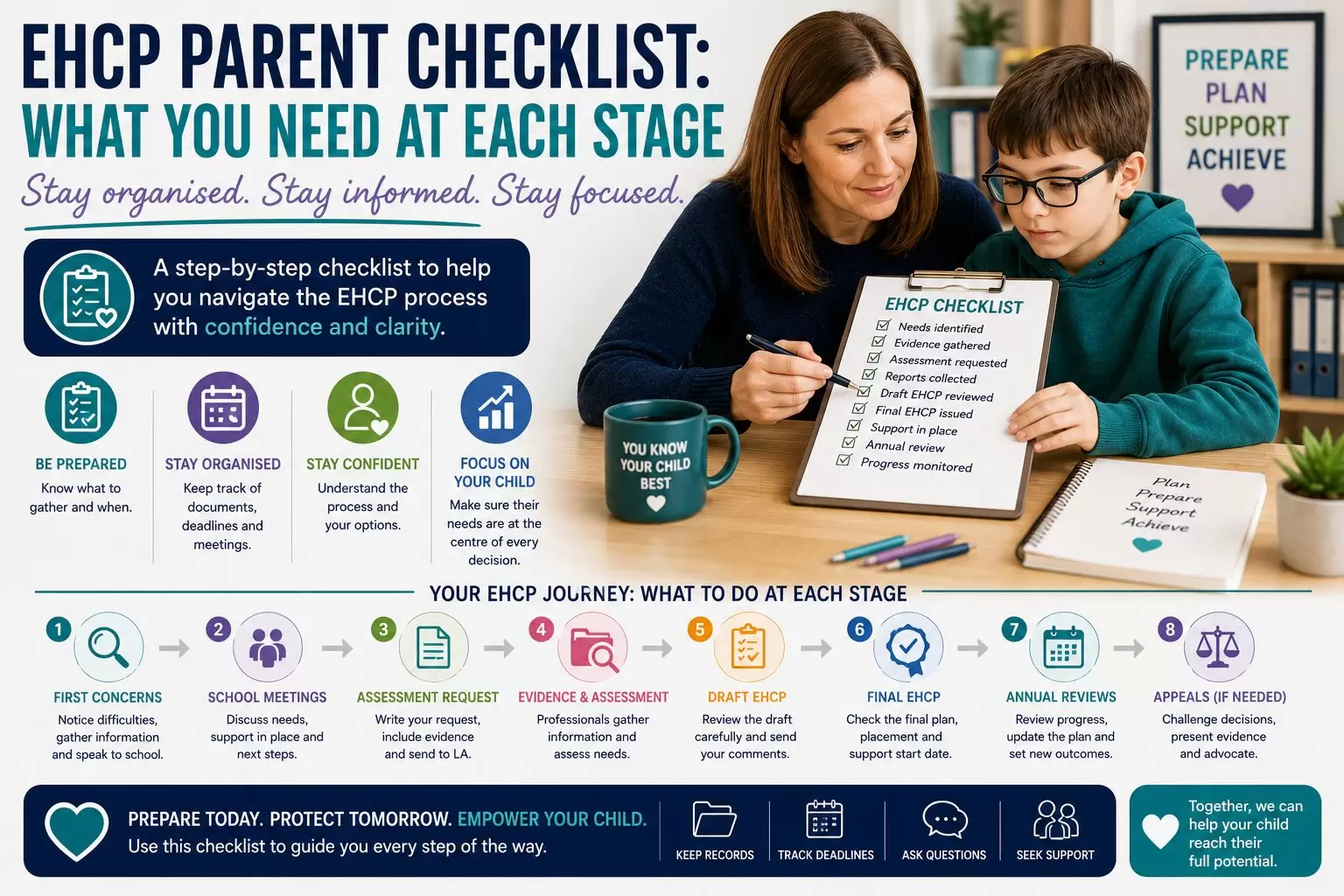
Evidence Checklist for Parents
Before submitting your request, check whether you have included the most relevant available evidence.
Child and Parent Evidence
- parent statement;
- child or young person’s views;
- developmental history;
- home diary or chronology;
- examples of daily support.
School Evidence
- SEN Support plans;
- assess, plan, do and review records;
- provision maps;
- progress and attainment data;
- teacher or SENCO observations;
- attendance records;
- behaviour, incident or exclusion records;
- meeting notes.
Professional Evidence
- educational psychology;
- speech and language therapy;
- occupational therapy;
- ADHD or autism assessments;
- medical evidence;
- mental health evidence;
- social care information.
Application Documents
- written EHC needs assessment request;
- evidence index;
- concise evidence summary;
- clearly named attachments;
- proof of submission.
Not every family will have every item. Submit what is relevant and available.
How School of Diversity Can Help
Our EHCP evidence support can include:
- reviewing the evidence you already hold;
- identifying significant gaps;
- explaining which documents are most relevant;
- preparing a parent statement;
- creating an evidence index;
- organising the bundle;
- producing an evidence summary;
- linking needs to educational impact;
- preparing an EHC needs assessment request;
- helping you respond to a refusal to assess.
Frequently Asked Questions
How Much Evidence Do I Need?
There is no fixed number of documents.
The evidence should be sufficient to explain the child’s needs, educational impact, existing support and why an assessment may be necessary.
Do I Need an Educational Psychologist’s Report?
No. It may be helpful, but it is not a prerequisite for requesting an EHC needs assessment.
Does My Child Need a Diagnosis?
No. EHCP decisions are based on special educational needs and required provision, not diagnosis alone.
Can Parent Evidence Be Used?
Yes. Parents have important information about their child’s history, functioning, support needs and experiences outside school.
Can I Use Emails as Evidence?
Yes, where they demonstrate concerns, requests, incidents, support arrangements or responses from the school or local authority.
Should I Include Every School Report?
Include reports that add relevant information. Avoid unnecessary duplication.
What if My Evidence Is Old?
Older evidence can remain useful where it shows longstanding needs, but explain whether the findings are still relevant and add updated evidence where possible.
Can I Apply Before All Assessments Are Complete?
Yes. You can apply using the information currently available.
Will Strong Evidence Guarantee an EHCP?
No. Evidence can strengthen and clarify the request, but it cannot guarantee a particular local-authority or tribunal decision.
Get Help Organising Your EHCP Evidence
You do not need to submit the largest possible bundle.
You need a clear account of your child’s needs, the effect on education, the support already tried and why a formal assessment may now be necessary.
School of Diversity can review your documents, identify gaps and help prepare a coherent evidence submission.
Important Information
This page concerns the Education, Health and Care Plan framework in England.
School of Diversity provides SEND advocacy, evidence review and document-preparation support. Outcomes cannot be guaranteed.
Unless expressly confirmed otherwise, the service does not constitute representation by a solicitor or barrister and is not a substitute for regulated legal advice.
Parents and young people remain responsible for meeting local-authority, mediation and tribunal deadlines.