
DLA evidence and supporting statements
Connect reports, records and everyday examples to the help your child needs.
A useful evidence pack is relevant, accurate and easy to understand. It does more than confirm a diagnosis: it explains the additional care, prompting, supervision or mobility support required.
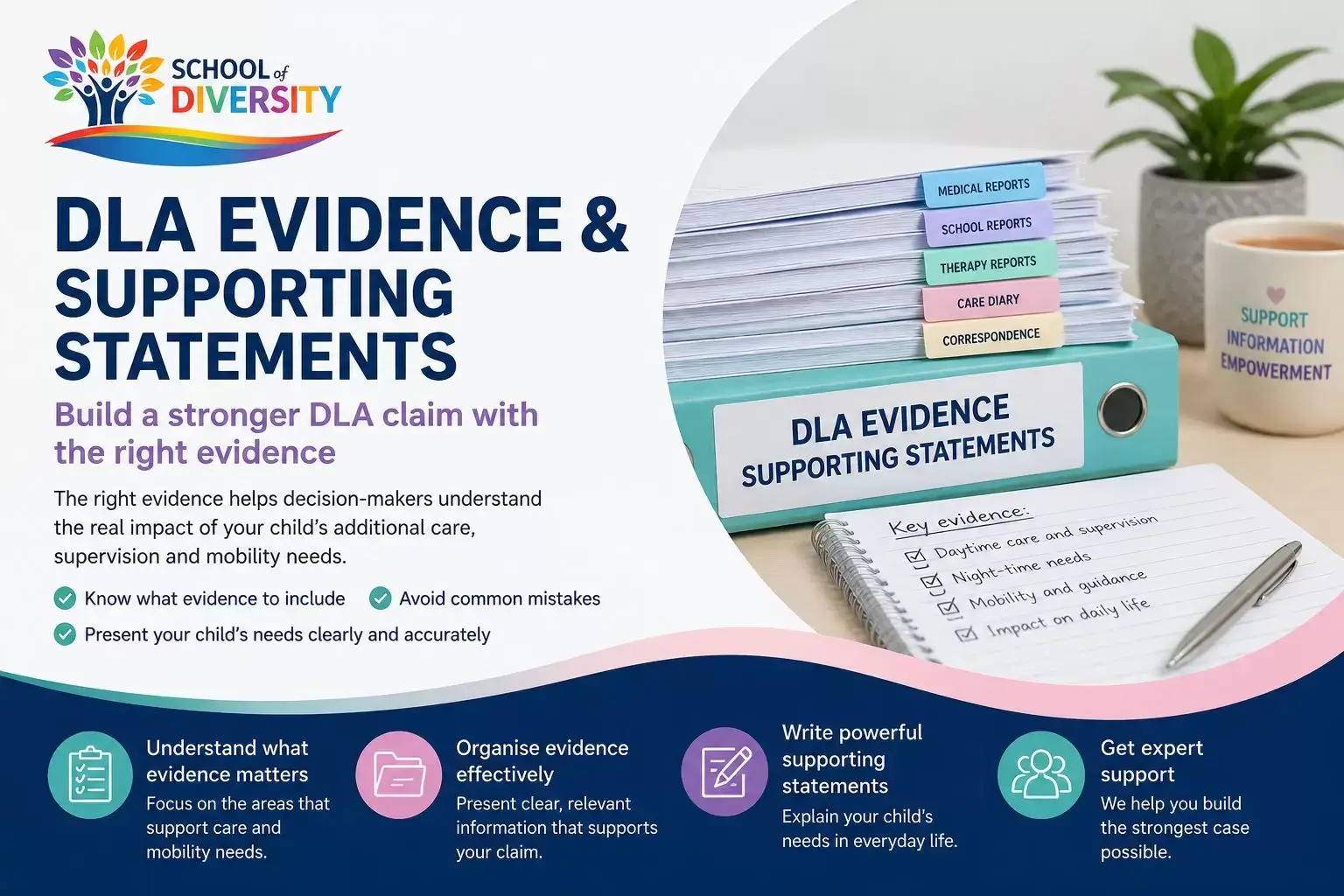
What should the evidence help explain?
The additional help
What an adult must do, why it is needed and how care needs differ from those of a child of the same age without a disability.
The pattern
Frequency, duration, variation and whether help is needed during the day, night or outdoors.
The practical impact
Safety, personal care, communication, independence and what happens without support.
No single report is compulsory for every claim. Choose evidence relevant to your child and the applicable DLA criteria. A diagnosis alone does not establish entitlement, and a large bundle is not automatically stronger.
Which documents may help?
Medical, diagnostic and therapy information
Relevant paediatric, GP, hospital, autism or ADHD assessment, neurology, mental-health, continence, physiotherapy, Occupational Therapy or Speech and Language Therapy reports may help.
Identify child-specific information about functional needs, supervision, personal care, sleep, communication, mobility and required support.
School and SENCO evidence
Consider support plans, pupil passports, risk assessments, sensory plans, attendance or incident records, school reports and SENCO correspondence.
Explain the prompts, adult assistance, supervision and adjustments actually provided and why they are needed. Being on a SEN register alone does not explain the care or mobility criteria.
Care diaries, sleep logs and everyday records
These can show support that professional reports do not capture at home. Record representative periods and include dates, help provided and the time involved.
Statements from people who know your child
A useful statement explains who the person is, their contact with your child and what they directly observe. Specific examples of support are more informative than a general endorsement of the claim.
Keep a representative care diary
Record several typical days and relevant nights. A diary can help identify support you provide automatically; it should not delay returning the claim.
Record the intervention
- Date, time and activity.
- Difficulty or risk.
- Prompting, assistance, reassurance or supervision provided.
- Frequency and duration.
- Outcome and relevant consequences without help.
Consider the full routine
Dressing, washing, toileting, meals, medication, communication, transitions, regulation, safety, leaving home and journeys.
For relevant night-time needs, note waking, intervention, monitoring, continence support and how long an adult must remain awake.
Describe easier and harder periods honestly. Do not present occasional events as daily occurrences or omit help simply because it feels normal within your family.
How to structure a parent supporting statement
A statement can bring interacting needs together, explain variation or provide space for information that does not fit neatly on the form. It should complement the answers, not replace them.
- Brief context. Identify your child, their age, your relationship and the purpose of the statement.
- Daytime care. Explain personal care, routines, communication, prompting, regulation, medication and supervision.
- Night-time needs. Describe the timing, frequency, duration and intervention required where relevant.
- Mobility. Explain walking difficulties or outdoor guidance and supervision relevant to the criteria.
- Variation and examples. Give an accurate pattern with specific incidents or routine examples.
- Evidence references. Link useful reports or records to the need they support and relevant form questions.
Useful structure: Need → help → frequency → duration → consequence. Include a date and follow the form’s instructions for identifying additional sheets.
Explain what happens without help
Prompting during dressing
Instead of only “needs prompting”, explain that repeated instructions and supervision are required because your child stops part-way through and does not finish until an adult intervenes.
Supervision outdoors
Instead of only “needs supervision”, describe the traffic risk or impulsive movement and why an adult must stay close enough to intervene.
Illustrative examples only. Use your child’s actual circumstances. Do not withhold necessary care or expose your child to risk to demonstrate a consequence.
More form-completion tipsAutism, ADHD and needs that are less visible
Evidence may need to explain executive function, impulsivity, sensory differences, regulation, communication, anxiety, transitions, sleep, toileting, restrictive eating or masking.
Physical ability to dress, wash or walk does not describe all the prompting or supervision required. Explain what an adult actually does.
No diagnosis yet?
School, GP, therapy or support-service records, diaries and parent evidence may still show relevant needs. A formal diagnosis is not a prerequisite, but the qualifying care or mobility needs and other conditions must be established.
Make differences between reports understandable
Evidence may describe different dates, settings or levels of support. Do not alter original reports to make them match. Explain the context and seek clarification where useful.
A school description of “independent in class” may refer to a structured setting with visual prompts, adult check-ins, sensory adjustments and preparation. Identify that support rather than dismissing the report.
If a report no longer reflects current needs, explain what changed and when, with relevant supporting information.
Organise the pack simply
- Completed application and a copy for your records.
- Parent statement linked to relevant questions.
- Representative care diary or sleep log where useful.
- Relevant professional reports.
- School evidence showing actual support.
- Other records that add useful information.
A short document list can identify titles, dates and the needs supported. Use report page references to help the reader find key passages while retaining context. Follow current instructions and send copies rather than original reports.
Check before sending
Compare frequency, duration, supervision, independence, sleep, toileting, communication and mobility across the form and evidence. Explain apparent differences rather than hiding them.
Common evidence mistakes
- Sending documents without explaining their relevance.
- Relying only on a diagnostic label.
- Using vague statements such as “constant support” without examples.
- Describing only the hardest days.
- Overlooking repeated prompting, checks or reassurance.
- Assuming all SEND provision demonstrates DLA eligibility.
- Submitting repetitive or generic material that adds little child-specific information.
If a claim has already been refused
Start with the decision reasons, original answers and evidence supplied. Identify the disputed care or mobility findings, then consider which details or records clarify the position at the relevant decision date.
New deterioration after the decision may require different advice from evidence explaining needs that already existed. Check challenge deadlines promptly.
Continue your DLA journey
Understand the claim
DLA parent guide Eligibility explained How to applyPrepare your answers
Completing the form Care and mobility sections DLA rates for 2026This guide mainly concerns DWP child DLA claims in England and Wales. Scotland and Northern Ireland have different arrangements. See the official form and notes for current instructions.
Need help bringing the evidence together?
We can review agreed reports, identify gaps, help structure parent evidence and connect it to the form. Scope and fees are agreed before work begins; an award cannot be guaranteed.