
Go into your school meeting with a clear plan.
Prepare the questions, evidence and priorities that matter for your child.
A meeting should leave you clearer about your child’s needs, the support being provided and what happens next. We help you prepare a focused discussion and identify the outcomes you want to agree.
Meeting preparation · Evidence review where agreed · Online attendance through supported casework.

Feel more prepared, whatever stage you have reached.
You do not need to know exactly what to ask for before contacting us.
A meeting is coming up
You want a clear agenda, useful questions and confidence presenting your main concerns.
Support is unclear
You are unsure what school provides, how often it happens or how progress is measured.
Little has changed
Previous meetings or interventions have not led to meaningful progress.
A report has recommendations
You want to discuss an ADHD, autism, dyslexia or other assessment and how its findings relate to school support.
Your child is struggling more
Anxiety, attendance, school avoidance, sensory needs or emotional wellbeing need attention.
You need a next step
You want to explore adjustments, changes to the support plan, specialist advice or whether an EHCP should be considered.
A focused meeting plan you can work from.
Depending on the service agreed, preparation can include priorities, evidence points, questions, suggested adjustments and a meeting action sheet.
Your main concerns
Identify the most important issues affecting learning, participation and wellbeing so they do not get lost in the discussion.
Relevant evidence
Choose the plans, reports, progress information, parent observations and previous actions most relevant to this meeting.
Targeted questions
Clarify provision, delivery, progress, professional recommendations and areas where more information is needed.
Requested outcomes
Prepare specific actions to discuss, with responsibilities, timescales, progress measures and a review date.
The aim: leave knowing what has been agreed, who will do it, when it will happen and how you will know whether it has helped.
Preparation, or help through the next school stage.
We confirm the work included, relevant documents and fee before you proceed.
Meeting Preparation Support
For parents who want help organising their concerns and preparing a structured discussion.
- Main concerns and meeting priorities
- Suggested questions and evidence points
- Adjustments and areas to clarify
- Suggested outcomes and a meeting action sheet
Fee confirmed for the agreed work.
A fuller document review, attendance and follow-up are included only where specifically agreed.
Ask about meeting preparationSupported SEND Casework
From £425
Support through the next agreed school stage, which can include:
- SEND review and relevant document review
- Meeting priorities, questions and requested outcomes
- Online attendance at one agreed meeting
- Support presenting key concerns
- Review of agreed actions
- An agreed follow-up communication
Scope, meeting availability and the final fee are confirmed before work begins.
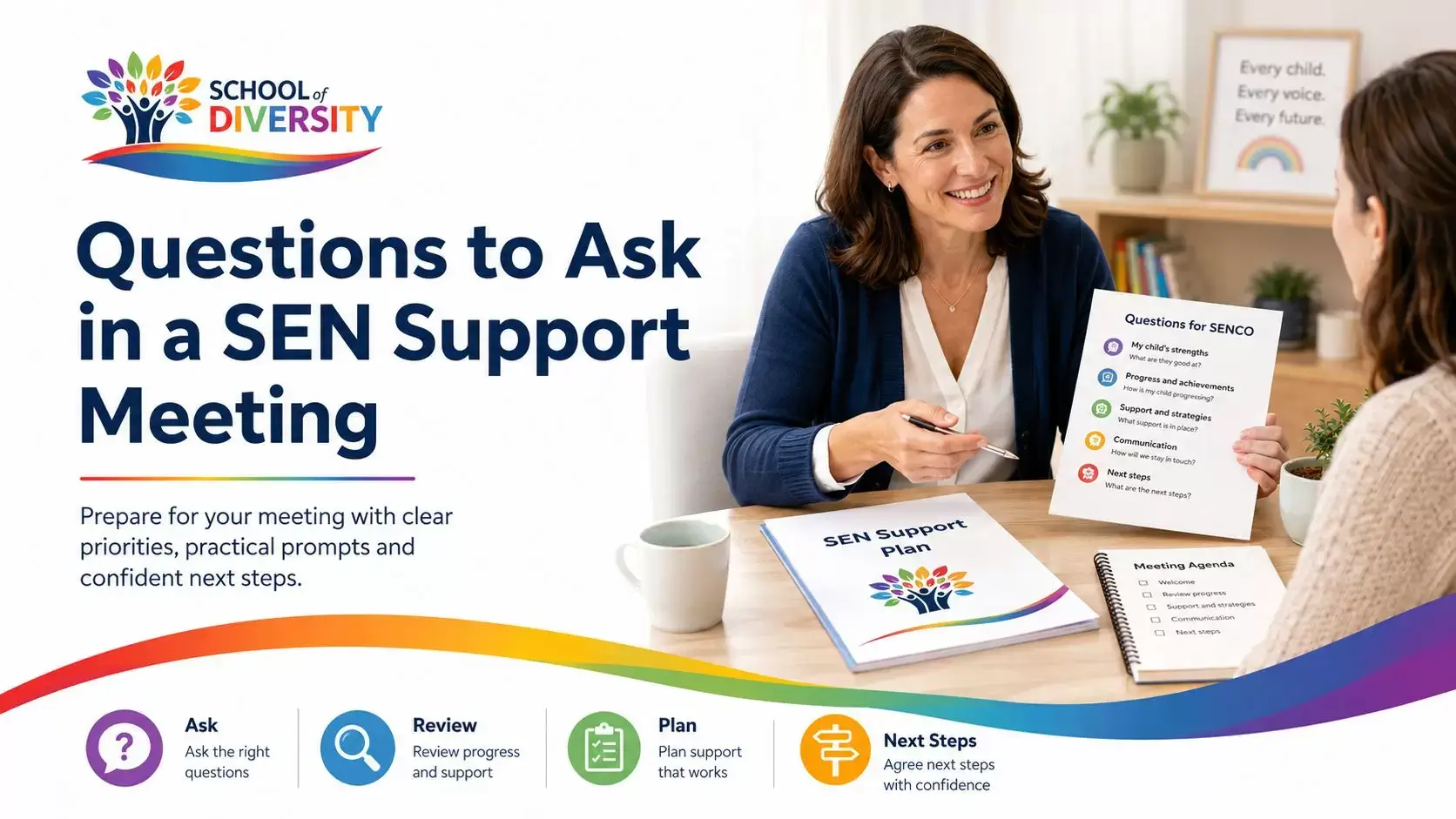
Discuss supported caseworkWhat should you ask the SENCo?
You do not need to ask every question. Choose the ones that address the gaps in your child’s current support.
Needs and SEN Support status
- Is my child formally recorded as receiving SEN Support?
- What needs and barriers has school identified?
- How have parent observations and my child’s views been considered?
- What do we still need to understand?
Provision and who delivers it
- What support is currently provided?
- How often does each intervention happen, and for how long?
- Who is responsible for delivery?
- Which professional recommendations have been implemented?
- Are there recommendations that have not been put in place, and why?
Outcomes, progress and previous interventions
- What are the intended outcomes?
- What baseline is being used?
- How is progress measured?
- What has already been tried?
- Which strategies have worked, and which have not?
- What evidence shows the impact of support?
Adjustments, wellbeing and attendance
- What adjustments are currently used?
- What additional changes could address my child’s barriers?
- How is emotional wellbeing monitored?
- How are attendance concerns being considered alongside SEND?
- What does my child tell us about the school environment?
Further advice, review dates and next steps
- Is specialist advice or further assessment needed?
- What actions will we agree today, and who is responsible?
- When will each action happen?
- When will the support plan be reviewed?
- What happens if the revised support does not improve the situation?
Use the evidence that matters.
Where included in your service, a document review helps you understand what school has recorded and where clarification may be needed.
- SEN Support plans and APDR records
- School reports, progress data and intervention records
- Attendance information
- Relevant professional assessments and recommendations
- Parent observations, emails and previous meeting notes
We consider how clearly needs are described, whether provision matches those needs and how outcomes and impact are reviewed.
Explore the SEND Review & Action PlanThe standalone written SEND Review & Action Plan is £195. Meeting attendance is agreed separately through supported casework.
Bring the APDR cycle into the discussion.
Assess
What are your child’s strengths, needs, current attainment and barriers?
Plan
What outcomes, provision, adjustments and responsibilities have been agreed?
Do
Has the planned support been delivered consistently?
Review
What difference has it made, and what should change?
Discuss adjustments linked to the barrier.
Depending on your child’s needs, discussion points might include written or visual instructions, processing time, sensory changes, movement breaks, reduced copying, different ways to record work, organisation support, predictable routines, transition support, discreet check-ins, a named adult or adapted homework.
Explore reasonable adjustments →Keep the focus on the full picture.
“They are doing fine in school.”
Discuss the support and prompting needed to maintain that performance, alongside independence, wellbeing and what happens at home.
Masking, exhaustion, anxiety or distress after school may provide important information. Quiet behaviour or expected grades do not describe every aspect of your child’s experience.
Working with school →“We have had this meeting before.”
Return to what was previously agreed. Was it delivered? What changed? What evidence shows whether it helped?
Use written records to identify what needs to be different in the next plan and when its impact will be reviewed.
When SEN Support is not working →Leave with a clear record of agreement.
Ask for the key points to be confirmed in writing so everyone understands the next steps.
Identified needs
The difficulties and barriers the plan will address.
Agreed support
What provision and adjustments will happen.
Responsibility
Who will arrange, deliver and monitor each action.
Frequency
How often support will happen, where relevant.
Outcomes
What improvement or change is being sought.
Evidence
What information will show whether support is working.
Review date
When you will meet or review progress again.
Next steps
What will be considered if support does not help.
A clear process before, during and after.
Tell us about the meeting
Share its date, purpose and your main concerns.
Agree the information
Where included, provide the relevant school and professional documents.
Identify priorities
Focus on the issues that most need attention.
Prepare your meeting plan
Organise questions, evidence points and requested outcomes.
Attend the meeting
Use the preparation yourself, or receive agreed online support through supported casework.
Confirm the actions
Record what was agreed and arrange any follow-up included in your service.
Should an EHCP be part of the discussion?
A SENCo meeting does not automatically mean an EHCP should be requested. Many children receive support through school-based SEN Support.
If needs are complex, progress remains limited, specialist provision or substantial adult help is needed, or attendance and placement concerns are increasing, it may be appropriate to review whether an EHC needs assessment should be considered.
We can help you organise the relevant evidence and questions. These indicators do not guarantee an assessment or a plan.
Your questions answered.
Can you prepare questions for my child’s SENCo?
Yes. We tailor questions to your child’s needs, current support and the relevant information available.
Can you attend the meeting?
Online attendance can be included in an agreed Supported SEND Casework package, subject to availability. It is not automatically included in standalone preparation.
Do I need to send all my child’s records?
No. We agree which documents are relevant to the meeting and what review is included before work begins.
Can you help without a diagnosis?
Yes. Preparation focuses on your child’s educational needs, barriers and support, using the information available.
Can you help me ask about adjustments?
Yes. We identify possible adjustments to discuss based on the barriers described and relevant evidence.
What if school disagrees with me?
We help you present concerns clearly, ask focused questions and refer to relevant evidence. We cannot guarantee agreement or direct the school’s decisions.
Can you help after the meeting?
Where agreed within your service, we can review the actions, identify next steps and prepare a follow-up communication.
Make your next school meeting count.
Go in with clear priorities. Come away knowing what has been agreed and what should happen next.
Tell us the meeting date.
When you enquire, include the meeting’s purpose, your main concerns and whether you want preparation only or online attendance as well. We will confirm availability and scope.
office@schoolofdiversity.com
0333 577 1179