
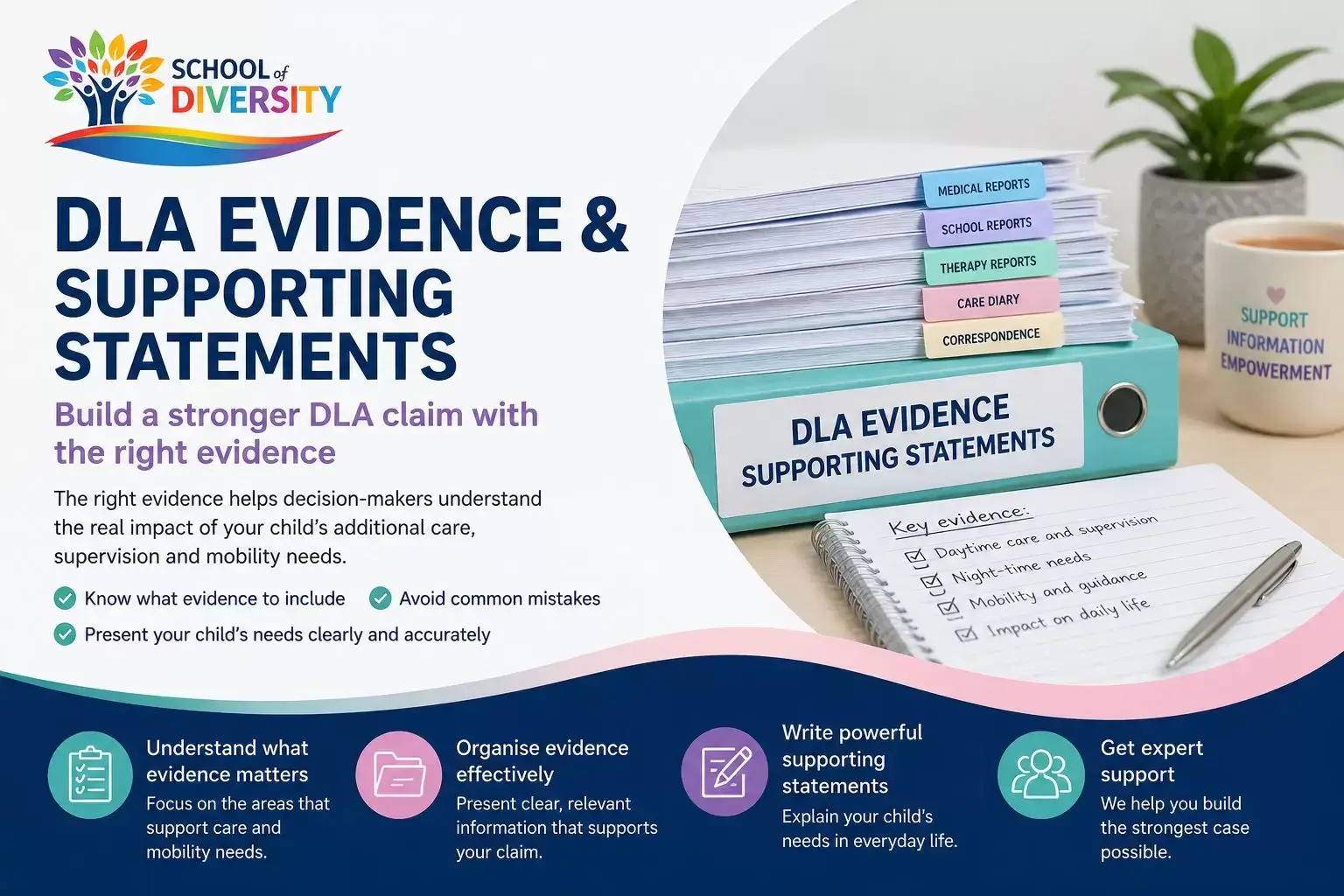
DLA Evidence & Supporting Statements for Parents
When applying for Disability Living Allowance (DLA) for a child, good supporting evidence can help the decision-maker understand the level of additional care, supervision, prompting, guidance and mobility support your child needs in everyday life.
Evidence does not need to consist of a large bundle of medical reports. What matters is whether the information is relevant, consistent and clearly connected to your child’s actual needs.
At School of Diversity, we help parents identify the evidence that may strengthen a DLA claim, organise it effectively and explain how it supports the information provided on the application form.
If you are at the beginning of your claim, visit our DLA Support for Parents hub for guidance through each stage of the process.
Why Is Supporting Evidence Important for a DLA Claim?
The person making the DLA decision does not know your child.
They will usually be making their decision using the information contained within the application form together with any supporting documents provided.
Your evidence can therefore help demonstrate:
- how much additional help your child requires;
- how often support is needed;
- how long support can take;
- what happens without adult intervention;
- whether supervision is required for safety;
- whether needs occur during the day, night or both;
- whether your child requires guidance or supervision outdoors;
- how your child’s needs affect everyday activities;
- and how their support needs differ from those of another child of the same age.
The strongest evidence does more than confirm a diagnosis. It helps show what the diagnosis, disability or difficulty means in everyday life.
For a broader explanation of the application process, read our guide to How to Apply for DLA for a Child.
What Evidence Can Support a Child's DLA Claim?
There is no single document that every parent must provide.
The most useful evidence will depend on your child’s circumstances.
Potential evidence can include:
Medical and Diagnostic Reports
Examples may include:
- paediatric reports;
- autism assessment reports;
- ADHD assessment reports;
- neurology reports;
- mental health correspondence;
- GP letters;
- hospital reports;
- continence service records;
- physiotherapy reports;
- occupational therapy reports;
- and speech and language therapy reports.
A diagnostic report can be helpful, but the diagnosis itself is only part of the picture.
Where possible, look for information within reports that describes your child’s:
- functional difficulties;
- supervision needs;
- communication;
- emotional regulation;
- sensory needs;
- safety awareness;
- personal care;
- sleep;
- mobility;
- independence;
- and support requirements.
School and SENCO Evidence
School evidence can be particularly useful because it can show how much additional support your child requires outside the home.
Relevant evidence may include:
- SEN Support Plans;
- Individual Education Plans;
- pupil passports;
- behaviour support plans;
- risk assessments;
- sensory plans;
- school reports;
- attendance information;
- records of incidents;
- communication from the SENCO;
- evidence of additional adult support;
- reasonable adjustments;
- and information about interventions.
For example, if your child requires repeated reminders, close supervision, movement breaks, emotional-regulation support or additional adult assistance at school, this may help demonstrate that the same difficulties are present across different environments.
The important point is not simply that your child receives SEND support. The evidence should help explain why that support is needed.
DLA Care Diaries
A care diary can be particularly valuable where reports do not fully capture what happens at home.
Parents often provide significant amounts of support automatically and may not initially recognise everything they do as additional care.
Recording several typical days can help identify patterns.
You might record:
- what time your child wakes;
- assistance with dressing;
- toileting support;
- washing and personal care;
- prompting required for routines;
- eating and drinking support;
- medication;
- supervision for safety;
- emotional dysregulation;
- meltdowns;
- reassurance;
- sensory support;
- help with transitions;
- difficulties leaving the house;
- supervision outdoors;
- bedtime routines;
- waking during the night;
- continence support;
- and how long each intervention takes.
Try to record what actually happens rather than what you think a DLA decision-maker wants to hear.
A detailed and accurate picture of everyday life is usually much more useful than general statements such as:
“My child needs lots of help.”
Instead, explain what help is required, how often it happens and what would happen if that support were not provided.
What Is a DLA Supporting Statement?
A supporting statement gives you an opportunity to explain your child’s needs in a more structured way.
It can be particularly helpful where:
- the DLA form does not provide enough space;
- your child’s needs are complex;
- several difficulties interact with one another;
- support varies depending on the day;
- your child masks difficulties outside the home;
- professional reports do not fully explain everyday care needs;
- or you need to bring information from several sources together.
A good supporting statement should complement the DLA form rather than simply repeat it.
What Should a DLA Supporting Statement Include?
Depending on your child’s needs, a supporting statement might cover:
Daytime Care and Supervision
Explain any additional help required with:
- getting dressed;
- washing;
- toileting;
- eating;
- medication;
- communication;
- understanding instructions;
- emotional regulation;
- transitions;
- completing routines;
- safety;
- impulsivity;
- and supervision.
Night-Time Needs
Where relevant, explain:
- how often your child wakes;
- whether they need reassurance;
- whether they require toileting or continence support;
- whether they need help returning to sleep;
- whether they wander;
- whether they require monitoring for safety;
- and approximately how long interventions take.
Mobility and Getting Around
Depending on your child’s circumstances, this may include:
- physical walking difficulties;
- fatigue;
- pain;
- behavioural difficulties outdoors;
- poor danger awareness;
- impulsivity;
- difficulties following routes;
- becoming overwhelmed;
- running away;
- or the need for close adult guidance and supervision.
For more detail on these areas, see our guide to the DLA Care and Mobility Sections.
Explain What Happens Without Support
One of the most useful ways of explaining additional needs is to describe what happens when the support is not provided.
For example:
Instead of:
“She needs prompting to get dressed.”
You might explain:
“She requires repeated verbal prompts and adult supervision throughout dressing. Without this, she becomes distracted, stops part-way through the task and may remain undressed until an adult intervenes.”
Instead of:
“He needs supervision outside.”
You might explain:
“He has limited awareness of traffic danger and can move impulsively towards the road. An adult must remain close enough to intervene immediately when walking near traffic.”
The aim is not to exaggerate difficulties. It is to make invisible support visible to the person reading the claim.
Our guide to Completing the DLA Form for Your Child explains this approach in more detail.
Compare Your Child With Another Child of the Same Age
One of the most important principles when completing a child’s DLA claim is recognising that many children require some level of parental care.
The relevant issue is whether your child requires substantially more attention, supervision or assistance than would normally be expected for another child of the same age.
This makes age comparison particularly important.
For example, a younger child may normally need reminders to get dressed.
However, an older child who requires:
- every item of clothing laid out;
- repeated prompts;
- step-by-step instructions;
- physical assistance;
- supervision;
- and emotional support
may have needs that go significantly beyond what would usually be expected for their age.
For more information about eligibility, read Who Can Qualify for DLA?.
Evidence for Children With Autism or ADHD
DLA claims involving autism or ADHD can require particularly careful explanation because some of the child’s most significant needs may not involve physical assistance.
Additional support can arise from:
- impulsivity;
- poor danger awareness;
- executive-functioning difficulties;
- emotional dysregulation;
- sensory processing differences;
- communication difficulties;
- anxiety;
- difficulties with transitions;
- sleep difficulties;
- toileting;
- restrictive eating;
- masking;
- and the need for substantially more prompting or supervision.
A child may be physically capable of dressing, washing or walking while still needing extensive adult involvement to complete those activities safely, reliably and consistently.
Read our guide to Common DLA Claim Mistakes for Children With ADHD or Autism for further guidance.
What If My Child Does Not Have a Diagnosis?
A formal diagnosis can provide useful evidence, but a DLA claim should focus on the child’s actual care and mobility needs.
If your child is awaiting assessment or does not yet have a formal diagnosis, you may still have valuable evidence from:
- school;
- the SENCO;
- your GP;
- paediatrics;
- therapists;
- support services;
- behaviour records;
- care diaries;
- and your own detailed account of everyday difficulties.
Do not assume that having no diagnosis means there is nothing to evidence.
The key question is what additional support your child needs and whether those difficulties are expected to meet the relevant DLA requirements.
Common DLA Evidence Mistakes
Sending Evidence Without Explaining It
A large bundle of reports does not automatically create a stronger claim.
Highlight the information that supports the needs described in the application.
Focusing Only on Diagnosis
A diagnosis may explain why difficulties occur.
The DLA form still needs to explain what support your child actually requires.
Only Describing the Worst Days
Your application should give an accurate picture of your child’s needs over time.
If needs fluctuate, explain:
- what an average day looks like;
- how often more difficult days occur;
- and what additional intervention is required when difficulties increase.
Underestimating Everyday Support
Parents often become accustomed to:
- reminding;
- prompting;
- checking;
- supervising;
- preparing;
- reassuring;
- redirecting;
- anticipating;
- and preventing problems.
Because these interventions have become normal within family life, they can easily be overlooked when completing the claim.
Using Vague Statements
Statements such as:
- “needs constant support”;
- “has no danger awareness”;
- “has lots of meltdowns”;
- or “doesn’t sleep”
need further explanation.
Whenever possible explain:
What happens? How often? How long does it last? What do you have to do? What happens without intervention?
How to Organise Your DLA Evidence
ou do not need to make the evidence unnecessarily complicated.
A simple structure can work well.
1. DLA Application Form
Keep a copy of the completed claim.
2. Parent Supporting Statement
Use this to bring the main care and mobility needs together.
3. Care Diary
Where useful, include a representative diary showing everyday support.
4. Professional Evidence
Arrange relevant reports logically.
5. School Evidence
Include documents that demonstrate additional support and supervision.
6. Additional Records
This could include relevant correspondence, incident records, sleep information or other evidence that supports the claim.
Consider numbering documents or creating a simple evidence list if you are providing several items.
Does More Evidence Mean a Better DLA Claim?
Not necessarily.
Relevant evidence is more valuable than volume.
A 40-page report that contains one paragraph relevant to the DLA criteria may be less useful than a concise school statement clearly describing the supervision your child requires throughout the day.
Ask yourself:
What does this document prove about my child’s additional care, supervision, guidance or mobility needs?
If you cannot identify the answer, consider whether it adds anything meaningful to the application.
Make Sure Your Evidence Is Consistent With the DLA Form
Before sending your application, compare the supporting evidence with what you have written on the form.
Look for consistency around:
- frequency;
- duration;
- supervision;
- independence;
- sleep;
- toileting;
- behaviour;
- danger awareness;
- mobility;
- communication;
- and school support.
Small differences are normal because reports are written at different times and for different purposes.
However, if something appears contradictory, it can be useful to explain why.
For example, a school report saying a child is “independent in class” may need context if that independence is only possible because of:
- visual prompts;
- structured routines;
- adult check-ins;
- reduced demands;
- sensory adjustments;
- or significant preparation before tasks.
Evidence After a DLA Refusal
If your child’s claim has already been refused, evidence becomes particularly important.
Start by looking carefully at the decision and identifying what the DWP appears not to have accepted or understood.
You can then consider whether:
- the original application lacked detail;
- a care need was underestimated;
- supporting evidence was missing;
- frequency or duration was unclear;
- night-time needs were not explained sufficiently;
- mobility difficulties were misunderstood;
- or important information needs to be clarified.
Read our guide to DLA Refused – Common Reasons and How to Appeal.
If the decision needs to be formally challenged, you may also wish to explore our DLA Mandatory Reconsideration Support.
Professional DLA Evidence and Application Support
At School of Diversity, we can help parents turn a collection of reports, observations and everyday experiences into a clearer picture of their child’s additional needs.
Depending on the support required, this can include:
- reviewing existing evidence;
- identifying potentially important gaps;
- helping you recognise additional care and supervision needs;
- reviewing school and professional reports;
- helping structure a parent supporting statement;
- identifying information relevant to care and mobility;
- helping organise evidence;
- reviewing how evidence relates to answers on the DLA form;
- and helping parents prepare a clearer and more comprehensive claim.
The aim is not to make your child’s needs sound worse than they are.
It is to make sure the application accurately reflects the support you actually provide.
Need Help With Your Child’s DLA Claim?
If you would like professional support with the wider application, visit our DLA Application Support page.
Or return to our main DLA resource centre:
Continue Your DLA Journey
You may also find these guides helpful:
- DLA Support for Parents
- DLA for Children – Parent Guide
- Who Can Qualify for DLA?
- How to Apply for DLA for a Child
- Completing the DLA Form for Your Child
- DLA Care and Mobility Sections
- Common DLA Claim Mistakes for Children With ADHD or Autism
- DLA Rates for Children 2026
- DLA Refused – Common Reasons and How to Appeal