

Specialist SEND Support
Practical support focused specifically on SEND, EHCPs and education.
Evidence-Led
We look at what the evidence actually establishes — and what may still be missing.
Neurodiversity-Informed
Experienced in autism, ADHD, sensory needs, masking, anxiety and complex educational profiles.
Support Across England
Document review, consultation and case preparation can be provided remotely.
EHCP Appeal and SEND Tribunal Support
Clear, Structured Support When an EHCP Dispute Needs to Go Further
If you disagree with a local authority decision about your child’s Education, Health and Care Plan and the issue cannot be resolved through discussion or mediation, you may have a right of appeal to the Special Educational Needs and Disability Tribunal.
For many parents, this is the point where the EHCP process begins to feel significantly more formal.
There may be:
- statutory deadlines;
- appeal forms;
- professional reports;
- disputed EHCP sections;
- local authority responses;
- evidence bundles;
- case-management directions;
- working documents;
- witness evidence;
- and preparation for a Tribunal hearing.
School of Diversity provides EHCP Appeal and SEND Tribunal Support to help parents understand what is being challenged, organise the evidence and prepare a clear, structured case.
Our focus is not simply on producing more paperwork.
It is on identifying:
What decision are you challenging?
What evidence supports your case?
What outcome are you asking the Tribunal to order?
What Is the SEND Tribunal?
The Special Educational Needs and Disability Tribunal is part of the First-tier Tribunal.
It is independent of the local authority.
The Tribunal can determine certain disputes relating to Education, Health and Care assessments and plans.
Depending on the decision being appealed, this can include disputes about:
- whether an EHC needs assessment should take place;
- whether an EHCP should be issued;
- the special educational needs described in an EHCP;
- the special educational provision specified in the plan;
- the educational placement named;
- amendments following review;
- or a decision to cease an EHCP.
The Tribunal does not simply review whether the local authority followed its own preferred process.
It considers the evidence and determines the appeal within its jurisdiction.
When Might You Need SEND Tribunal Support?
Our support may be appropriate if the local authority has:
- refused to carry out an EHC needs assessment;
- refused to issue an EHCP following assessment;
- issued a final EHCP which does not properly describe your child’s needs;
- issued a final EHCP with vague or inadequate Section F provision;
- named a school or college you believe is unsuitable;
- refused your preferred placement;
- declined to amend an EHCP following annual review;
- decided to cease an EHCP;
- failed to resolve important issues through mediation;
- or issued another appealable EHCP decision that you wish to challenge.
You may also benefit from support if you have already registered an appeal and now need help organising the case.
What Can Be Appealed?
The precise right of appeal depends on the decision made by the local authority. Common EHCP appeals include:
Refusal to Assess
The local authority has refused to carry out an EHC needs assessment.
Refusal to Issue
An EHC needs assessment has taken place, but the local authority has decided not to issue an EHCP.
Section B – Special Educational Needs
You believe the final plan does not accurately or fully describe the child or young person's special educational needs.
Section F – Special Educational Provision
You believe the provision is insufficient, vague, unquantified or inconsistent with professional recommendations.
Section I – Placement
You disagree with the school, college or type of setting named in the EHCP.
Refusal to Amend
Following review, the local authority has decided not to make the amendments you consider necessary.
Ceasing an EHCP
The local authority has decided that the EHCP is no longer required. The evidence and strategy needed will depend substantially on the type of appeal.
Tribunal Cases Are Built Around Issues, Evidence and Outcomes
A SEND Tribunal appeal should not simply become a chronological account of everything that has gone wrong.
A stronger approach is usually:
Issue → Evidence → Tribunal Outcome
For each disputed point, ask:
What is the issue?
For example:
Section F does not specify the frequency of Speech and Language Therapy.
What evidence supports the appeal?
For example:
The SALT report recommends a direct 45-minute session every fortnight and a staff programme reviewed half-termly.
What outcome are you seeking?
For example:
Amend Section F to specify the direct therapy and indirect programme recommended by the Speech and Language Therapist.
That gives the Tribunal a clear dispute to determine.
This structured approach sits at the centre of our Tribunal preparation.
Appealing Section B – Special Educational Needs
Section B should accurately describe all of the child or young person’s special educational needs.
Appeals can arise because:
- significant needs are missing;
- professional findings have been reduced to vague summaries;
- sensory needs are omitted;
- communication needs are understated;
- executive-function difficulties are absent;
- anxiety-related educational needs are not properly described;
- emotional-regulation needs are minimised;
- learning needs are incomplete;
- masking or presentation across environments is not reflected;
- or the educational impact of diagnosed conditions is inadequately explained.
We can compare Section B with the professional evidence and help identify the wording that remains disputed.
Appealing Section F – Special Educational Provision
Section F is often central to EHCP appeals.
A child may have substantial professional evidence but still receive wording such as:
- “access to support”;
- “regular opportunities”;
- “as required”;
- “when necessary”;
- “up to”;
- “adult support available”;
- or “opportunities to develop”.
The problem is that these phrases may not clearly establish:
- what will be provided;
- how often it will happen;
- how long it will last;
- who will deliver it;
- what group size is required;
- what professional oversight is necessary;
- what training staff need;
- or how a recommended intervention will actually operate.
We can help identify where professional recommendations and Section F wording diverge and prepare the disputed provision in a clear form.
Appealing Section I – School or College Placement
Placement appeals can involve substantial evidential and strategic questions.
You may be arguing that:
- the named school cannot meet need;
- your preferred school can meet need;
- mainstream provision is unsuitable;
- specialist provision is required;
- the local authority has relied too heavily on cost;
- a consultation response is inaccurate;
- environmental requirements have not been considered;
- or the current placement has broken down.
A placement case should generally connect:
Needs → Provision → Environment → Placement
The stronger question is not simply:
“Which school do the parents prefer?”
It is:
“Which placement can actually meet the child or young person’s identified needs and deliver the provision they require?”
Our dedicated EHCP Placement Support service can also help before a dispute reaches Tribunal.
Do Not Miss the SEND Tribunal Appeal Deadline
In most EHCP appeals, you must first consider mediation and obtain a mediation certificate before registering the appeal.
You do not necessarily have to participate in mediation.
You can receive mediation advice and decide not to proceed with a mediation meeting.
There is an important exception where the appeal is only about Section I — the school, college or other placement named in the EHCP.
For a placement-only appeal, you do not normally have to obtain a mediation certificate.
However, where Sections B or F are also being appealed, the mediation requirements generally apply.
Do Not Miss the SEND Tribunal Appeal Deadline
Appeal deadlines are extremely important.
An appeal must normally be received by the Tribunal within the later of:
Two months from the date of the local authority decision letter
or
One month from the date of the mediation certificate.
Do not assume that:
- ongoing discussions;
- school consultations;
- emails with the caseworker;
- promises to reconsider;
- annual review discussions;
- or informal negotiations
automatically stop the appeal clock.
Record the deadline as soon as you receive the decision.
If you are unsure whether you intend to appeal, it is still important to understand the deadline before it expires.
How Do You Register a SEND Tribunal Appeal?
Appeals about EHC plan decisions can currently be submitted using the HMCTS SEND35 appeal process.
There is also an online route for submitting the appeal.
Depending on the appeal, you will normally need information including:
- the local authority decision being challenged;
- the relevant decision letter;
- the mediation certificate where required;
- the grounds of appeal;
- relevant supporting evidence;
- information about the child or young person;
- and details of the outcome you are seeking.
The appeal should explain why you say the local authority’s decision should be changed rather than simply stating that you disagree.
What Are Grounds of Appeal?
The grounds of appeal are the reasons you say the local authority decision is wrong or the EHCP requires amendment.
Strong grounds usually connect:
The disputed decision
to
the evidence
to
the outcome sought.
For example:
Weak Ground
“We do not agree with Section F because our child needs more support.”
More Focused Ground
“Section F does not incorporate the Educational Psychologist’s recommendation for daily structured literacy intervention. The final report dated [date] recommends a 30-minute evidence-based intervention five times each week, whereas the EHCP states only that the child will have access to literacy support. We seek amendment of Section F to specify the recommended frequency and duration.”
That makes the disputed issue much easier to understand.
What Evidence Can Be Used in a SEND Tribunal Appeal?
- the final EHCP;
- draft EHCPs;
- the local authority decision letter;
- Educational Psychologist reports;
- Speech and Language Therapy reports;
- Occupational Therapy reports;
- specialist teacher reports;
- autism or ADHD assessment reports;
- paediatric evidence;
- school SEN records;
- provision maps;
- progress data;
- attendance records;
- suspension records;
- reduced timetable evidence;
- incident logs;
- annual review documents;
- correspondence;
- placement consultations;
- school responses;
- parental statements;
- the child or young person’s views;
- witness statements;
- and other relevant professional evidence.
The important point is not how many documents you submit.
It is whether the documents prove the issues in dispute.
Evidence Should Have a Purpose
Before relying on a document, ask:
What does this evidence establish?
Does it show:
- an identified need?
- a required provision?
- the frequency of an intervention?
- a placement requirement?
- academic impact?
- sensory impact?
- communication difficulties?
- attendance deterioration?
- placement breakdown?
- inability of a setting to meet need?
Evidence without a clear connection to the dispute can make a case harder to navigate.
We therefore help parents identify priority evidence rather than simply creating the largest possible bundle.

Do I Need New Professional Evidence?
Not necessarily.
Sometimes the existing evidence is already strong but has not been accurately reflected in the EHCP.
In other cases there may be a genuine evidential gap.
For example:
- no recent Educational Psychologist evidence;
- no Speech and Language assessment;
- sensory needs identified but no Occupational Therapy evidence;
- a placement dispute without professional evidence about environmental requirements;
- or significant changes since the existing reports were completed.
The question should be:
What fact or disputed issue would the new assessment help establish?
Professional evidence should be obtained for a reason rather than simply because Tribunal proceedings have begun.
What Happens After the Appeal Is Registered?
Once the appeal has been registered, the Tribunal process becomes more structured.
Depending on the type of appeal, this can include:
- formal registration of the appeal;
- case-management directions;
- a timetable for evidence;
- the local authority’s response;
- exchange of evidence;
- amendment discussions;
- working documents in EHCP-content appeals;
- witness arrangements;
- potential case-management applications;
- and preparation for the final hearing or determination.
The exact procedure will depend on the appeal.
Tribunal directions should be read carefully and deadlines recorded.

What Is the Working Document?
In appeals concerning the contents of an EHCP, the parties may use a working document.
This is a version of the EHCP that shows the wording each party:
- agrees;
- wants removed;
- wants added;
- or continues to dispute.
The working document can become one of the most important documents in an appeal concerning Sections B, F or I.
It should make clear:
What wording has been agreed?
What wording is still disputed?
What exact wording is each party proposing?
A poorly organised working document can make an already complex appeal much harder to understand.
We can help parents review proposed amendments and keep the focus on the evidence supporting each outstanding point.
Tribunal Appeals Can Narrow Over Time
Registering an appeal does not mean every issue must remain disputed until the hearing.
During the process, the local authority may agree:
- changes to Section B;
- additional Section F provision;
- therapy wording;
- further assessment;
- amendments to outcomes;
- or a different placement.
Where agreement is reached, the outstanding issues can be narrowed.
This can be a positive development.
A focused case involving three genuinely disputed issues is often easier to present than a case where twenty historic disagreements are retained unnecessarily.
What Is a Witness?
A witness provides evidence relevant to the dispute.
Depending on the case, witnesses might include:
- a parent;
- Educational Psychologist;
- Speech and Language Therapist;
- Occupational Therapist;
- SENCO;
- teacher;
- specialist practitioner;
- placement representative;
- or another relevant professional.
The value of a witness depends on what evidence they can provide.
You should understand:
What issue will this witness address?
and
Why is their evidence necessary?
Not every professional report writer must automatically become a witness.
Preparing a Parent Witness Statement
Parent evidence can be extremely important.
Parents often have evidence about:
- what happens outside school;
- how much support their child actually requires;
- distress before or after school;
- masking;
- attendance;
- dysregulation;
- homework;
- sleep;
- independence;
- transition difficulties;
- communication;
- placement breakdown;
- and the impact of unmet provision.
A parent statement should usually be evidence-focused rather than becoming a general account of every difficulty experienced with the local authority.
Where possible, connect the evidence to the issues being appealed.
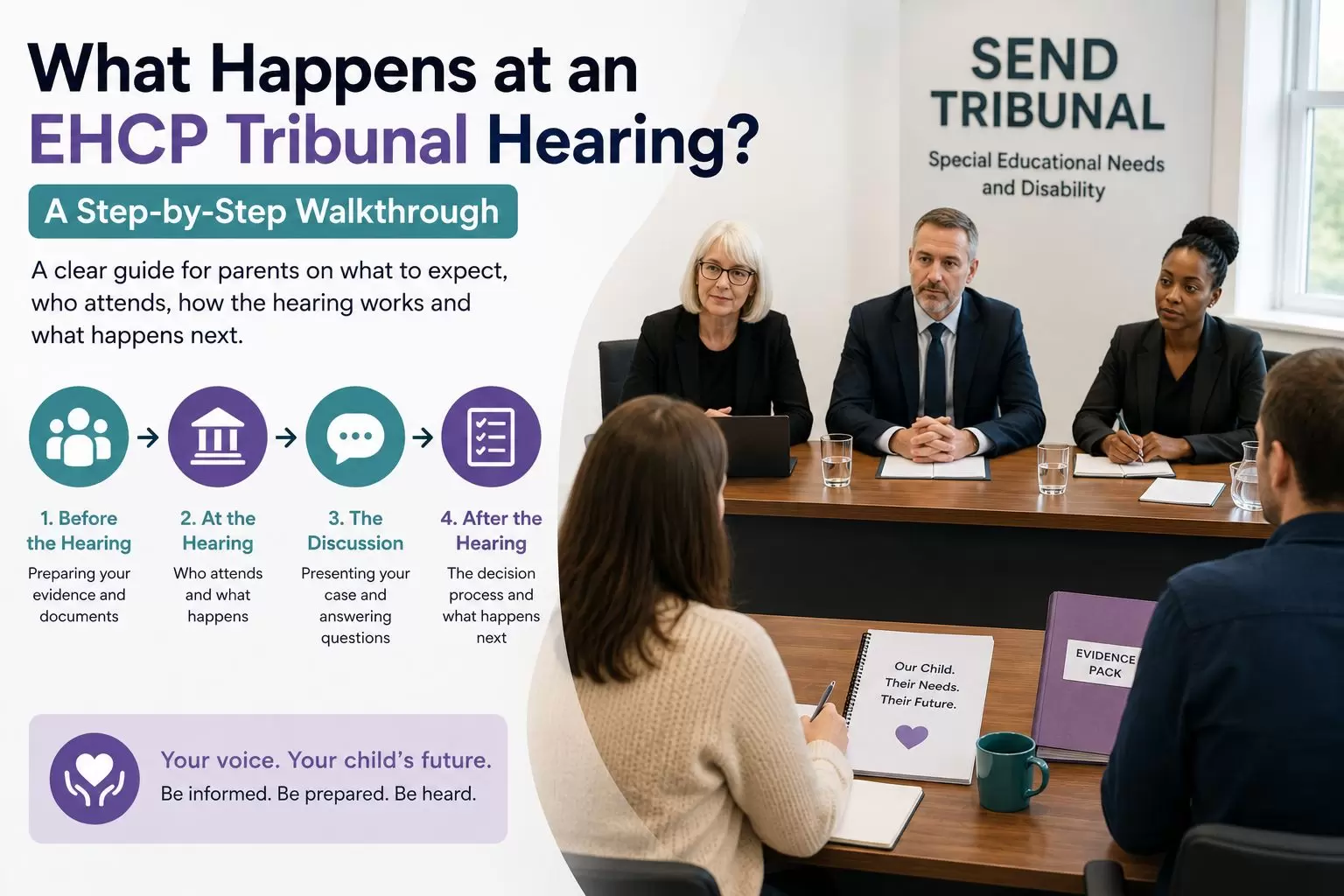
What Happens at a SEND Tribunal Hearing?
A SEND Tribunal hearing is more formal than mediation, but it is designed to allow the Tribunal to understand the evidence and determine the appeal.
A Tribunal panel may:
- ask questions of parents;
- ask questions of local authority representatives;
- question witnesses;
- examine professional evidence;
- discuss disputed EHCP wording;
- consider placement evidence;
- and clarify the outcomes each party seeks.
Parents should therefore understand their case rather than relying only on a written bundle.
You should be able to explain:
What your child’s needs are
What provision is required
What evidence supports that position
What remains disputed
and
What you want the Tribunal to decide.
Paper Hearings and Oral Hearings
Some appeals may be determined on the papers, while others proceed to an oral hearing.
The appropriate format depends on the circumstances and Tribunal arrangements.
An oral hearing can be particularly important where:
- significant factual disputes exist;
- witnesses need to be questioned;
- professional evidence conflicts;
- placement suitability is disputed;
- or the parent needs to explain evidence directly.
A paper determination may be appropriate in some more focused cases where the issues and evidence are sufficiently clear from the documents.
The decision about hearing format should be considered in the context of the individual case.
What If the Local Authority Makes an Offer Before the Hearing?
Local authorities sometimes propose amendments or settlements during the appeal process.
Do not assess an offer only by whether it sounds positive.
Compare it with:
- the professional evidence;
- the actual wording requested;
- the remaining disputed issues;
- and the outcome needed for the child.
Ask:
Does the offer genuinely resolve the issue?
For example, changing:
“access to literacy support”
to
“regular literacy intervention”
may still leave the frequency and duration unclear.
The question is not simply whether the wording changed.
It is whether the problem was actually resolved.
When Should an Appeal Be Withdrawn?
An appeal should normally only be withdrawn once you are satisfied that the disputed issues have genuinely been resolved or there is another clear reason not to proceed.
Where agreement has been reached, check:
- the exact wording;
- whether all disputed sections have been addressed;
- what placement will be named;
- what action the local authority has committed to;
- and whether the agreement has been properly recorded.
Do not withdraw solely because discussions are ongoing if the important issues remain unresolved.
What Happens After the Tribunal Decision?
The Tribunal will issue its decision following determination of the appeal.
Where the Tribunal orders amendments or another action within its jurisdiction, the local authority must comply with the order in accordance with the applicable statutory requirements.
The decision should be read carefully so that parents understand:
- what was decided;
- what changes were ordered;
- what the local authority must now do;
- and what implementation should follow.
A Tribunal decision is legally binding on the parties.
Our SEND Tribunal Support
Initial Appeal Review
Review of:
- the local authority decision;
- appeal rights;
- relevant EHCP sections;
- mediation position;
- and initial evidence.
Grounds of Appeal Support
Help identifying:
- the disputed issues;
- supporting evidence;
- weaknesses in the local authority decision;
- and the outcomes being sought.
Evidence Review and Organisation
Support identifying:
- priority evidence;
- evidential gaps;
- key professional recommendations;
- and evidence relevant to each ground.
EHCP Working Document Support
Where Sections B, F or I are appealed, support reviewing:
- local authority amendments;
- agreed wording;
- disputed wording;
- and proposed replacement wording.
Parent Evidence
Support preparing a clear parental statement focused on the Tribunal issues.
Case Strategy
Help understanding:
- what remains in dispute;
- what further evidence may be needed;
- whether an offer resolves the case;
- and what should remain a priority.
Hearing Preparation
Preparation may include:
- reviewing the final disputed issues;
- organising key documents;
- identifying likely questions;
- preparing points for the hearing;
- and helping the parent understand the case they will need to explain.
The precise scope will depend on the complexity and stage of the appeal.
Refusal to Assess Appeals
A refusal to assess appeal is different from a dispute about the contents of an existing EHCP.
The central issue is whether the legal threshold for an EHC needs assessment is met.
Evidence may include:
- SEN Support already provided;
- lack of progress;
- increasing support requirements;
- school evidence;
- professional assessments;
- attendance difficulties;
- emotional or sensory barriers;
- repeated intervention;
- and evidence that the child may require special educational provision through an EHCP.
If your case is still at the refusal stage, our dedicated EHCP Refusal to Assess Support service may be the most appropriate starting point.
Refusal to Issue Appeals
A refusal to issue appeal arises where the local authority has completed an EHC needs assessment but decided that an EHCP is not necessary.
The case may involve evidence showing that:
- the child’s needs require coordinated special educational provision;
- existing SEN Support is insufficient;
- provision cannot reasonably be secured through ordinary arrangements;
- substantial professional recommendations exist;
- or the child requires provision that needs to be specified and secured through an EHCP.
Because an assessment has already taken place, there may be substantial professional evidence available.
The task is often to demonstrate what that evidence means for the level and nature of provision required.
Section B and F Appeals
Where a final EHCP has been issued but is inadequate, it may be necessary to appeal both Section B and Section F.
This matters because:
Section B identifies the needs.
Section F specifies the provision required to meet them.
If an important need is missing from Section B, the provision required to address it may also remain absent or weakened.
Appealing only the wording of Section F may therefore fail to address the underlying omission.
The sections should be considered together.
Placement Appeals and Section I
Placement disputes can be especially complex because the suitability of the school may depend on what Sections B and F actually require.
For example:
If Section F does not specify:
- class-size requirements;
- specialist teaching;
- therapy;
- staff expertise;
- regulation provision;
- environmental requirements;
- or adult support,
it can become harder to demonstrate why one setting can meet need and another cannot.
This is why placement strategy should begin with the EHCP itself.
Health and Social Care Recommendations
Where an appeal concerns specified educational aspects of an EHC plan, the Tribunal may also have powers to make non-binding recommendations concerning certain health and social care aspects of the plan.
These recommendations are different from the binding educational orders the Tribunal can make.
Whether health or social care issues should be included will depend on the facts and scope of the appeal.
Common SEND Tribunal Mistakes
Parents can weaken an otherwise strong case by:
- missing the appeal deadline;
- appealing the wrong decision;
- failing to identify the disputed EHCP sections;
- submitting large volumes of irrelevant evidence;
- focusing primarily on poor local authority behaviour rather than the legal dispute;
- relying on diagnosis without showing educational need;
- requesting provision without professional or other supporting evidence;
- failing to state the exact amendment required;
- concentrating on school preference without establishing placement suitability;
- failing to challenge Section B where relevant needs are absent;
- leaving evidence gathering until shortly before the hearing;
- ignoring Tribunal directions;
- failing to keep track of agreed amendments;
- or withdrawing before the actual dispute has been resolved.
A structured approach from the beginning can prevent many of these problems.
Tribunal Support Is Not About Making the Case Sound More Dramatic
A strong Tribunal appeal does not need exaggerated language.
It needs:
Clear issues.
Relevant evidence.
Specific outcomes.
For example:
Instead of saying:
“The local authority has completely failed our child and ignored everything.”
a stronger argument may be:
“The final EHCP does not include the Occupational Therapist’s recommendation for a sensory regulation programme reviewed every six weeks. This recommendation appears at page 14 of the OT report dated [date]. We seek amendment of Section F to include that provision.”
Evidence usually carries more weight than rhetoric
SEND Tribunal FAQs
Do I need a solicitor to appeal?
Parents can bring SEND Tribunal appeals without a solicitor.
Some families choose legal representation, particularly in complex cases, while others prepare and present their own appeals with independent support.
The appropriate level of support depends on the complexity of the dispute and the family’s circumstances.
Is the SEND Tribunal independent of the local authority?
Yes.
The Tribunal is independent of the local authority whose decision is being appealed.
How long do I have to appeal?
The appeal must normally be received within the later of:
- two months from the date of the local authority decision letter; or
- one month from the date of the mediation certificate.
Do I need a mediation certificate?
Usually, yes.
You generally need to obtain one before appealing, even if you decide not to participate in mediation.
The main exception is where the appeal concerns only Section I placement.
Can I appeal Section B and Section F together?
Yes, where you have a right of appeal following the relevant final decision.
In many cases the two sections are closely connected because Section F should respond to the needs described in Section B.
Can I appeal the school named in Section I?
Yes, where the statutory right of appeal applies.
Placement disputes can concern the school or other institution named in the final EHCP.
Can I submit more evidence after registering the appeal?
The Tribunal process usually includes directions and deadlines for submitting evidence.
You should comply with those directions rather than assuming evidence can be submitted at any time.
Can the local authority change the EHCP during the appeal?
Discussions and proposed amendments can continue during the appeal.
Some issues may therefore be resolved before the final hearing.
Any agreement should be recorded clearly.
Do all appeals have a hearing?
The procedure can vary.
Some cases may be determined on the papers while others proceed to an oral hearing.
The Tribunal manages the appeal and determines the appropriate procedure.
What if mediation did not work?
You can still appeal provided you have the required right of appeal, certificate where applicable and remain within the statutory deadline.
The mediation process may still have helped clarify the outstanding areas of disagreement.
Can you represent me at Tribunal?
The precise support and involvement School of Diversity provides should be agreed before accepting a case.
Our core service focuses on case preparation, evidence, EHCP wording, strategy and hearing preparation.
Where formal legal representation or specialist legal advice is required, we may recommend that parents consider obtaining advice from an appropriately qualified SEND solicitor or legal representative.
Why Choose School of Diversity?
By the time a parent reaches Tribunal, they may have accumulated hundreds of pages of correspondence and evidence.
The problem is rarely a lack of information.
It is knowing:
- what matters;
- what does not;
- what remains disputed;
- what evidence proves each point;
- and what the Tribunal is being asked to decide.
Our approach is structured and evidence-led.
We help parents move from:
“There are so many things wrong with this EHCP.”
to:
“These are the disputed issues, this is the evidence supporting each one, and these are the amendments we are asking for.”
That clarity can make a complex appeal substantially easier to manage.
From Mediation to Tribunal
If you have already completed mediation and the local authority has not resolved the dispute, the next stage may be to consider registering an appeal.
The work completed during mediation can provide a useful starting point.
You may already have:
- a mediation position statement;
- identified disputed issues;
- professional evidence;
- requested amendments;
- the local authority’s response;
- and a mediation certificate.
We can help turn that material into a more structured Tribunal case.
Tribunal Appeal Preparation — From £595
This package may be suitable where the appeal is clearly defined and the parent is comfortable managing the later stages.
Depending on the issues being appealed, it may include:
- initial case consultation;
- review of the final EHCP;
- review of an agreed evidence allowance;
- identification of appealable issues;
- review of Sections B, F and I;
- preparation or review of the SEND35 form;
- grounds of appeal;
- detailed parent statement;
- evidence index;
- mediation guidance;
- submission checklist;
- one consultation;
- one agreed revision.
The precise fee will depend on:
- the sections being appealed;
- whether placement is disputed;
- the amount of evidence;
- the complexity of the requested amendments;
- the number of professional reports involved.
Supported Tribunal Casework — From £1,650
This package is designed for parents who want continued practical support after the appeal has been prepared or registered.
It may include everything in Tribunal Appeal Preparation, plus:
- agreed submission of appeal documents;
- service of agreed documents on the local authority;
- case-deadline schedule;
- review of the local authority’s response;
- support responding to tribunal directions;
- additional evidence organisation;
- preparation of a chronology;
- working document support;
- Case Review Form support;
- review of disputed wording;
- witness-planning guidance;
- preparation of key issues and questions;
- hearing-preparation consultations;
- support through to the agreed pre-hearing stage.
Hearing attendance, formal representation and substantial expert evidence are not included unless expressly confirmed in writing.
How Our EHCP Appeal Support Works
Book a Free Consultation
Tell us:
- the decision received;
- the date of the decision letter;
- the sections in dispute;
- any placement concerns;
- whether mediation has been considered;
- the appeal deadline.
Send the Principal Documents
We may request:
- the final EHCP;
- the decision letter;
- professional reports;
- earlier draft plans;
- parental representations;
- local-authority correspondence;
- evidence relating to placement.
Receive a Package Recommendation
We assess whether you are likely to need:
- Tribunal Appeal Preparation; or
- Supported Tribunal Casework.
Confirm the Scope and Fee
You receive a written service schedule setting out:
- the work included;
- evidence allowance;
- consultations;
- correspondence;
- stages covered;
- fee and payment schedule;
- exclusions.
Prepare the Case
We complete the agreed review, drafting and evidence organisation.
Continue Through the Agreed Stage
Where Supported Tribunal Casework is selected, we remain involved through the case-management and hearing-preparation stages specified in the agreement.
Who Is This Service For?
The service may be suitable where:
- a final EHCP omits important needs;
- Section F provision is vague or insufficient;
- professional recommendations have not been included;
- the named placement is unsuitable;
- the preferred placement has been refused;
- the local authority has refused to amend the plan;
- the local authority has decided to cease the EHCP;
- mediation has not resolved the dispute;
- the parent is unsure how to prepare SEND35;
- the evidence is extensive or difficult to organise;
- a working document is required;
- tribunal directions or deadlines feel overwhelming;
- the parent requires structured hearing preparation.
.
Get Help With an EHCP Appeal
You do not need to approach a SEND Tribunal appeal as one enormous dispute.
The case can be broken down.
Decision
What has the local authority decided?
Issue
What do you disagree with?
Evidence
What supports your position?
Outcome
What do you want the Tribunal to change?
School of Diversity can help you structure the appeal around those questions and prepare the evidence and EHCP wording needed for the next stage.
Do Not Let the Appeal Deadline Pass
Appeal deadlines are limited.
Send us the final EHCP, decision letter and any mediation certificate as soon as possible so that we can identify the relevant issues and recommend the appropriate level of support.