

EHCP Refusals and Appeals 2026: A Parent's Complete Guide to Challenging the Decision
Receiving an EHCP refusal from your local authority can feel like the end of the process.
It isn’t.
Parents and young people in England have legal rights to challenge a number of local authority decisions about Education, Health and Care (EHC) needs assessments and EHCPs.
Depending on what has happened, you may be able to challenge a:
- refusal to carry out an EHC needs assessment;
- refusal to carry out a reassessment;
- refusal to issue an EHCP following assessment;
- refusal to amend an existing EHCP;
- decision to cease an EHCP;
- or the contents of a final EHCP, including Sections B, F and I.
The important first step is understanding exactly which decision has been made.
Different decisions involve different appeal issues, evidence and Tribunal forms.
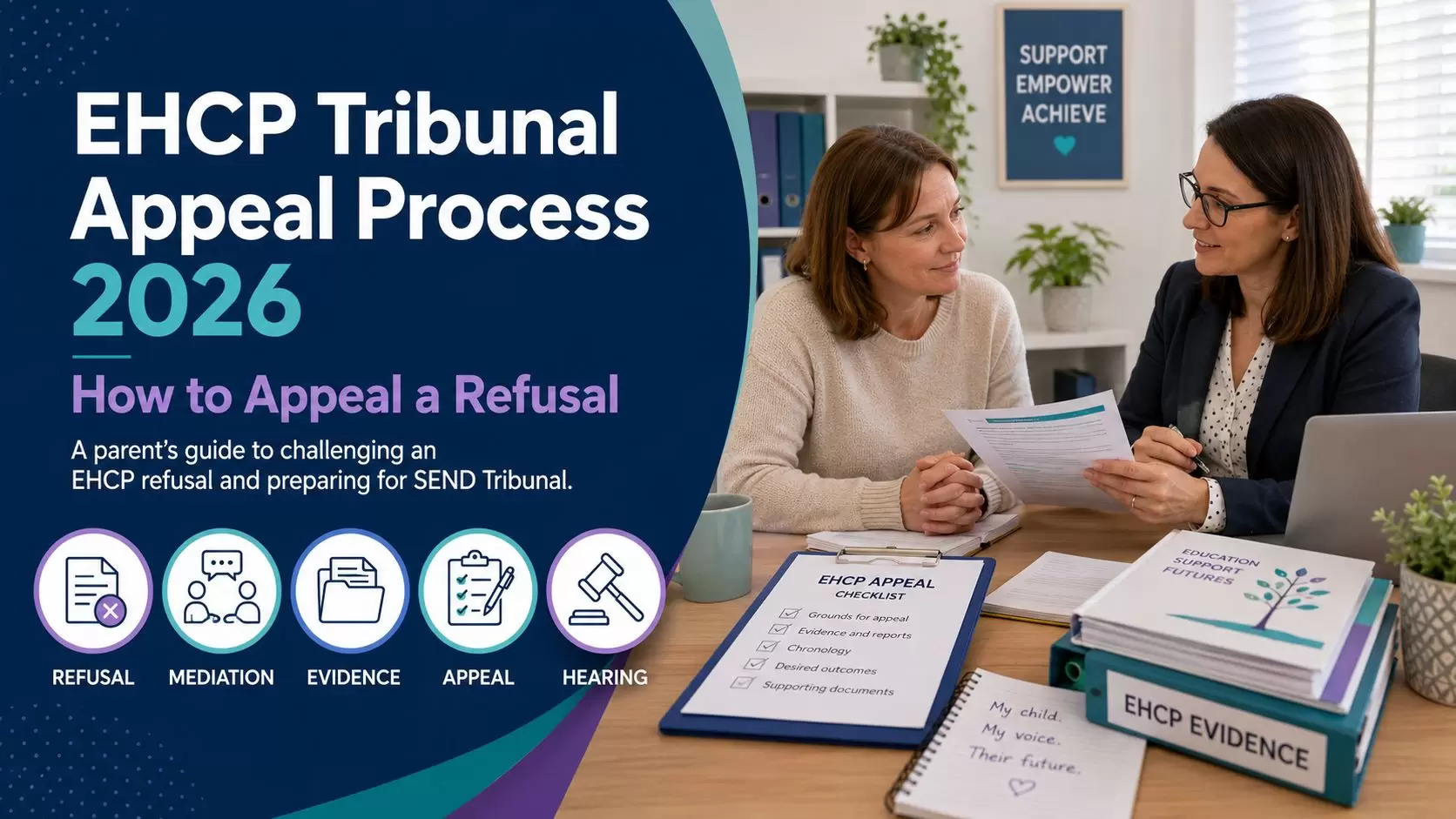
This guide explains what EHCP refusals mean, your appeal rights in 2026, mediation, SEND Tribunal deadlines, evidence and what parents can do next.
If you would like an overview of professional support available at every stage, visit our EHCP Advocacy Support for Families page.
What Counts as an EHCP Refusal?
Parents sometimes use the phrase “my child’s EHCP has been refused” to describe several different situations.
They are not all the same.
Refusal to Assess
A refusal to assess happens when the local authority receives a request for an EHC needs assessment but decides not to carry one out. This does not mean the local authority has assessed your child and decided that they definitely do not need an EHCP. It means the authority has decided not to begin the statutory assessment process. The legal question at this stage is whether: the child or young person has or may have special educational needs; and it may be necessary for special educational provision to be made through an EHCP. If your child has been refused an assessment, read our dedicated EHCP Refusal to Assess Support page. You may also find our guide Why Was My EHCP Refused? useful when reviewing the reasons given by the local authority.
Refusal to Reassess
This arises where an EHCP already exists and a reassessment has been requested, but the local authority refuses to carry one out. A reassessment may be requested where, for example, needs have changed substantially or the existing assessment information no longer accurately reflects the child or young person.
Refusal to Issue
A refusal to issue an EHCP is different. Here, the local authority has already carried out an EHC needs assessment but has decided that it is not necessary to issue an Education, Health and Care Plan. Parents and eligible young people have a right to appeal that decision.
Disagreement With a Final EHCP
Sometimes the local authority agrees to issue an EHCP, but the dispute is about what the final plan actually says.
You may disagree with:
- Section B – your child’s special educational needs;
- Section F – the special educational provision required;
- Section I – the school, college or type of placement.
If you are still at draft stage rather than dealing with a final plan, it may be more appropriate to address deficiencies before the EHCP is finalised. Our Draft EHCP Review Service explains how we help parents review needs, provision, outcomes and placement before responding to a draft.
Refusal to Assess and Refusal to Issue: What Is the Difference?
These two decisions are frequently confused.
| Decision | What it means | Possible next step |
|---|---|---|
| Refusal to assess | The LA decides not to carry out an EHC needs assessment | Consider mediation and/or appeal |
| Refusal to reassess | The LA refuses a requested reassessment | Consider mediation and/or appeal |
| Refusal to issue | Assessment has taken place but the LA decides not to issue an EHCP | Consider mediation and/or appeal |
| Disagreement with final EHCP | An EHCP exists but Sections B, F or I are disputed | Mediation and/or SEND Tribunal appeal may be available |
| Refusal to amend | The LA decides not to make changes following review | Appeal rights may arise |
| Cease to maintain | The LA proposes that the EHCP should end | The decision can be appealed |
Identifying the correct decision matters because it determines what you need to prove and which Tribunal procedure applies.
Can You Appeal an EHCP Refusal?
In many circumstances, yes.
The First-tier Tribunal (Special Educational Needs and Disability), commonly known as the SEND Tribunal, hears appeals against certain local authority decisions concerning EHC assessments and plans.
The Tribunal is independent of the local authority.
Depending on the decision being challenged, the Tribunal can consider disputes about:
- whether an EHC needs assessment should take place;
- whether an EHCP should be issued;
- the special educational needs described in Section B;
- the special educational provision in Section F;
- the school or placement named in Section I;
- refusal to amend;
- and decisions to cease to maintain an EHCP.
If your dispute has reached this stage, see our dedicated EHCP Appeal and SEND Tribunal Support service.
Do You Need the School's Permission to Appeal?
No.
The right of appeal normally belongs to the parent or eligible young person, not the school.
A school may agree strongly with your position.
It may be neutral.
It may even disagree with you.
That does not, by itself, remove your appeal rights.
School evidence can nevertheless be extremely important.
Records showing interventions, progress, additional adult support, attendance difficulties, SEN Support and unsuccessful Assess, Plan, Do, Review cycles may become valuable evidence.

Mediation Before an EHCP Appeal
In most EHCP appeal cases, you must first contact a mediation adviser and consider mediation before registering an appeal.
That does not necessarily mean that you must actually participate in a mediation meeting.
After speaking to the mediation service, you may choose either to:
- proceed to mediation; or
- obtain a mediation certificate without attending mediation.
There is an important exception where an appeal relates only to Section I — the educational placement named in the EHCP.
Where other issues such as Sections B or F are also being appealed, the position is different.
Because of this, parents should identify exactly which parts of the decision they intend to challenge before deciding their next step.
For detailed guidance and professional preparation, see our EHCP Mediation Support service.
Should You Attend EHCP Mediation?
There is no single answer that is right for every family.
Mediation can provide an opportunity to:
- understand why the local authority made its decision;
- identify the issues in dispute;
- present additional evidence;
- clarify what outcome you are seeking;
- ask the authority to reconsider;
- and potentially resolve some or all of the disagreement without a Tribunal hearing.
If you decide to attend, preparation matters.
Do not approach mediation simply as a conversation about how unhappy you are with the decision.
Try to establish:
What has the local authority decided?
Why do you say that decision is wrong?
What evidence supports your position?
What do you want the local authority to agree to?
Those four questions give the meeting a much clearer structure.
EHCP Appeal Deadlines in 2026
This is one of the most important parts of the appeal process.
The SEND Tribunal must normally receive an appeal within:
two months from the date of the local authority’s decision letter
or
one month from the date of the mediation certificate
whichever gives you the later deadline.
Do not calculate the deadline from:
- the day you happened to open the letter;
- when you discussed it with school;
- when you obtained another professional report;
- or when you decided that you wanted to appeal.
The date on the local authority’s decision notice is important.
What should you do when a refusal arrives?
Immediately:
- record the date on the decision letter;
- identify what has actually been refused;
- check your appeal rights;
- contact the mediation service where required;
- start organising your evidence;
- calculate the Tribunal deadline.
Do not deliberately wait until all your evidence is complete before thinking about the deadline.
Further evidence may be submitted during the Tribunal process in accordance with the directions issued in your case.
Which SEND Tribunal Form Do You Need?
The form depends upon what you are appealing.
SEND35A
SEND35A is used when appealing a local authority’s decision not to carry out an EHC needs assessment.
A refusal-to-assess appeal asks the Tribunal to decide whether the local authority should carry out the statutory assessment.
It does not ask the Tribunal to immediately issue an EHCP.
If you need help preparing this type of appeal, our Refusal to Assess Support includes help reviewing the refusal, identifying relevant evidence and preparing the case.
SEND35
SEND35 is used for other EHC plan appeals, including certain disputes following assessment or involving an existing plan.
Always use the current Tribunal documentation and instructions rather than relying on an old downloaded copy.

What Evidence Helps an EHCP Appeal?
A strong appeal is not simply about producing as much paperwork as possible.
The objective is to show the relationship between:
Need → Educational Impact → Support Already Tried → Progress → Provision Required
Relevant evidence might include:
- the local authority’s refusal or decision letter;
- the original EHC needs assessment request;
- SEN Support plans;
- Assess, Plan, Do, Review records;
- provision maps;
- school reports;
- progress information;
- attendance records;
- behaviour or incident records;
- exclusion information;
- Educational Psychologist reports;
- Speech and Language Therapy reports;
- Occupational Therapy reports;
- autism or ADHD assessment reports;
- medical evidence;
- specialist teacher reports;
- correspondence with school;
- parental evidence;
- and your child’s or young person’s views.
Our EHCP Evidence Review and Preparation service is designed specifically to help parents identify what the evidence establishes, what may be missing and how different documents connect to the issues being challenged.
Building an Evidence-Led EHCP Appeal
One of the most common problems in SEND cases is having a large amount of evidence without clearly explaining what it demonstrates.
For example, simply attaching an Educational Psychologist report is not the same as identifying:
- which needs the psychologist found;
- how those needs affect education;
- what provision was recommended;
- whether that provision has been tried;
- whether school can realistically provide it through existing SEN Support;
- and how the findings support the decision you want changed.
A useful approach is to ask of every important document:
What does this evidence prove?
Which issue in the appeal does it relate to?
Where does it contradict or challenge the local authority’s position?
What outcome does it support?
That can turn a collection of documents into a coherent evidence-based case.

Refusal to Assess: What Does the Tribunal Consider?
For a refusal-to-assess appeal, the central question is not whether you can already prove that your child definitely requires an EHCP.
The issue is whether the statutory threshold for an EHC needs assessment is met.
Evidence could therefore include:
- difficulties continuing despite SEN Support;
- repeated intervention with limited progress;
- increasing adult support;
- difficulties accessing the curriculum;
- sensory or communication barriers;
- attendance problems;
- emotional distress connected to educational demands;
- professional recommendations requiring further assessment;
- or uncertainty about the full extent of the child’s educational needs.
A diagnosis can be useful evidence, but a diagnosis is not a prerequisite for requesting an EHC needs assessment.
If you are still considering making the original request rather than appealing a refusal, visit our EHCP Application Support page.
Refusal to Issue: What Changes?
A refusal-to-issue case begins from a different position.
The local authority has already carried out an EHC needs assessment.
The issue is whether an EHCP is required following that assessment.
The evidence gathered during the assessment therefore becomes particularly important.
Look carefully at:
- what each professional identified;
- the provision recommended;
- whether recommendations require coordination across services;
- whether existing SEN Support is sufficient;
- what additional or specialist provision is required;
- and whether the child’s needs can realistically be met without an EHCP.
The question is no longer simply whether further assessment should take place.
The dispute is about whether special educational provision through an EHCP is necessary.
Appealing the Contents of an EHCP
Parents can also appeal where an EHCP exists but does not adequately reflect the child’s needs or required provision.
Section B – Special Educational Needs
Section B should accurately describe all identified special educational needs.
A weakness in Section B can have significant consequences because provision in Section F should respond to the needs identified in the plan.
Section F – Special Educational Provision
Section F is particularly important because it specifies the educational provision required to meet the child’s identified needs.
Problems may include provision that is:
- vague;
- unquantified;
- dependent upon availability;
- described as occasional when evidence indicates regular support;
- missing completely;
- or inconsistent with professional recommendations.
Section I – Placement
Section I concerns the educational placement.
Disputes may involve:
- mainstream versus specialist provision;
- the suitability of the named school;
- parental preference;
- environmental needs;
- the ability of a setting to deliver Section F;
- or the cost and suitability of different placements.
These cases often require the evidence to connect:
Needs → Provision → Environment → Placement
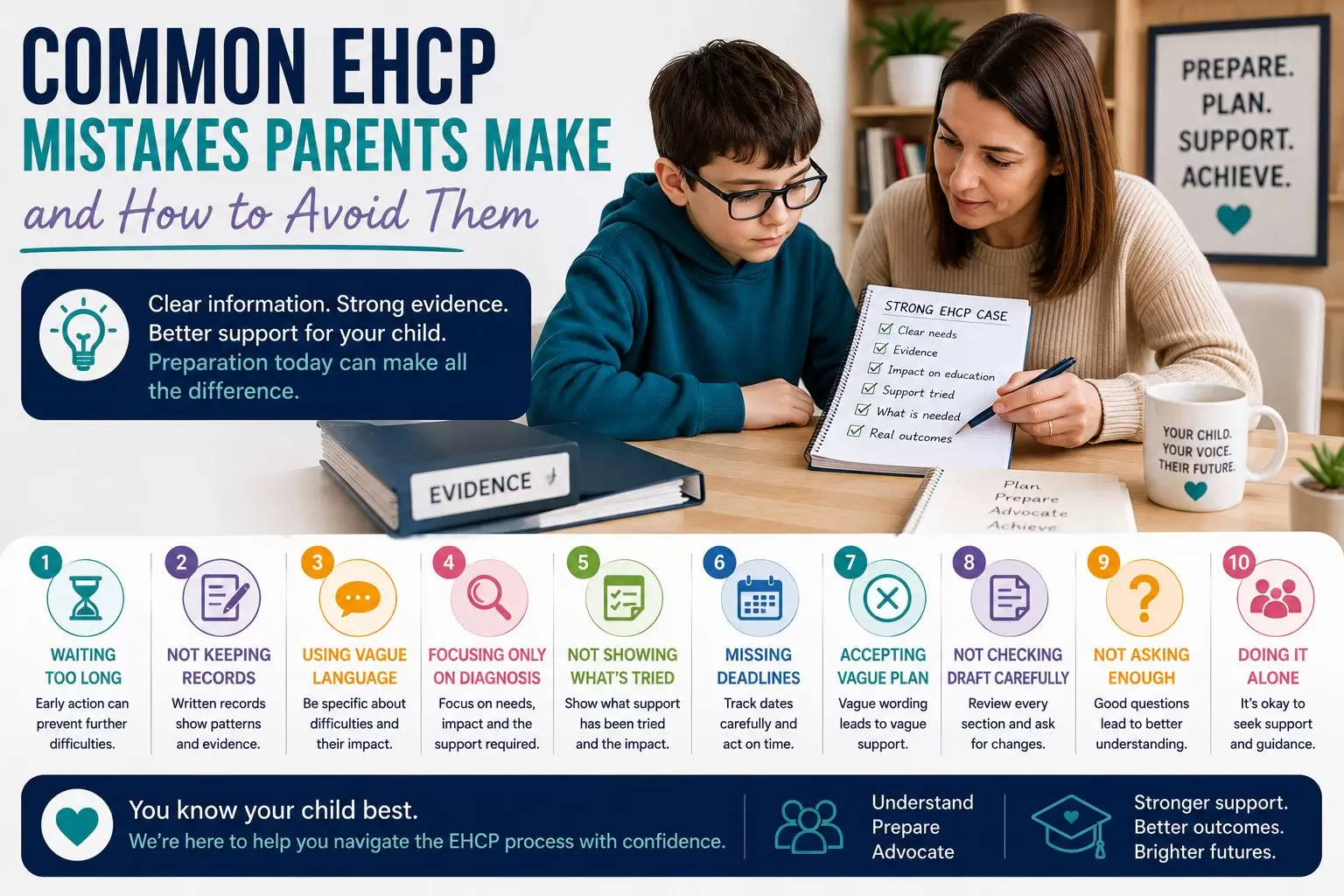
Common Mistakes That Can Weaken an EHCP Appeal
Waiting for the School to Appeal
The school does not normally bring the appeal on your behalf.
Parents should understand their own deadline.
Focusing Only on Diagnosis
An appeal should explain the educational impact of the child’s needs and the provision required.
A diagnostic label alone does not answer those questions.
Sending Everything Without Structure
More documents do not automatically mean a stronger case.
Relevant, organised evidence is much more useful than an unstructured bundle.
Focusing Mainly on Emotion
Parents understandably feel frustrated, angry or exhausted.
Your experience matters and parental evidence can be extremely valuable.
However, your appeal should translate those experiences into evidence about need, impact and provision.
Missing the Deadline
This is potentially the most serious mistake.
Record the appeal deadline as soon as you receive the local authority decision.
Arguing About the Wrong Legal Question
A refusal-to-assess appeal and refusal-to-issue appeal are not asking the Tribunal to decide the same thing.
Your evidence and grounds should address the decision actually being challenged.
How Successful Are SEND Tribunal Appeals?
Parents sometimes assume that challenging a local authority is unlikely to succeed.
Official Ministry of Justice statistics show a very different picture.
For the 2024/25 academic year, around 25,000 SEN appeals were registered.
Of the appeals that were ultimately decided by the Tribunal, approximately 99% were recorded as decided in favour of the appellant.
That statistic needs to be understood carefully.
It does not mean that 99% of everyone who registers a SEND appeal automatically wins.
Cases can:
- be conceded;
- settle;
- be withdrawn;
- change during the proceedings;
- or conclude without a final contested Tribunal decision.
It does, however, demonstrate why parents should not automatically assume that a local authority refusal is the final word.
An appeal still requires careful preparation and no individual outcome can ever be guaranteed
EHCP Appeals Are Increasing
The number of SEND appeals continues to rise.
Official statistics recorded approximately 29,000 SEND Tribunal receipts during 2025/26, the highest annual figure in the published time series.
This reflects the growing pressure within the SEND system and the increasing number of families challenging local authority decisions.
In 2025 alone, local authorities received approximately 162,700 requests for EHC needs assessments.
Around 43,300 requests — 26.6% — were recorded as decisions not to proceed with an assessment.
A refusal is therefore something thousands of families experience.
But it remains an appealable decision.
How Long Does an EHCP Appeal Take?
Tribunal cases do not normally resolve immediately.
The length of a case can depend on:
- the type of appeal;
- the issues in dispute;
- the number of witnesses;
- professional evidence;
- Tribunal directions;
- whether the local authority concedes;
- whether agreement is reached during proceedings;
- and hearing availability.
Once an appeal is registered, the Tribunal will issue case-management directions setting out what needs to happen next.
These can include deadlines for:
- evidence;
- local authority responses;
- witness information;
- case-review documentation;
- working documents;
- and preparation for the hearing.
Parents should treat those directions as important procedural documents and record every deadline immediately.
Our EHCP Appeal and SEND Tribunal Support can assist parents who need structured support with the case after the appeal stage has been reached.

What Happens While You Wait for the Tribunal?
An appeal should not mean that your child’s current educational difficulties are ignored for months.
Where your child remains in school, continue discussing appropriate SEN Support and reasonable adjustments with the setting.
Keep records of:
- meetings;
- interventions;
- attendance;
- support provided;
- incidents;
- progress;
- emerging needs;
- and changes in your child’s presentation.
Evidence produced after the original refusal can become relevant as the case develops, subject to Tribunal directions.
What Happens if the Local Authority Changes Its Mind?
Not every registered appeal reaches a contested hearing.
A local authority can reconsider its position.
Issues may be resolved:
- following further discussion;
- during mediation;
- after additional evidence is supplied;
- after the appeal is registered;
- or during Tribunal case preparation.
If agreement is proposed, make sure you understand exactly:
- what the local authority is agreeing to;
- what will happen next;
- the timescale;
- and whether any part of the appeal remains unresolved.
Do not withdraw an appeal simply because there has been an informal indication that something may change without first understanding the implications.
What if You Lose an EHCP Appeal?
An unsuccessful appeal does not necessarily mean that an EHCP can never be obtained.
Children’s circumstances change.
Educational placements change.
Needs can become clearer.
Further professional evidence may emerge.
SEN Support may demonstrate over time that the child’s needs cannot be adequately met without statutory provision.
Depending on the circumstances, a future request or reassessment may therefore become appropriate.
The important point is to understand why the previous case did not succeed and what has changed before simply repeating the same arguments.
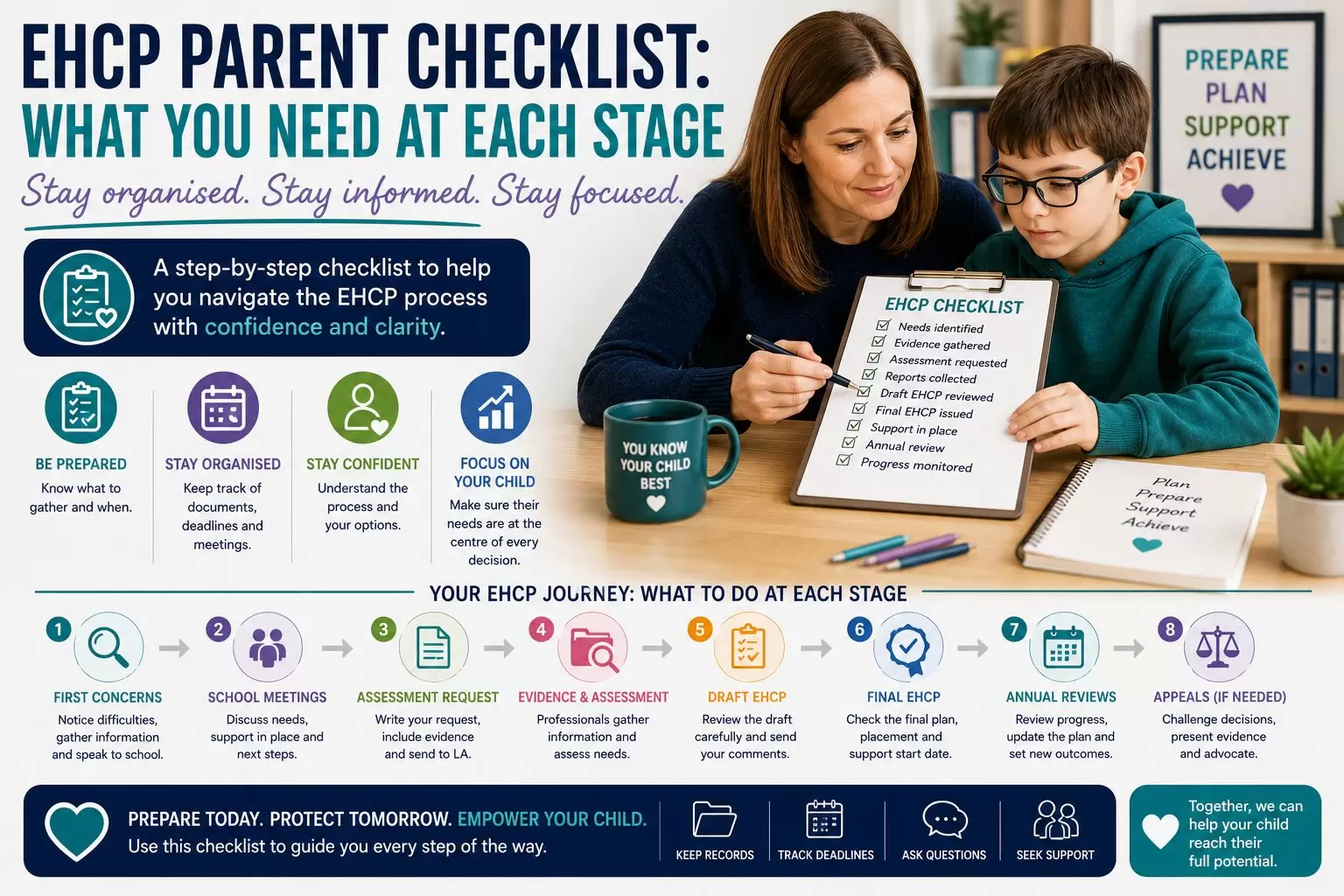
EHCP Refusal and Appeal Checklist
If you have just received a local authority decision, work through the following steps.
- Read the decision letter carefully.
- Identify exactly what has been refused or what you disagree with.
- Record the date on the decision letter.
- Calculate your appeal deadline.
- Contact the mediation service where required.
- Decide whether mediation is appropriate.
- Obtain your mediation certificate.
- Identify which Tribunal form applies.
- Gather the original application and local authority evidence.
- Collect relevant school and professional records.
- Identify what each piece of evidence actually proves.
- Prepare clear grounds explaining why the decision should change.
- Submit the appeal before the deadline.
- Keep copies and proof of everything submitted.
- Record all subsequent Tribunal directions and deadlines.
Where Can Parents Get Free EHCP Appeal Advice?
Parents do not necessarily need to pay for help.
Useful sources of free information include:
- GOV.UK for the official SEND Tribunal appeal process and current forms;
- IPSEA for independent SEND legal information;
- SENDIASS for local impartial information, advice and support;
- and Tribunal guidance issued by HM Courts and Tribunals Service.
It is sensible to use official and specialist sources when checking procedural requirements because forms and processes can change.
School of Diversity also publishes practical information for parents navigating SEN Support, EHCP applications, refusals, mediation and appeals.
Professional EHCP Refusal and Appeal Support
Some parents are comfortable managing an appeal themselves but want help understanding the evidence.
Others want more structured support throughout the process.
School of Diversity provides practical, evidence-led EHCP advocacy and case preparation for families across England.
Depending on your stage, support may include:
- reviewing the local authority decision;
- examining the original EHCP application;
- identifying the relevant legal and evidential issues;
- reviewing professional and school evidence;
- preparing a chronology;
- preparing grounds of appeal;
- mediation preparation;
- SEND35A or SEND35 preparation support;
- parental statements;
- evidence indexes;
- review of the local authority’s response;
- working-document preparation;
- Tribunal directions;
- hearing preparation;
- and ongoing case support where agreed.
Choose the Support That Matches Your Situation
Have you been refused an EHC needs assessment?
Visit EHCP Refusal to Assess Support.
Need help organising professional and school evidence?
Visit EHCP Evidence Review and Preparation.
Preparing for mediation?
Visit EHCP Mediation Support.
Preparing or managing a Tribunal appeal?
Visit EHCP Appeal and SEND Tribunal Support.
Not sure which stage or service applies?
Start with our main EHCP Advocacy Support page.

Frequently Asked Questions About EHCP Refusals and Appeals
Can I appeal if the local authority refuses an EHC needs assessment?
Yes.
A parent or eligible young person can appeal a refusal to carry out an EHC needs assessment.
The specific Tribunal form for this is SEND35A.
Read more about challenging a refusal to assess.
Does my child need a diagnosis to appeal an EHCP refusal?
No.
An EHC needs assessment is based on the child’s special educational needs and whether special educational provision through an EHCP may be necessary.
A diagnosis may provide helpful evidence but is not itself a prerequisite.
Can I appeal if my child is academically able?
Yes.
Special educational needs are not determined solely by academic attainment.
A child may be achieving academically while requiring substantial support with communication, sensory processing, executive functioning, emotional regulation, attendance or other aspects of accessing education.
Do I have to attend mediation before appealing?
In most cases, you must contact a mediation adviser and consider mediation.
You can generally choose not to proceed with the mediation meeting and obtain a mediation certificate.
An exception applies where the appeal concerns only Section I placement.
How long do I have to appeal an EHCP decision?
The Tribunal must normally receive the appeal within two months of the date of the local authority decision letter or one month from the date of the mediation certificate, whichever is later.
Always check the deadline applying to your individual decision.
What form do I use for a refusal-to-assess appeal?
The current form specifically used for a local authority refusal to carry out an EHC needs assessment is SEND35A.
What form is used for other EHCP appeals?
SEND35 is used for a range of other appeals concerning EHC plans and decisions following assessment.
Always check the current GOV.UK Tribunal guidance before submitting an appeal.
Can the local authority change its decision after I appeal?
Yes.
A local authority can reconsider its position during mediation or after an appeal has been registered.
Some cases therefore resolve without a final Tribunal hearing.
Does winning a refusal-to-assess appeal mean my child automatically receives an EHCP?
No.
If you win a refusal-to-assess appeal, the Tribunal can require the local authority to carry out an EHC needs assessment.
The assessment process then takes place.
A separate decision is subsequently made about whether an EHCP should be issued.
What evidence is most important in an EHCP appeal?
The strongest evidence depends on the issue being appealed.
Generally, useful evidence establishes:
- your child’s special educational needs;
- the impact on their access to education;
- what support has already been provided;
- whether that support has been effective;
- what additional provision professionals recommend;
- and why the local authority decision should change.
Our EHCP Evidence Review and Preparation service can help identify which evidence is most relevant to your particular appeal.
An EHCP Refusal Is a Decision — Not Necessarily the End of the Process
A local authority refusal can be upsetting, particularly when you have already spent months trying to secure the right support for your child.
But a refusal does not automatically mean that the local authority’s decision is correct.
And it does not mean that you have no further options.
The most effective response is usually to move from:
“They have refused.”
to:
“What decision have they made, what is the correct test, what does our evidence show, and what do we need to do next?”
That change in approach turns a refusal into a process that can be examined and, where appropriate, challenged.
If you have received a refusal or final EHCP decision and are unsure what to do next, School of Diversity can help you review the decision, organise your evidence and understand the available options.