
A school support plan should show what happens next.
Understand your child’s needs, the support agreed and how its impact will be reviewed.
A SEN Support plan should connect needs, outcomes, provision and review. Assess, Plan, Do, Review helps school build that understanding and change support when it is not working.
Parent guidance for England · Clear provision, practical review questions and next steps.
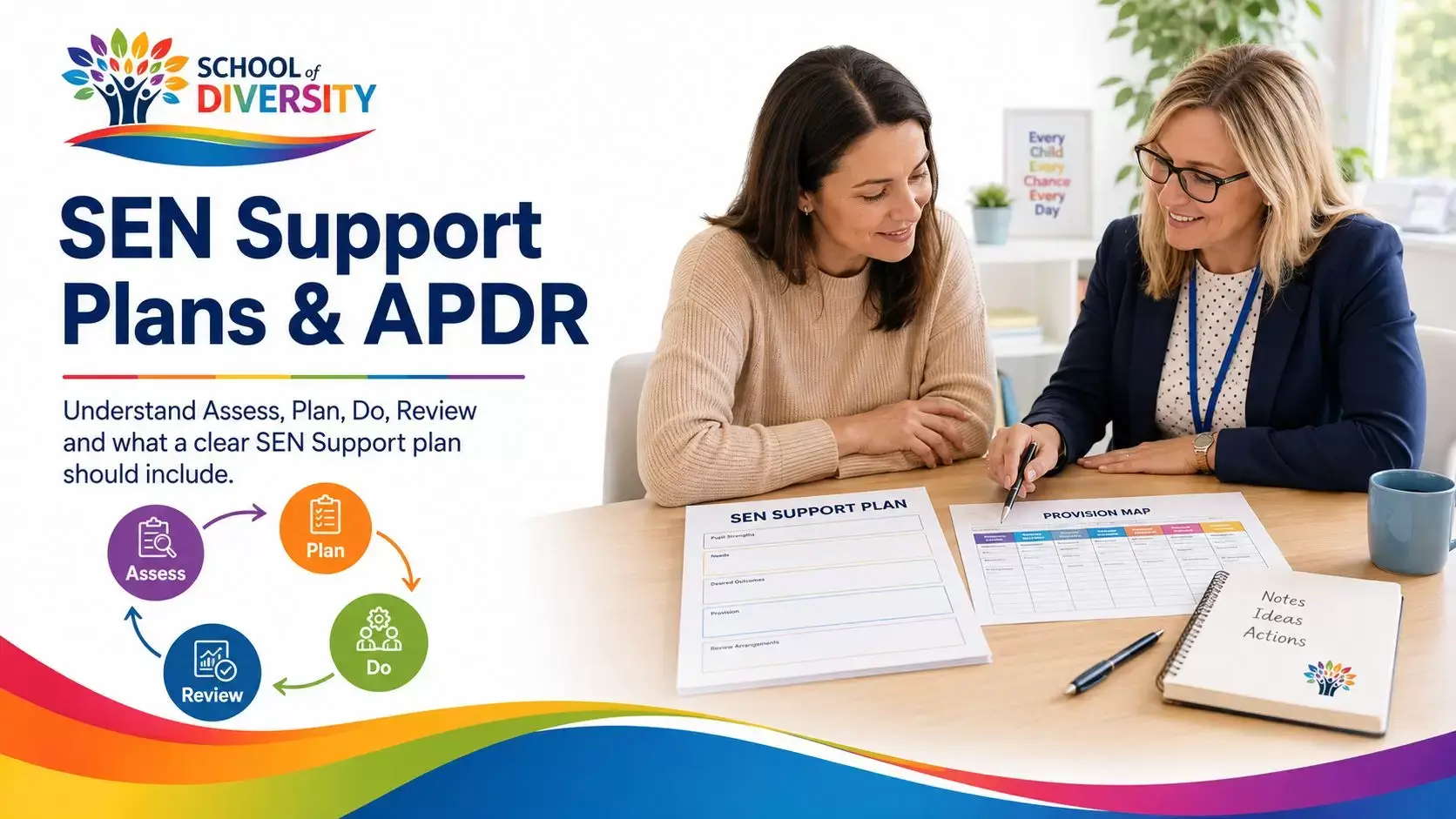
What is a SEN Support plan?
A written record of the additional or different educational support being provided for a child with special educational needs.
Schools use different formats
You may see a SEN or SEND Support Plan, Individual Education Plan, learning plan, pupil passport, one-page profile or provision plan.
Some formats summarise information rather than contain every detail. Ask where the full needs, provision, outcomes and review records are kept.
The important connections
- Need: what barrier has been identified?
- Outcome: what change are we working towards?
- Provision: what support will happen?
- Review: how will we know whether it helped?
There is no single national template that every school must use.
What should the records make clear?
Identified needs
Describe how learning, communication, attention, sensory, regulation, physical or other difficulties affect education.
A diagnosis alone does not explain the support your child needs.
Strengths and pupil views
Record interests, motivation, successful approaches and what helps your child feel confident and participate.
Include their perspective in an accessible way.
A starting point
Use relevant baseline information: attainment, engagement, prompting, independence, attendance or another meaningful measure.
Clear outcomes
Explain what the support is intended to achieve and how progress will be judged. Outcomes can be qualitative or numerical.
Specific support
Describe interventions, teaching approaches and adjustments, with frequency, duration and responsibility where relevant.
Review arrangements
Record how delivery and impact will be checked, when you will review progress and who should be involved.
Move beyond vague wording.
These examples illustrate clearer wording. They are not prescribed targets or provision for every child; each plan needs an appropriate baseline and individual context.
| Less informative | More useful detail |
|---|---|
| “Has ADHD.” | Explain the educational impact, such as difficulty retaining multi-step verbal instructions and the need for smaller steps with visual reinforcement. |
| “Improve concentration.” | For a suitable task, define the engagement being sought, the support provided and how progress will be observed against the child’s starting point. |
| “Small-group literacy support.” | Specify the programme, frequency, session length, group size and who delivers it—for example, three 20-minute sessions weekly in a group of up to four, if appropriate for this child. |
| “Support when needed.” | Explain what prompts or assistance will be used, when they apply, who provides them and how access is monitored. |
Ask what the words mean in practice. The right level of detail depends on the support and the child. Clarity helps you check both delivery and impact.
Assess, Plan, Do, Review.
An ongoing cycle of understanding needs, agreeing support, delivering it and evaluating what should change.
Assess
Consider strengths, needs, attainment and barriers using teacher observations, parent information, pupil views, classroom work, progress records and relevant professional evidence.
Update the picture as new information emerges.
Plan
Agree outcomes, provision, adjustments, responsibilities, progress measures and a review date.
Parents should understand what has been agreed, with the child involved where appropriate.
Do
Deliver the support consistently. Check whether staffing changes, cancelled sessions or communication gaps affect implementation.
A plan on paper is not evidence that support happened.
Review
Evaluate progress, delivery and impact. Consider changed needs, effective and ineffective approaches, and whether further advice is needed.
The review should lead to a decision about the next cycle.
What should the review establish?
- What worked, and what did not?
- What progress occurred, and what difficulties remain?
- Was the agreed support actually delivered?
- Has our understanding of the child’s needs changed?
- What provision or adjustments will change?
- Is further professional advice or assessment needed?
- Who is responsible for the next actions?
- When will the revised plan be reviewed?
Ask for the agreed actions and review date to be confirmed in writing.
Prepare for a SENCo review meeting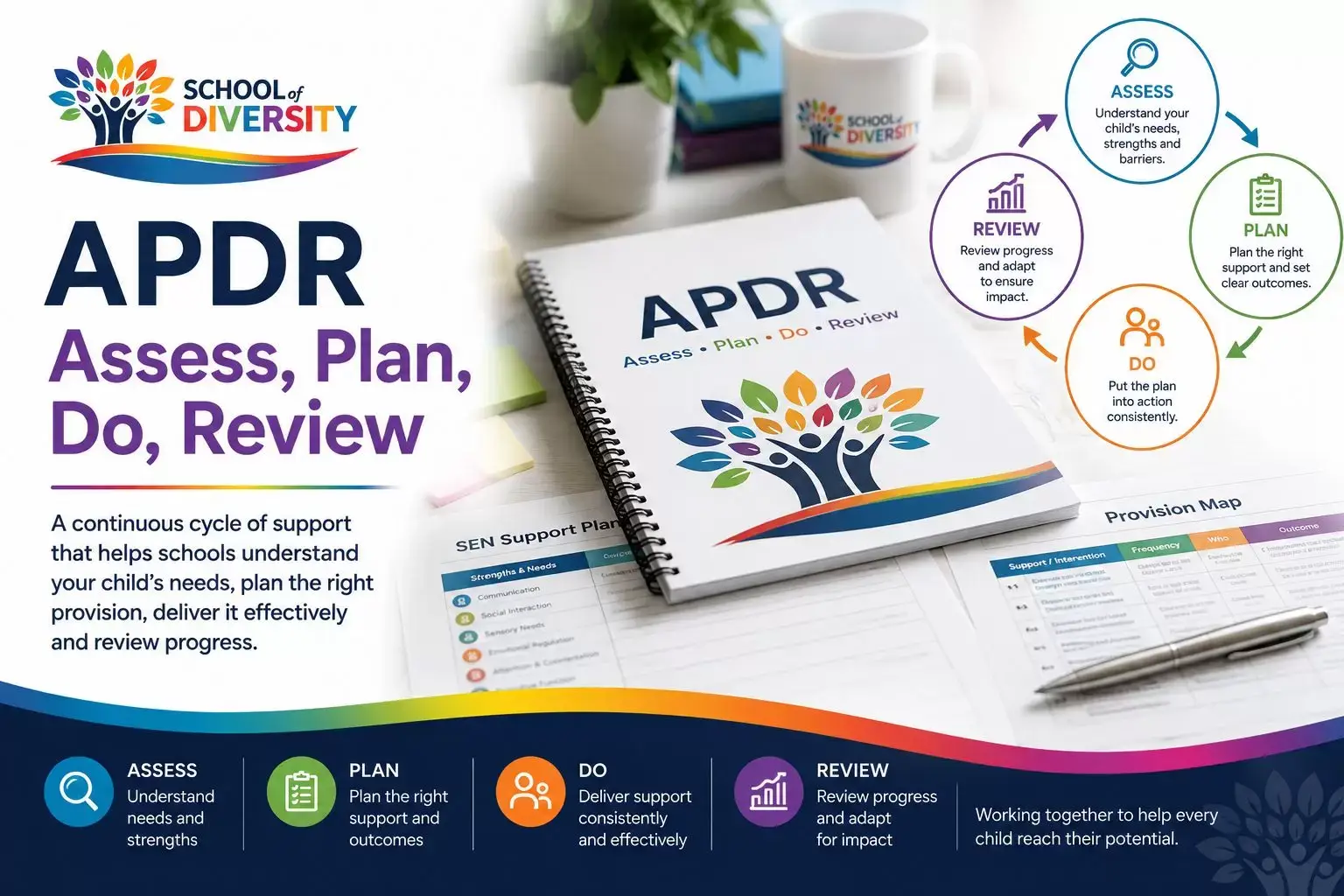
Signs the plan may need a closer look.
These are prompts for discussion, rather than automatic proof that school is failing.
The plan lacks clarity
- Very brief descriptions of needs
- Generic targets repeated each term
- Outcomes with no clear way to measure progress
- Provision described as “when needed” or “as available”
- No frequency or delivery responsibilities
- Missing adjustments or professional recommendations
The experience is not improving
- Progress discussed without supporting evidence
- Support varying with staffing
- Continuing difficulties despite repeated cycles
- Increasing anxiety or dysregulation
- Deteriorating attendance
- Growing adult support needs to access learning
Look at supported performance as well as independence.
Your child may complete work because instructions are repeated, tasks are broken down, materials are organised or an adult provides frequent prompts.
That support may be appropriate. The review should recognise how much assistance is required, rather than assume completed work means no further need.
Include adjustments and professional recommendations.
Record important adjustments
Visual instructions, processing time, movement breaks, sensory changes, reduced copying, alternative recording, predictable routines and transition support may be relevant.
Ask how staff will know what to use and how consistency will be checked.
Explore reasonable adjustments →Discuss professional advice
Consider relevant psychology, therapy, specialist teacher, diagnostic or other professional reports alongside the school plan.
- Which recommendations are being used?
- Where are they recorded?
- How are they implemented?
- How will their impact be reviewed?
A report in the school file does not itself show that recommendations are being delivered.
The next cycle should respond to what you have learnt.
Repeated records can show what has been tried. Limited progress should prompt a discussion about whether the approach needs to change.
Possible next steps
- Change an intervention or its delivery
- Alter provision or introduce different adjustments
- Gather stronger baseline or progress information
- Obtain specialist advice or further assessment
- Review outcomes and environmental barriers
- Consider whether current SEN Support remains sufficient
When an EHC needs assessment may be worth exploring
Complex needs, limited progress, substantial assistance, specialist provision or worsening access to education may justify a wider review.
APDR records can help explain what has been tried and what difficulties remain. There is no fixed number of cycles that every child must complete before a parent can request an assessment.
When to consider an EHCP → Explore EHCP support →Need help making sense of the plan?
We can help identify unclear wording, gaps, evidence priorities and practical questions for school.
SEND Review & Action Plan
£195
A written review of agreed evidence, which can include your child’s support plan, APDR records, targets, interventions, adjustments and professional reports.
- Needs and provision requiring clarification
- Weak outcomes or missing recommendations
- Evidence gaps and questions for the SENCo
- Practical next-step recommendations
SENCo Meeting Support
Prepare priorities, questions, evidence points, adjustments to discuss and outcomes you want agreed.
If you need continued help, supported casework can include agreed online meeting attendance and follow-up.
Supported SEND Casework from £425. Scope, availability and the final fee are confirmed before work begins.
Explore meeting supportSEN Support Plans: your questions answered.
Does every school have to use the same plan template?
No. Schools use different recording systems. Ask where needs, provision, outcomes and review arrangements are recorded, and request the relevant records.
What does APDR stand for?
Assess, Plan, Do, Review: the graduated cycle used to understand needs, plan provision, deliver it and evaluate its impact.
Does my child need a diagnosis?
No. SEN Support should respond to identified educational needs and barriers rather than wait for a particular diagnostic label.
Should parents be involved?
Yes. Parent observations help inform discussions about needs, outcomes and support, especially when home and school see different things. The child’s views should also inform planning in an appropriate way.
How often should support be reviewed?
Agree a review date appropriate to the needs and provision being tried, and review sooner if circumstances change. The SEND Code of Practice says schools should meet parents of pupils receiving SEN Support at least three times each year.
What if there is no document called a SEN Support plan?
Ask whether your child is recorded as receiving SEN Support, where needs and provision are recorded, what outcomes are agreed, how progress is reviewed and how you can receive the relevant records.
What if support on the plan is not happening?
Raise this with the SENCo. Ask what was delivered, when and by whom, and what will be done about any gaps. Impact cannot be judged reliably without knowing what support actually happened.
What if the plan is not working?
Review whether needs have been understood, provision matches them, delivery is consistent and progress is measured. Consider changed support, adjustments, specialist advice or wider next steps.
Read the next-steps guide →Further reading: SEND Code of Practice: 0 to 25 years.
Understand what is agreed—and what needs to change.
Turn school paperwork and concerns into focused questions and practical recommendations.
Tell us where things stand.
Let us know what support is in place, what concerns remain and whether you have a review meeting approaching.
office@schoolofdiversity.com
0333 577 1179