
Specialist SEND Support
Practical support focused specifically on SEND, EHCPs and education.
Evidence-Led
We look at what the evidence actually establishes — and what may still be missing.
Neurodiversity-Informed
Experienced in autism, ADHD, sensory needs, masking, anxiety and complex educational profiles.
Support Across England
Document review, consultation and case preparation can be provided remotely.
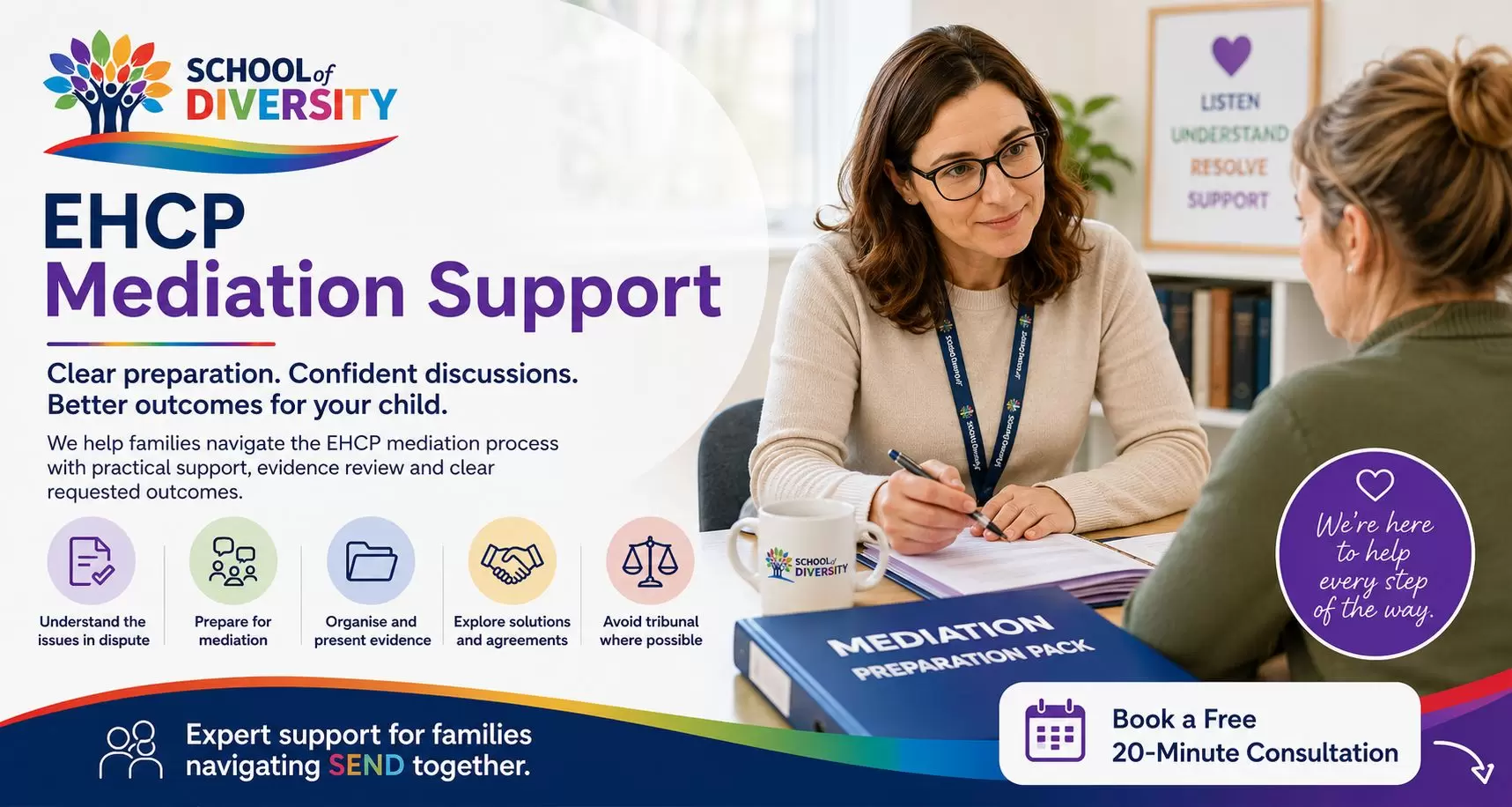
EHCP Mediation Support
Disagree with an EHCP decision? We help parents identify the issues, organise the evidence and clearly set out the changes they want before mediation with the local authority.
Prepare Clearly. Present the Evidence. Know What You Want to Change.
If you disagree with a local authority decision about your child’s Education, Health and Care Plan, mediation can provide an opportunity to try to resolve the dispute without immediately proceeding to the SEND Tribunal.
But attending mediation without being properly prepared can leave parents trying to explain complex concerns, professional evidence and EHCP wording under pressure.
School of Diversity provides EHCP Mediation Support to help you identify the issues that matter, organise the evidence and set out clearly what you want the local authority to change.
Whether you intend to attend mediation independently or would like more comprehensive casework support, we can help you approach the meeting with a clear, evidence-led position.
Independent • Evidence-Led • Parent-Focused SEND Support
What Is EHCP Mediation?
EHCP mediation is a structured process intended to help parents or young people and the local authority discuss a disagreement and explore whether an agreement can be reached.
An independent mediator facilitates the meeting.
The mediator does not decide who is right and does not impose an outcome in the way a Tribunal judge can.
Instead, mediation provides an opportunity to:
- identify the issues in dispute;
- clarify the local authority’s position;
- present relevant evidence;
- explain the changes you are requesting;
- explore possible agreement;
- and potentially resolve some or all of the disagreement without a Tribunal hearing.
The effectiveness of that discussion often depends on how clearly the issues have been identified beforehand.
When Might EHCP Mediation Be Relevant?
Mediation may arise where the local authority has:
- refused to carry out an EHC needs assessment;
- refused to issue an EHCP following an assessment;
- issued a final EHCP that you consider inadequate;
- failed to include important special educational needs in Section B;
- included vague or insufficient provision in Section F;
- named a placement in Section I that you disagree with;
- refused amendments following an annual review;
- decided not to amend an EHCP following review;
- decided to cease an EHCP;
- or made another appealable EHCP decision.
The precise issues will determine what evidence and preparation are needed.
What Is EHCP Mediation?
Mediation is a structured discussion between the parent or young person and the local authority.
It is facilitated by an independent mediator whose role is to help the parties explore whether the disagreement can be resolved.
Mediation may relate to decisions such as:
- refusing to carry out an EHC needs assessment;
- refusing to issue an EHCP;
- refusing to reassess;
- disagreement about Sections B, F or I of a final EHCP;
- refusing to amend an EHCP;
- deciding to cease maintaining an EHCP.
The mediator does not make a binding tribunal-style decision about who is right.
The purpose is to help the parties discuss the issues and consider whether an agreement can be reached.
Mediation Is Not Just About Attending a Meeting
1. What exactly do I disagree with?
Not simply:
“The EHCP is not good enough.”
But, for example:
“Section F does not specify the frequency and duration of the literacy intervention recommended by the Educational Psychologist.”
2. What evidence supports my position?
For example:
- Educational Psychologist recommendations;
- Speech and Language Therapy evidence;
- Occupational Therapy evidence;
- school records;
- attendance evidence;
- professional assessments;
- progress data;
- correspondence;
- or evidence from the child or young person.
3. What exactly do I want changed?
You should ideally be able to identify the amendment or decision you are seeking.
4. Why is that change necessary?
The requested amendment should connect logically to the child’s identified needs and evidence.
This is the approach we use when helping parents prepare.
Our Mediation Approach
We structure EHCP mediation preparation around:
Issue → Evidence → Requested Change
For every significant disagreement, we aim to establish:
What is wrong or missing?
↓
What evidence demonstrates the problem?
↓
What change should the local authority agree to?
This makes it easier to present your position clearly and prevents the mediation becoming overwhelmed by a long history of correspondence or peripheral disagreements.
Mediation About Section B – Special Educational Needs
Section B should accurately identify the child or young person’s special educational needs.
Disputes can arise where:
- an identified need is absent;
- a professional assessment has been inadequately summarised;
- sensory needs are overlooked;
- communication difficulties are minimised;
- executive-function needs are missing;
- emotional-regulation difficulties are inadequately described;
- literacy or learning needs are understated;
- anxiety-related barriers to education are omitted;
- or the educational impact of a diagnosis is not properly explained.
Where Section B is disputed, we can help compare the EHCP against professional evidence and identify the amendments being sought.
Mediation About Section F – Special Educational Provision
Section F is frequently one of the most important areas of disagreement.
A plan may recognise that a child needs support but describe the provision using wording such as:
- “access to support”;
- “regular opportunities”;
- “as required”;
- “when necessary”;
- “up to”;
- “support where appropriate”;
- or “opportunities for intervention”.
The issue is often not whether support has been mentioned.
It is whether the provision is sufficiently clear about:
- what will be delivered;
- frequency;
- duration;
- staffing;
- group size;
- specialist involvement;
- training;
- oversight;
- and how recommendations will actually be implemented.
We can help identify where professional recommendations appear to have been weakened or omitted and formulate the changes you may wish to seek through mediation.
Mediation About School or College Placement
Placement disputes may involve Section I of the EHCP.
For example:
- you prefer a different school;
- the local authority has named a setting you consider unsuitable;
- your preferred school has said it cannot meet need;
- the local authority says your preferred setting is too expensive;
- mainstream and specialist provision are disputed;
- or your child’s current placement is breaking down.
Placement disputes should normally be supported by evidence about:
Needs → Provision → Environment → Placement
Rather than simply arguing that one school is preferable, the case should explain why a particular educational environment is required to deliver the provision the child needs.
Where placement is the main issue, our dedicated EHCP Placement Support service may also be appropriate.
Do I Have to Attend Mediation Before Appealing?
For many EHCP appeals, you must first contact the mediation service and obtain a mediation certificate before registering an appeal with the SEND Tribunal.
That does not necessarily mean you must take part in a mediation meeting.
You can receive mediation advice and decide whether mediation is appropriate.
There is an important exception where the appeal is only about Section I — the school, college or other placement named in the EHCP.
In a placement-only appeal, a mediation certificate is not normally required before appealing.
However, if Sections B or F are also disputed, the position is different.
This is why it is important to identify exactly which sections of the EHCP need to be challenged before deciding what to do.
Mediation or SEND Tribunal?
Mediation
Mediation is designed to explore whether agreement can be reached between the parties.
It can be useful where:
- the dispute is relatively focused;
- the local authority appears willing to reconsider;
- additional evidence may resolve the issue;
- particular wording needs clarification;
- only a small number of amendments remain;
- or both sides appear capable of reaching a compromise.
SEND Tribunal
The SEND Tribunal is a judicial process.
It may become necessary where:
- the local authority fundamentally disputes the child’s needs;
- major professional recommendations remain rejected;
- placement remains disputed;
- negotiations have failed;
- the disagreement concerns substantial Sections B or F issues;
- or mediation does not resolve the case.
The appropriate route depends on the individual circumstances.
Mediation can resolve all issues, some issues, or none of them.
It should therefore be approached with a clear understanding of what outcome would genuinely resolve the dispute.
Do Not Lose Sight of Your Appeal Deadline
Mediation should not result in parents accidentally losing their Tribunal appeal rights.
If you are considering an appeal, keep the statutory deadline clearly recorded.
The Tribunal must normally receive an appeal by the later of:
two months from the date of the local authority decision letter
or
one month from the date of the mediation certificate.
Do not assume that informal discussions with the local authority automatically suspend the appeal deadline.
What Evidence Should I Take to EHCP Mediation?
The right evidence depends on the issues in dispute.
It might include:
- the final EHCP;
- the local authority decision letter;
- previous draft EHCPs;
- Educational Psychologist reports;
- Speech and Language Therapy reports;
- Occupational Therapy reports;
- paediatric evidence;
- autism or ADHD assessments;
- school SEN records;
- provision maps;
- progress data;
- attendance evidence;
- behaviour or incident records;
- annual review documentation;
- professional recommendations;
- correspondence with the local authority;
- school consultation responses;
- placement information;
- parental evidence;
- and the child or young person’s views.
However, more evidence does not automatically mean a stronger case.
The important question is:
Which evidence proves the point you are making?
Avoid Taking an Unstructured Evidence Bundle Into Mediation
Parents understandably collect large quantities of information during the EHCP process.
The difficulty is that a mediation meeting has limited time.
A 300-page bundle is not useful if nobody can immediately identify the three pages that prove the disputed point.
We therefore focus on identifying:
The Issue
What is disputed?
The Evidence
Which report, assessment or record supports your position?
The Recommendation
What did the professional actually say?
The Requested Outcome
What specifically should the local authority agree to?
This allows the meeting to focus on the evidence that matters.
What Should a Mediation Position Statement Include?
A useful mediation position statement does not need to repeat the entire history of the EHCP process.
It should normally identify:
- the decision being challenged;
- the main disputed issues;
- the relevant EHCP sections;
- the evidence supporting each issue;
- the amendments or outcomes being requested;
- and any key questions requiring a response from the local authority.
The aim is clarity.
For example:
Issue
Section F does not quantify Occupational Therapy provision.
Evidence
The OT report recommends direct therapist input once every six weeks and a staff programme reviewed termly.
Current EHCP
The plan says the child will have “access to OT strategies as required.”
Requested Change
Amend Section F to reflect the specific direct and indirect OT provision recommended by the therapist.
That provides a much clearer basis for discussion.
Questions You May Want to Ask the Local Authority
Depending on your case, useful questions may include:
- Which professional evidence does the local authority disagree with?
- What evidence supports the local authority’s alternative position?
- Why was a particular professional recommendation omitted?
- Who determined the level of provision in Section F?
- What provision does the local authority believe will meet this identified need?
- How frequently will that provision actually be delivered?
- Who will deliver it?
- Can the proposed school deliver every element of Section F?
- Which statutory ground is being relied upon to reject the preferred placement?
- What evidence supports the decision to cease the EHCP?
- What additional evidence would cause the local authority to reconsider?
The exact questions should be tailored to the dispute.
What Happens During EHCP Mediation?
Although individual mediation services may structure meetings differently, the process will usually involve:
- introductions;
- clarification of the disputed issues;
- each party explaining their position;
- discussion of relevant evidence;
- exploration of possible solutions;
- identifying points of agreement;
- recording any agreed actions or amendments.
The mediator remains independent.
Their role is to facilitate the discussion rather than decide the case.
What If We Agree Changes at Mediation?
Any agreement should be recorded clearly.
Do not rely only on your recollection of what was said during the meeting.
Where amendments to an EHCP are agreed, you should understand:
- exactly what wording will change;
- which section will be amended;
- what action the local authority has agreed;
- who is responsible;
- and what happens next.
If wording is important, try to ensure the agreement is sufficiently precise rather than simply recording that the local authority will “consider” an issue later.
What If Mediation Resolves Only Part of the Dispute?
That can still be useful.
A mediation does not have to resolve every issue to have value.
For example, the local authority may agree:
- several Section B amendments;
- additional provision in Section F;
- further professional assessment;
but placement may remain disputed.
That can narrow the issues that need to proceed further.
You should therefore keep a clear record of:
Agreed Issues
What has been resolved?
Outstanding Issues
What remains disputed?
Further Action
What needs to happen next?
What If Mediation Does Not Resolve the Dispute?
If the issues remain unresolved and you have a right of appeal, you can consider proceeding to the SEND Tribunal.
At that point, the work already undertaken for mediation can be valuable.
You may already have:
- identified the disputed EHCP sections;
- organised the evidence;
- clarified your requested amendments;
- obtained the mediation certificate;
- and understood the local authority’s arguments.
Our EHCP Appeal and SEND Tribunal Support service can then help you prepare for the next stage.
Our Two Levels of Mediation Support
Parents can choose preparation-only support or continued support through the mediation stage.
Compare EHCP Mediation Packages
| Feature | Mediation Preparation | Supported Mediation Casework |
|---|---|---|
| Price | £295 | From £475 |
| Best for | Parents attending mediation independently | Parents wanting preparation and practical support through the meeting |
| Decision letter reviewed | ✓ | ✓ |
| Relevant EHCP sections reviewed | ✓ | ✓ |
| Agreed evidence reviewed | ✓ | ✓ |
| Disputed issues identified | ✓ | ✓ |
| Requested outcomes prepared | ✓ | ✓ |
| Mediation position statement | ✓ | ✓ |
| Key evidence summary | ✓ | ✓ |
| Questions for local authority | ✓ | ✓ |
| Preparation consultation | ✓ | ✓ |
| Attendance at one online mediation meeting | — | Where permitted and agreed |
| Support presenting the case | — | ✓ |
| Review of proposed agreement | — | ✓ |
| Written clarification request | — | One agreed response |
| Initial post-mediation advice | — | ✓ |
| Tribunal appeal preparation | — | Quoted separately |
Mediation Preparation — £295
Best for parents attending mediation independently
This option is designed for parents who are comfortable speaking for themselves at mediation but want their case properly prepared beforehand.
Includes:
- review of the local authority decision;
- review of the relevant EHCP sections;
- review of agreed relevant evidence;
- identification of the principal disputed issues;
- clear requested outcomes;
- mediation position statement;
- concise evidence summary;
- questions for the local authority;
- one preparation consultation;
- and one agreed revision.
Suitable Where:
You want to enter mediation knowing:
what the issues are,
what evidence supports them,
and
what you want the local authority to agree.
Supported Mediation Casework — From £475
Best for parents wanting more practical support through the process
This option provides the preparation above together with additional casework support appropriate to the circumstances.
This may include:
- fuller review of disputed evidence;
- help refining amendment wording;
- preparation of a structured mediation case;
- support reviewing local authority responses;
- additional preparation before the meeting;
- strategic discussion about offers or proposed amendments;
- and practical support connected with the mediation process.
The precise scope is agreed in advance based on the complexity of the case.
Which Mediation Support Option Do I Need?
Choose Mediation Preparation if:
- the issues are reasonably defined;
- you are confident attending the meeting yourself;
- you mainly need your evidence organised;
- you want a clear position statement;
- and you want help identifying what to ask for.
Consider Supported Mediation Casework if:
- the case involves multiple disputed EHCP sections;
- professional reports conflict;
- placement is disputed;
- the local authority has already rejected significant amendments;
- substantial correspondence needs reviewing;
- or you would benefit from more intensive preparation.
If you are unsure, book a free consultation and we can help identify which level of support appears proportionate.
Why Choose School of Diversity for EHCP Mediation Support?
Parents often come to mediation after months — sometimes years — of meetings, reports, emails and disagreements.
It can become very difficult to separate:
what has happened
from
what now needs to be decided.
Our role is to bring the case back to the evidence.
We help you identify:
- the actual disputed issue;
- the evidence supporting your position;
- the weakness in the current decision or EHCP wording;
- and the precise outcome you want.
Our approach is:
Evidence-Led
We focus on professional evidence and documented need.
Structured
We organise the dispute into clear issues rather than presenting a long chronology.
Parent-Focused
We explain the process in straightforward language so you understand your own case.
Proportionate
Not every disagreement requires immediate Tribunal proceedings.
Where a focused mediation may resolve the problem, we help you prepare for that opportunity properly.
EHCP Mediation FAQs
Is mediation free?
The statutory SEND mediation service itself is provided without charge to parents and young people.
Our fees relate to the independent professional support we provide to help you prepare and present your case.
Do I have to agree to mediation?
Not in every situation.
For many types of SEND Tribunal appeal, you must obtain mediation advice and a mediation certificate, but you can decide whether you actually wish to participate in a mediation meeting.
Placement-only Section I appeals are treated differently.
Will the mediator decide whether my EHCP is legally adequate?
No.
A mediator does not make a binding judicial determination in the same way as the SEND Tribunal.
Their role is to facilitate discussions and help the parties explore whether agreement can be reached.
Can I take someone with me to mediation?
Parents and young people may be able to have appropriate support during mediation, subject to the arrangements made with the mediation provider.
Check the meeting arrangements in advance.
Can mediation change Section F?
Potentially.
If the local authority agrees that amendments are required, mediation can result in agreement about changes to EHCP wording or further action.
The precise effect will depend on the decision being challenged and the agreement reached.
What happens if the local authority refuses to change the EHCP?
If you retain a right of appeal and the dispute remains unresolved, you can consider registering an appeal with the SEND Tribunal within the applicable statutory deadline.
Should I mediate or appeal immediately?
That depends on the circumstances.
A focused wording dispute may potentially be resolved through mediation.
A fundamental disagreement about needs, provision or placement may ultimately require Tribunal determination.
The key is not to allow attempts at negotiation to put your appeal deadline at risk.
Can you review my EHCP before mediation?
Yes.
Where the dispute concerns the contents of the EHCP, we can review the relevant sections against professional evidence and identify the issues that should be addressed during mediation.
Can you help after an unsuccessful mediation?
Yes.
If the dispute remains unresolved, our SEND Tribunal Support service can help you consider the next stage.
Get Help Preparing for EHCP Mediation
You do not need to arrive at mediation carrying every document you have received and hoping you remember everything you want to say.
A stronger approach is to know:
What is disputed?
What evidence proves it?
What needs to change?
School of Diversity can help you organise the case, prepare your position and