
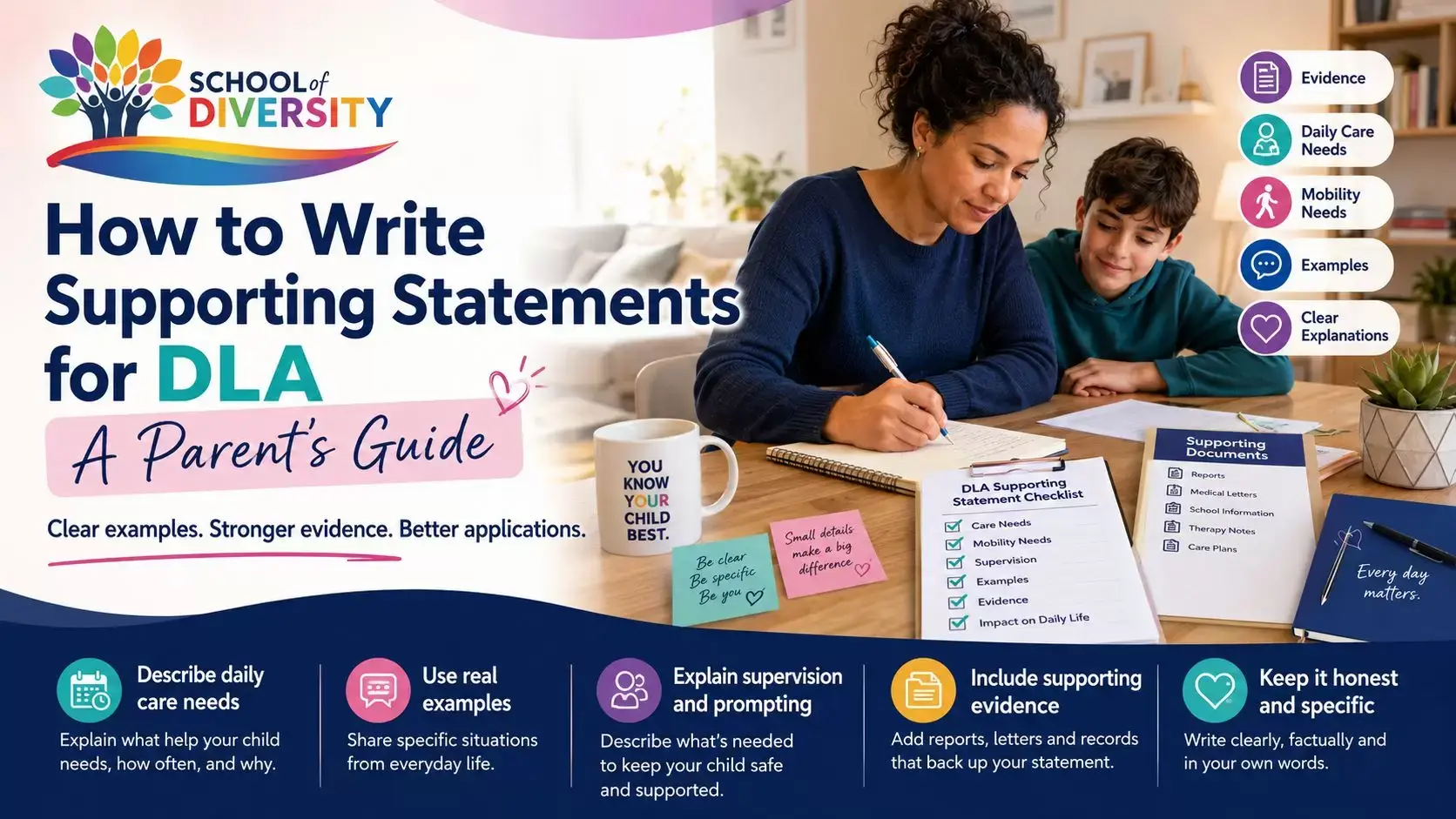
How to Write Supporting Statements for DLA: Parent Guide
Applying for Disability Living Allowance (DLA) for a child under 16 in England and Wales involves more than filling in the claim form. You also need to show the person assessing the claim exactly how much extra care and support your child needs. A supporting statement for a child’s DLA application is one of the most valuable pieces of evidence you can provide. It gives you space to explain the full picture in your own words and helps the decision maker understand what daily life is like for your family. This guide explains what a supporting statement should cover, who can write one, and how to approach it.
What Is a Supporting Statement for DLA?
A supporting statement is a written account of the extra care and support your child needs because of their disability or condition. It can be written by you, as a parent or carer, or by a professional who knows your child well. It sits alongside the DLA claim form and adds detail that a form alone cannot capture.
The aim is straightforward. Make clear all the extra care and support your child needs, and include details of the amounts and types of care required. When you explain when, why and how often that care happens, the assessor can build a realistic picture of your child’s needs.
Who Can Write a Supporting Statement for a Child's DLA Claim?
Parents often wonder whether they are allowed to write a supporting statement as well as a professional. The answer is yes. Your daily experience of caring for your child is important evidence, and your own words can carry real weight.
You can also ask other people to contribute:
- Education staff, including teachers and teaching assistants, who see your child in school. Official guidance for education staff explains how to provide a statement in support of a pupil’s DLA application.
- Health and care professionals who know your child and provide professional oversight and assistance tailored to their needs.
- Anyone else with direct knowledge of your child’s difficulties and the care they require.
It is not compulsory to have a statement from a professional. However, it does help to gather together as much evidence as possible, so do include one if you can.
What to Include in a Supporting Statement
The most useful supporting statements are specific and factual. A diagnosis alone does not explain the daily impact of a condition, so the statement needs to show what that diagnosis means in practice.
Make sure you cover the following:
- Explain the full picture of your child’s needs across home, school and the community.
- Include the amounts and types of care your child needs, such as help at night, during meals, with personal care, or with staying safe.
- Focus on the care your child needs because of their disability rather than the care they need because of their age.
- Describe any diagnosis or medical conditions that affect daily life.
- Give practical examples from a typical day so the assessor can see how needs appear in real life.
If a professional is writing the statement, they should also include their role, their organisation, how long they have known the child, and the date they first started supporting them. This helps the assessor understand the writer’s perspective and the quality of their knowledge.
How to Write Your Own Statement as a Parent
Your supporting statement does not need to be formal or medical. The most persuasive accounts are clear, honest and personal. Start by describing your child and their condition in your own words, then move on to the care they actually need.
Walk through a typical day from morning to night. Think about what you do for your child that a child of the same age without a disability would do for themselves. That could include help with washing, dressing, eating, using the toilet, crossing roads, managing emotions, or settling to sleep.
Be specific about amounts. Rather than saying your child needs constant supervision, explain when and why. Describe how often your child wakes at night, how long you spend supporting them with meals, or the level of supervision needed when you leave the house.
Avoid spending too much space on care that any child of that age would need. The assessor needs to understand the additional care caused by the disability itself. If you are unsure whether your draft is clear, ask someone who knows your child well to read it and tell you whether it matches what they see.
How to Structure a Supporting Statement
A clear structure makes the information easier to follow. A typical supporting letter for a DLA application begins with the writer’s address, the date, and the line “To Whom It May Concern”.
The subject line should read: “Re: Supporting Letter for [Child’s Full Name], of [Address] – Application for Disability Living Allowance (DLA)”.
The opening paragraph usually says: “I am writing to provide supporting information for [Child’s Name] in relation to their application for Disability Living Allowance (DLA).”
The writer then explains who they are and the nature of their involvement. A professional might describe their title, their organisation, and how long they have supported the child, noting that they provide professional oversight and assistance tailored to the child’s medical and care needs. From there, the statement moves into the detail of the child’s condition, the care they need, and the impact of their difficulties.
How Education Staff Can Help
Schools can play an important part in the evidence process. Education staff can provide a statement to support a pupil’s application for disability living allowance, and official guidance explains how they should approach it. If your child receives SEN support at school, ask the relevant staff member whether they would be willing to contribute.
A professional statement from someone at school adds a different perspective to your own. It can describe the support your child receives in the classroom, the difficulties they face, and the supervision they need during the school day. While this kind of statement is not compulsory, it helps to build a stronger evidence base for the claim.
Common Mistakes to Avoid
Some common errors can weaken a supporting statement. Being aware of them helps you write a stronger account.
- Focusing on age-related care instead of disability-related care. This is the issue that advice services highlight most often.
- Using vague language. Phrases such as “needs a lot of help” do not tell the assessor how much support is required. Give amounts and types of care instead.
- Leaving out difficult areas. If your child needs significant help at night, with personal care, or with their wellbeing, include it. The statement should reflect the full picture.
- Relying on diagnosis alone. A diagnosis explains a condition, but it does not explain the daily impact. The statement must show what the diagnosis means in practical terms.
Where to Find Help with the DLA Form
You do not need to write a supporting statement without any support. Several sources of guidance can help you complete the form and gather evidence:
- GOV.UK provides the Disability Living Allowance (DLA) for children claim form, which is used to apply for DLA for children under 16 in England and Wales.
- Citizens Advice offers help with filling in the DLA form for your child, including advice on explaining the full picture.
- Contact publishes tips on completing the DLA form, covering some of the more difficult parts and the kind of information to include.
- The Child Poverty Action Group (CPAG) provides guidance on completing disability living allowance statements for children and young people.
If your child lives in Scotland, note that Child Disability Payment applies there, so check the separate guidance for the Scottish system.
Frequently Asked Questions
Can a parent write a supporting statement for their child’s DLA claim?
Yes. You are allowed to write a supporting statement for your child’s DLA claim, and you can do this alongside a statement from a professional. Your account of the care you provide is valuable because you know your child’s needs in the most detail. The key is to explain the full picture and focus on the extra care your child needs because of their disability.
Do I need a professional supporting statement for a DLA claim?
No. A statement from a professional is not compulsory when applying for DLA for a child. However, it does help to gather together as much evidence as possible, so it is worth including one if you can. Education staff can provide statements in support of a pupil’s application, and other professionals who know your child can also contribute.
What evidence should I gather for a child’s DLA claim?
It is important to make clear all the extra care and support your child needs, so your evidence should reflect the amounts and types of care required. Your own supporting statement is part of that evidence, along with letters from professionals, school records, therapy notes and assessment reports. The more detailed the evidence, the easier it is for the assessor to understand your child’s daily needs.
How do I describe my child’s care needs in a supporting statement?
Describe the care your child needs because of their disability rather than the care they need because of their age. Be specific about how often help is needed and what that help involves. Use examples from a typical day, including the more difficult moments. Make sure you explain the full picture so the assessor understands the reality of caring for your child.
Final thoughts
A strong supporting statement for DLA should help the decision maker understand your child’s real daily needs, not just their diagnosis. Focus on the extra care, supervision, prompting, safety support and mobility help your child needs compared with another child of the same age. Use clear examples, explain how often support is needed, and make sure your statement matches the evidence you include. You may find it helpful to read our wider DLA for Children guide and our step-by-step guide on how to apply for Disability Living Allowance for your child. If you are completing the form, our guide on completing the DLA form for your child can help you avoid common pitfalls. For tailored help reviewing your wording and evidence, explore our DLA Application Support for Children service.