
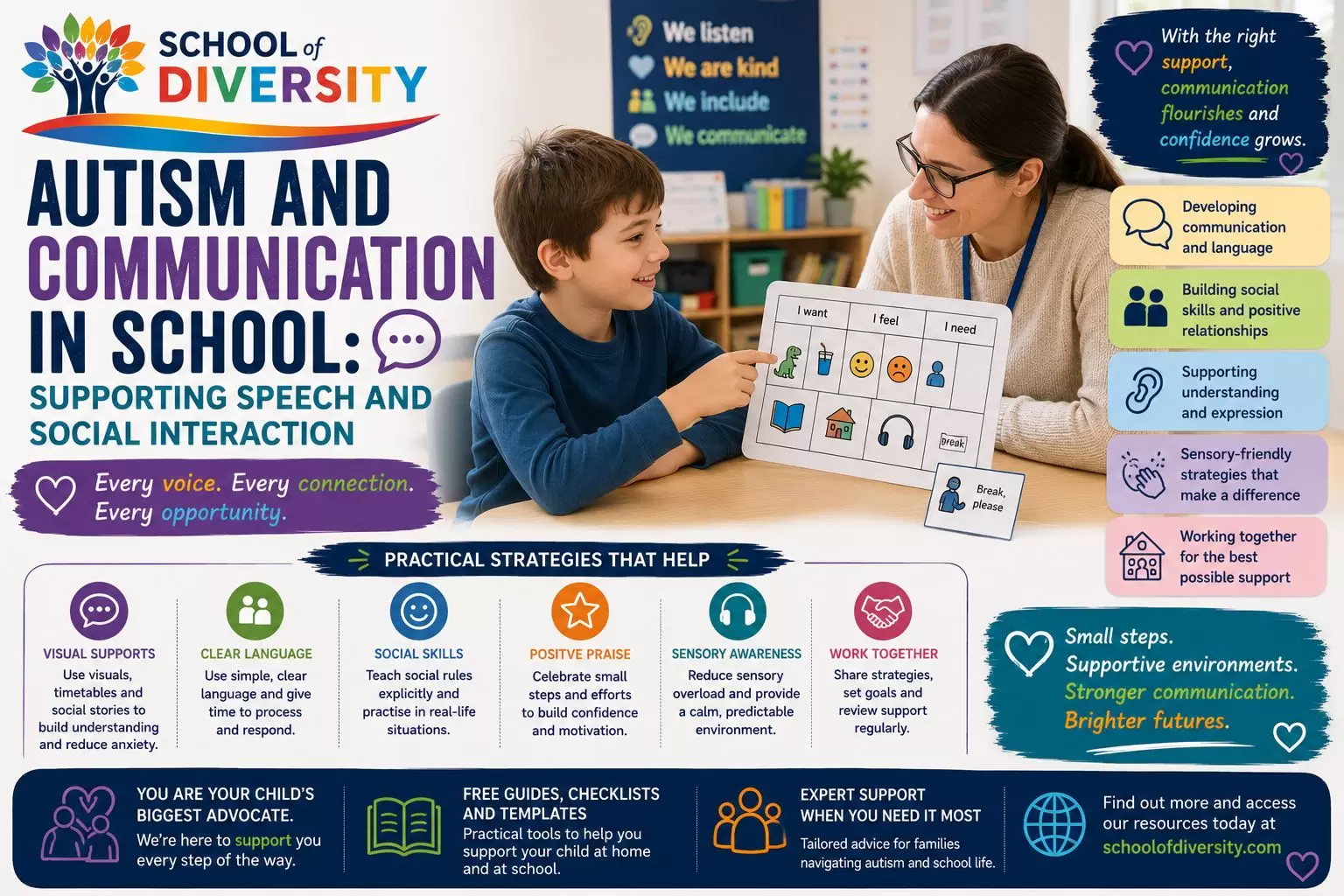
Autism and Communication in School: Supporting Speech and Social Interaction
Communication is central to a child’s experience at school, but for autistic pupils the environment can present unique challenges. Under the Equality Act 2010, schools must make reasonable adjustments, yet many parents find themselves navigating a patchwork of support. This guide explains how autism affects communication, what effective school-based support looks like, and how you can work with your child’s school to ensure their needs are met.
Understanding Autism and Communication Differences
For an autism diagnosis to be made, communication differences must be present from birth and have a clinically significant impact on daily life. These differences are not deficits; they are simply a different way of processing and using language. Many autistic people prefer direct, unambiguous language and may find indirect communication, such as hints or sarcasm, confusing. They may also use fewer gestures in childhood and find it challenging to interpret body language or non-literal phrases.
Speech and language can vary widely. Some autistic children develop typical or advanced language, while others use limited speech or do not develop spoken language at all, particularly if they have a co-occurring learning disability. Echolalia (repeating words or phrases) is common, as are differences in tone, volume, and speed of speech. Non-speaking autistic children may communicate using writing, British Sign Language (BSL), augmentative and alternative communication (AAC), vocalisations, or gestures. The key is to recognise each child’s unique profile and ensure the school staff are trained to respond appropriately.
Whole School Approaches That Make a Difference
Effective communication support starts with a whole school culture that values neurodiversity. Many local authorities in England provide guidance on sensory-friendly classrooms and social communication approaches. For example, Trafford’s local offer outlines a graduated approach that begins with universal provision, such as visual timetables and predictable routines, before moving to targeted interventions. Sensory checklists help teachers make reasonable adjustments for autistic pupils, reducing overload and creating a calm environment where communication can flourish.
Schools like Great Park Academy offer a range of practical strategies. These include additional adult support during unstructured times (like break and lunch), in-class support for speech and language, and targeted intervention programmes such as Zones of Regulation. Visual timetables help pupils understand what is happening next, reducing anxiety and supporting comprehension. Information and Communication Technology (ICT) can also reduce barriers, for instance by providing typed or symbol-based alternatives to spoken instructions.
Staff training is crucial. Services such as East Sussex CLASS provide training to mainstream schools on neurodiversity and speech, language, and communication needs (SLCN). Their link advisers work with every primary and secondary school in the county, offering consultations and transition support into reception year. Oxfordshire’s SENSS communication and interaction team focus on empowering school staff to understand the needs of children with social communication difficulties. Similarly, Hertfordshire has a dedicated Speech, Language, Communication and Autism Team made up of qualified teachers and specialists.
Key Strategies for the Classroom
The Autism Toolbox, a well-established resource, recommends several core strategies:
- Using visual supports such as symbols, pictures, and written words alongside verbal instructions.
- Teaching the names of key people and explicitly explaining roles (e.g., “Mrs Smith is the teaching assistant who helps with maths”).
- Providing opportunities for initiation so the child can start a conversation or ask a question, not just respond.
- Allowing time for processing – an autistic child may need several seconds longer to understand and respond.
These approaches are not costly or time-consuming to implement, but they require consistent application across all staff members.
Local Authority Support Services: What to Expect
Support for autism communication varies by local authority. Below is a summary of services mentioned in official local offer pages, which parents can use to compare with their own area.
| Local Authority | Service Name | Key Features |
|---|---|---|
| East Sussex | CLASS (Communication, Language and Autism Support Service) | Link adviser for every school; training on neurodiversity; transition support for reception year; staff hold additional qualifications in SLCN, SpLD, and ADHD. |
| Oxfordshire | SENSS Communication and Interaction Team | Empowers school staff to understand social communication difficulties; provides consultation and training. |
| Trafford | Local Offer Communication and Interaction Pathway | Graduated approach with universal provision, sensory-friendly classroom checklists, and reasonable adjustments guidance. |
| Hertfordshire | Speech, Language, Communication and Autism Team | Qualified teachers and specialists supporting children with SLCN; works with schools and families. |
Not every area offers the same level of provision. Some schools may rely on external speech and language therapy services, while others have in-house teams. If your child’s school does not currently access a service like these, you can request an assessment through the local authority’s local offer portal or as part of an Education, Health and Care (EHC) needs assessment.
Speech and Language Interventions and Resources
Beyond whole school approaches, targeted speech and language interventions can address specific needs. Elklan offers an e-learning course titled “Communication and Language Support for Autistic Children and Young People” which uses a strength-based lens and covers topics such as Gestalt Language Processing. This course is designed for professionals and parents alike, and can help build understanding of how autistic children develop language differently.
Interventions like Zones of Regulation teach children to recognise their own emotional state and choose appropriate communication strategies. In-class support from a teaching assistant or speech and language therapist can model language, introduce visual supports, and help the child practise social interaction in a low-pressure environment. The goal is always to build the child’s independence and confidence, not to force conformity to neurotypical communication styles.
How to Advocate for Communication Support at School
If you believe your child’s communication needs are not being met, the first step is to speak with the class teacher or SENCO. Explain the specific differences you observe at home and ask what strategies are in place at school. You can request a copy of the school’s SEN information report and ask whether they have received training on autism and communication.
If progress is slow, you may need to consider an Education, Health and Care Plan (EHCP). An EHCP can secure legally enforceable support, such as access to a speech and language therapist, a communication passport, or a dedicated teaching assistant trained in AAC. The evidence you gather should include reports from any private assessments, observations from school, and examples of how communication difficulties impact your child’s access to learning.
Remember that you are entitled to request an EHC needs assessment from your local authority. If the request is refused, you have the right to appeal. Services like the School of Diversity can guide you through this process, helping you strengthen your evidence and argue for the support your child needs.
Frequently Asked Questions
Can my child receive speech and language therapy without an EHCP?
Yes, schools can commission speech and language therapy directly or through NHS services, but this varies. Many schools have a link therapist, but waiting lists can be long. An EHCP makes therapy a legal requirement, which often speeds up access and ensures consistency.
What is a communication passport and how does it help?
A communication passport is a document that summarises how a child communicates best, including their preferences, strengths, and needs. It helps all staff understand the child quickly, reducing misunderstandings and supporting consistent approaches across lessons and break times.
Should I push for my non-speaking child to use AAC at school?
Augmentative and alternative communication (AAC) can include picture boards, tablets, or speech-generating devices. If your child is non-speaking or has limited speech, AAC can be life-changing. You should ask for a speech and language therapy assessment to determine the most suitable system and ensure staff are trained to use it.
What if the school says they don’t have funding for autism communication support?
Schools receive a notional SEN budget and also have access to funding from the local authority for high-needs pupils. If the school claims lack of funding, you can request a meeting to review the support plan. If necessary, an EHCP can release additional top-up funding (element 3) that is ring-fenced for your child’s needs.
Supporting an autistic child’s communication at school is a partnership between parents, educators, and specialists. While the system can be complex, understanding what is available and knowing how to advocate effectively can make a real difference to your child’s confidence, learning, and wellbeing. Start by documenting what works at home, share that with the school, and do not hesitate to ask for a formal assessment if progress stalls.
Final Thoughts
Autism and communication support in school should focus on helping the child feel understood, safe and able to express themselves in the way that works best for them. Some autistic children may need speech and language support, visual communication tools, social interaction strategies, sensory adjustments or more time to process and respond. You may find it helpful to read our wider guide on EHCPs for autism and our page on EHCPs for speech and language needs. If sensory needs are also affecting communication or classroom participation, our guide on EHCPs for sensory processing needs may also be useful. Where school-based support is not enough, our guide on SEN Support vs EHCPs can help you understand what additional support may be available.
3 Responses