
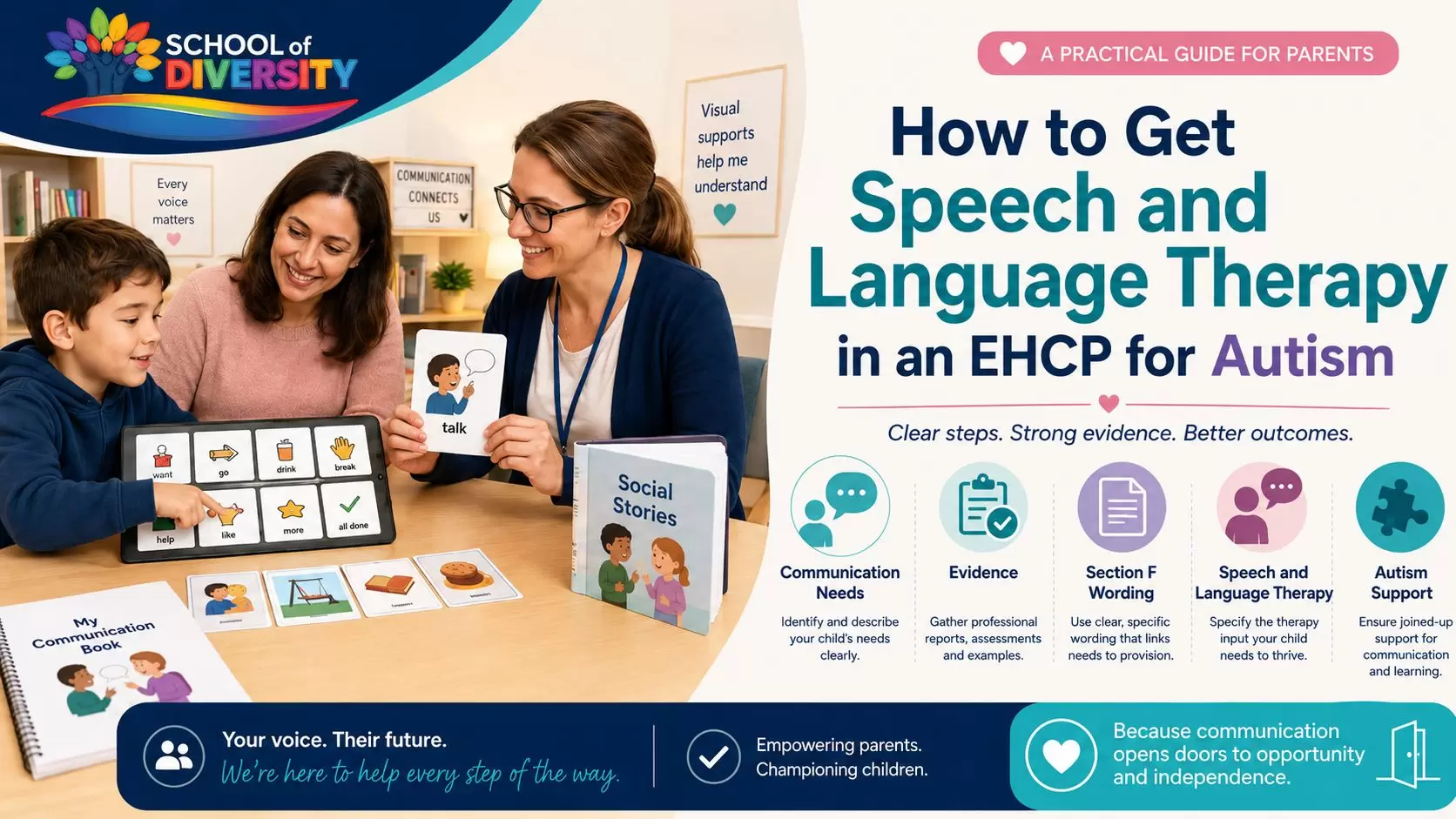
How to Get Speech and Language Therapy in an EHCP for Autism
For many autistic children, communication is not just about speech. It can involve understanding language, processing instructions, using social communication, expressing needs, managing sensory overload, building relationships and feeling confident enough to participate in school life. Where these needs are significant, speech and language therapy can be an important part of an EHCP.
This guide explains how parents can seek speech and language therapy in an EHCP for autism, what evidence may be needed, how therapy provision should be written, and what to look for in Section F of the plan. If you are at the start of the process, you may also find our wider guide on EHCPs for autism helpful.
Why speech and language therapy may be needed for autistic children
Autistic children may communicate in many different ways. Some may use spoken language fluently but still struggle with understanding social communication, implied meaning, emotional language or classroom instructions. Others may have delayed speech, selective mutism, situational communication differences or need alternative communication methods such as visuals, communication boards or AAC.
Speech and language therapy may help where a child has difficulties with:
- Understanding spoken language
- Following multi-step instructions
- Expressing needs, feelings or choices
- Social communication and interaction
- Using language in different settings
- Understanding non-literal language
- Processing verbal information
- Asking for help
- Joining peer conversations
- Managing communication during anxiety or overload
- Using alternative or augmentative communication
- Developing functional communication for everyday school life
If your child’s main difficulty is communication within the classroom, our guide on autism and communication in school may help you understand the types of support that can make a difference.
Speech and language therapy is not only about speech
One common misunderstanding is that speech and language therapy is only needed where a child has unclear speech or limited spoken language. This is not correct. Many autistic children who appear verbally able may still have substantial communication needs.
For example, a child may be able to talk about their interests in detail but struggle to:
- Explain when they are overwhelmed
- Tell an adult they do not understand
- Join group work
- Understand playground expectations
- Cope with changes in routine
- Interpret tone, facial expression or social cues
- Use language flexibly under stress
- Communicate pain, anxiety or sensory discomfort
This is why it is important that the EHCP reflects the child’s real communication profile, not just whether they can speak in full sentences.
When should speech and language therapy be included in an EHCP?
Speech and language therapy should be considered where communication needs are affecting the child’s access to education, independence, emotional wellbeing or social inclusion.
It may be needed where:
- School-based strategies are not enough
- The child needs specialist assessment or advice
- Communication needs affect learning across the curriculum
- The child struggles to express needs or emotions
- Anxiety or sensory overload reduces communication
- Social interaction difficulties affect school life
- The child needs visual supports, AAC or alternative communication
- Staff need training to support communication properly
- Communication needs are linked to behaviour, distress, avoidance or withdrawal
If you are unsure whether your child’s needs may require an EHCP, our guide on what level of need qualifies for an EHCP explains how parents can think about complexity, persistence and impact.
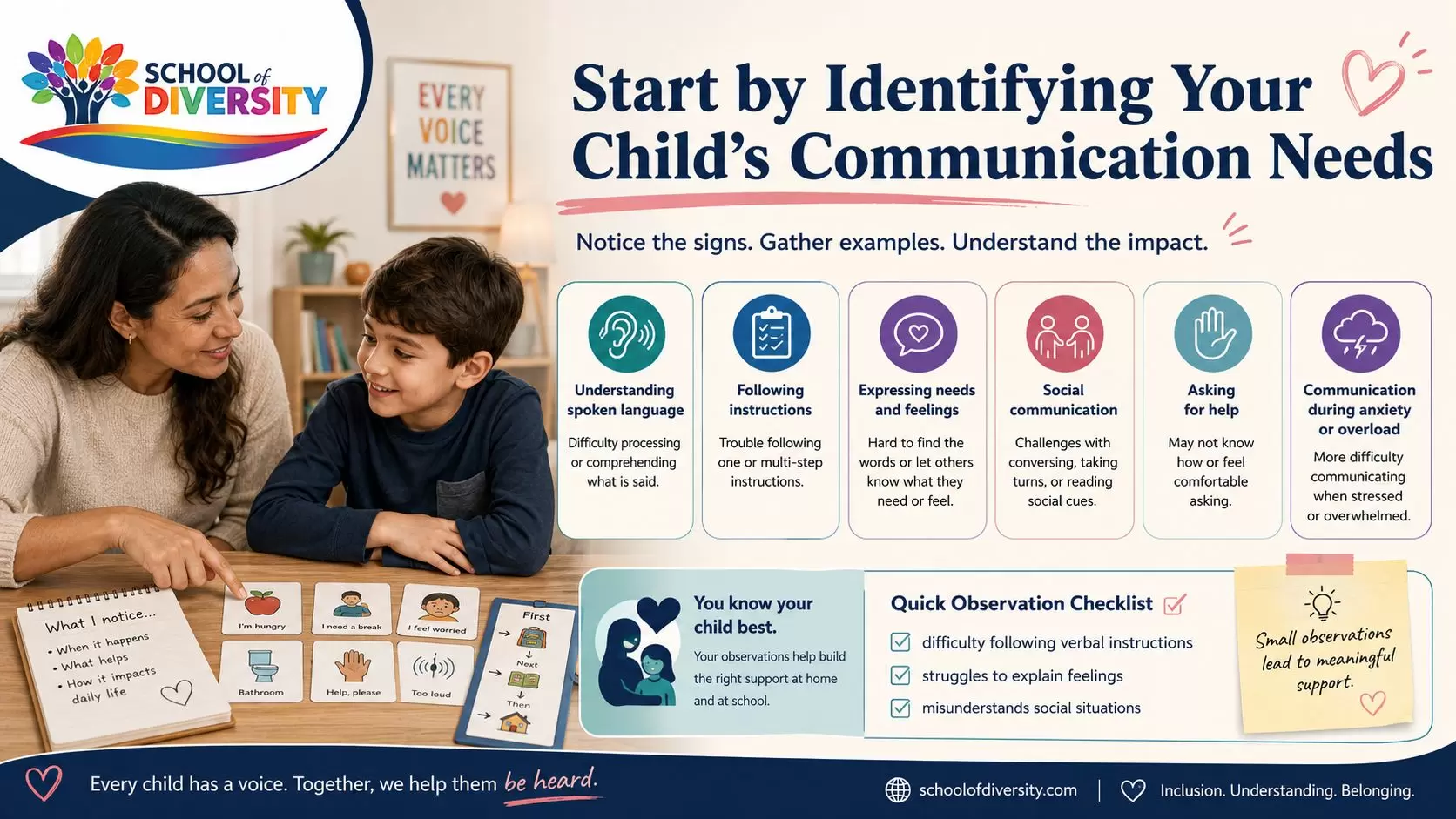
Start by identifying your child’s communication needs
Before asking for speech and language therapy to be included, it helps to be clear about the specific difficulties your child experiences.
Try to gather examples from home and school, such as:
- Difficulty following verbal instructions
- Needing instructions repeated or broken down
- Becoming distressed when language is unclear
- Struggling to explain what has happened
- Avoiding group work or peer interaction
- Becoming silent or unable to speak when anxious
- Difficulty asking for help
- Misunderstanding social situations
- Relying heavily on adults to interpret needs
- Using behaviour to communicate distress
- Struggling with transitions because they do not understand what is happening next
These examples can help show why speech and language therapy is educationally relevant.
.
Ask school what support is already in place
If your child is receiving SEN Support, ask school what communication strategies are currently being used and whether they are working.
Useful questions include:
- Has my child had a speech and language screening or assessment?
- Has the SENCO sought advice from speech and language therapy?
- Are visual supports being used consistently?
- Does my child have a way to ask for help or a break?
- Are staff adapting their language?
- How are social communication needs supported?
- Are communication difficulties affecting learning or behaviour?
- Is there evidence that current support is not enough?
If school is supporting your child without an EHCP, it may help to understand the difference between ordinary school-based support and formal provision by reading SEN Support vs EHCPs.
Request a speech and language therapy assessment
A speech and language therapy assessment can be important evidence. It can identify your child’s communication profile and recommend support.
Parents can ask school, the SENCO, health professionals or the local authority to consider whether a speech and language therapy assessment is needed. If the EHCP process is already underway, parents can ask the local authority to seek advice from a speech and language therapist as part of the assessment.
A strong request should explain:
- What communication needs you are concerned about
- How those needs affect school access
- What support has already been tried
- Why specialist assessment is needed
- What impact the difficulties have on learning, wellbeing or social inclusion
If you need help understanding how to make this request in a school context, our guide on how to request a speech and language therapy assessment at school explains the process in more detail.
What evidence helps secure speech and language therapy in an EHCP?
The strongest evidence usually shows both the child’s needs and the impact of those needs.
Helpful evidence may include:
- Speech and language therapy reports
- Autism assessment reports
- Educational psychology reports
- School SEN Support records
- Teacher observations
- Parent observations
- Examples of communication breakdowns
- Evidence of anxiety, distress or withdrawal
- Behaviour logs where behaviour may be communication
- Attendance or school refusal evidence
- Social communication concerns
- Records of interventions already tried
- Evidence of visual supports or AAC being needed
It is not enough to say that a child is autistic and therefore needs speech and language therapy. The evidence should explain how autism affects communication and what specialist support is required.
Our guide on EHCP evidence for parents may help you organise reports, observations and examples into a stronger evidence base.
How speech and language needs should appear in Section B
Section B of the EHCP should describe your child’s special educational needs. If your child has communication needs linked to autism, they should be clearly written into Section B.
This may include needs such as:
- Difficulty understanding spoken language
- Difficulty processing verbal instructions
- Social communication differences
- Difficulty expressing emotional or sensory needs
- Reliance on visual supports
- Anxiety affecting communication
- Difficulty with peer interaction
- Need for additional time to process and respond
- Need for predictable communication routines
- Difficulty generalising communication skills across settings
If these needs are not included in Section B, it becomes harder to argue for specific provision in Section F.
For a wider explanation of how EHCP sections work, read our guide to EHCP sections explained.
How speech and language therapy should be written in Section F
Section F is the part of the EHCP that sets out special educational provision. This is where speech and language therapy support should be clearly specified if it is required.
The wording should explain:
- What therapy or support will be provided
- Who will provide it
- How often it will happen
- How long sessions will last
- Whether support is direct or indirect
- What staff training is needed
- How strategies will be embedded in class
- How progress will be reviewed
- What visual or communication tools must be used
Vague wording can cause problems. Phrases such as “access to speech and language advice”, “opportunities to develop communication”, or “support as required” are usually too unclear.
Stronger wording may say:
“The child will receive direct speech and language therapy input for X minutes per week, delivered by a qualified speech and language therapist, focusing on functional communication, emotional expression and social communication. The therapist will also provide a written programme for school staff, reviewed termly, with staff trained to use agreed strategies consistently across the school day.”
The exact provision must always be based on the child’s evidence and professional recommendations.
Our guide to Section F wording examples can help you understand the difference between vague and specific EHCP provision.
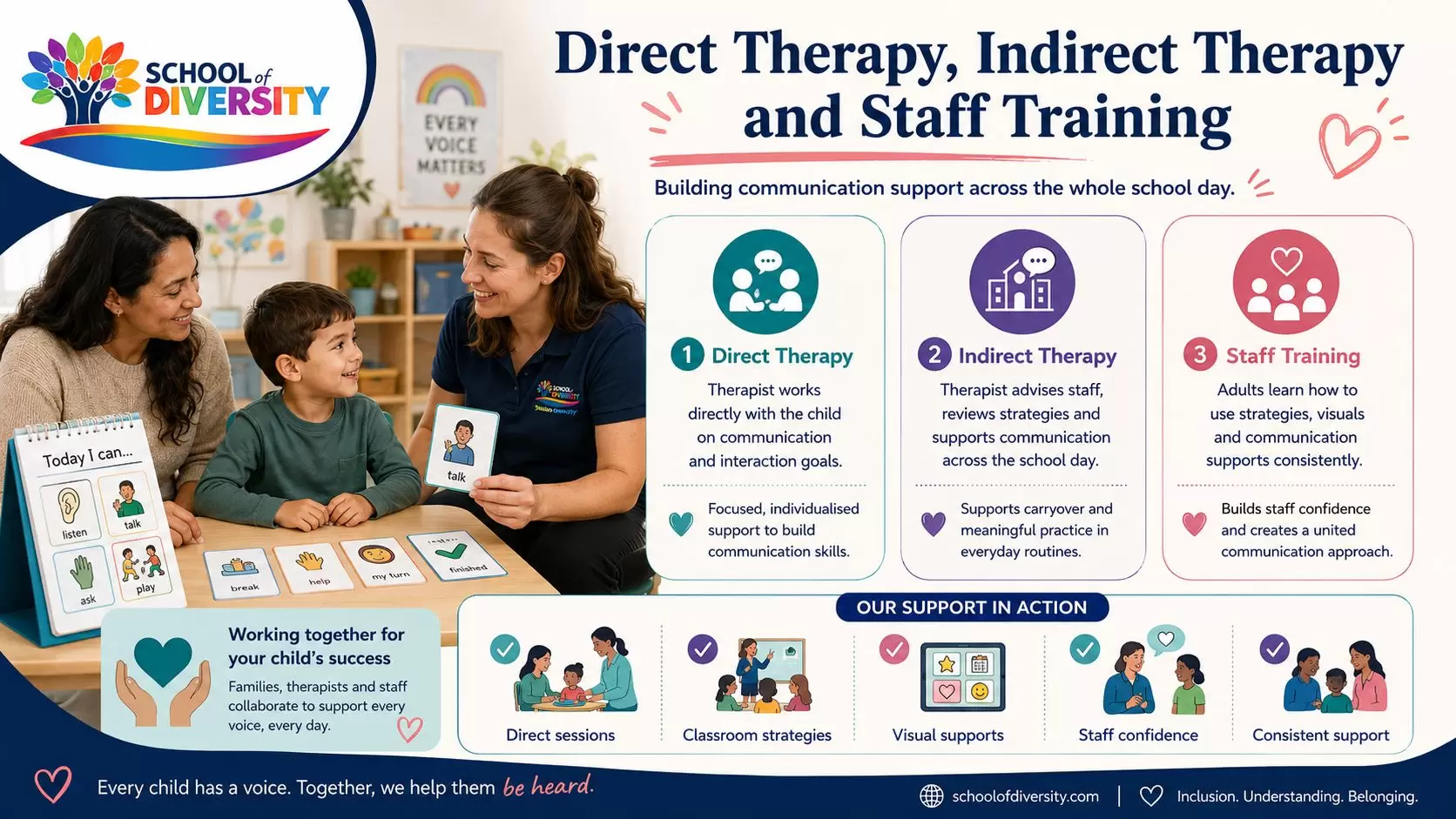
Direct therapy, indirect therapy and staff training
Speech and language therapy in an EHCP may include different types of support.
Direct therapy may involve the therapist working directly with the child. Indirect therapy may involve the therapist advising staff, reviewing strategies, creating programmes or training adults who support the child every day.
For many autistic children, indirect support can be important because communication strategies need to be used consistently throughout the school day, not just during therapy sessions.
Provision may include:
- Direct therapy sessions
- Small group communication work
- Social communication programmes
- Staff training
- Visual support planning
- AAC or communication board advice
- Parent and school consultation
- Termly reviews
- Written programmes
- Environmental communication adjustments
The key issue is whether the provision is specific enough and whether it matches the child’s assessed needs.
Visual supports and alternative communication
Some autistic children need visual or alternative communication tools to understand routines, express choices or communicate distress.
This may include:
- Visual timetables
- Now-and-next boards
- Social stories
- Choice boards
- Emotion cards
- Break cards
- Communication books
- PECS
- AAC devices
- Communication apps
- Low-tech communication boards
If your child needs these tools to access education, they should be clearly described in the EHCP. Our guide on alternative communication methods for autistic children explains how these methods can support communication in school.
You may also find our guide on social stories and visual supports for classroom routines helpful if your child needs structured visual support across the school day.
Linking communication support to outcomes
Section E of the EHCP sets out outcomes. These should link to your child’s communication needs and the provision in Section F.
Communication outcomes might relate to:
- Expressing needs clearly
- Asking for help
- Using a communication system
- Managing transitions
- Participating in group activities
- Understanding classroom routines
- Developing independence
- Improving emotional communication
- Building social confidence
Outcomes should not be vague aspirations. They should be meaningful, realistic and linked to the support your child will receive.
What if the EHCP does not include speech and language therapy?
If the EHCP does not include speech and language therapy but you believe it should, check:
- Is the communication need clearly included in Section B?
- Is there professional evidence recommending therapy?
- Does Section F include any communication provision?
- Is the wording specific or vague?
- Has school-based support been enough?
- Are visual or communication tools included?
- Is staff training specified?
- Are outcomes linked to communication?
If the plan is weak, unclear or missing key provision, parents may need to request amendments, use the annual review process or consider appeal routes.
Our guide on EHCP good vs bad examples may help you identify whether the wording is strong enough.
Using the annual review to request speech and language therapy
If your child already has an EHCP, the annual review is an important opportunity to ask for communication needs and therapy provision to be updated.
Before the review, gather:
- Current examples of communication difficulties
- School records
- Parent observations
- Any new reports
- Evidence that current strategies are not enough
- Examples of distress, withdrawal or misunderstanding
- Evidence of social communication difficulties
- Information about transitions or changes
At the review, ask for the plan to be amended so that needs, outcomes and provision are properly aligned.
Our guide on EHCP annual reviews explains how this process works and what parents should prepare.
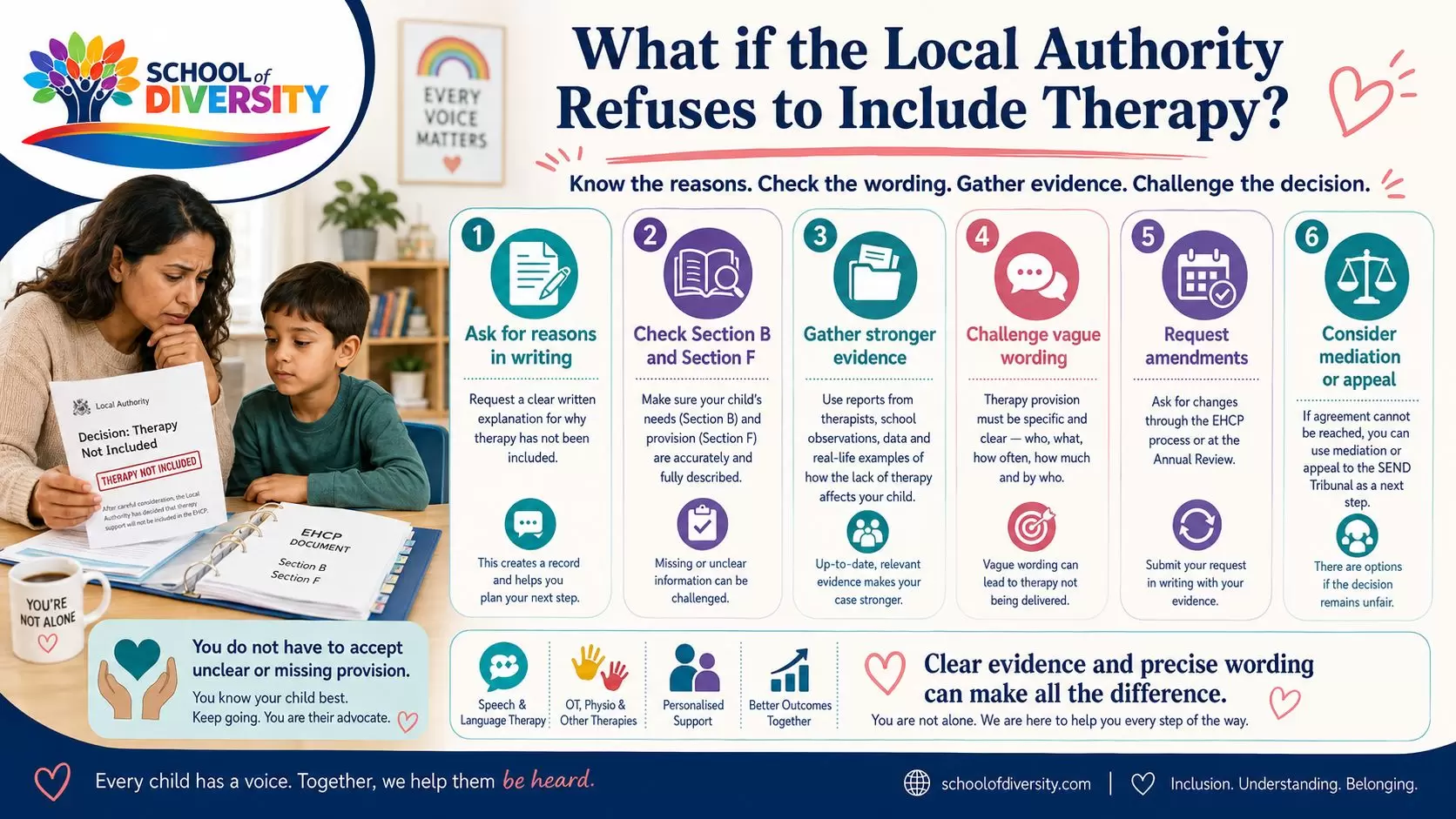
What if the local authority refuses to include therapy?
If the local authority refuses to include speech and language therapy, ask for clear reasons in writing. You may need to show that the provision is necessary for your child to access education and that current support is not enough.
You may need to challenge:
- Missing communication needs in Section B
- Vague or insufficient Section F wording
- Failure to follow professional recommendations
- Lack of quantified therapy provision
- Lack of staff training
- No clear system for visual or alternative communication
- Failure to consider the impact of autism on communication
If disagreement remains, parents may need to consider mediation or appeal. Our guide on the EHCP appeal process explains the steps parents can take when they disagree with the contents of an EHCP.
Practical tips for parents
When trying to secure speech and language therapy in an EHCP for autism, parents should:
- Keep clear examples of communication difficulties
- Ask school to record what support is being used
- Request specialist speech and language assessment where needed
- Link communication needs to learning, wellbeing and independence
- Check that Section B includes all relevant communication needs
- Check that Section F is specific and quantified
- Ask for visual supports or AAC to be included where needed
- Request staff training if adults need to use strategies consistently
- Use annual reviews to update the plan
- Challenge vague wording where provision is not clear
Key message for parents
Speech and language therapy in an EHCP for autism should be based on the child’s individual communication profile. Some children need support with speech, others need help with understanding language, social communication, emotional expression, processing or alternative communication. What matters is that the EHCP clearly identifies the need and sets out the provision required to meet it.
Final Thoughts
Getting speech and language therapy into an EHCP for autism depends on clear evidence, accurate wording and a strong link between your child’s communication needs and the support required in school. The plan should not simply mention autism or communication in general terms; it should explain what your child needs, what support must be provided and how that support will help them access education.
If your child’s plan is missing key communication provision, or the wording is too vague, it may be time to review the evidence and request clearer amendments. The stronger the link between need, provision and outcomes, the more effective the EHCP is likely to be.