
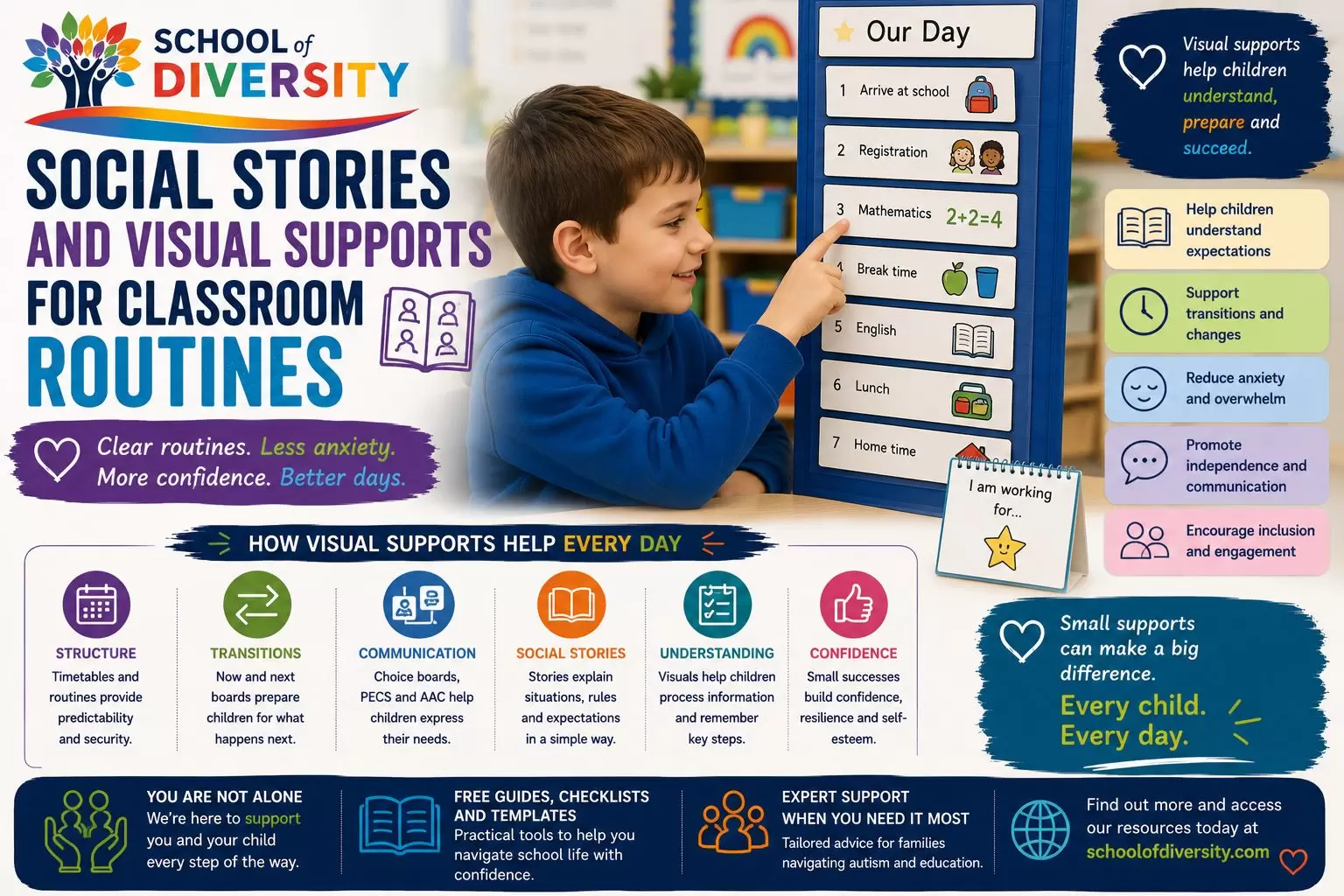
Social Stories and Visual Supports for Classroom Routines
For many autistic children, the school day can feel unpredictable, fast-moving and difficult to understand. Changes in routine, transitions between activities, noisy classrooms, social expectations and unclear instructions can all increase anxiety and make it harder for a child to participate confidently. Social stories and visual supports can help by making expectations clearer, routines more predictable and communication easier.
These tools are especially helpful for children who need support with communication, processing language, managing transitions or understanding what is expected in the classroom. They can also form part of wider support for children with autism, communication differences or speech and language needs. If your child’s communication needs are affecting their access to school life, you may also find our guide on autism and communication in school helpful.
What are social stories?
Social stories are short, simple stories that explain a situation, routine or expectation in a clear and reassuring way. They are often written from the child’s perspective and may include pictures, symbols or photographs to help the child understand what is happening and what they can do.
A social story might explain:
- What happens when I arrive at school
- How I line up after breaktime
- What to do if I feel worried
- How to ask for help
- What happens during assembly
- How to cope with a change in the timetable
- How to take turns in a game
- What happens when a supply teacher is in class
The aim is not to control the child’s behaviour, but to help them understand the situation and feel more prepared.
What are visual supports?
Visual supports are tools that use pictures, symbols, written words, photographs or objects to help a child understand information. They can be especially helpful for children who process visual information more easily than spoken language.
Examples of visual supports include:
- Visual timetables
- Now-and-next boards
- First-and-then boards
- Choice boards
- Emotion cards
- Break cards
- Traffic light systems
- Task checklists
- Visual classroom rules
- Transition cards
- Social scripts
- Communication boards
- Picture Exchange Communication System tools
- AAC devices or apps
Some children may need alternative or additional ways to communicate beyond spoken language. If this applies to your child, our guide to alternative communication methods for autistic children explains how tools such as AAC, PECS, communication boards and visual systems can support children in school.
Why classroom routines can be difficult for autistic children
Classroom routines may look simple from the outside, but they often involve many hidden demands. A child may need to understand verbal instructions, process changes quickly, move between spaces, manage sensory input, interact with peers and complete tasks in a particular order.
Autistic children may find this difficult because of:
- Differences in communication and language processing
- Anxiety around uncertainty or change
- Sensory sensitivities
- Difficulty with transitions
- Executive functioning challenges
- Social communication differences
- A need for predictable structure
- Difficulty understanding implied expectations
- Emotional regulation needs
When routines are not clearly explained, a child may appear distressed, avoidant, withdrawn, disruptive or non-compliant. In reality, they may be overwhelmed or unsure what is expected.
For children with more significant communication, interaction or sensory needs, visual supports may need to sit alongside wider SEN provision. Parents may find it useful to understand the difference between school-based support and formal provision by reading our guide on SEN Support vs EHCPs.
How social stories can support classroom routines
Social stories can help children prepare for situations before they happen. They can reduce anxiety by explaining what will happen, why it happens and what the child can do.
For example, a social story about morning registration might explain:
“When I come into class, I put my bag on my peg. Then I sit on the carpet or at my table. My teacher will say good morning. I can look at the visual timetable to see what will happen next. If I feel unsure, I can ask an adult for help.”
This type of story gives the child clear information without criticism or pressure.
How visual timetables help
A visual timetable shows the order of the day using pictures, symbols or words. It helps the child know what is happening now and what will happen next.
A good visual timetable can:
- Make the school day more predictable
- Reduce repeated questioning
- Support transitions
- Help the child prepare for change
- Build independence
- Reduce anxiety
- Support understanding of time and sequence
For some children, a whole-day timetable is useful. For others, it may be better to show only part of the day, such as “now”, “next” and “later”, to avoid overload.
Now-and-next boards
A now-and-next board is a simple visual tool that shows the child what they are doing now and what will happen next.
For example:
Now: Maths
Next: Snack
This can be helpful when a child struggles with transitions or motivation. It can also support understanding when a preferred activity is coming after a less preferred task.
First-and-then boards
First-and-then boards are similar but often used to support task completion.
For example:
First: Write three sentences
Then: Choose a book
This helps the child understand the sequence and what is expected before moving on.
Choice boards
Choice boards allow a child to communicate preferences or needs using pictures, words or symbols. They can be used for activities, sensory tools, break options, communication choices or regulation strategies.
A choice board might include:
- I need help
- I need a break
- I feel worried
- I want quiet time
- I need a drink
- I want to draw
- I want to read
- I need my headphones
Choice boards can be especially helpful for children who find it difficult to explain how they feel verbally. Where a child has ongoing speech, language or communication needs, it may also be helpful to read our guide on EHCPs for speech and language needs.
Emotion cards and regulation visuals
Some children find it difficult to recognise or communicate emotions. Emotion cards, feelings thermometers or zones of regulation visuals can help a child show how they are feeling before they become overwhelmed.
These tools can help adults respond earlier and more appropriately. For example, if a child points to “worried” or “too noisy”, staff can offer reassurance, quiet space or sensory support before the situation escalates.
Supporting transitions
Transitions are one of the most common pressure points in the school day. Moving from one activity to another, changing rooms, stopping a preferred activity or entering a noisy space can be difficult.
Visual supports can help by showing:
- What is happening now
- What will happen next
- How long an activity will last
- Where the child is going
- Who will be there
- What they need to take
- What they can do if they feel worried
A transition card, countdown timer or now-and-next board can make the change feel more manageable.
Using social stories for change
Changes to routine can be especially difficult for some autistic children. Social stories can help prepare the child for changes such as:
- A school trip
- A fire drill
- A new classroom
- A new teacher
- A supply teacher
- A change in lunchtime arrangements
- A different seating plan
- A special event day
- Moving to a new year group
The story should be shared before the change happens, repeated as needed and kept calm, factual and reassuring.
What makes a good social story?
A good social story should be:
- Short and clear
- Positive and supportive
- Written at the child’s level of understanding
- Specific to the child’s situation
- Free from blame or shame
- Focused on understanding rather than punishment
- Supported by visuals where helpful
- Reviewed regularly
Avoid wording that sounds like a demand or behaviour correction. The purpose is to help the child understand and prepare.
Example social story: When the classroom feels too noisy
Sometimes the classroom feels noisy.
Lots of children may be talking, moving or using resources.
Noise can make my body feel uncomfortable or worried.
If the classroom feels too noisy, I can show my break card.
An adult can help me find a quieter space.
I can use my headphones or calming activity.
When I feel ready, I can return to my learning.
It is okay to ask for help.
Example social story: Using a now-and-next board
My now-and-next board helps me understand my day.
The first picture shows what I am doing now.
The second picture shows what will happen next.
Sometimes the activities change.
An adult will help me understand the change.
I can look at my board when I feel unsure.
The board helps me feel prepared.
How schools should use visual supports
Visual supports should not be used once and then forgotten. They work best when they are part of everyday classroom practice.
Schools should:
- Use visuals consistently
- Keep them accessible to the child
- Teach the child how to use them
- Review whether they are helping
- Update them when routines change
- Involve parents where possible
- Avoid removing visuals as a punishment
- Make sure all relevant staff understand them
A visual support is only effective if the child knows what it means and adults use it properly.
Working with parents
Parents often know which visuals, words, symbols or approaches work best for their child. Schools should listen to parental knowledge and share what is being used in class so that home and school can work consistently.
Parents may want to ask:
- Does my child have a visual timetable?
- Are now-and-next boards used?
- Does my child have a way to ask for help or a break?
- Are social stories used before changes?
- How are transitions supported?
- Are visuals used consistently by all staff?
- Can I have copies to use at home?
- How do you know whether the support is working?
If your child is autistic and needs consistent support across the school day, our page on EHCPs for autism explains how autism-related needs and provision can be identified within an EHCP.
When visual supports should be included in SEN Support
If a child needs visual supports to access learning, manage transitions or communicate needs, this should be recorded in their SEN Support plan. The support should be clear enough that everyone understands what is being provided.
For example:
“The pupil will have access to a personalised visual timetable, now-and-next board and break card throughout the school day. Staff will use these consistently to support transitions, reduce anxiety and help the pupil understand classroom routines.”
This is stronger than simply writing “visuals to be used where needed”.
When visual supports may need to be included in an EHCP
If a child has significant or long-term communication, interaction, sensory or regulation needs, visual supports may need to be written into an EHCP as part of their special educational provision.
This may be relevant where:
- The child cannot access learning without visual structure
- Transitions cause significant distress
- The child needs a consistent communication system
- There are frequent meltdowns, shutdowns or school refusal
- Visual supports are needed across the whole school day
- Staff need training to use communication tools properly
- The child needs specialist speech and language therapy input
- School-based support is not enough
In an EHCP, provision should be specific. It should say what support will be used, when, by whom and how often it will be reviewed. Parents may find our guide to Section F wording examples useful when checking whether support is clear, specific and enforceable.
Practical tips for parents
Parents can support their child by:
- Asking school what visual supports are already in place
- Sharing visuals that work well at home
- Keeping examples of difficulties with transitions or routines
- Asking for support to be written into the SEN Support plan
- Requesting social stories before known changes
- Asking whether speech and language advice is needed
- Keeping records of what helps and what does not
- Reviewing whether support is consistent across the school day
If you are gathering information to show why your child needs additional support, our guide on EHCP evidence for parents explains the types of evidence that can help build a clearer picture of your child’s needs.
Key message for parents
Social stories and visual supports are not “extras” or optional decorations. For many autistic children, they are essential tools that help them understand, communicate, regulate and participate in school life. When used properly, they can reduce anxiety, improve independence and help children feel safer and more included.
Final thoughts
Social stories and visual supports can make classroom routines feel more predictable, accessible and less overwhelming for autistic children. When children can see what is happening now, what comes next and what is expected of them, they are often better able to manage transitions, communicate needs and participate with greater confidence.
If visual supports form part of your child’s everyday support, it is important to make sure they are used consistently and recorded properly. Where school-based support is no longer enough, parents may need to consider whether an EHCP is required, particularly if communication, sensory or transition needs are significantly affecting access to education.
One Response