
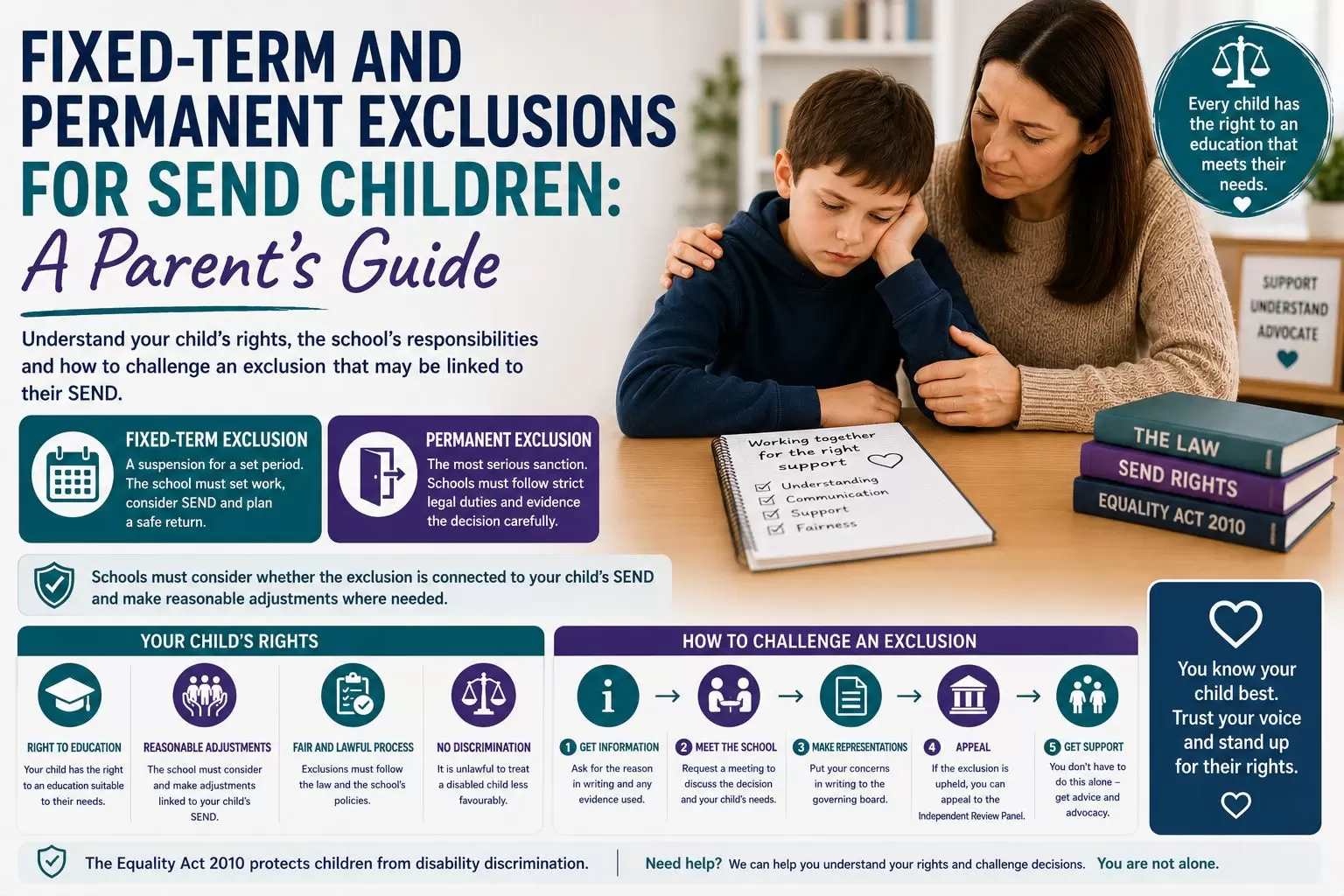
Fixed Term and Permanent Exclusions for SEND Children: A Parent's Guide
In England, exclusion is the formal sending home of a pupil from school for disciplinary reasons. An exclusion can be permanent or fixed term (temporary, also known as a suspension). No child should be excluded for an indefinite period, for a non-disciplinary reason, or without formal notice in writing from the head teacher. For the vast majority of pupils, suspensions and permanent exclusions may not be necessary because other strategies can manage their behaviour. However, when a child has special educational needs or a disability (SEND), the situation often calls for closer scrutiny to ensure the exclusion is lawful and fair.
Fixed Term Exclusion (Suspension) vs Permanent Exclusion
A fixed term exclusion (suspension) means your child is temporarily removed from school. A permanent exclusion means your child is no longer allowed to attend the school and their name will be removed from the school roll, unless the parent chooses to follow the route of an Independent Review Panel. Crucially, the head teacher must not remove a pupil’s name from the school Admissions Register until the outcome of that Independent Review Panel, if parents pursue that option.
| Aspect | Fixed Term Exclusion (Suspension) | Permanent Exclusion |
|---|---|---|
| Duration | Temporary removal for a set number of days | No limit; child cannot return to the school |
| Removal from school roll | No, the child remains on roll | Yes, but not until after any Independent Review Panel |
| Reinstatement possibility | Automatic after suspension period ends | Possible via Independent Review Panel or successful challenge |
| Written notice required | Yes, from the head teacher | Yes, from the head teacher |
Why SEND Children Are at Higher Risk of Exclusion
Children with special educational needs are disproportionately affected by exclusions. Forty-five per cent of all permanently excluded children have special educational needs. Children with identified mental health problems are ten times more likely than average to be excluded. Permanent exclusions rose by 60 per cent between 2013/14 and 2017/18, from 4,949 to 7,905. In 2017/18, 41 children were permanently excluded every day. Autistic students are the largest single SEND group to be excluded, and for many of these pupils the reason for exclusion will be unmet SEND need.
The Children’s Commissioner’s report highlighted that primary schools experienced the largest percentage increase in exclusions, with a whole class’s worth of children permanently excluded every week during term time in 2017/18. These figures show that the current system often fails to identify and meet the needs of SEND pupils before behaviour becomes a problem.
Legal Duties When Excluding a SEND Child
Schools are not allowed to suspend or permanently exclude a pupil for a non-disciplinary reason, and they must follow the statutory guidance set out in the Department for Education’s “Suspension and permanent exclusion guidance”. When a child has special educational needs, the head teacher should consider whether the behaviour is a result of unmet need.
The Independent Provider of Special Education Advice (IPSEA) explains that pupils with SEN are sometimes excluded because their needs are not being properly met, and when this happens the exclusion may not be fair or lawful. It can also indicate that the child may have needs that require more investigation or help. If your child does not have an Education, Health and Care (EHC) plan, the next steps will differ from those for a child who already has one. The governing board and local authority also have specific duties to review exclusions and ensure proper procedures are followed.
What to Do If Your Child Is Excluded
Get the Facts in Writing
As soon as your child is excluded, the head teacher must provide formal notice in writing. This notice should state the reason for the exclusion, its duration (if fixed term) and the name of the school. Keep a copy of this letter. If you believe the exclusion is related to your child’s disability or SEN, note this down and gather any evidence of previous requests for support.
Seek Independent Advice
You do not have to face this alone. SENDIASS (Special Educational Needs and Disabilities Information, Advice and Support Service) provides free, impartial advice. IPSEA also offers detailed guidance on what to do if your child is excluded, including steps depending on whether or not your child has an EHC plan. Contact, a charity for families with disabled children, also provides advice on exclusions. The next steps will involve thinking about what can be done to get your child’s needs better met to avoid further exclusions in the future.
Challenge the Exclusion if Necessary
If your child has been permanently excluded, you have the right to request an Independent Review Panel. The head teacher must not remove your child’s name from the school roll until the outcome of that panel. You can also challenge the exclusion if you believe it was unlawful, discriminatory or based on unmet SEND. Consider requesting an Education, Health and Care needs assessment if your child does not already have an EHC plan, as a plan can provide legally enforceable support.
Understanding the Impact on Your Child
Exclusion can be a deeply stressful experience for both the child and the family. For a child with SEND, being removed from the school environment may exacerbate anxiety or sensory difficulties. It is important to maintain open communication with your child, reassure them, and work with professionals to create a plan that addresses their underlying needs. The aim should always be to secure the right support so that your child can access education successfully, whether at their current school or, in the case of permanent exclusion, at a new setting such as a pupil referral unit or alternative provision.
If your child is facing exclusion, remember that you have rights and there are expert organisations ready to help. The school should have used other strategies before resorting to exclusion, and if the behaviour was linked to unmet SEND, the exclusion may be challenged. Take time to gather information, seek advice from SENDIASS, IPSEA or Contact, and consider whether your child’s needs are being fully identified. For many families, an Education, Health and Care plan can be a vital tool to secure the support your child deserves. The School of Diversity offers guidance on EHCP applications and appeals to help you navigate this complex system and advocate effectively for your child.
Final thoughts
Fixed-term suspensions and permanent exclusions can have a significant impact on a child with SEND, particularly where behaviour may be linked to unmet needs, disability or a lack of appropriate support. Parents should check whether the school followed a lawful process, considered the child’s SEND and made suitable reasonable adjustments before deciding to exclude. You may also find it helpful to read our wider guide on school exclusions and SEND, alongside your child’s legal rights under the Equality Act 2010. Where exclusion concerns are connected to ongoing unmet needs, our guide on SEN Support vs EHCPs can help you consider whether more formal support is needed. If you believe the exclusion involved disability discrimination, read our guide on how to make a disability discrimination claim against a school.