
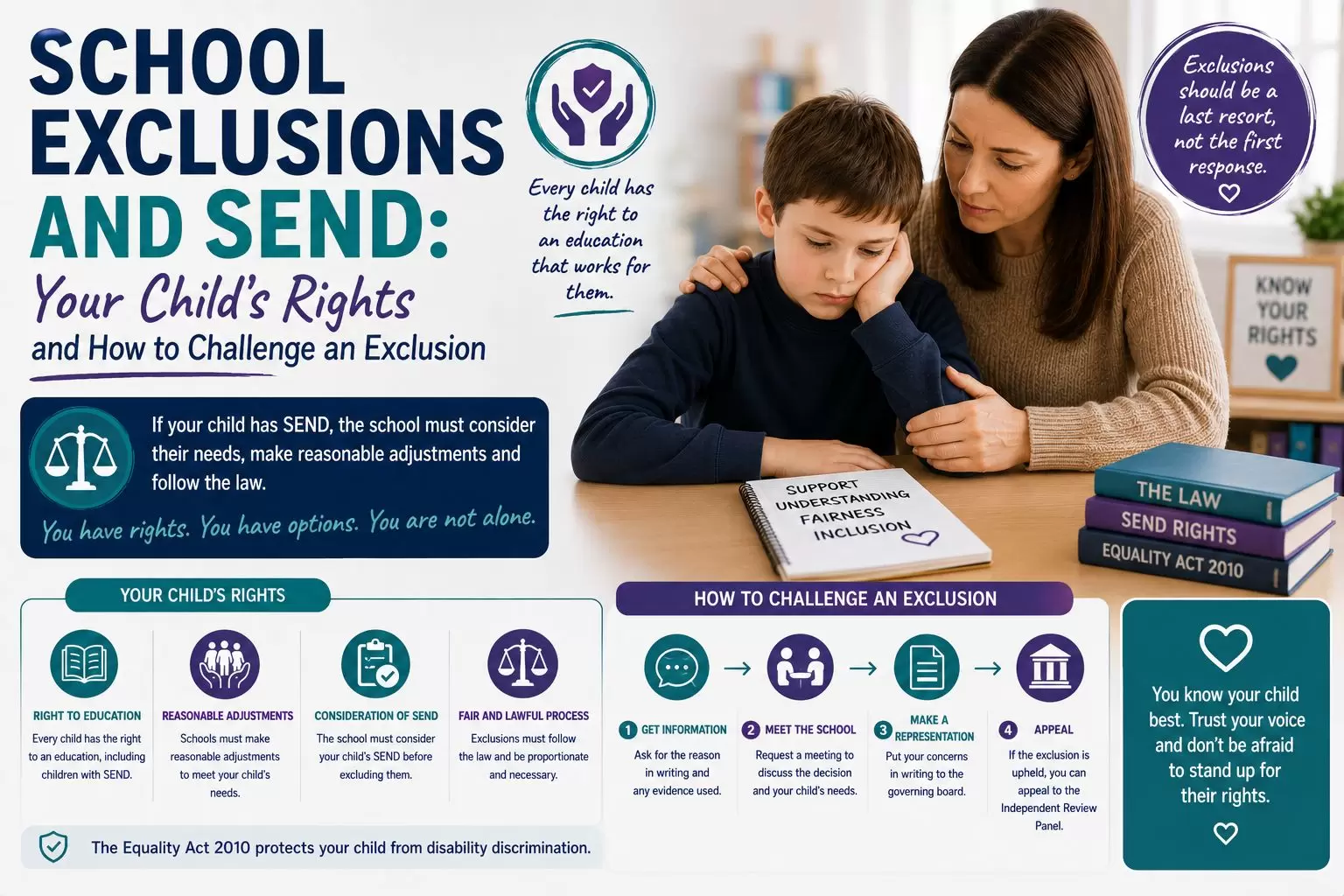
School Exclusions and SEND: Your Child's Rights and How to Challenge an Exclusion
A head teacher or principal can exclude a child from school for disciplinary reasons. There are two lawful types of exclusion: fixed-term (also called a suspension) and permanent. A fixed-term exclusion lasts for a set number of days, after which your child can return to school. A permanent exclusion means your child is no longer allowed to attend that school. No child should be excluded for an indefinite period, for a non-disciplinary reason, or without formal notice in writing from the head teacher. If your child has special educational needs or a disability (SEND), the exclusion may raise additional legal and practical issues that you need to understand.
How SEND Affects Exclusions
Pupils with special educational needs are sometimes excluded because their needs are not being properly met. When this happens, the exclusion may not be fair or lawful. It could also indicate that your child may have needs that require further investigation or help. Autistic students are the largest SEND group to be excluded, and in many cases the reason for the exclusion is unmet SEND need rather than wilful misbehaviour. If your child has been excluded, whether for a fixed period or permanently, it is important to consider what can be done to get their needs better met to avoid further exclusions in the future.
Your Child's Legal Rights Under the Equality Act 2010
The Equality Act 2010 places legal duties on your child’s school in relation to the exclusion of disabled pupils. This means the school must not discriminate against your child because of their disability. If your child’s behaviour is linked to their SEND, the school should have made reasonable adjustments and put appropriate support in place before resorting to exclusion. An exclusion that results from a failure to meet these duties could be unlawful. You have the right to challenge an exclusion if you believe the school has not followed its legal obligations.
Challenging an Exclusion: Step by Step
First Step: Contact the School and Gather Evidence
As soon as you receive the formal exclusion letter from the head teacher, start gathering evidence. Collect any reports from the school, records of support plans, communication with staff, and information about your child’s SEND. If your child has an education, health and care (EHC) plan, include that as well. Think about whether the exclusion may have happened because your child’s needs were not properly met. Write down your own observations and any conversations you have had with the school about your child’s behaviour and support.
Present Your Case to the Governing Body
If you disagree with the school’s decision to exclude your child, you have the right to state your case, in person, to the governors of the school. The governing body will review the exclusion and decide whether to uphold it or reinstate your child. You can attend the meeting and explain why you believe the exclusion is wrong, especially if it relates to unmet SEND needs. You may also bring a friend or representative. The school must consider your views before making a final decision.
Request an Independent Review Panel (IRP)
If the governing body upholds the decision to exclude, the pupil’s parent has the right to have the decision reviewed by an independent review panel. The IRP is separate from the school and can consider whether the exclusion was lawful, reasonable, and procedurally fair. The panel cannot force the school to reinstate your child, but it can recommend that the governing body reconsider its decision. If the panel finds that the exclusion was flawed, it may also order that additional support or training is put in place for the school.
If Your Child Has an EHC Plan
The next steps you take will differ depending on whether your child has an EHC plan. If your child does not have a plan, you may want to consider requesting an EHC needs assessment to ensure that their educational needs are formally recognised and that the local authority has a duty to arrange the support they require. An EHC plan can give your child a stronger legal framework and make it harder for a school to exclude without thorough justification. For children who already have a plan, the local authority must review the plan if an exclusion happens and ensure that appropriate provision continues.
What to Do If Your Child Is Excluded Without Formal Notice (Illegal Exclusions)
An exclusion is only lawful if it is for a disciplinary reason, for a fixed or permanent period, and given in writing by the head teacher. If your child is sent home without a formal exclusion letter, or if the school asks you to keep them at home without going through the proper process, this may be an illegal exclusion. It is also unlawful to exclude a child for an indefinite period or for a reason that is not related to discipline, such as because the school cannot meet your child’s needs. If you suspect an illegal exclusion, contact the school and ask for a written explanation. You can also raise the matter with the governing body or seek advice from a specialist SEND advice service.
Seeking Full-Time Education After a Permanent Exclusion
If your child is permanently excluded, your local council must arrange full-time education from the sixth school day after the exclusion. The school and local authority have a duty to ensure that your child continues to receive an education, even while you challenge the exclusion or look for a new school place. If your child is only excluded for a few days, they may not receive any teaching during that period, but the school cannot simply leave them without any provision. Make sure you ask the school and local authority about what education will be provided from day one.
Frequently Asked Questions
Can a child with SEND be excluded from school?
Yes, a child with SEND can be excluded if the exclusion is for a disciplinary reason and follows the proper legal process. However, if the exclusion results from unmet SEND needs or a failure to make reasonable adjustments, it may be unlawful. Autistic pupils are the largest SEND group to be excluded, often because their needs are not being properly met.
What is an illegal exclusion from school?
An illegal exclusion is one that does not follow the correct legal procedure. This includes excluding a child without written notice from the head teacher, excluding for a non-disciplinary reason, excluding indefinitely, or asking a parent to keep a child at home without formally excluding them. Schools must not send a child home simply because they cannot meet the child’s needs.
What can I do if my child keeps getting excluded from school?
If your child is repeatedly excluded, consider whether their SEND needs are being properly assessed and met. You have the right to request an EHC needs assessment from your local authority. You should also gather evidence of the exclusions, speak to the school about support strategies, and present your concerns to the governing body. Challenge each exclusion individually using the formal processes available.
Is it illegal to exclude a child with an EHCP?
It is not automatically illegal to exclude a child with an EHC plan, but the school and local authority must follow additional duties. The exclusion must still be for a disciplinary reason and properly notified. If the exclusion happens because the support in the plan is not being provided, it may be unlawful. The local authority should review the plan promptly after an exclusion to ensure the child’s needs continue to be met.
Final Thoughts
School exclusions involving children with SEND should always be considered carefully, particularly where behaviour may be linked to unmet needs, disability or a failure to provide appropriate support. Parents should ask whether the school made suitable reasonable adjustments, followed a fair process and properly considered the child’s SEN before deciding to exclude. It may also help to review your child’s rights under the Equality Act 2010 and our guide to disability discrimination in schools. Where exclusion is connected to wider unmet needs, our guide on SEN Support vs EHCPs can help you consider whether more formal provision is required. If you believe the exclusion involved unlawful discrimination, read our guide on how to make a disability discrimination claim against a school
One Response