
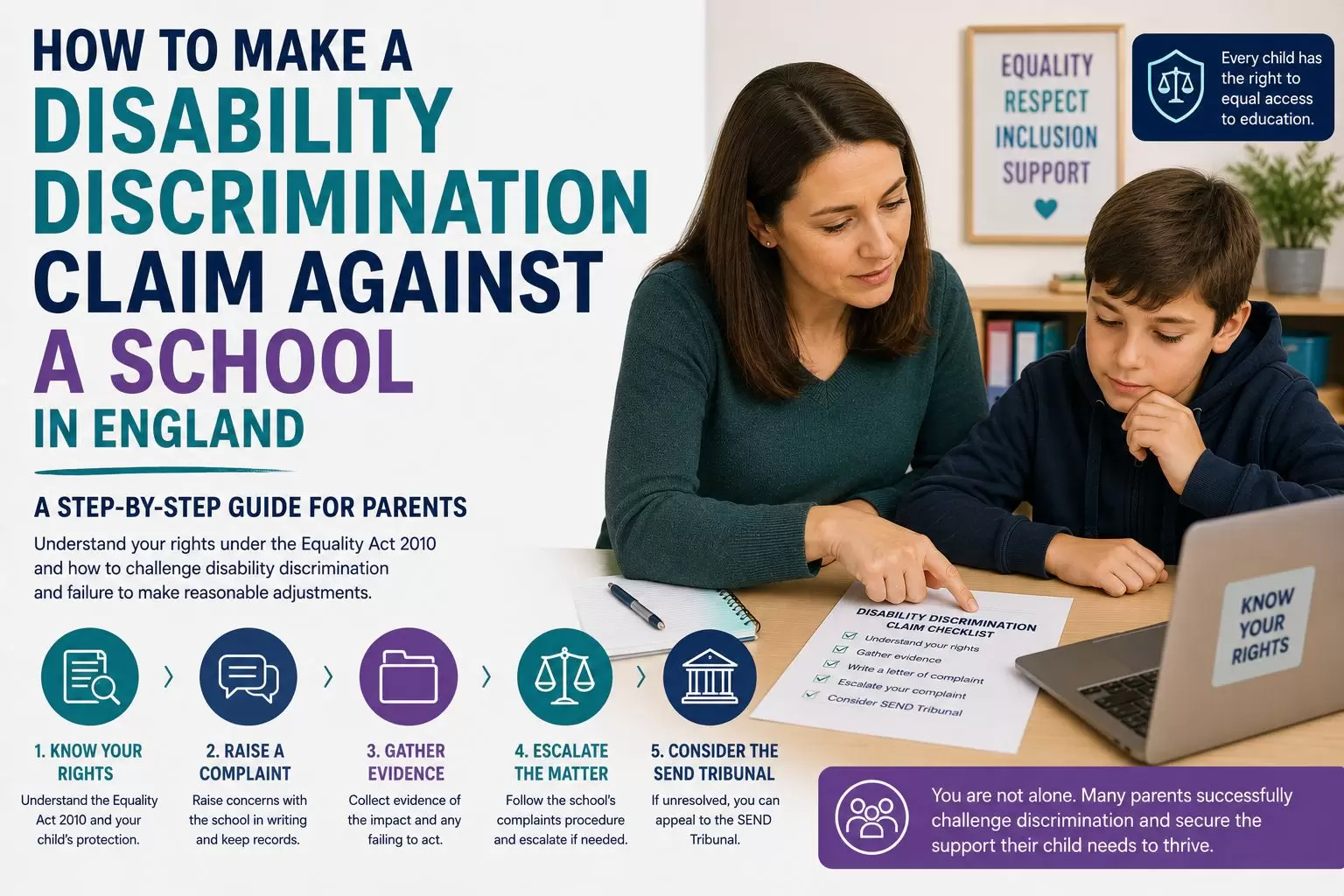
How to Make a Disability Discrimination Claim Against a School in England
If your child has a disability and you believe a school in England has treated them unfairly because of it, you may be able to make a disability discrimination claim to the First-tier Tribunal (SEND Tribunal). This process is set out under the Equality Act 2010 and is designed to hold schools accountable when they fail to meet their legal duties. Understanding the steps involved, the time limits, and the types of discrimination that can be challenged will help you decide whether to proceed.
In England, schools must not discriminate against disabled pupils in admissions, the provision of education, access to benefits, facilities and services, or in exclusions. The SEND Tribunal can hear claims against local authority maintained schools, independent schools, academies, free schools, and pupil referral units. It cannot hear claims against private nurseries (unless they are part of a school) or further education colleges.
What Counts as a Disability Under the Equality Act 2010
Before making a claim, you need to be sure your child meets the legal definition of disability. Under the Equality Act 2010, a disability is ‘a physical or mental impairment which has a substantial and long-term adverse effect on a person’s ability to carry out normal day-to-day activities’. This can include conditions such as autism, ADHD, dyslexia, hearing or visual impairments, physical disabilities, and many others. The effect must be substantial (more than minor or trivial) and long-term (likely to last at least 12 months or for the rest of the person’s life).
If your child is not yet diagnosed but you have evidence of an impairment that has these effects, you may still be able to argue they are disabled for the purposes of the Act. Schools are expected to consider whether a pupil is disabled even without a formal diagnosis, based on the impact of the condition.
Types of Discrimination Schools Must Not Commit
The Equality Act 2010 prohibits several forms of discrimination. Understanding these categories will help you identify whether what happened to your child could form a valid claim.
| Type of discrimination | Explanation | Can it be justified? |
|---|---|---|
| Direct discrimination | Treating a disabled pupil less favourably than someone who is not disabled because of their disability. | No, direct discrimination cannot be justified in any circumstances. |
| Indirect discrimination | Applying a practice, criterion or provision that puts disabled pupils at a disadvantage compared to non-disabled pupils. | Yes, if it is a proportionate means of achieving a legitimate aim. |
| Discrimination arising from disability | Treating a pupil unfavourably because of something connected to their disability (e.g., behaviour caused by the disability). | No, unless the school can show the treatment was a proportionate means of achieving a legitimate aim. |
| Failure to make reasonable adjustments | Not taking steps to remove or reduce a disadvantage the disabled pupil faces compared to non-disabled pupils. | No, the duty is anticipatory and cannot be justified. |
| Harassment | Engaging in unwanted conduct related to disability that violates the pupil’s dignity or creates an intimidating, hostile, degrading, humiliating or offensive environment. | No. |
| Victimisation | Treating a pupil (or parent) unfavourably because they have made or supported a complaint about discrimination. | No. |
Direct discrimination is the most straightforward type: if a school excludes a pupil specifically because of their disability and treats them less favourably than a non-disabled pupil in similar circumstances, that is direct discrimination and cannot be justified. Indirect discrimination may sometimes be allowed if the school can prove the practice was necessary and proportionate.
Time Limits: You Have Six Months
Claims must be made within six months of the alleged discrimination. This is a strict time limit. If the discrimination is ongoing, the six months runs from the date of the last act of discrimination. For a permanent exclusion, you should act quickly as there is an expedited (fast-track) process with a decision expected within six weeks.
The six-month deadline applies from the date the discrimination occurred or ended. If you are unsure about timing, it is safer to submit your claim as soon as possible. The tribunal may have discretion to extend the deadline in exceptional circumstances, but you should not rely on this.
Who Can Make a Claim and Against Which Schools
A claim can only be made by a parent or someone with parental responsibility, including birth parents, anyone who has parental responsibility by court order, and anyone with whom the child lives (such as a foster carer). The child themselves cannot make a claim, even if they are 18 or older. A young person over school leaving age (but under 18) can make the claim themselves using form SEND4B.
The SEND Tribunal can hear claims against the following types of schools:
- Local authority maintained schools (community schools, foundation schools, voluntary aided schools)
- Academies and free schools
- Independent schools (private schools)
- Pupil referral units (PRUs)
It cannot hear claims against private nurseries that are not part of a mainstream school, or against further education colleges. If your child attends a further education college, the claim would need to be made to the county court under the Equality Act 2010.
Admissions: A Special Note for State-Funded Schools
If the discrimination relates to a refusal to admit your child to a state-funded school (including academies and free schools), the SEND Tribunal cannot hear that claim. There is a separate appeal process for school admissions. However, the tribunal can hear a claim about refusal to admit to a private (independent) school.
How to Make the Claim: Forms and Procedure
Making a complaint to the SEND Tribunal is free. You do not need to pay a fee to submit your claim. Parents should use form SEND4A. Young people aged over school leaving age but under 18 use form SEND4B. Both forms are available from HM Courts & Tribunals Service, either online or by request.
You will need to provide details about your child, the school, the incident(s) of discrimination, and how the school’s actions relate to the Equality Act 2010. It is a good idea to describe what happened in chronological order and explain which type of discrimination you believe occurred (direct, indirect, failure to make reasonable adjustments, etc.). You should also include copies of any evidence you have, such as emails, letters, school policies, reports from professionals, or records of meetings.
Although you can complain directly to the tribunal without making a formal complaint to the school first, it is generally advisable to raise the issue with the school and follow their complaints procedure. Many disagreements can be resolved at that stage without needing a tribunal claim. The tribunal may also expect you to have attempted to resolve the matter locally before filing a claim.
Expedited Claims for Permanent Exclusions
If your child has been permanently excluded from school and you believe the exclusion was discriminatory because of their disability, you can ask for an expedited (fast-track) claim. The tribunal will aim to give a decision within six weeks. This is important because the exclusion will have immediate and serious consequences for your child’s education.
What the SEND Tribunal Can Order
If the tribunal upholds your claim, it can make orders to remedy the discrimination. These may include:
- Reinstating a pupil who has been permanently excluded (if still appropriate)
- Requiring the school to provide an apology
- Directing the school to take specific steps to avoid future discrimination, such as changing a policy or providing staff training
- Requiring the school to make reasonable adjustments that should have been made earlier
It is important to understand that the SEND Tribunal does not award financial compensation (damages) for disability discrimination in schools. The remedy focuses on putting things right for the future rather than providing monetary payment.
Consider Getting Legal Advice
Disability discrimination claims can be legally complex. While you can represent yourself at tribunal, many parents find it helpful to seek advice from a specialist education solicitor, or from organisations such as IPSEA (Independent Provider of Special Education Advice) or Contact (for families with disabled children). These organisations can help you assess the strength of your claim and understand the evidence you need.
Statistics show that the SEND Tribunal receives around 250 disability discrimination claims each year. While this is a relatively small number, the process exists to protect your child’s rights. Taking action can also benefit other disabled pupils at the same school by encouraging the school to improve its practices.
Frequently Asked Questions
Can I make a claim if my child does not have a formal diagnosis?
Yes. The legal definition of disability is based on the effect of an impairment, not on a formal medical label. If your child has a physical or mental impairment that has a substantial and long-term adverse effect on their ability to do normal day-to-day activities, they are disabled under the Equality Act 2010, with or without a diagnosis.
What if I miss the six-month deadline?
You should submit your claim as soon as possible. The tribunal has limited discretion to extend the time limit in exceptional circumstances, but they rarely do so. If you have missed the deadline, contact an adviser immediately to discuss your options. Do not delay filing your claim.
Do I need to complain to the school first before going to tribunal?
No, you can make a direct claim to the SEND Tribunal without a prior complaint to the school. However, it is often a good idea to raise the issue with the school first. Many problems can be resolved informally or through the school’s complaints procedure, saving you time and stress. The tribunal may also look favourably on attempts to resolve matters locally.
Can I claim against a further education college?
No. The SEND Tribunal cannot hear disability discrimination claims against further education colleges. If your child attends a further education college and you believe they have been discriminated against because of disability, you would need to bring a claim in the county court under the Equality Act 2010. Seek legal advice for this route.
Making a disability discrimination claim is a significant step, but it can be an effective way to hold a school accountable and secure the support your child is entitled to. By understanding the legal framework, acting within time limits, and gathering strong evidence, you can increase the chances of a successful outcome. For detailed guidance tailored to your situation, consult the official GOV.UK pages or speak to a specialist adviser.
Final Thoughts
Making a disability discrimination claim against a school in England can feel overwhelming, but parents should not ignore situations where a child is being treated unfairly, excluded from opportunities or denied reasonable adjustments. The strongest cases are usually supported by clear evidence, written records and examples showing how the school’s actions have affected the child’s education, wellbeing or access to learning. You may find it helpful to read our guide on Equality Act 2010 disability discrimination in schools, alongside our page on reasonable adjustments for SEND children. Where discrimination concerns overlap with wider unmet SEND needs, our guides on SEN Support vs EHCPs and EHCP evidence for parents can help you consider whether further support or formal provision may also be needed.