
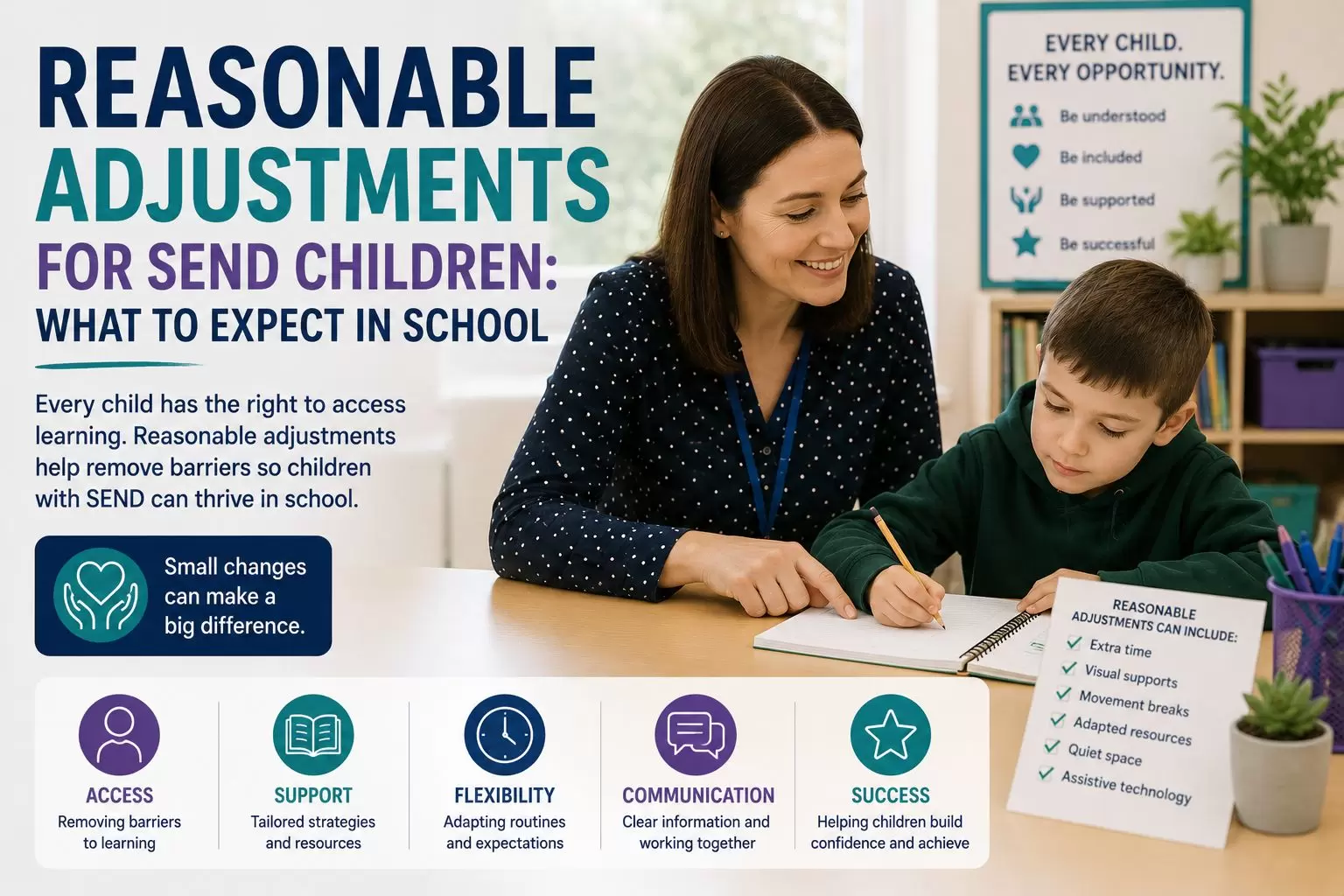
Reasonable Adjustments for SEND Children: What to Expect in School
If your child has special educational needs or a disability, you may have heard the term “reasonable adjustments” but felt unsure what it means in practice. In England, schools and other education providers have a legal duty to make changes so that disabled pupils are not put at a disadvantage compared with their peers. These changes are called reasonable adjustments. They can cover everything from the way lessons are delivered to school policies on uniform and behaviour. Understanding what reasonable adjustments are and how they work is a key step in getting the right support for your child.
What Are Reasonable Adjustments?
Reasonable adjustments are changes that organisations and people providing services must make if someone’s physical or mental disability puts them at a substantial disadvantage compared with non-disabled people. In the context of school, this means altering aspects of school life so that a disabled child can participate fully. The term is often used in a general way to apply to all children with SEND, but legally it is specifically about supporting children who meet the definition of disability under the Equality Act 2010. The definition of disability is broad, and many children and young people who have special educational needs may also have a disability. Any reasonable adjustments required will depend on the individual child’s needs.
The Legal Duty Under the Equality Act 2010
Schools and education authorities have had a duty to provide reasonable adjustments for disabled pupils since 2002, originally under the Disability Discrimination Act 1995 and, from October 2010, under the Equality Act 2010. Under this law, education providers must take positive steps to enable a disabled pupil to participate in education and enjoy the same opportunities as other pupils. This duty applies to all schools in England, including maintained schools, academies, and independent schools. It is not optional. If a school fails to make reasonable adjustments, it may be acting unlawfully. The parent of a disabled child can challenge this through the school’s complaints procedure or, in serious cases, by taking legal action.
Examples of Reasonable Adjustments in School
What counts as a reasonable adjustment will vary from child to child. The school must consider the child’s specific needs and what changes would remove or reduce the disadvantage they face. Some common examples include:
- Changing the school timetable, for instance to allow for rest breaks or to avoid times of day when a child finds it hardest to concentrate.
- Thinking about where a child sits in the classroom to minimise sensory distractions or to be closer to the teacher.
- Making changes to the school uniform policy, such as allowing a child to wear softer fabrics or different clothing if the standard uniform causes discomfort or sensory overload.
- Adjusting the behaviour policy to take account of a child’s disability. For example, a child with autism may need a different approach to discipline if their behaviour is related to their condition.
- Providing auxiliary aids, such as assistive technology, visual timetables, or specialist equipment, as part of the child’s SEN provision.
- Modifying teaching methods or providing additional support during lessons and exams.
Many disabled children will have a statement of SEN or an Education, Health and Care (EHC) plan, and auxiliary aids that are necessary as part of their SEN provision will be provided through that plan. However, reasonable adjustments can be made even without an EHC plan, as the duty under the Equality Act applies regardless of whether the child has a plan or a statement.
How Reasonable Adjustments Relate to SEN Support and EHC Plans
Reasonable adjustments are separate from the SEN support system, but the two often work together. SEN support refers to the extra help a school provides for children with special educational needs, as set out in the SEND Code of Practice. This support is planned through an Assess, Plan, Do, Review cycle. Reasonable adjustments, on the other hand, are a legal requirement under the Equality Act to prevent discrimination against disabled pupils. In practice, many children who receive SEN support will also need reasonable adjustments to access the curriculum and school life fully. If a child has an EHC plan, the plan should specify any auxiliary aids and provision that are necessary. But even without a plan, the school must still make reasonable adjustments for any child who is disabled under the Equality Act.
What Makes an Adjustment "Reasonable"?
There is no fixed list of what is reasonable. The school must consider factors such as:
- The effectiveness of the adjustment in removing or reducing the disadvantage.
- The practicality of the adjustment for the school.
- The cost of the adjustment and the school’s resources.
- The impact on other pupils and staff.
- The availability of external funding or support.
If an adjustment would cause an unreasonable burden on the school, it may not be required. However, the duty to make reasonable adjustments is an anticipatory one. Schools must think ahead about the needs of disabled pupils generally, not just react to individual requests. This means they should plan for a range of possible needs and have policies in place to support inclusion.
How to Request Reasonable Adjustments for Your Child
If you believe your child needs reasonable adjustments, the first step is to talk to the school. You can speak to your child’s class teacher, the SENCO (Special Educational Needs Coordinator), or the headteacher. It helps to be clear about what your child’s disability is and the specific disadvantage they face at school. You can ask for a meeting to discuss possible adjustments. It is useful to have any supporting evidence, such as a diagnosis from a doctor or educational psychologist, though a formal diagnosis is not always required. The school should consider your request and respond with what they can or cannot do, and why. If you are not satisfied with the school’s response, you can follow the school’s complaints policy. In some cases, you may also seek advice from your local SENDIASS (Special Educational Needs and Disabilities Information, Advice and Support Service) or from a legal adviser.
What If the School Refuses to Make Adjustments?
If a school refuses to make reasonable adjustments and you believe they are acting unreasonably, you have options. You can raise the issue formally through the school’s complaints procedure. If the school’s decision is based on a misunderstanding of the law, you may point them to the Equality and Human Rights Commission’s guidance, “Reasonable Adjustments for Disabled Pupils”. In some cases, you can also make a claim to the First-tier Tribunal (Special Educational Needs and Disability) if the refusal relates to a disability discrimination claim under the Equality Act. It is important to act promptly, as there are time limits for making claims. Seeking advice from a specialist SEN adviser or solicitor can be helpful, especially if the situation is complex.
Frequently Asked Questions
Do reasonable adjustments apply to children without an EHC plan?
Yes. The duty to make reasonable adjustments under the Equality Act applies to all disabled pupils, regardless of whether they have an EHC plan or a statement of SEN. If your child is disabled (as defined by the Act) and attends a school in England, the school must consider and make reasonable adjustments to prevent them from being at a substantial disadvantage compared with non-disabled pupils.
Are SEND children automatically considered disabled under the Equality Act?
Not automatically. The definition of disability under the Equality Act 2010 is broad but requires that the child has a physical or mental impairment which has a substantial and long-term adverse effect on their ability to carry out normal day-to-day activities. Many children with SEND will meet this definition, but not all. If you are unsure, you can check guidance from the Equality and Human Rights Commission or speak to a professional.
Can a school refuse a reasonable adjustment because of cost?
Yes, but only if the cost would cause an unreasonable burden on the school. The school must consider its resources, the effectiveness of the adjustment, and other factors. However, the duty is anticipatory, meaning schools should plan ahead. In many cases, low-cost adjustments (such as changes to seating or timetables) are expected to be made. For more expensive auxiliary aids, the school may need to use its SEN budget or apply for top-up funding.
What is the difference between reasonable adjustments and SEN support?
SEN support is part of the SEND system and refers to the extra help a school provides to children with special educational needs through a graduated approach (Assess, Plan, Do, Review). Reasonable adjustments are a legal duty under the Equality Act to prevent discrimination against disabled pupils. They can overlap, but they come from different legal frameworks. A child may need both SEN support and reasonable adjustments to fully access education.
Understanding your child’s rights to reasonable adjustments is an important part of advocating for their education. Schools have a legal duty to take positive steps to ensure disabled pupils are not disadvantaged. By knowing what to ask for and how to work with the school, you can help secure the support your child needs to learn and thrive.
Final Thoughts
Reasonable adjustments for SEND children should remove barriers, not lower expectations. The right support can help a child access learning, feel understood and participate more confidently in school life. For many children, adjustments can begin through SEN Support, but if needs are significant, ongoing or not being met, parents may need to consider whether an EHCP is required. You may find it helpful to read do I need an EHCP?, what support does an EHCP provide? and what level of need qualifies for an EHCP?. If school says further support is not needed, our guide on school says my child doesn’t need an EHCP can help you understand your options.
2 Responses