Alternative Communication for Autistic Children in School: AAC Methods and Support
When a child struggles to speak or to be understood, everyday school life can become frustrating for everyone involved. Alternative communication methods, known as Alternative and Augmentative Communication (AAC), can give autistic children a reliable way to express their needs, thoughts, and feelings. In UK schools, a range of AAC tools are used, from simple picture cards to speech-generating apps. This article explains what AAC is, the different types available, how schools can support their use, and what parents should know to help their child communicate effectively in the classroom.
What is AAC and Why Is It Used in Schools?
AAC stands for Alternative and Augmentative Communication. It covers all methods of communication that can support speech or be used in place of speech. For some autistic children, speaking is difficult or impossible in certain situations, and AAC provides a visual or physical way to communicate. AAC may be someone’s only method of communication, their main method, or a back-up when speech is not working. The goal is always to reduce frustration and increase participation in learning and social life.
Research shows that AAC can help autistic children learn and use words because they remember the visual image associated with the word. This means AAC does not hold back speech development, it often supports it. In inclusive-oriented schools, however, AAC is too often implemented outside the main classroom and used mainly for social purposes rather than academic ones. Parents and school staff need to work together to ensure AAC is fully integrated into all parts of the school day.
Low-Tech and High-Tech AAC: What’s the Difference?
AAC methods are often split into low-tech and high-tech categories. Both are equally valuable. High-tech AAC is not better than low-tech AAC; the best system is the one that fits the child’s needs at that particular time.
Low-Tech AAC Systems
Low-tech systems do not require batteries or electronic devices. They include:
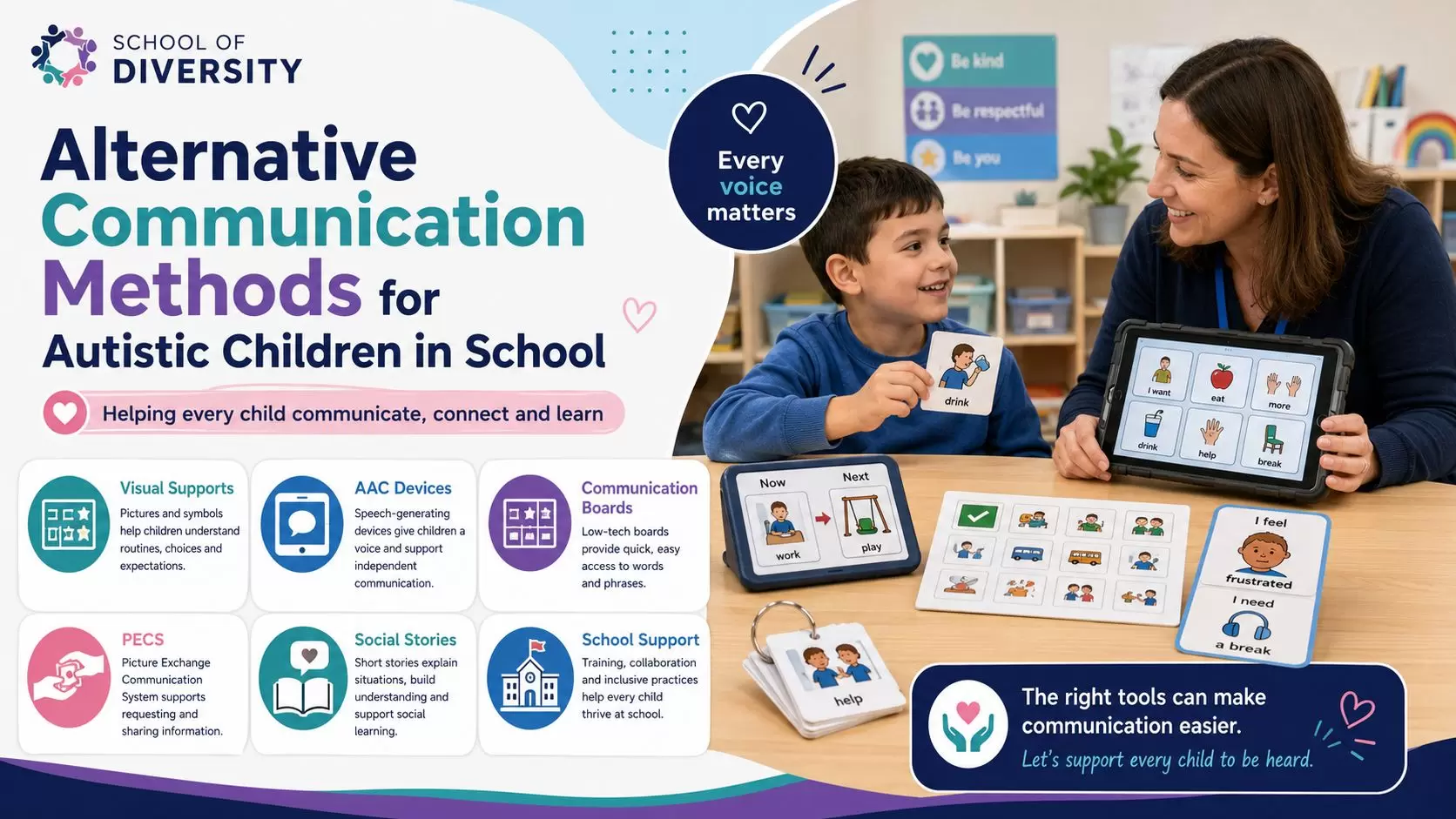
- PECS (Picture Exchange Communication System), the child gives a picture to a communication partner to request or comment.
- Communication boards and books, a collection of symbols or photos arranged on a board or in a book.
- Choice boards, a small board with a few options to help the child make a selection.
- Makaton, a signing system that uses signs and symbols alongside speech.
- Gesture and objects of reference, simple hand movements or real objects that stand for an activity or request.
Low-tech systems are durable, inexpensive, and always available. They can be used anywhere, including outdoors or in noisy environments. Many schools start with low-tech AAC before considering a high-tech option.
High-Tech AAC Systems
High-tech AAC relies on electronic devices, usually tablets or dedicated speech-generating devices, with communication software. Common high-tech systems include:
- Proloquo2Go, an app that turns symbols into spoken words.
- Grid, a grid-based communication app (e.g., Grid Player).
- GoTalk, a device with recorded speech buttons.
High-tech AAC can be powerful because it gives voice output and can hold thousands of words. However, it can break, run out of battery, or be lost. That is why a low-tech back-up system should always be available if a child uses high-tech AAC.
How Schools Should Support AAC Use
Good practice in UK specialist schools, such as Step by Step School and BeyondAutism Schools, shows clear principles that should be followed in any educational setting.
Always Accessible and Never Withheld
AAC devices should be accessible at all times during the school day. They should not be taken away as a punishment or because the child is “too reliant” on them. The policy at both Step by Step School and BeyondAutism Schools states that AAC devices must never be removed without consulting the Speech and Language Therapist. If a device is removed for any reason, an alternative low-tech option must be provided. This ensures the child can always communicate.
Modelling by Adults
Communication partners, teachers, teaching assistants, therapists, and parents, should model the use of the AAC system. Modelling means using the AAC tool yourself while speaking, so the child sees how it works in real-life communication. Adults must also allow processing time; a common recommendation is to count slowly to ten before expecting a response. This gives the child time to understand and formulate a reply using their AAC system.
Interdisciplinary Assessment and Trial
Choosing the right AAC system is not a decision for one person alone. An interdisciplinary team should be involved, including a Speech and Language Therapist, an Occupational Therapist, a Behaviour Analyst, and the child’s family. At BeyondAutism Schools, a high-tech AAC trial lasts six weeks. During this period, the team observes how the child uses the device across different situations and adjusts the system as needed. A low-tech back-up is always ready during the trial.
Real-Life Outcomes: Reducing Frustration
When AAC is implemented properly, the impact can be significant. At Holy Family Special School in the UK, which has 179 students, over 100 of them autistic, implementing high-tech AAC reduced student frustration and challenging behaviours. Children who previously had no reliable way to communicate could suddenly ask for help, express preferences, and interact with peers. This kind of outcome shows why persistent, consistent AAC support matters in school.
What Parents Can Do to Support AAC at School
If your child is autistic and struggling to communicate at school, here are practical steps you can take:
- Ask for a Speech and Language Therapy assessment. A Speech and Language Therapist can help identify the best AAC system for your child’s needs.
- Request that AAC be available all day. If the school uses a tablet or symbol book, check that it is not locked away or only used in certain lessons.
- Ensure a low-tech back-up is in place. If the school relies on a high-tech device, ask what happens if the device fails or is forgotten.
- Ask about modelling. Are staff trained to model AAC use? Do they give your child enough processing time (for example, a count of ten) before moving on?
- Find out who is involved. The team should include at least a Speech and Language Therapist and a family member. If only one person is deciding, that is not enough.
If the school is not providing adequate communication support, this may be a reason to consider escalating to an Education, Health and Care Plan (EHCP) that explicitly names AAC provision. Specialist advice can help you build the right evidence.
Frequently Asked Questions about AAC and Autism in School
How can I get an AAC assessment for my child through the school?
Start by speaking to the Special Educational Needs Coordinator (SENCo) at your child’s school. Ask for a referral to the NHS Speech and Language Therapy service or, if the school has one, a private therapist. The assessment should involve an interdisciplinary team including a Speech and Language Therapist, Occupational Therapist, and your family. If the school is unresponsive, you may need to request an Education, Health and Care Plan assessment to secure statutory support.
Will AAC stop my child from learning to talk?
No. Research shows that AAC can actually help autistic children learn and use words because they remember the visual image. AAC does not replace speech, it supports communication. Many children who use AAC go on to develop spoken language, while others continue to rely on AAC as their main method. Both outcomes are positive because the child can communicate effectively.
What is the difference between Makaton and PECS?
Makaton uses signs (hand gestures) and symbols alongside spoken language. The child learns to sign key words while the adult speaks. PECS (Picture Exchange Communication System) is a structured system where the child gives a picture card to a communication partner to make a request or comment. Both are low-tech AAC methods. A Speech and Language Therapist can advise which one suits your child best.
Is high-tech AAC always better than low-tech?
No. According to BeyondAutism, high-tech AAC is not better than low-tech AAC. The best system is the one that fits the child’s individual needs at that time. Some children communicate more easily with a simple symbol board than with an app. Others benefit from the voice output of a tablet. A low-tech back-up should always be available if a child uses high-tech AAC, in case the device fails.
Every autistic child deserves a reliable way to communicate at school. Whether through a simple symbol card or a speech-generating app, consistent AAC use can reduce frustration, build confidence, and open up learning. By working with the school and seeking specialist advice, you can help your child access the communication support they need.
Final Thoughts
Alternative communication methods can make a significant difference for autistic children in school, especially where spoken language is difficult, inconsistent or overwhelming. Tools such as visual supports, AAC devices, communication boards, PECS, now-and-next boards and social stories can help a child express choices, understand routines and feel more included in the classroom. You may find it helpful to read our wider guide on autism and communication in school, as well as our page on EHCPs for autism. If your child’s communication needs require specialist provision, our guide on EHCPs for speech and language needs explains how support can be written into a formal plan. Where support is currently school-based, our guide on SEN Support vs EHCPs can help you understand when additional provision may be needed.
2 Responses