
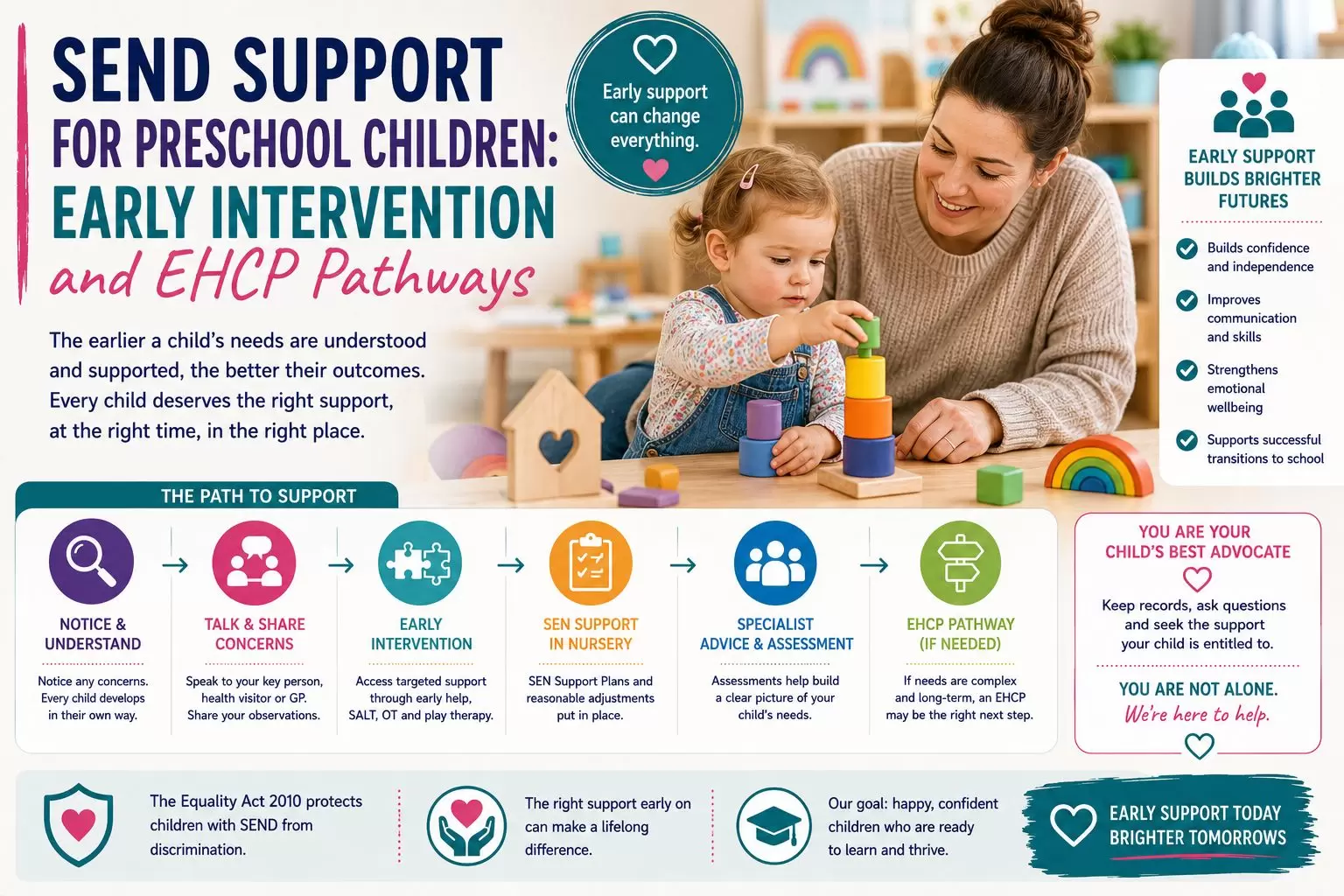
SEND Support for Preschool Children: Early Intervention and EHCP Pathways
Finding the right SEND support for preschool children can feel overwhelming when you are still learning the system. In England, early years providers such as childminders, nurseries, pre-schools, and children’s centres all have legal duties to identify and support children with special educational needs from the very start. Early intervention offers the best chance to help your child develop core skills, build confidence, and access the right settings. This article explains how that support works, what the graduated approach involves, and how you can pursue an Education, Health and Care (EHC) plan if your child needs it.
Understanding SEND in the Early Years
What is SEND and who does it apply to?
SEND stands for Special Educational Needs and Disabilities. It refers to children who require extra support with learning and development, or who have a disability that affects their daily life. The term covers a wide range of needs, from speech and language delays to more complex physical or sensory conditions. The Department for Education (DfE) states that all early years providers should identify and support children with special educational needs as early as possible.
The role of the Early Years Foundation Stage (EYFS)
Every early years setting in England must follow the Early Years Foundation Stage (EYFS) framework. This statutory framework sets standards for learning, development, and care, and it incorporates the SEND Code of Practice. The Code of Practice provides detailed guidance on how settings should identify, assess, and support children with SEND. Because the EYFS is mandatory, the requirement to offer appropriate support applies to all group-based providers, including nurseries, pre-schools, and children’s centres.
How Early Years Settings Provide SEND Support
The Special Educational Needs Coordinator (SENCO)
All early years settings are required to have a designated Special Educational Needs Coordinator, known as a SENCO. This person is responsible for coordinating SEND provision within the setting, liaising with parents, and ensuring that staff understand each child’s needs. If you think your child may have special educational needs, the first step is to speak to the SENCO at their nursery or pre-school. The SENCO can help you understand what support is already available and what additional steps might be needed.
The graduated approach: Assess, Plan, Do, Review
Support for preschool children with SEND is delivered through a four-part cycle called the graduated approach. This cycle is outlined in the SEND Code of Practice and consists of Assess, Plan, Do, Review.
- Assess: The setting gathers information about your child’s strengths and needs. This may involve observations, discussions with you, and input from other professionals such as health visitors or speech and language therapists.
- Plan: The SENCO and you agree on specific outcomes for your child and decide what support will be put in place. The plan is clear about who will provide the support and when.
- Do: The setting delivers the planned support, often with targeted interventions such as small-group work or individualised activities. The child’s key person or teacher monitors progress daily.
- Review: You and the setting meet regularly to review how well the support is working. If needed, the cycle begins again with a new cycle of assessment.
This approach ensures that support is adjusted as your child develops and that no child is left waiting for help.
When to Consider an Education, Health and Care (EHC) Plan
If the support provided through the graduated approach is not enough to meet your child’s needs, you may decide to request an Education, Health and Care Needs Assessment. Importantly, you do not have to wait for the early years setting to make this request. You as a parent can apply directly to your local authority for an assessment. The local authority will then decide whether your child has or may have special educational needs that require provision beyond what the setting can ordinarily offer. An EHC plan is a legal document that sets out the support a child or young person up to age 25 is entitled to receive.
SEN support versus an EHC plan
It is helpful to understand the difference between SEN support and an EHC plan. SEN support is provided by the early years setting itself. It might include things like speech therapy delivered at nursery, additional adult support during group activities, or visual timetables to help a child with transitions. An EHC plan, on the other hand, is a statutory document that can secure more intensive or specialist provision. It is designed for children with more complex needs that require co-ordinated help from education, health, and social care.
Your child may be eligible for SEN support such as speech therapy or for an EHC plan, depending on the level of need. The decision is made on an individual basis by the local authority following a statutory assessment.
Local Authority SEND Services: Examples from Derbyshire and Warrington
Local authorities in England each have their own structure for early years SEND support. Although all follow the graduated approach, the specific services and referral routes can differ. Below is a comparison of two examples.
| Area of service | Derbyshire | Warrington |
|---|---|---|
| Specialist teams available | Portage Service, Specialist Teacher Service, SEMH Outreach | Inclusion Panel referrals, strategy sheets, local SEND team support |
| Referral process | Direct access via the local offer website | Referrals through the Early Years Service Inclusion Panel |
| Key principles | Works within the graduated approach; offers home-visiting support (Portage) | Provides written strategy sheets for settings; SEND team offers consultation |
This table shows that services vary, so it is always wise to check your own local authority’s local offer to see exactly what is available in your area.
How Parents Can Take the First Steps
If you are concerned about your preschool child’s development, your first point of contact should be the SENCO at their nursery, pre-school, or children’s centre. You can also talk to your health visitor or GP. The graduated approach means that early support can begin without a formal diagnosis. You are not alone in this process, and you have the right to ask for an EHC needs assessment at any time. Keep a record of any concerns, observations, and communication with professionals. Official resources such as the DfE and Dingley’s Promise have created child-centred, strengths-based SEND assessment resources for early years practitioners, which can be helpful to reference during conversations with staff.
Remember that you do not need to wait for the setting to act. If you believe your child’s needs are not being met, you can request an assessment directly from your local authority. Early intervention can make a significant difference, and the law is on your side when it comes to ensuring your child gets the support they deserve.
Frequently Asked Questions
Can my child get an EHC plan before they start school?
Yes, an Education, Health and Care plan can be issued for a preschool child. The plan may name the early years setting your child attends and specify the support they must receive. Many plans are issued before the child moves into reception class, ensuring a smooth transition to school.
What if my child’s nursery does not have a SENCO?
All early years settings that provide group care are required by law to have a SENCO. If your child attends a childminder, arrangements may differ. If you are unsure, ask the setting directly. If they do not have a named SENCO, you can contact your local authority’s early years team for advice.
How long does an EHC needs assessment take?
The legal maximum for an EHC needs assessment is 20 weeks from the date the local authority receives your request. However, this timescale can vary. You should receive a decision within six weeks on whether the assessment will go ahead. If the timescale is not met, you can challenge the delay through the local authority’s complaints process.
Is an EHC plan the same as SEN support?
No. SEN support is provided directly by the early years setting without a legal document. An EHC plan is a statutory document that outlines the exact support a child must receive, often involving specialist services from health or social care. Children with more complex needs are more likely to be eligible for an EHC plan.
What should I do if the setting says my child is “too young” for support?
The EYFS framework and SEND Code of Practice apply from birth. There is no age too young for early intervention. If a setting refuses to provide support, you can remind them of their legal duties. You can also contact your local authority’s parent partnership service (Information, Advice and Support Service) for independent advice.
Final Thoughts
Early SEND support for preschool children can make a significant difference to communication, development, confidence and the transition into school. Parents should keep clear records of concerns, share observations with nursery or early years professionals, and seek specialist advice where needs appear persistent or complex. Many children can be supported through early SEN Support, but where needs require provision beyond what a nursery or setting can normally provide, it may be appropriate to consider how to apply for an EHCP. You may also find it helpful to read do I need an EHCP? and what level of need qualifies for an EHCP? to understand when an EHCP pathway may be needed.