
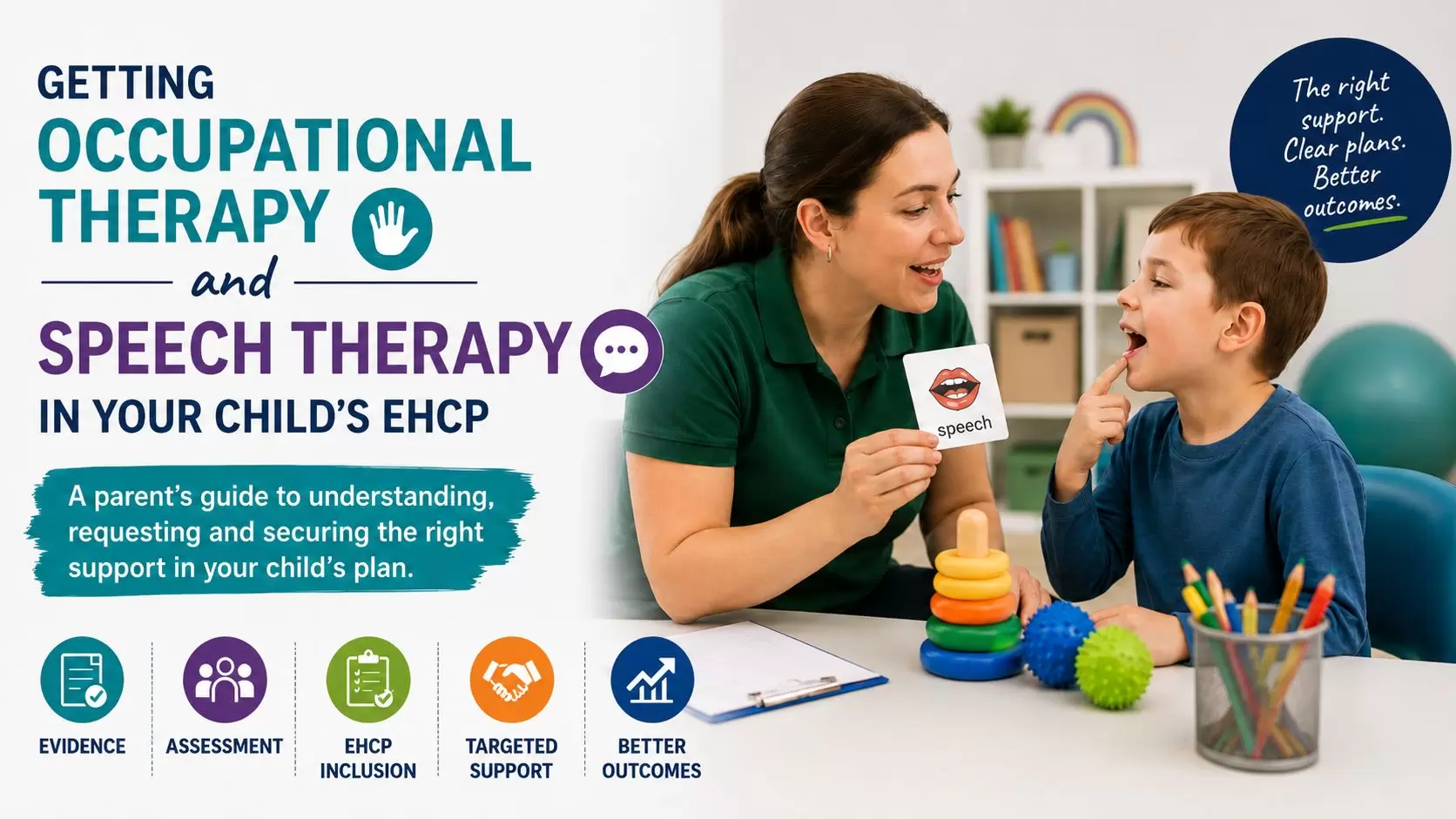
Getting Occupational Therapy and Speech Therapy in Your Child's EHCP
If your child needs occupational therapy (OT) or speech and language therapy (SALT) to make progress at school, getting those therapies written into an Education, Health and Care Plan (EHCP) can be the difference between vague recommendations and legally enforceable support. Many parents find that their child’s school agrees therapy would help, but the provision never actually arrives. That often happens because the therapy is not properly specified and quantified in the EHCP. This article explains how to request OT and SALT assessments, what evidence to gather, and how to make sure the final plan gives you the legal right to those services.
Why Occupational Therapy and Speech Therapy Belong in an EHCP
EHCPs were introduced by the Children and Families Act 2014 to replace Statements of Special Educational Needs. They are meant to cover all the special educational provision a child needs from birth to age 25, including therapy. The law is clear: speech and language therapy is presumed to be educational provision and should be placed in Section F of the EHCP, not in Section C or G. This principle comes from section 21 of the Children and Families Act 2014 and the case law R v Lancashire County Council ex parte M [1989]. Occupational therapy and physiotherapy can also be educational provision, depending on the individual child’s needs, as set out in paragraph 9.74 of the SEND Code of Practice 2015. The independent advisory service IPSEA confirms that occupational therapy is likely to be special educational provision and should be specified in Section F.
Placing therapy in Section F is crucial because the local authority (LA) has a legal duty under section 42(2) of the Children and Families Act 2014 to fund and deliver everything written in that section. If therapy is wrongly placed in Section C (health needs) or Section G (social care), the LA may argue it is not their responsibility to provide it. So getting OT and SALT into Section F is the number one goal.
How to Request a Therapy Assessment for an EHCP
The EHCP process starts when you request an assessment from your child’s local authority. The LA has six weeks to decide whether to carry out the assessment. If they agree, the full process should take 20 weeks in total: 6 weeks for the decision, 12 weeks to gather information and draft the plan, and 2 weeks for the final plan. However, nationally only 51% of EHCPs were issued on time as of June 2023 (Children’s Commissioner data), so delays are common.
During the assessment, the LA will ask for advice from relevant professionals. For occupational therapy, the referral can only be made by the child’s EHCP co‑ordinator (the SEN case officer), not directly by you or the school SENCO. For speech and language therapy, the referral can be made by the SENCO. These referral routes may vary between local authorities, so it is wise to check your LA’s local offer.
If your child is already known to an NHS OT or SLT service, that service will contribute to the assessment. If not, the LA should seek a new assessment. The NHS OT assessment process (for example, at East London NHS Foundation Trust) typically involves information gathering, a 1‑hour assessment session if the child is not already known, and a report listing specific outcomes and provisions.
Using Private Therapy Assessments
Some parents choose to pay for a private occupational therapy or speech and language therapy assessment to speed things up or to get a more detailed report. Private providers can often complete assessments and produce reports within six weeks. It is even possible to have combined OT and SLT assessments done in a single appointments, which can save time. Before commissioning a private assessment, check with your LA whether they will accept it as part of the EHCP process. Most will, but it is sensible to confirm.
Gathering the Right Evidence
To persuade the LA that your child needs OT or SALT as special educational provision, you need evidence of need. Occupational therapy assessments for EHCP focus on how a child functions in everyday school activities, fine motor skills, handwriting, self‑care, sensory processing, not on a diagnosis alone. Speech therapy assessments will look at expressive and receptive language, social communication, and any difficulties with phonics or comprehension.
Start by collecting reports from school, such as teacher observations, SEN support records, and any existing reports from the school’s own therapist if they employ one. Private or NHS therapy notes from services your child has already accessed are also useful. If your child has no current therapy involvement, you can ask the school to make a referral to the local NHS children’s therapy service. Even if the NHS waiting list is long, the referral itself creates a paper trail that demonstrates need.
You can also write a detailed parental contribution, describing the difficulties your child faces at home and at school and how these affect their learning and participation. This should be sent to the LA as part of the assessment.


Ensuring Provision Is Specified and Quantified
This is the most important step. Many EHCPs contain vague wording such as “the school will provide access to occupational therapy as needed” or “speech therapy input will be available”. That kind of wording is unenforceable because it does not say how much therapy, how often, or who will deliver it. To be legally enforceable, the provision in Section F must be specified (clear about what is being provided) and quantified (includes frequency, duration, and method of delivery).
For example, instead of “occupational therapy as required”, the plan should say “30 minutes of direct occupational therapy per week from a qualified occupational therapist, delivered on a 1:1 basis at school, with a review after 6 weeks”. For speech therapy, specify the minutes per week, whether it is individual or group, and whether it is delivered by a qualified speech and language therapist or a therapy assistant under supervision.
If the LA tries to write therapy provision in Section C (health) or Section G (social care), you have the right to challenge this at the draft plan stage. You can cite the SEND Code of Practice and the established legal presumption that speech therapy is educational provision. For occupational therapy, you need to argue that the child’s OT needs affect their ability to access education, making it special educational provision.
Common Pitfalls and How to Avoid Them
One common mistake is assuming that once an EHCP is issued, therapy will automatically start. The LA is legally responsible for delivering Section F provision, but in practice they may try to pass responsibility to the school health service or to the NHS, which can cause delays. Check that the plan names the responsible service, often it will say “the LA will secure…” or the name of a specific NHS trust.
Another pitfall is the “notional budget”. Schools are required to meet the first £6,000 of the cost of each child’s EHCP from their own budget before additional government funding kicks in. If the therapy provision is very intensive, the school may resist because of the cost. However, the legal duty remains with the LA; if the school cannot fund therapy from their own budget, the LA must provide top‑up funding. Make sure the plan clearly states that funding will follow the child, not be capped by the school’s budget.
Some LAs also try to write therapy as “advice” rather than “provision”. For example, they might say “the OT service will provide advice to staff”. This is not the same as direct therapy. If your child needs direct intervention, insist that the plan says “direct therapy sessions” and quantifies them.
What to Do if Your EHCP Does Not Include Necessary Therapy
If the final EHCP does not include the therapy your child needs, or places it in the wrong section, you have the right to appeal to the First‑tier Tribunal (Special Educational Needs and Disability). Before appealing, you must go through mediation, but you can skip mediation if the only issue is the description of special educational provision. Many parents find it helpful to get legal advice from a solicitor specialising in SEN law, such as those at SEN Experts Solicitors, who are familiar with the case law on therapy provision.
It is also worth contacting your local parent carer forum or an organisation like IPSEA for free support. The more specific your evidence about what therapy is needed and why it is educational, the stronger your case.
Frequently Asked Questions
Can I request an occupational therapy assessment for my child’s EHCP myself?
No, the referral for an occupational therapy assessment must be made by the child’s EHCP co‑ordinator (SEN officer). You can, however, request privately and submit the report as evidence. For speech and language therapy, the SENCO can make the referral directly.
Does the local authority have to fund therapy written in Section F?
Yes. Under section 42(2) of the Children and Families Act 2014, the local authority is legally required to arrange and fund all the special educational provision specified in Section F of an EHCP. That includes occupational therapy and speech therapy if they are listed there.
How can I tell if the therapy wording in my child’s EHCP is strong enough?
Good wording includes specific details: frequency (e.g., twice a week), duration (e.g., 30 minutes per session), setting (e.g., 1:1 at school), and who delivers it (e.g., qualified occupational therapist). If the plan only says “access to therapy” or “therapy as needed”, it is too vague and likely unenforceable. You can request a change at the draft stage.
What if the school says they cannot afford the therapy in the EHCP?
Schools contribute the first £6,000 of the cost from their own budget, but the local authority is responsible for any additional funding above that amount. If the school cannot meet the cost, the LA must provide top‑up funding. The EHCP should state that the child will receive the provision regardless of school budget limitations.
Securing occupational therapy and speech therapy in your child’s EHCP is a matter of knowing the law and gathering clear evidence. Focus on getting the provision specified and quantified in Section F, and do not accept vague wording. With the right approach, you can turn a piece of paper into a legally enforceable plan that ensures your child gets the therapy they need to thrive at school.
Final Thoughts
Getting occupational therapy and speech and language therapy written into an EHCP can make a significant difference when a child’s needs affect communication, learning, independence, sensory regulation or daily participation in school. The key is to make sure the evidence clearly explains the child’s needs and that the support is written into the plan in a specific, measurable and legally clear way. You may find it helpful to read our guide on what support an EHCP can provide, as well as our dedicated pages on EHCPs for speech and language needs and EHCPs for sensory processing needs. If you are preparing evidence or challenging vague provision, our guides on EHCP evidence for parents and Section F wording examples can help you understand how therapy should be properly included.