
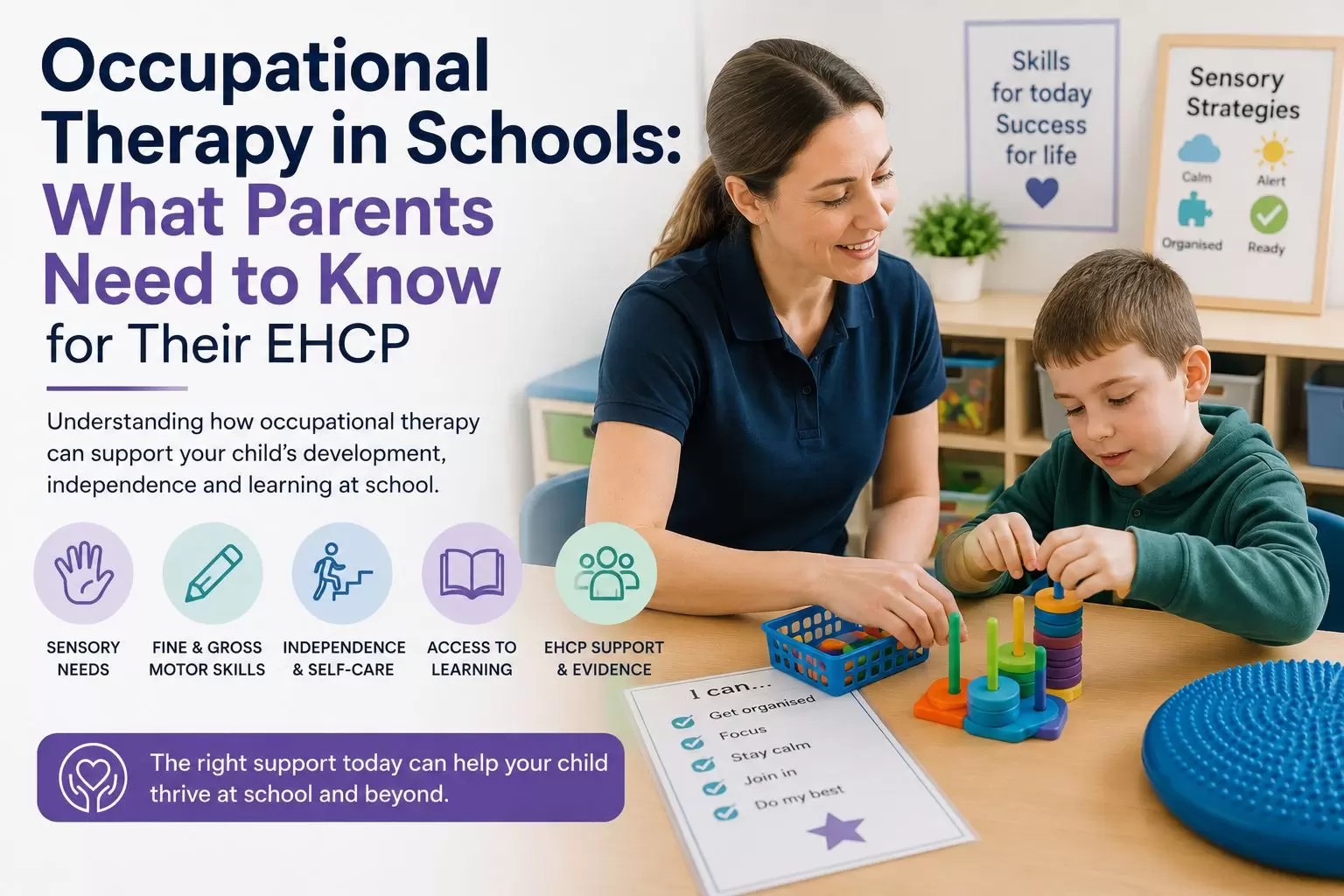
Occupational Therapy in Schools: What Parents Need to Know for Their EHCP
When a child has special educational needs, occupational therapy (OT) can make a real difference to their ability to learn, take part in school life, and develop everyday skills. For parents in England who are navigating the Education, Health and Care Plan (EHCP) process, understanding how occupational therapy fits into the plan is essential. This article explains what occupational therapy means in a school context, how it relates to an EHCP, and what you can do to make sure your child’s needs are properly recognised.
What is an EHCP and how does occupational therapy fit in?
An Education, Health and Care Plan (EHCP) is a legally binding document that describes all the special education, health and care needs of a child or young person. It also details the extra help and support they will need to learn. Occupational therapy can be specified within an EHCP as part of the support the child receives at school.
Occupational therapy is likely to be considered special educational provision if it educates or trains the child. Under section 21(5) of the Children and Families Act 2014, this means it should be recorded in Section F of the EHCP, not just in Section G (health care provision). Getting OT written into Section F is important because it makes the local authority legally responsible for securing that provision, even if local health services cannot provide it themselves.
What areas does an occupational therapy assessment for an EHCP cover?
If your child is referred for an occupational therapy assessment as part of the EHCP process, the OT will look at a range of areas that affect their ability to participate in school. According to professional practice, an assessment typically examines:
- Fine motor skills – tasks such as handwriting, using scissors, and fastening buttons.
- Gross motor skills – balance, coordination, and moving around the classroom or playground.
- Sensory processing – how the child responds to sounds, touch, movement, and other sensory input.
- Daily living skills – activities like dressing, eating, and managing personal care at school.
- Participation in school life – the child’s ability to engage in lessons, play, and social interactions.
Occupational therapists complete parts B and F of the EHCP assessment. They provide recommendations based on the needs of the child, not limited by the resources currently available. This means the OT report should give an honest picture of what your child requires.
The EHCP process and the role of occupational therapy
The statutory process from the written request to the final EHCP should take 20 weeks. This breaks down as six weeks for the local authority to decide whether to proceed, twelve weeks to prepare the draft plan, and two weeks for the final version. However, nationally only 51 per cent of EHCPs were issued within the 20-week deadline according to the Children’s Commissioner in June 2023.
If your child has been referred for occupational therapy separately from the EHCP process, they will remain on the waiting list. The GP or a specialist might also refer your child, but when it comes to the EHCP, referrals for occupational therapy can only be made by the child’s EHCP co-ordinator (SEN). This is an important distinction because it means the OT assessment for the EHCP is arranged through the education system rather than the NHS.
Why Section F matters for occupational therapy provision
One of the most common challenges parents face is getting occupational therapy specified in Section F of the EHCP rather than Section G. The legal basis for this comes from the Children and Families Act 2014: if the therapy educates or trains the child, it counts as special educational provision and belongs in Section F.
Local authorities may resist this because putting OT in Section F makes them legally responsible for securing it, even if the local NHS services cannot provide it. If the local authority places occupational therapy in Section G instead, parents have the right to appeal to the SEND Tribunal to have it moved into Section F. This can be a powerful way to ensure your child actually receives the therapy they need.
The Royal College of Occupational Therapists (RCOT) has produced guidance on the EHCP process to help occupational therapists write high quality reports and identify appropriate outcomes. That guidance supports the principle that OT for educational purposes belongs in the special educational provision section.
Assessment timeline and treatment options
The OT assessment itself happens within a set timeframe once it is arranged. For example, some private providers report that they complete their assessments and provide a report within six weeks of the initial appointment. The statutory EHCP process overall takes up to 20 weeks, but as noted, many local authorities fail to meet this deadline.
After the assessment, ongoing treatment may be available. If the OT is written into the EHCP, the local authority must arrange for the provision to be delivered. If your child is already on a separate NHS waiting list for occupational therapy, they will remain there even if the EHCP process is ongoing, unless the new provision through the plan replaces that referral.
NHS versus private occupational therapy assessments for an EHCP
Input for an EHCP can come from either an NHS/local authority occupational therapist or a private OT. Private reports are accepted by local authorities and can sometimes be obtained more quickly. They also tend to be more comprehensive, but they come at a cost. Because the OT is working outside the NHS system, waiting times can be much shorter.
One advantage of a private assessment is that you receive a thorough report that can be used as evidence for the EHCP. This can help families secure the right educational placement and one-to-one support from a learning support assistant. However, the local authority still makes the final decision on whether to grant the EHCP, and a private report does not guarantee any particular outcome.
If you choose a private OT, make sure they have extensive postgraduate training and clinical experience in writing EHCP reports. Not all occupational therapists are experienced in this area, and the quality of the report matters when the local authority is making its decision.
What the EHCP means once it is in place
If your child receives an EHCP that includes occupational therapy, the school is required to implement the plan. Schools must meet the first £6,000 of the cost of each child’s EHCP from their current budgets before additional government funding is provided. This means that even with an EHCP in place, there can be financial pressures on the school to deliver the specified support.
The EHCP must be reviewed annually. It follows the child up to age 25, except in universities and higher education. This annual review is your opportunity to check whether the occupational therapy provision is actually being delivered and whether it is making a difference. If it is not, you can request changes to the plan.
How to strengthen your child’s EHCP evidence with occupational therapy
If you believe your child needs occupational therapy at school, the first step is to raise this with the school’s SEN co-ordinator (SENCO). They can refer your child to the local authority’s OT service as part of the EHCP assessment. You can also seek a private OT assessment to provide additional evidence.
When the OT report is written, check that it clearly explains how the therapy educates or trains your child. This is the key argument for having it placed in Section F. If you are not satisfied with the draft plan, you can submit your concerns during the consultation period and, if necessary, appeal to the SEND Tribunal.
Occupational therapy EHCP reports can help families secure the right educational placement and one-to-one support from a Learning Support Assistant. The recommendations from the OT are based purely on the child’s needs, not on what resources are available, so they should give a clear picture of what is required.
Frequently Asked Questions
Can I request an occupational therapy assessment as part of my child’s EHCP?
Yes, you can raise your concerns with the school’s SEN co-ordinator, who can initiate a referral for occupational therapy as part of the EHCP process. Referrals for OT through the EHCP can only be made by the child’s EHCP co-ordinator. You can also seek a private OT assessment to provide additional evidence.
What happens if the local authority puts OT in Section G instead of Section F?
If the local authority places occupational therapy in Section G (health care provision) when it should be in Section F (special educational provision), you can appeal to the SEND Tribunal to have it moved. The legal basis is section 21(5) of the Children and Families Act 2014, which states that provision that educates or trains the child counts as special educational provision.
How long does the EHCP process take when occupational therapy is involved?
The statutory process from the written request to the final plan should take 20 weeks: six weeks for the local authority decision, twelve weeks for the draft, and two weeks for the final version. However, many local authorities miss this deadline. The OT assessment itself may take several weeks depending on whether it is done through the NHS or a private provider.
Does a private OT assessment guarantee my child will get an EHCP?
No, a private occupational therapy report does not guarantee that an EHCP will be granted. The local authority makes the final decision based on all the evidence provided. A high quality private report can strengthen your case, but it is one piece of evidence among others. It can also help secure the right placement and support if the plan is issued.
Understanding how occupational therapy fits into the EHCP process gives you the knowledge to advocate effectively for your child. Whether you are just starting the assessment or challenging a draft plan, knowing the difference between Section F and Section G, the timeline involved, and the options for private assessments can make a real difference. Work closely with your school’s SENCO and consider seeking specialist advice if the local authority resists putting OT where it legally belongs.
Final Thoughts
Occupational therapy in schools can play an important role in helping children develop independence, access learning, manage sensory needs and participate more confidently in the classroom. If your child needs occupational therapy support, it is important that their difficulties are clearly evidenced and that any provision is written precisely into the EHCP.
You may find it helpful to read our guide on EHCPs for sensory processing needs, as well as our wider page on what support an EHCP can provide. If you are preparing evidence or checking whether the provision is specific enough, our guides on EHCP evidence for parents and Section F wording examples can help you understand how occupational therapy should be properly included.