
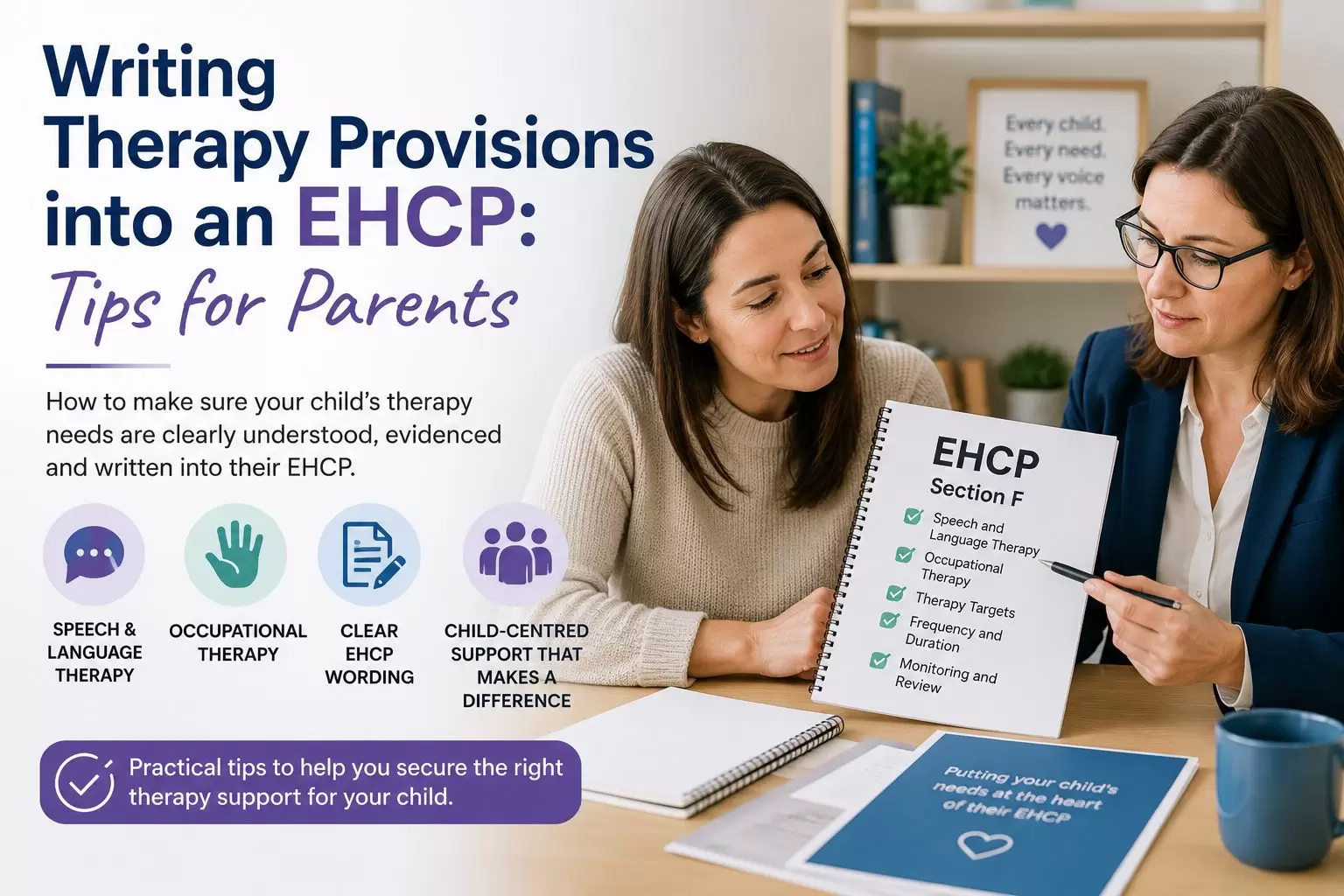
Writing Therapy Provisions into an EHCP: Tips for Parents
When your child needs speech and language therapy, occupational therapy, or physiotherapy as part of their special educational provision, getting those therapies written properly into an Education, Health and Care (EHC) plan is essential. A vague or open-ended description can leave you fighting for the support your child should be receiving. This article provides practical tips for parents on how to ensure therapy provisions are detailed, specific, and quantified in an EHCP, drawing on the legal requirements that local authorities must follow.
Why specificity matters for therapy provisions
The SEND Code of Practice is clear: special educational provision in an EHC plan must be detailed, specific, and quantified. This is not a suggestion but a legal requirement. Without precise wording, parents, schools, and health professionals cannot be sure exactly what therapy must be delivered, how often, for how long, and by whom. The local authority has a duty, set out in section 42(2) of the Children and Families Act 2014, to secure all of the special educational provision specified in Section F of the plan. If the provision is poorly described, enforcing that duty becomes difficult.
For therapy, this means describing the type of therapy (for example, speech and language therapy, occupational therapy, or physiotherapy), the frequency (number of sessions per week or month), the duration of each session, and the level of expertise required (such as a qualified therapist or a therapy assistant under supervision). The plan should also specify where the therapy will take place and whether it will be delivered individually or in a group.
What the law requires: specificity and quantification
The SEND Code of Practice paragraph 9.69(F) states: ‘Provision must be detailed and specific and should normally be quantified, for example, in terms of the type, hours and frequency of support and level of expertise, including where this support is secured through a Personal Budget.’ This applies directly to therapy provisions. In writing EHC plans, a local authority must by law ‘specify’ the support children and young people must receive. This means describing it in enough detail so that parents and young people, among others, can clearly tell what must be delivered, how often, how long for, and who by.
It is important to remember that the EHCP must also be clear, concise, understandable, accessible, forward-looking, and outcomes focused. It should positively describe what the child or young person can do and their achievements. For therapy provisions, this means linking the provision to the outcomes in Section E and the needs in Section B.
How to write therapy provisions in an EHCP
When you are contributing to the drafting of an EHCP or requesting amendments, focus on three elements: the needs (Section B), the outcomes (Section E), and the provision (Section F). For each therapy need identified, you need to ensure that the provision in Section F is sufficiently detailed.
Be specific about the type of therapy
Instead of writing “speech and language therapy as required”, specify the exact type, for example: “Direct speech and language therapy delivered by a qualified speech and language therapist to address expressive language delay.” If more than one therapy is needed, list each separately.
Quantify the hours and frequency
Include the number of sessions per week or month and the duration of each session. For example: “One 45-minute individual session per week with a registered occupational therapist, plus a daily 15-minute sensory circuit delivered by a teaching assistant under the therapist’s direction.” This level of detail makes the provision measurable and enforceable.
State the level of expertise
Specify who should deliver the therapy. For example, “therapy to be provided by a HCPC registered speech and language therapist” or “input from a specialist physiotherapist with experience in paediatric neurological conditions.” The level of expertise matters because it affects the quality and effectiveness of the support.
Link provision to outcomes
In Section E, outcomes should be written in a way that makes clear what the therapy aims to achieve. For example, “By the end of Year 5, Charlie will use a full sentence of at least five words to request items in class, with no more than one verbal prompt, in 8 out of 10 opportunities as recorded by a speech and language therapist.” The provision in Section F must then specify exactly what therapy is needed to reach that outcome.
Working with professionals to strengthen the evidence
You are not alone in this process. Health professionals such as speech and language therapists, occupational therapists, and paediatric physiotherapists can provide expert advice to inform the EHCP. Their reports should detail the child’s needs and the specific therapy required. The guidance for paediatric physiotherapists writing advice for EHC plans emphasises that assessments should be built on an understanding of the aspirations of the child and family and the outcomes they want to achieve.
When you receive reports from professionals, check that they recommend quantified provision. If a report says “requires regular occupational therapy”, ask the therapist to give a specific number of sessions. Keep a diary or log of any therapy that is not being provided. This record can be essential if you need to enforce the plan later.
What to do if the therapy provision is not specified
If the draft EHCP you receive contains vague wording such as “access to speech therapy” or “as required”, you have the right to request amendments. The local authority must have regard to the SEND Code of Practice and the legal duty to specify provision. You can use the law to push for clearer wording.
Keep a written record of the special educational provision which is not being made. If the planned provision has been specified but is not being delivered, you can refer to the local authority’s duty under section 42 of the Children and Families Act 2014. The law is on your side. It is also helpful to note that the obligation to deliver the provision is a legal duty, not just an aspiration.


Using a Personal Budget for therapy
The SEND Code of Practice mentions that quantifcation of provision includes where support is secured through a Personal Budget. If you are considering a Personal Budget to arrange therapy directly, the EHCP must still specify the provision in detail. The Personal Budget simply gives you the control to purchase the therapy, but the plan itself must contain the same level of specificity to ensure funding is allocated appropriately.
Final thoughts on writing therapy provisions into an EHCP
Getting therapy provisions written into an EHCP requires persistence and attention to detail. The law is clear that provision must be specific and quantified. By focusing on the type, hours, frequency, and level of expertise of each therapy, and by linking provision to outcomes, you can create a plan that is legally enforceable. Use professional reports to back up your requests and keep a log if provision is not being delivered. The local authority has a legal duty to deliver what is written in Section F, so make sure the wording leaves no room for ambiguity. With careful preparation, you can secure the therapy support your child needs to thrive at school.
Frequently Asked Questions
Can an EHCP pay for private therapy?
Yes, if the EHCP specifies therapy provision and you choose to use a Personal Budget, you can arrange private therapy with the funds allocated. However, the plan must still contain detailed, quantified provision. The local authority remains responsible for ensuring the provision is delivered, whether directly or through a Personal Budget.
What is Section 42 of the Children and Families Act 2014?
Section 42(2) places a legal duty on the local authority to secure the special educational provision specified in Section F of an EHC plan. This means that once an EHCP is finalised, the local authority must ensure that all provision listed, including therapy, is delivered. This duty is enforceable by parents if provision is not made.
What should I do if my child’s EHCP says ‘therapy as required’?
You should request an amendment to the draft plan. Provide evidence from professionals showing the specific type, frequency, and duration of therapy needed. Reference the SEND Code of Practice requirement that provision must be detailed and quantified. If the local authority refuses, you can appeal to the First-tier Tribunal (SEND).
Who is responsible for writing the therapy parts of an EHCP?
The local authority is responsible for drafting the entire EHCP, but they must gather advice from relevant professionals. For therapy, this usually comes from a speech and language therapist, occupational therapist, or physiotherapist. Parents can submit their own evidence and request specific wording to ensure the plan is accurate and precise.
How often should therapy be written into an EHCP?
The frequency must be specified in the plan. For example, “one 30-minute session per week” is clear. Without a time frame, the provision is not quantified and may be difficult to enforce. Always ask for the frequency to be written in hours per week or per term, linked to the outcomes your child needs to achieve.
Final Thoughts
Writing therapy provision into an EHCP is not just about naming occupational therapy or speech and language therapy; it is about making sure the support is clear, specific and linked directly to your child’s needs. Vague wording can make provision difficult to deliver, so parents should check that therapy support is properly included in Section F of the EHCP and supported by strong evidence. You may also find it helpful to read our guides on what support an EHCP can provide, EHCPs for speech and language needs and EHCP evidence for parents. Clear therapy provision can make a meaningful difference to communication, regulation, independence and access to learning.