
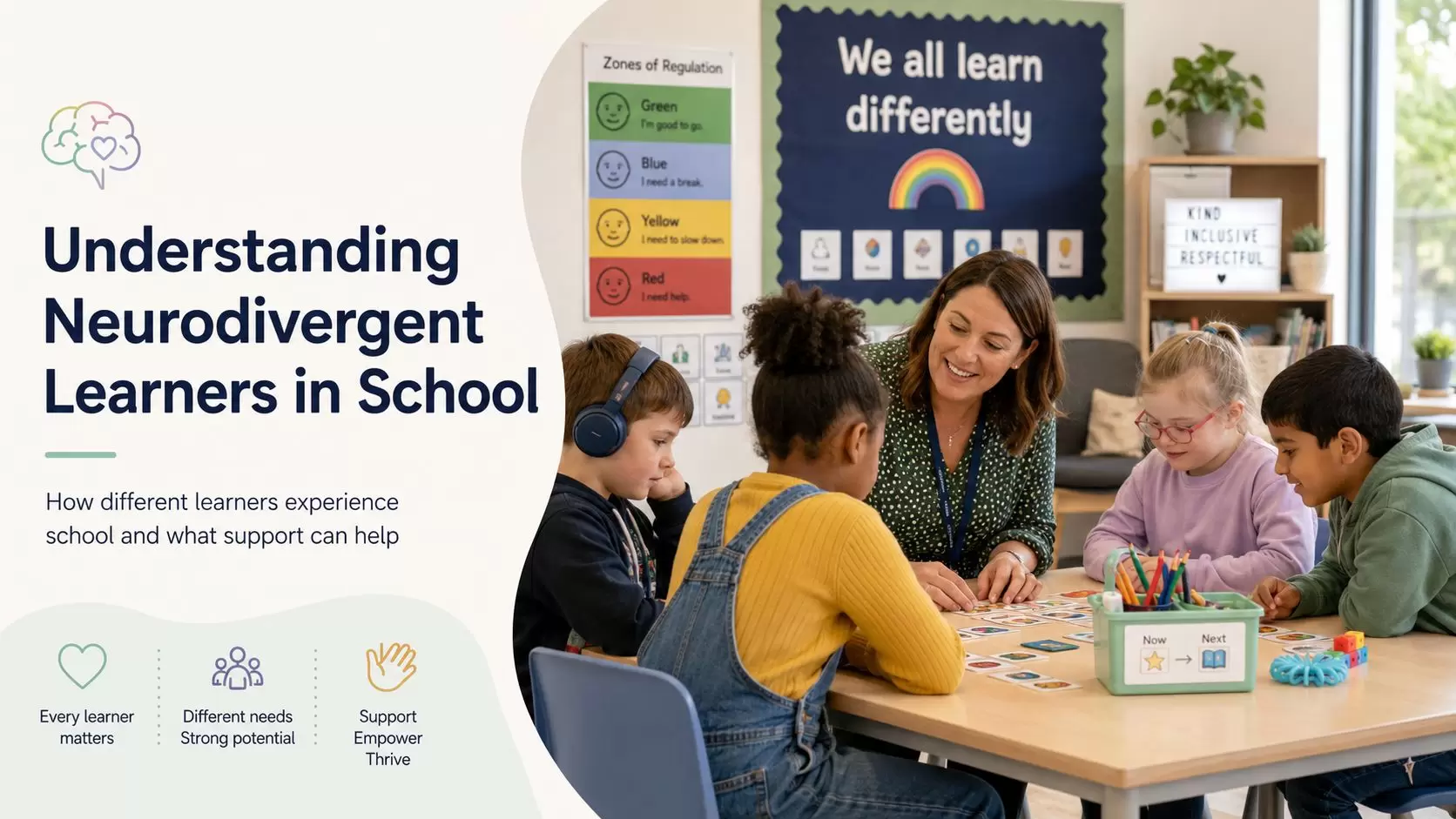
Understanding Neurodivergent Learners in School
Every child learns differently, but neurodivergent learners may experience school in ways that are less obvious to others.
A child may be bright, curious, and capable, yet still find the school environment overwhelming or difficult to manage. For many parents, this can feel confusing. Your child may seem fine in some situations, then struggle deeply in others.
Understanding neurodivergence can help parents and schools respond with more patience, clarity, and practical support.
What Does Neurodivergent Mean?
Neurodivergent describes people whose brains process information, communication, emotions, or sensory experiences differently.
This can include children with:
- Autism
- ADHD
- Dyslexia
- Dyspraxia
- Tourette’s syndrome
- Speech and language needs
- Sensory processing differences
Neurodivergence is not a problem to fix. It is a different way of experiencing and responding to the world.
The challenge often comes when school systems are not flexible enough to meet those differences.
How Neurodivergent Learners May Experience School
School can be demanding for neurodivergent children because it involves much more than academic learning.
A typical school day includes:
- Following instructions
- Managing noise and movement
- Sitting still for long periods
- Understanding social expectations
- Coping with transitions
- Processing spoken information quickly
- Managing emotions in busy environments
For some children, these demands can feel exhausting.
A child may cope during the school day, then become distressed at home. This does not mean they are fine at school. It may mean they are using all their energy to hold things together.
Common Signs a Neurodivergent Child May Need Support
Some signs are easy to spot. Others are more subtle.
You may notice:
- Difficulty concentrating
- Frequent anxiety before school
- Emotional outbursts after school
- Sensory overwhelm
- Struggles with friendships
- Avoidance of certain lessons or environments
- Difficulty following multi-step instructions
- Falling behind despite effort
If these signs are happening regularly, it may be worth exploring whether your child needs additional support.
You can also read signs your child may need an EHCP if you are unsure whether your child’s needs go beyond usual classroom support.
Why Neurodivergent Learners Can Be Misunderstood
Neurodivergent children are often misunderstood because their difficulties may not always be visible.
A child may be described as:
- Not listening
- Disruptive
- Too sensitive
- Defiant
- Lazy
- Disorganised
- Overreacting
In reality, these behaviours may be signs of unmet needs.
For example, a child who refuses to enter a noisy hall may be experiencing sensory overwhelm. A child who avoids writing may be struggling with motor skills, planning, or processing speed.
Understanding the reason behind the behaviour is essential.
What Support Can Help Neurodivergent Learners?
Support should be based on the child’s individual needs.
Helpful adjustments may include:
- Clear visual instructions
- Predictable routines
- Movement breaks
- Quiet spaces
- Reduced sensory demands
- Extra processing time
- Small group support
- Emotional regulation strategies
- Communication support
- Flexible approaches to written work
The best support is consistent, practical, and understood by all staff working with the child.
The Role of Inclusive Education
Inclusive education means adapting the environment so children can access learning in a way that works for them.
For neurodivergent learners, this may mean changing how instructions are given, how tasks are structured, or how emotional needs are supported.
You can explore this further in what is inclusive education and why it matters for your child.
Inclusive education is not about lowering expectations. It is about removing barriers so children can show what they are capable of.
When SEN Support May Not Be Enough
Many neurodivergent children receive support through SEN provision at school.
This may be enough if the child is making progress and coping well.
However, SEN support may not be enough if:
- Your child is still falling behind
- Support is inconsistent
- Anxiety or distress is increasing
- The school cannot meet needs from existing resources
- Specialist input is required
- Your child needs a legally defined support plan
In these situations, parents may need to explore whether an EHCP assessment is appropriate.
You can read more about this in SEN support vs EHCP.
How Parents Can Help Schools Understand Their Child
Parents often hold information that schools may not see.
You can help by sharing:
- What triggers overwhelm
- What helps your child calm down
- What your child finds difficult at home
- What has worked in previous settings
- Patterns in behaviour or anxiety
- Any professional reports or assessments
Keeping a short written record can be useful, especially if concerns continue over time.
Questions to Ask the School
If you are concerned about your child’s support, you may want to ask:
- What support is currently in place?
- How is my child’s progress being measured?
- Are staff aware of my child’s needs?
- What happens when my child becomes overwhelmed?
- Are reasonable adjustments being made consistently?
- Is further assessment needed?
These questions can help move conversations from general reassurance to practical action.
Add Your Heading Text Here
What does neurodivergent mean in education?
Neurodivergent means a child may think, learn, communicate, or process the world differently. This can affect how they experience school and what support they need.
What conditions are considered neurodivergent?
Neurodivergence can include autism, ADHD, dyslexia, dyspraxia, Tourette’s syndrome, speech and language needs, and sensory processing differences.
How can schools support neurodivergent learners?
Schools can support neurodivergent learners through clear routines, visual instructions, sensory adjustments, movement breaks, emotional support, and flexible teaching methods.
Can a neurodivergent child get an EHCP?
Yes, a neurodivergent child may qualify for an EHCP if their needs require support beyond what the school can usually provide through SEN support.
Does my child need a diagnosis to receive support?
No, support should be based on need, not diagnosis alone. A diagnosis can help explain needs, but schools should respond to the difficulties a child is experiencing.
Why does my child seem fine at school but struggle at home?
Some children mask their difficulties during the school day and release stress at home. This can be a sign that school is more demanding than it appears.
What should I do if school does not understand my child’s needs?
Start by requesting a meeting with the teacher or SENCO. Share clear examples, ask what support is in place, and keep written notes of concerns and progress.
Final Thoughts
Neurodivergent learners can thrive when their needs are properly understood and supported.
The goal is not to make every child fit the same mould. The goal is to create the right conditions for learning, confidence, and wellbeing.
If you want to understand how neurodivergent needs connect with SEN support and EHCPs, you can explore our comprehensive EHCP guide, which explains each stage in detail.
2 Responses