
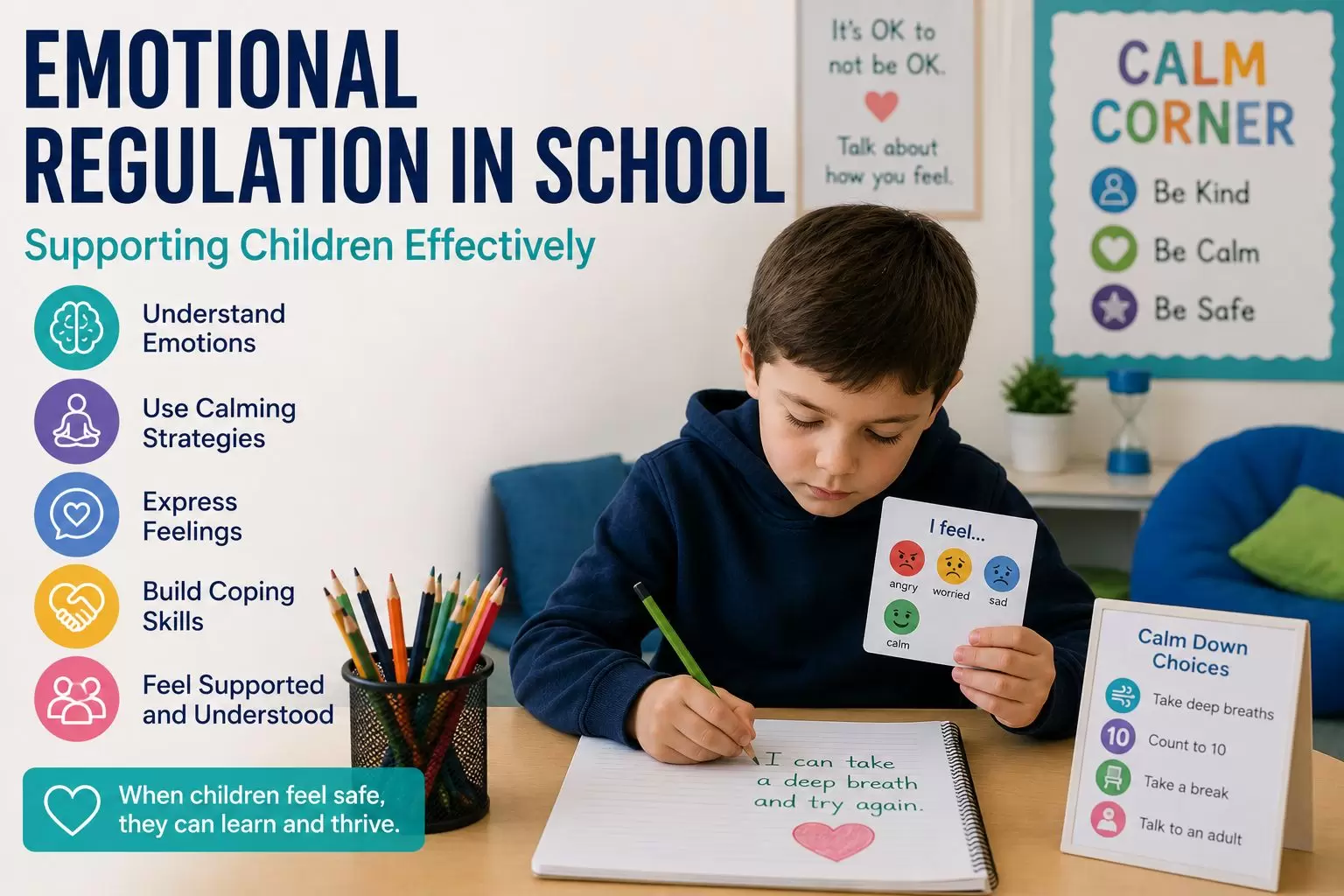
Emotional Regulation in School: Supporting Children Effectively
Emotional regulation is the ability to understand, manage, and respond to feelings in a way that is safe and appropriate.
For many children, this does not come easily. School can be full of demands, noise, transitions, social pressure, and unexpected changes. When a child is overwhelmed, their emotions can become difficult to manage.
Parents may notice that their child becomes upset after school, avoids certain lessons, struggles with friendships, or has emotional outbursts that seem out of proportion to the situation.
These behaviours are often signs that a child needs support, not judgement.
What Is Emotional Regulation?
Emotional regulation means being able to recognise feelings and respond to them in a manageable way.
It involves skills such as:
- Understanding emotions
- Communicating needs
- Managing frustration
- Coping with disappointment
- Recovering after becoming upset
- Asking for help
- Using calming strategies
Children are not born with these skills fully developed. They learn them over time, often with support from adults.
Some children need more help than others, especially if they are neurodivergent, anxious, overwhelmed, or struggling with unmet needs.
Why Children May Struggle With Emotional Regulation at School
School places a lot of demands on children.
They are expected to:
- Follow instructions
- Sit still
- Share attention with others
- Cope with noise
- Manage friendships
- Move between activities
- Complete work under pressure
- Stay calm when things feel difficult
For some children, these demands build up throughout the day.
By the time they react, the real issue may have started much earlier.
A child who becomes upset during maths may not only be reacting to maths. They may already be tired, anxious, sensory overwhelmed, or worried about break time.
Common Signs of Emotional Regulation Difficulties
Children show emotional distress in different ways.
Some signs include:
- Frequent crying
- Angry outbursts
- Refusing to complete work
- Leaving the classroom
- Shutting down
- Becoming withdrawn
- Avoiding school
- Difficulty recovering after upset
- Anxiety before or after school
- Physical symptoms such as stomach aches
- Meltdowns after school
Some children hold everything together during the school day, then release their emotions at home. This can still be a sign that school is too demanding.
Why Emotional Regulation Difficulties Are Often Misunderstood
When a child struggles emotionally, adults may focus only on behaviour.
A child may be described as:
- Defiant
- Disruptive
- Overreacting
- Attention-seeking
- Too sensitive
- Difficult
These labels do not help identify the cause.
Emotional reactions often happen when a child feels unsafe, misunderstood, overwhelmed, or unable to communicate what they need.
Support should focus on understanding what sits underneath the behaviour.
Emotional Regulation and Neurodivergence
Neurodivergent children may find emotional regulation particularly difficult.
This can include children with:
- Autism
- ADHD
- Sensory processing differences
- Speech and language needs
- Anxiety
- Learning differences
A child may struggle to explain what they feel, process what is happening, or calm down once they are overwhelmed.
You can read more about this in understanding neurodivergent learners in school.
What Support Can Help in School?
Emotional regulation support should be calm, consistent, and proactive.
Helpful strategies may include:
- Predictable routines
- Emotion check-ins
- Visual regulation tools
- Calm spaces
- Movement breaks
- Trusted adult support
- Clear instructions
- Reduced sensory demands
- Positive reinforcement
- Social stories
- Emotion coaching
- Support after difficult moments
The goal is not to stop children feeling emotions. The goal is to help them understand and manage those emotions safely.
The Importance of Prevention
Support should not only happen after a child has become distressed.
Prevention is key.
Schools can help by identifying:
- Triggers
- Difficult times of day
- Sensory pressures
- Social challenges
- Academic demands
- Transition difficulties
- Signs that a child is starting to struggle
When adults recognise early warning signs, they can step in before a child reaches crisis point.
What Emotional Regulation Support Might Look Like in an EHCP
If emotional regulation difficulties significantly affect learning, attendance, or wellbeing, they may need to be included in an EHCP.
Support may include:
- A named key adult
- Daily emotional check-ins
- Access to a calm space
- Structured regulation breaks
- Visual support tools
- Clear transition plans
- Reduced demands during overwhelm
- Staff training
- Therapeutic input
- Support during unstructured times
The wording should be clear and specific, so everyone understands what must happen and when.
You can read more about what support should be included in an EHCP.
When SEN Support May Not Be Enough
SEN support may be enough if your child is making progress and emotional difficulties are reducing.
However, more structured support may be needed if:
- Emotional distress is frequent
- Your child is missing learning
- School refusal is developing
- Support is inconsistent
- Your child cannot recover after becoming upset
- Behaviour policies are being used without understanding the need
- Specialist input is required
In these situations, it may be worth considering whether an EHCP assessment is needed.
What Evidence Can Help?
If you are seeking more support, evidence can help show the impact of emotional regulation difficulties.
Useful evidence may include:
- School behaviour records
- Regulation or incident logs
- Attendance records
- SEN support plans
- Parent notes
- Professional reports
- Examples of school refusal
- Records of anxiety or distress
- Communication with school
- Notes about triggers and patterns
The aim is to show how emotional regulation difficulties affect your child’s access to education.
Questions to Ask Your Child’s School
If you are concerned, you may want to ask:
- What happens when my child becomes overwhelmed?
- Are triggers being recorded?
- Is there a regulation plan in place?
- Does my child have access to a calm space?
- Who is my child’s trusted adult?
- Are staff using consistent strategies?
- Is my child being punished for behaviour linked to unmet needs?
- Is further assessment needed?
These questions can help move the conversation toward support that is practical and consistent.
How Parents Can Support Emotional Regulation at Home
Parents can also help by noticing patterns and sharing what works.
This might include:
- Keeping routines predictable
- Naming emotions calmly
- Giving time to decompress after school
- Using simple language during distress
- Avoiding too many questions immediately after school
- Sharing successful strategies with school
- Recording patterns over time
Home and school do not need to be identical, but communication between both can make support more effective.
Frequently Asked Questions: Emotional Regulation in School
What is emotional regulation in children?
Emotional regulation is a child’s ability to recognise, manage, and respond to feelings in a safe and appropriate way. Some children need extra support to develop these skills.
Why does my child struggle with emotional regulation at school?
Children may struggle because of anxiety, sensory overwhelm, communication difficulties, learning demands, transitions, social pressure, or unmet needs.
Can emotional regulation difficulties be part of SEN support?
Yes, schools can support emotional regulation through SEN support, including calm spaces, regulation tools, trusted adult support, and structured routines.
Can emotional regulation be included in an EHCP?
Yes, if emotional regulation difficulties affect learning, attendance, or wellbeing, they can be included in an EHCP with specific support.
What support helps children regulate emotions in school?
Helpful support includes predictable routines, calm spaces, movement breaks, visual tools, emotional check-ins, trusted adults, and proactive trigger planning.
Is emotional dysregulation the same as bad behaviour?
No. Emotional dysregulation often means a child is overwhelmed and unable to manage their feelings in that moment. It should be understood as a support need.
When should I ask for more support?
You should ask for more support if your child is frequently distressed, missing learning, avoiding school, struggling to recover, or if current support is not working.
Final Thoughts
Emotional regulation difficulties are not a sign of a child being difficult. They are often a sign that a child is overwhelmed, anxious, misunderstood, or not receiving the support they need.
When emotional needs are understood, children are more likely to feel safe, ready to learn, and able to recover from difficult moments.
If you want to understand how emotional regulation support connects with the wider EHCP process, you can explore our comprehensive EHCP guide, which explains each stage in detail.