
What Happens During an Autism Assessment?
Last reviewed: March 2026
Written by: School of Diversity SEND Support Team
Topic: Autism Assessment and Diagnosis
This guide explains what happens during an autism assessment for children, including the evaluation process, the professionals involved and what parents can expect during assessment appointments.
During an autism assessment, trained professionals evaluate a child’s communication, behaviour, social interaction and developmental history. The process usually involves discussions with parents, observation of the child and input from specialists to understand the child’s developmental profile.
Key Takeaways
Autism assessments help professionals understand a child’s development and support needs.
The process usually involves developmental history discussions and observation.
Assessments may include input from psychologists, paediatric specialists or speech therapists.
Information from parents and schools helps build a complete understanding of the child.
The assessment may lead to recommendations for support or further evaluation.
When a child is referred for an autism assessment, parents often wonder what will happen during the process. Autism assessments are designed to help professionals understand how a child communicates, interacts and experiences the world.
The assessment process focuses on understanding the child’s development and identifying the support that may help them thrive at home and in school.
Autism Assessment Process
Autism assessments typically follow several stages to help professionals build a full understanding of a child’s development.
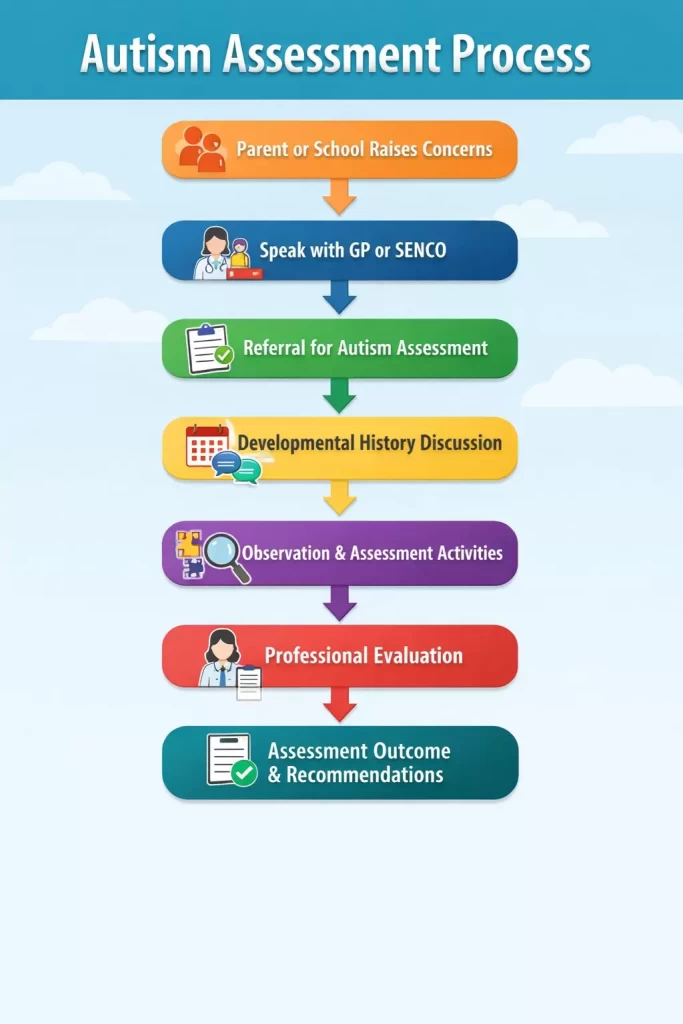
Developmental History Discussion
Direct answer:
Professionals usually begin by discussing the child’s early development with parents.
Parents may be asked about:
early communication and language development
social interaction and play
behaviour patterns and routines
sensory sensitivities
developmental milestones
This helps professionals understand the child’s developmental background.
Observation of Communication and Behaviour
Direct answer:
Professionals observe how the child communicates, interacts and responds to different situations.
Observation may include:
how the child communicates with others
responses to social interaction
play behaviour and imagination
responses to sensory input
These observations help professionals understand how the child experiences the world.
Assessment Activities
Children may take part in activities designed to evaluate communication and interaction.
These activities may involve:
play-based tasks
structured interaction activities
communication exercises
problem-solving tasks
The aim is not to test the child but to observe how they naturally communicate and interact.
Professionals Involved in Autism Assessments
Autism assessments are usually carried out by trained specialists.
Professionals may include:
clinical psychologists
paediatric specialists
speech and language therapists
educational psychologists
In many cases, a multidisciplinary team reviews information together.
Information From Schools or Nurseries
Professionals may also gather information from the child’s school or nursery.
Teachers may provide insights about:
learning behaviour
social interaction with peers
communication in classroom settings
behaviour patterns in structured environments
This helps ensure the assessment reflects the child’s experiences across different environments.
How Long Does an Autism Assessment Take?
Direct answer:
Autism assessments often involve several appointments depending on the child’s needs and the assessment pathway.
The assessment process may include:
initial discussions with parents
observation sessions
professional evaluations
review of information from schools
The timeline can vary depending on local services and assessment pathways.
What Happens After the Assessment?
Direct answer:
After the assessment process, professionals review all information collected during the evaluation.
Families may receive:
feedback about the assessment findings
a diagnostic report if criteria are met
recommendations for support
guidance for school support strategies
Many families then explore school support options, including SEN support or EHCPs if additional provision is required.
Preparing for an Autism Assessment
Parents may find it helpful to prepare information about their child’s development.
This might include:
notes about developmental milestones
examples of behaviour patterns
information from school or nursery
questions they would like to ask professionals
Preparation can help ensure professionals understand the child’s experiences fully.
FAQ
How many appointments are involved in an autism assessment?
The number of appointments varies depending on the assessment pathway and the child’s needs.
Do parents stay with their child during the assessment?
Parents are often involved in discussions and may be present during some activities.
Can schools contribute to autism assessments?
Yes. Teachers may provide valuable information about the child’s behaviour and learning in school.
Does an autism assessment automatically lead to a diagnosis?
Not always. The assessment helps professionals determine whether the child meets diagnostic criteria.
Explore More Autism Guidance
If you are exploring autism assessments for your child, you may find these guides helpful:
You can also explore our Autism Support for Parents hub, which brings together guidance on autism signs, assessments and school support.