




SEN Support for Parents: Clear Guidance and Practical Help
Navigating SEN Support in the UK can feel confusing, emotional and exhausting. If you are unsure whether your child is getting the right help — or you don’t know what to ask for — this guide explains everything clearly, step by step.
We’ll look at what SEN Support actually means, how schools should help, when to consider an EHCP, and what to do if progress isn’t happening.
Most parents describe the same experience:
constant worry about their child
mixed messages from school
endless meetings and paperwork
feeling like progress is slow or minimal
wondering whether they are missing something important
The truth is:
The SEN system is complex — even for professionals.
You are not failing.
You simply have not been given clear information or support.
This is where structured guidance makes the difference.
If you feel something isn’t right, it is reasonable to ask questions. These are the first steps most parents find helpful:
Speak to the class teacher about your concerns
Ask to meet with the SENCo
Request written notes and support plans
Keep copies of everything
Support should never rely on informal conversations alone — it should be recorded, reviewed and adjusted.
Comprehensive Guide To SEN In The UK
Independent SEN & SEND Advocate Support for Parents Across the UK
EHCP Advocacy & Support for Parents Across the UK
Book a Parent SEN Support Session
What SEN Support Actually Means in Schools
SEN Support is support given to a child without an EHCP.
It should include:
identifying needs
planning support
delivering targeted interventions
reviewing progress regularly
Every school must follow:
assess
plan
do
review
But in reality, parents are rarely shown what this looks like.
Good SEN Support should:
be written down
be reviewed termly
include measurable outcomes
involve you as a parent
Weak SEN Support looks like:
“we are keeping an eye”
informal conversations
no written plan
no evidence of progress
You deserve clarity — not guesswork.
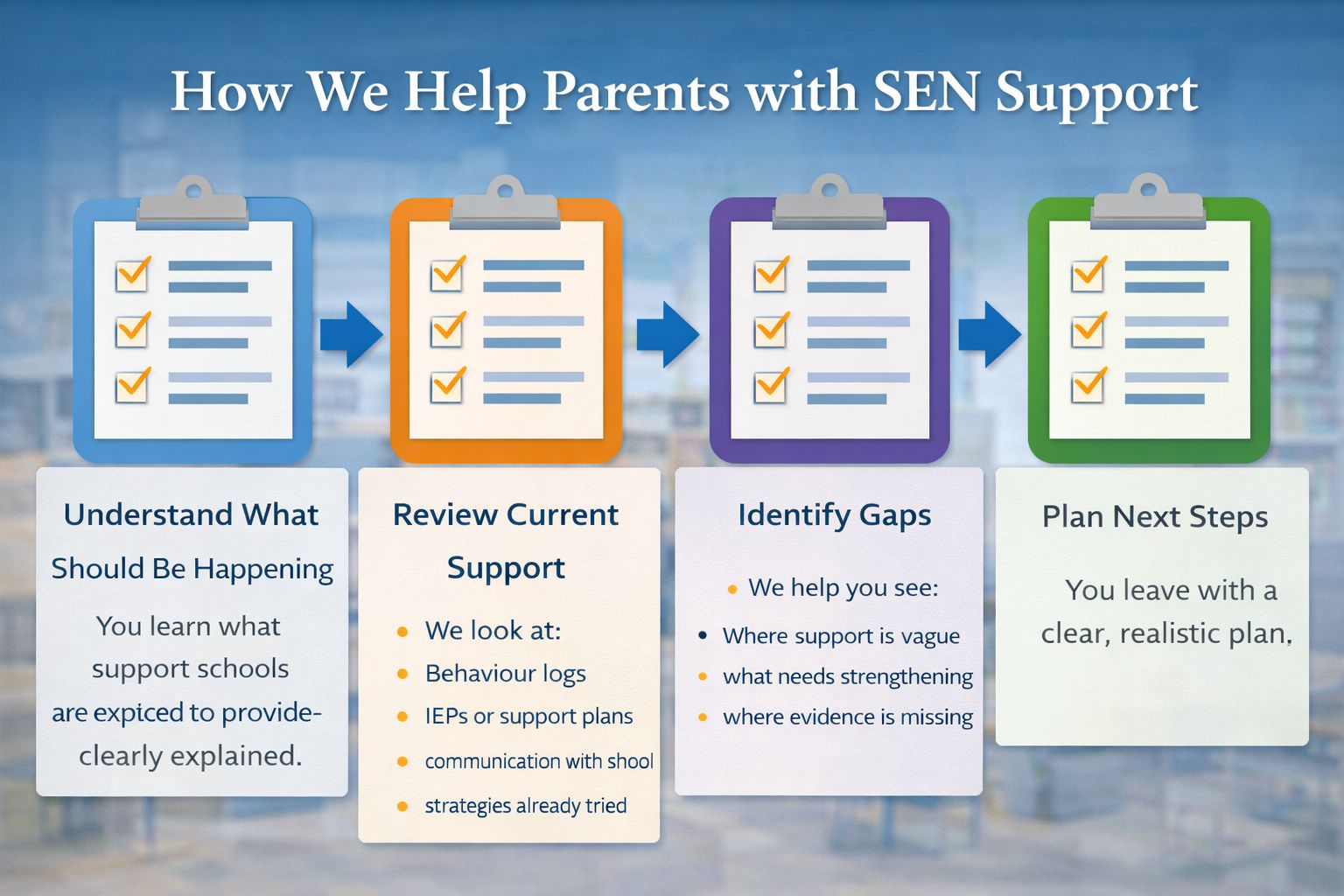
How We Help Parents with SEN Support
We work with you to:
Understand What Should Be Happening
You learn what support schools are expected to provide — clearly explained.
Review Current Support
We look at:
behaviour logs
IEPs or support plans
communication with school
strategies already tried
Identify Gaps
We help you see:
where support is vague
what needs strengthening
where evidence is missing
Plan Next Steps
You leave with a clear, realistic plan.
Helpful SEN Guides for Parents
The Parent Power Pack
The Parent Power Pack is a bundle of 20 expert guides covering everything from legal rights, SEN communication, evidence gathering, behaviour responses, to EHCP preparation and more.
When SEN Support Isn’t Enough
Sometimes, despite everyone’s effort, progress remains limited.
This may be the point to consider:
further assessment
specialist reports
or an EHCP request
Red flags include:
repeated exclusions
constant anxiety or refusal
no academic progress
unsafe behaviour
exhaustion or distress
You do not have to decide this alone. We work through it together.
Practical Tools to Help You Right Now
You will get practical resources you can use immediately.
These may include:
templates for communicating with school
questions to ask in meetings
tools to track incidents and support
guides to help interpret reports
These tools help conversations stay structured, respectful and productive.
Free SEN Parent Checklist
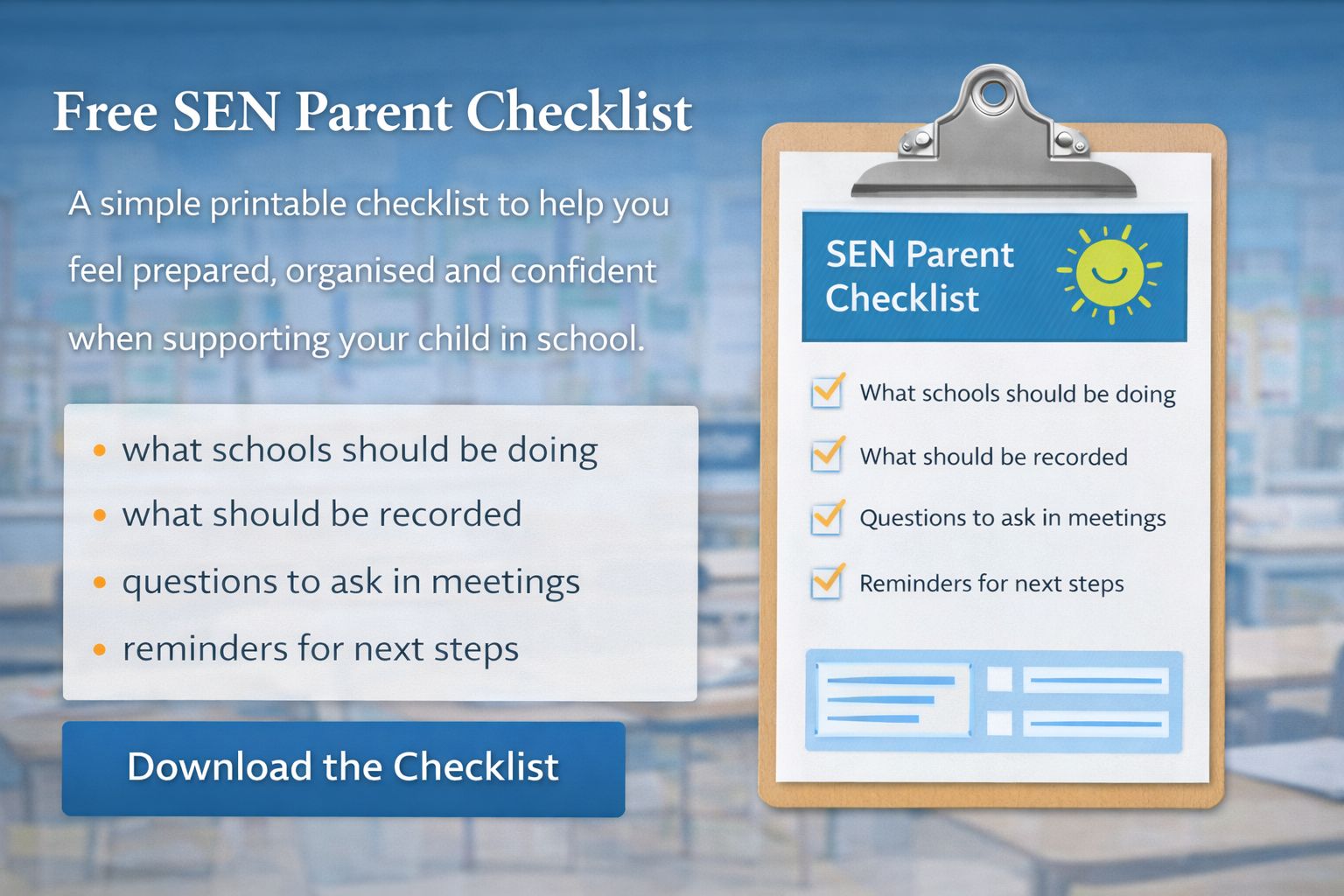
A simple printable checklist to help you feel prepared, organised and confident when supporting your child in school. Includes: what schools should be doing what should be recorded questions to ask in meetings reminders for next steps
Frequently Asked Questions
What does SEN actually mean?
SEN (Special Educational Needs) refers to children who need extra support to access learning because of learning, communication, emotional, sensory or physical needs.
What is the difference between SEN Support and an EHCP?
SEN Support is extra help provided by the school from its own resources, while an EHCP is a legal plan issued by the Local Authority for children with more complex needs who require specified, coordinated provision.
How do I know if my child needs SEN Support?
Your child may need SEN Support if they are falling significantly behind, are frequently anxious or refusing school, show ongoing behaviour difficulties, or are not making expected progress despite effort and basic support.
Who decides whether my child gets SEN Support?
The decision is usually made by the school, led by the SENCo, based on teacher observations, assessments and discussions with you as a parent, and you should be involved and informed in this process.
Does my child need a diagnosis to get SEN Support?
No. SEN Support should be based on your child’s needs, not on having a formal diagnosis, although a diagnosis can sometimes help explain their difficulties.
What should good SEN Support include?
Good SEN Support includes a written plan that clearly describes your child’s needs, the support to be provided, who will deliver it, how often it will happen, how progress will be measured and when it will be reviewed.
How often should SEN Support be reviewed?
SEN Support should be reviewed regularly, typically at least once per term, following an “assess, plan, do, review” cycle to check whether the support is working and to adjust it if needed.
What if school keeps saying “let’s wait and see”?
“Wait and see” can sometimes be reasonable, but it should not delay support indefinitely; you can ask what will be done in the meantime and request specific, documented support rather than open-ended delay.
What are signs that SEN Support is not enough?
Signs that SEN Support may not be enough include repeated exclusions, ongoing distress or school refusal, very limited progress, high anxiety, persistent behaviour issues and vague or minimal support plans.
Can I ask for specialist assessments?
Yes, you can ask for specialist assessments such as educational psychology, speech and language, occupational therapy or mental health input, especially where needs are complex or not fully understood.
How do I make sure things are recorded?
Ask for written meeting notes, updated support plans, review dates and copies of assessments, and follow up verbally agreed actions with a brief confirmation email to create a clear paper trail.
Can I challenge school decisions?
Yes. You can challenge decisions respectfully by asking for evidence, requesting meetings, making formal written requests and seeking advocacy support if you feel your child’s needs are not being met.
When should I think about an EHCP?
Consider requesting an EHCP when your child’s needs are complex, when progress remains limited despite support, or when significant additional or specialist provision is needed to help them access education.
How can a SEN advocate help?
A SEN advocate can explain processes, help organise evidence, support you in meetings, review documents, suggest next steps and give you confidence in navigating the SEN and EHCP system.
Will support damage my child’s confidence?
Good SEN Support should help your child feel understood, reduce stress and barriers, and improve confidence and wellbeing; it is not about labelling them negatively.
Can my child ever come off SEN Support?
Yes. If your child’s needs reduce and they are making good, sustained progress with greater independence, support can be gradually reduced and reviewed, rather than removed suddenly.
Book a Parent Support Session
Feel More Certain About What Should Happen Next
If you feel stuck or overwhelmed, I can help you make sense of everything and plan clear next steps.