
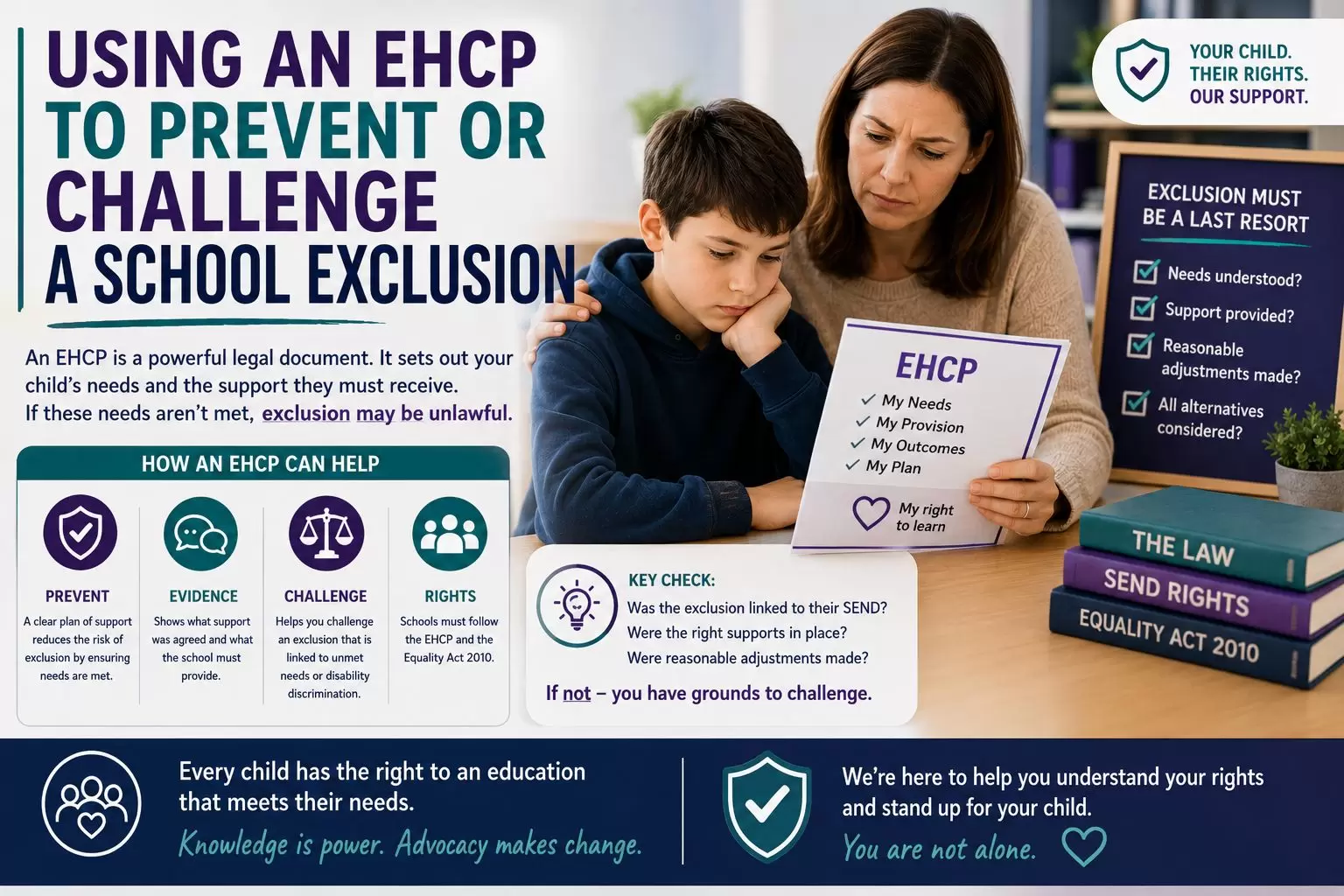
Using an EHCP to Prevent or Challenge a School Exclusion
Facing the possibility of your child being excluded from school is an anxious time for any parent. If your child has an Education, Health and Care (EHC) plan, you may wonder what legal weight that document carries when a school threatens a suspension or permanent exclusion. The short answer is that an EHC plan provides important safeguards, but it does not automatically prevent an exclusion. Understanding how to use the plan proactively and knowing your rights can make a significant difference in whether an exclusion happens, and how it is handled if it does.
This article explains the protections that exist for pupils with EHC plans, the steps you can take to challenge a proposed exclusion, and the role of the local authority after a permanent exclusion occurs. The guidance is based on official sources including GOV.UK, local SENDIASS services, and the National Education Union.
The Risk of Exclusion for Pupils with SEND and EHCPs
It might seem counterintuitive, but having an EHC plan does not make a child immune to exclusion. In fact, the statistics show that pupils with EHC plans are five times more likely to be excluded from school than pupils without an EHC plan, according to the National Education Union (NEU). Autistic students make up the largest single SEND group to be excluded. The NEU also notes that figures for children with undiagnosed SEND are likely much higher, though these are not recorded in official data.
These numbers highlight a troubling gap between the legal protections on paper and the reality in schools. An EHC plan can be a powerful tool to prevent exclusion, but only if parents and professionals use it deliberately and early. Knowing the safeguards available to you is the first step.
Legal Protections for Children with an EHCP
Government guidance is clear that a head teacher cannot suspend or permanently exclude a child simply because they have additional needs or a disability that the school feels it is unable to meet. This is a direct statement from the Department for Education’s guide for parents, which applies in England from 1 September 2023.
Beyond that basic protection, there is a strong expectation that head teachers should avoid permanently excluding any pupil with an EHC plan wherever possible. The childlawadvice.org.uk page on school exclusions makes this point explicitly for both children with EHC plans and looked-after children. The guidance from Hampshire SENDIASS, updated in May 2025, goes further: it states that head teachers should do everything possible to avoid exclusion, including calling an emergency or early annual review of the EHC plan.
These duties mean that the school must consider the EHC plan, the child’s needs, and whether additional support or a change of placement within the local system could prevent the exclusion. If the school believes it cannot meet the child’s needs, it should not respond by excluding the child; instead, parents should talk to the local authority to explore other options.
Using Your EHCP to Challenge a Proposed Exclusion
If your child is at risk of exclusion, the EHC plan gives you a clear route to challenge the decision. The most effective immediate step is to request an emergency annual review of the plan. This review brings together the school, the local authority, and any other professionals involved with your child. Its purpose is to assess whether the current provision is still appropriate and, if not, what changes are needed to prevent the exclusion.
You should also raise your concerns directly with the head teacher, pointing out the official guidance that exclusions based solely on unmet need are unlawful. Remind the school that it has a duty to make reasonable adjustments under the Equality Act. The head teacher may not be aware of the full range of support options that an early review can unlock.
Be aware that informal or unofficial exclusions – such as being sent home for a “cooling-off period” without a formal record – are unlawful. The Hampshire SENDIASS PDF explicitly states this. If your child is asked to leave school without a proper exclusion letter, you should object in writing and ask for the matter to be formalised or challenged.
What to Do if the School Says It Cannot Meet Your Child's Needs
Sometimes a school will admit frankly that it cannot provide the level of support your child requires. As noted above, this is not a lawful ground for exclusion. The correct response is for the parent to contact the local authority. The GOV.UK guide for parents advises exactly this: if the school says it is unable to meet the child’s needs, the parent should speak to the local authority.
You can ask the local authority to convene an emergency review of the EHC plan. That review can consider whether a different school or specialist placement would be more suitable, or whether additional funding or support can be put in place at the current school. The local authority has a duty to ensure the plan delivers the specified outcomes, and an appropriate placement is part of that duty.
Acting early is crucial. Do not wait for a permanent exclusion to happen before contacting the local authority. If you sense that the school is struggling to support your child, start the conversation now.
The Role of the Local Authority After an Exclusion
If a permanent exclusion occurs despite your efforts, the process does not end. When a child with an EHC plan is permanently excluded, the local authority is required to review the plan. This is stated in guidance from Suffolk SENDIASS. The review must happen promptly, and it gives the local authority an opportunity to consider whether the current placement is still appropriate and what alternative provision can be made.
Note that the requirement is to review the plan, not necessarily to amend it. However, a review may lead to changes in the placement, the support specified, or both. The review also provides a formal opportunity for you as a parent to argue that the exclusion itself was avoidable and that the EHC plan was not being properly implemented. The school’s actions during the period leading up to the exclusion will be part of the discussion.
While the review is taking place, your child must still receive suitable full-time education from the sixth day of the exclusion. Make sure you know who is responsible for arranging that and how the education will be delivered.
Frequently Asked Questions
Can a school exclude a child who has an Education, Health and Care Plan?
Yes, a school can exclude a child with an EHC plan, but there are additional safeguards. The head teacher should avoid permanent exclusion wherever possible, and cannot exclude simply because the school feels it cannot meet the child’s needs. If exclusion is considered, an emergency annual review should be called first.
What is an emergency annual review and how do I request one?
An emergency annual review is a formal meeting of everyone involved with your child’s EHC plan – including school staff, the local authority, and specialists – held outside the usual yearly cycle. To request one, write to the head teacher and the local authority explaining that your child is at risk of exclusion and that you believe the current provision is not meeting their needs.
Does an EHCP guarantee that my child will not be excluded?
No, an EHC plan does not guarantee protection from exclusion. Pupils with EHC plans are actually five times more likely to be excluded than those without. However, the plan gives you legal grounds to challenge an exclusion and to demand that the school and local authority fulfil their duties to avoid it.
What should I do if my child is informally excluded or sent home?
Informal exclusions are unlawful. If a school sends your child home without proper paperwork, write to the head teacher stating that you do not accept an unofficial exclusion and that you expect the correct legal process to be followed. Contact your local SENDIASS service for advice and consider raising the matter with the local authority.
Knowing your child’s rights under an EHC plan, and acting quickly when exclusion looms, can turn a frightening situation into one where you have real influence. The information in this guide is based on official sources, but every case is different, and you may need specific legal advice tailored to your circumstances. A good first step is to contact your local SEND Information, Advice and Support Service (SENDIASS) for free, impartial guidance.
Final Thoughts
An EHCP can be a powerful tool for preventing or challenging a school exclusion because it sets out your child’s needs, outcomes and the provision they must receive. If support in Section F has not been delivered, or the exclusion is linked to unmet SEND needs, parents should question whether the school and local authority have fulfilled their duties. It may also help to review what support an EHCP should provide, check whether the plan contains common EHCP mistakes and use the EHCP annual review process to seek urgent changes. If the plan is too vague or no longer reflects your child’s needs, our guides on EHCP evidence for parents and the EHCP appeal process can help you understand the next steps.