
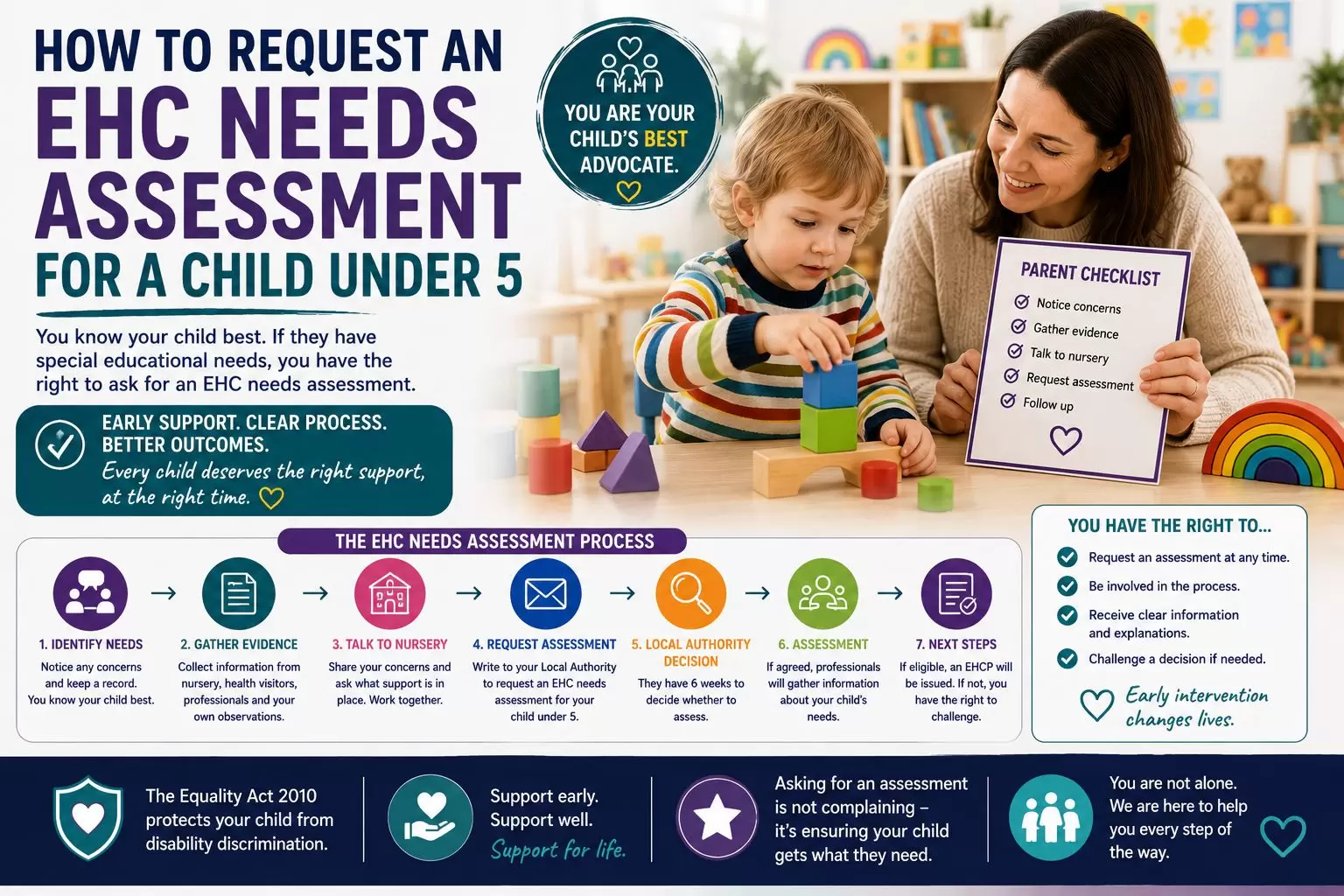
How to Request an EHC Needs Assessment for a Child Under 5
If you are the parent or carer of a child under 5 and you are concerned about their development, you may be wondering whether an Education, Health and Care (EHC) needs assessment is the right step. Many parents of very young children are unsure whether they can apply before their child starts school, or worry that they lack the necessary evidence. The law in England allows requests for children from birth, and the process is designed to identify early whether the additional support your child needs can best be arranged through an EHC plan. This article explains the legal criteria, the practical steps to make a request, and what you can expect from the local authority.
Understanding the Legal Framework for EHC Needs Assessments Under 5
The legal foundation for an EHC needs assessment is set out in Section 36(8) of the Children and Families Act 2014. A local authority must decide whether to carry out an assessment based on two criteria: first, whether the child has, or may have, special educational needs (SEN); and second, whether it may be necessary for special educational provision to be made through an EHC plan. This same legal test applies regardless of who makes the request, whether it is a parent, a young person, or an early years setting.
For children under 5, the local authority must consider developmental milestones rather than academic attainment when deciding whether the child has or may have SEN. This is stated in the SEND Code of Practice 2015 (paragraph 9.14), as advised by IPSEA. There is no requirement for a formal diagnosis of a condition such as autism or ADHD before you apply. The law does not condition an assessment on any medical label, and local authorities cannot lawfully ask for one.
When to Request an EHC Needs Assessment for a Child Under 5
You may be considering a request if your child is not meeting expected developmental milestones in areas such as communication, social interaction, play, physical skills, or behaviour. Perhaps they are not progressing despite support from early years providers, health visitors, or therapists. Or you may feel that the level of provision your child needs cannot be met from the resources ordinarily available in a mainstream early years setting. Approximately 4% of children nationally require an EHC plan because their needs cannot be met from a school’s or setting’s own resources. Trust your instincts as a parent; you know your child best. Do not wait until your child is school age, and do not feel you need the agreement of a nursery or pre-school before requesting an assessment.
How to Make a Request: Step by Step
Who Can Request
Any parent or carer of a child can make a written request to the local authority for an EHC needs assessment. Early years providers, schools, or health professionals may also request an assessment, but as a parent you do not need anyone else to act on your behalf. The legal test remains the same no matter who makes the request.
What to Include in Your Written Request
State clearly that you are making a request for an EHC needs assessment under the Children and Families Act 2014. Explain why you believe your child has or may have special educational needs, and why you think an EHC plan may be necessary. Provide any supporting evidence you have, such as reports from health visitors, speech and language therapists, occupational therapists, paediatricians, or your child’s key worker at nursery or a childminder. Your own observations are also valuable; describe the difficulties you see at home and in other settings.
Format of the Request
A written request in any format, whether a letter or an email, is valid. Local authorities sometimes ask parents to use an online form or a specific portal, but they cannot lawfully insist on this. If you prefer to write a letter or an email, you are entitled to do so. Keep a copy for your records.
Where to Send the Request
Send your request to the SEN (special educational needs) department of your local authority. If you are unsure of the correct address or email, you can check your local authority’s website or contact the parent partnership service (SENDIASS) in your area for guidance.
What Happens After You Request an Assessment
Local Authority Decision (6 Weeks)
The local authority must decide whether to carry out an EHC needs assessment within 6 weeks of receiving your request. If they fail to respond within this time, you can challenge this through the tribunal process. During these 6 weeks, they may ask for further information from you, your child’s early years setting, or health professionals. They must apply the two-part legal test and cannot add any extra conditions.
The Legal Test: What Authorities Cannot Add
Many local authorities try to impose additional requirements that are not in the law. For example, they may insist that your child has received a certain amount of SEN support (often called a ‘graduated approach’), that £6,000 of funding has already been spent, or that a specific percentile on a developmental test has been reached. IPSEA and SOSSEN confirm that these extra criteria are not lawful. If the only reason for refusal is an additional requirement not found in the Children and Families Act 2014, you have strong grounds to appeal.
If Assessment Is Agreed
If the local authority decides to carry out an EHC needs assessment, they have up to 16 weeks from that decision to decide whether to issue an EHC plan. The total time from the date of your original request to the final EHC plan is 20 weeks. During the assessment, the authority will gather advice from education, health, and care professionals. You will have the opportunity to submit your own views.
If Assessment Is Refused
You have a right to appeal a refusal to the First-tier Tribunal (SEND). The appeal must usually be lodged within two months of the refusal decision. Tribunal appeals can feel daunting, but many parents are successful, especially when the local authority has applied unlawful criteria. You do not need a solicitor, though you may seek support from IPSEA, SOSSEN, or a local SENDIASS service.
Common Obstacles and How to Overcome Them
One common obstacle is being told that your child is ‘too young’ for an EHC needs assessment. This is incorrect; the law allows requests from age 0. Another is being asked for a formal diagnosis before the assessment can proceed. As noted, no diagnosis is required. Some parents are told that the early years setting must agree first, or that the child must be on roll at a setting. In fact, you can request an assessment for a child who has not yet started any formal early education. If you face any of these barriers, reiterate your legal rights in writing and consider seeking legal advice or tribunal support.
Frequently Asked Questions
Can I request an EHC needs assessment for my child who is not in any early years setting?
Yes. The law permits requests for children from age 0 who have not yet started nursery, pre-school, or any other early years provision. The local authority must consider developmental milestones rather than academic attainment, so lack of a school or nursery place does not prevent an assessment. Your own observations and reports from health professionals can form the evidence base.
What if the local authority says my child needs a diagnosis first?
A formal diagnosis is not required to apply for an EHC needs assessment. This is emphasised by SOSSEN and confirmed by the legal framework. If the local authority refuses your request solely because there is no diagnosis, they are applying an unlawful condition. You can challenge that refusal at tribunal using the legal test from Section 36(8) of the Children and Families Act 2014.
Can the local authority refuse because my child is under 2 years old?
No. The Children and Families Act 2014 does not set a minimum age for an EHC needs assessment. Local authorities must consider requests for any child from birth to 25. For a child under 2, the SEND Code of Practice advises that the authority should take account of developmental milestones that are appropriate for that very young age. A refusal based purely on your child being under 2 would be unlawful.
What evidence should I include in my request?
Include any reports, letters, or notes from health visitors, GPs, speech and language therapists, occupational therapists, paediatricians, portage workers, early years practitioners, or other professionals. Your own written account of your child’s difficulties, such as delayed communication, social interaction challenges, sensory sensitivities, or behavioural concerns, is also evidence. The more specific you can be about the impact on daily life and learning, the stronger your case.
What are the timescales for an EHC needs assessment for a child under 5?
The local authority has 6 weeks from receiving your request to decide whether to carry out the assessment. If they agree, they then have up to 16 weeks from that date to issue a final EHC plan or decide not to. The total time from the initial request to the final decision is 20 weeks. These timescales apply to children of all ages, including under 5, and are set out by the Department for Education and GOV.UK.
Final Thoughts
Requesting an EHC needs assessment for a child under 5 can feel early, but young children do not need to wait until school age before their needs are properly considered. If your child has persistent or significant difficulties with communication, development, learning, sensory needs, physical skills, social interaction or emotional regulation, early evidence can help show why additional support may be needed. You may find it helpful to read our wider guide on SEND support for preschool children, as well as how to apply for an EHCP and EHCP evidence for parents. If you are unsure whether your child’s needs may meet the threshold, our guides on do I need an EHCP? and what level of need qualifies for an EHCP? can help you understand the next steps.