
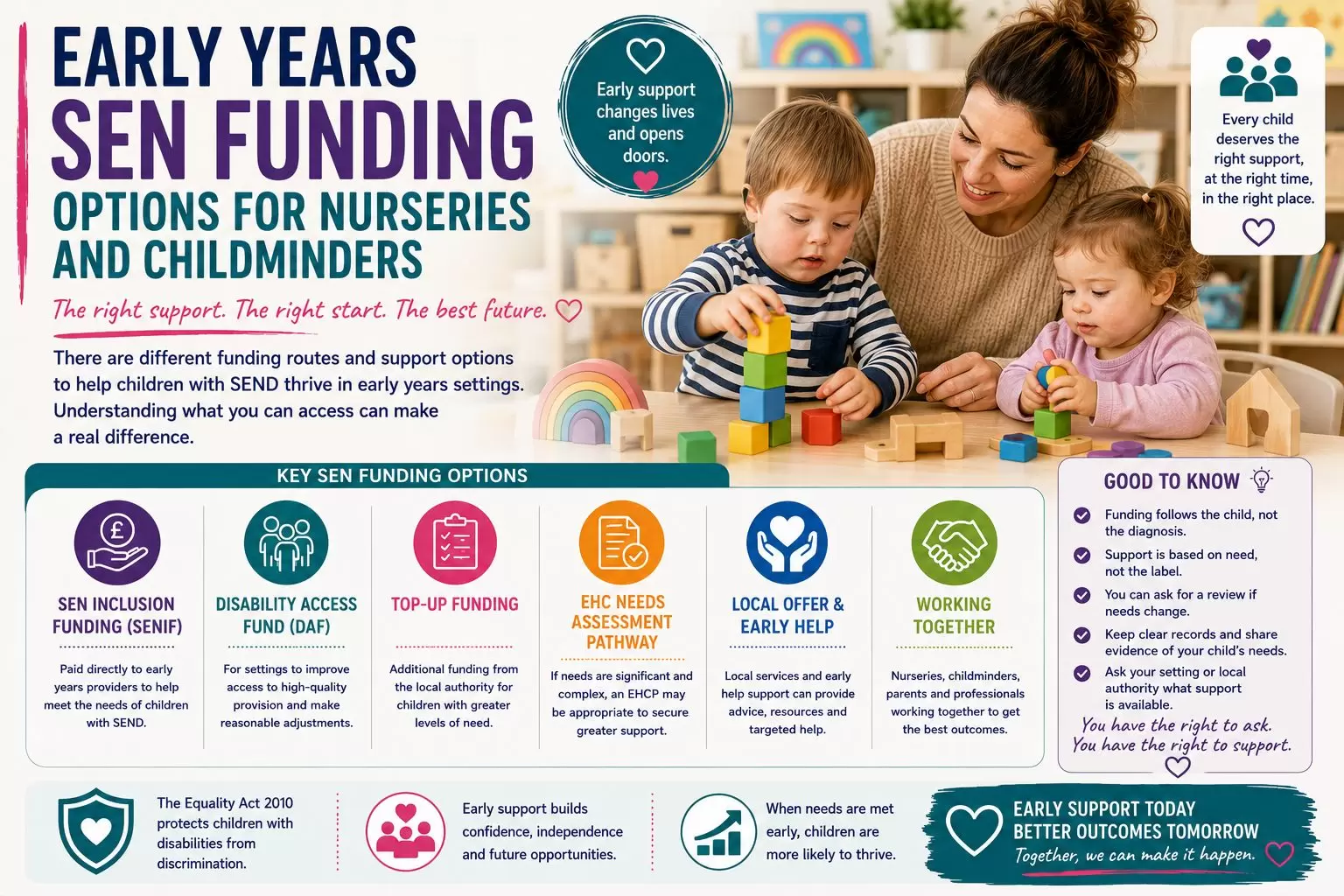
Early Years SEN Funding Options for Nurseries and Childminders
When your child has special educational needs, navigating the early years funding system can feel overwhelming. The good news is that several funding streams exist to help nurseries and childminders provide the right support. Understanding these options is the first step in making sure your child gets the help they need during their earliest years of education.
What Is Early Years SEN Funding?
Early years SEN funding is additional money paid to early years providers, nurseries, pre-schools, and childminders, to help them support children with special educational needs or disabilities (SEND). The funding is designed to cover extra costs such as enhanced staff ratios, specialist training, or additional resources that enable a child to access their free early education entitlement. Different types of funding exist, each with its own rules and amounts, and provision varies between local authorities.
The Main Types of Early Years SEN Funding
Universal Funding
Every child in England who takes up their Free Early Educational Entitlement (FEEE) brings a standard per-hour payment to their early years provider. This universal funding is paid regardless of whether the child has SEND. It is the baseline amount that providers receive, and it is not intended to cover the additional costs of supporting a child with significant needs.
Disability Access Fund (DAF)
The Disability Access Fund provides an additional £938 each year to help early years providers make adjustments to their setting for disabled children. To qualify, a child must be receiving Disability Living Allowance (DLA) and be attending an early years childcare provider for their free education entitlement. DAF is not automatic, it depends on the child meeting the eligibility criteria, and the provider must claim it on the child’s behalf. DLA itself is a tax-free benefit for disabled people under the age of 16 who need help with mobility or care costs.
SEN Inclusion Funding (SENIF)
Many local authorities offer a targeted pot of money called SEN Inclusion Funding, often shortened to SENIF. The exact name varies by area: in Cheshire East it is called SEN inclusion funding (SENIF); in Bristol it is known as Early Years Special Educational Needs Panel funding; in Staffordshire it is the SEND Inclusion Fund; in Hampshire it is SEN Inclusion Funding (SEN IF); and in Norfolk it is also referred to as SEN inclusion funding. While the purposes are similar, to support children with lower-level or emerging SEND who do not yet have an Education, Health and Care Plan (EHCP), the application process, funding amounts, and age ranges differ.
How SENIF Works in Practice
Applications for SENIF are usually made by the early years provider, but parents often need to give consent and provide information about their child’s needs. In Cheshire East, applications must be submitted through an online portal and require a provision map that outlines the support being planned. Panel meetings are held monthly except in August. In Hampshire, payments are made termly after early years funding payments, with specific application windows for spring, summer, and autumn terms.
Staffordshire uses a tiered system. Their SEND Inclusion Fund is available for children aged nine months to four years who are accessing their funded entitlement. Tier 1 means no additional funding is provided because the setting meets the child’s needs with its own resources. Tier 2 gives £410 per term, and Tier 3 is available for children with more significant needs (the exact amount is not specified in published guidance). Norfolk uses a single SEND application for all children in receipt of early education, including those with an EHCP, and awards are calculated using banding descriptors.
The National Inclusive Early Years Fund
Beyond local schemes, the government has announced an inclusive early years fund providing £47 million of additional early years funding in 2026 to 2027. This national fund is intended to support early years SEND provision. It is not clear from current guidance whether this sum replaces other funding streams or sits alongside them, so parents should check with their local authority for the most up-to-date information.
What This Means for Parents
As a parent, you do not need to manage every detail of the funding application, but you should know what is available so you can have informed conversations with your child’s nursery, pre-school, or childminder. If your child receives Disability Living Allowance, ask the setting whether they have claimed the Disability Access Fund. For children with emerging or lower-level SEND who do not yet have an EHCP, SENIF may be the right route. The key is to start early, provide any requested information promptly, and keep a record of your child’s needs and the support they are already receiving.
Frequently Asked Questions
Does my child need an EHCP to get early years SEN funding?
No, a child does not usually need an Education, Health and Care Plan to receive early years SEN inclusion funding. Many local authorities offer SENIF specifically for children with lower-level or emerging SEND who are not yet at the EHCP stage. However, children with an EHCP may also be eligible for additional funding through their plan.
Can I apply for SENIF myself as a parent?
In most cases, the early years provider, the nursery, pre-school, or childminder, submits the SENIF application. However, you will need to give your consent and may be asked to share information about your child’s development and needs. Your provider can guide you through the process and let you know what evidence is required.
How much funding can my child’s setting receive?
Funding amounts vary by local authority. The Disability Access Fund provides a fixed £938 per year. SENIF amounts differ: for example, Staffordshire offers £410 per term at Tier 2, while other authorities calculate awards based on hours and banding. Your local council’s local offer website will have the most accurate figures for your area.
What can early years SEN funding be spent on?
Funding is intended to help the provider meet your child’s needs. It can be used for enhancing staff-to-child ratios, paying for staff to attend specialist training, or purchasing additional resources that help your child access their free early education entitlement. Each local authority sets its own conditions on how the money can be used.
Understanding the funding options available is an important part of advocating for your child in the early years. By working closely with your child’s provider and your local authority, you can help ensure that the right financial support is in place to give your child the best start in their education journey.
Final Thoughts
Early years SEN funding can make a real difference when a nursery or childminder needs additional resources, staffing, training or specialist input to support a child properly. Parents should ask what support is already in place, what funding routes the setting has considered, and whether further evidence is needed to show the child’s needs clearly. You may find it helpful to read our guide on SEND support for preschool children and how to request an EHC needs assessment for a child under 5. If your child’s needs are significant or long-term, our wider guides on how to apply for an EHCP and EHCP evidence for parents can help you understand the next steps.