
Autism Assessment for Children
Last reviewed: March 2026
Written by: School of Diversity SEND Support Team
Topic: Autism Assessment and Diagnosis
This guide explains how autism assessments work for children, including when parents may seek an assessment, how the process works, and how assessments can help identify a child’s support needs.
An autism assessment for children is a professional evaluation used to understand whether a child meets the criteria for autism. Assessments usually involve discussions with parents about development, observation of the child’s communication and behaviour, and evaluation by trained professionals.
Key Takeaways
Autism assessments help professionals understand a child’s development and needs.
The process usually includes developmental history and behavioural observation.
Assessments are carried out by trained professionals such as psychologists or specialist clinicians.
Some children are assessed through NHS services or private specialists.
Assessment results can help schools provide appropriate support.
When parents notice differences in their child’s communication, behaviour or learning, they may begin exploring whether their child could be autistic. An autism assessment helps professionals understand how a child experiences the world and what support may help them thrive.
Assessments do not simply focus on challenges; they also help identify a child’s strengths and how best to support their development.
What Is an Autism Assessment?
Direct answer:
An autism assessment is a structured evaluation used to understand whether a child meets the diagnostic criteria for autism.
The assessment process usually examines:
communication development
social interaction
behaviour patterns
sensory responses
developmental history
The goal is to understand the child’s needs and provide guidance on appropriate support.
How Do I Know If My Child Needs an Autism Assessment?
Direct answer:
Parents may consider seeking an autism assessment if they notice persistent differences in communication, behaviour, social interaction or sensory responses that affect daily life or learning.
Parents may seek advice if their child:
has delayed speech or language development
struggles with social interaction or friendships
prefers routines and becomes distressed by change
shows strong sensory sensitivities
displays repetitive behaviours
A GP, health visitor or school professional can help advise whether an assessment may be appropriate.
What Age Can Children Be Diagnosed With Autism?
Direct answer:
Some children are identified in early childhood, while others may be diagnosed later when social or learning differences become more noticeable.
Signs may appear before the age of three, but diagnosis sometimes happens later in primary school when challenges with communication or social interaction become clearer.
Why Parents Seek Autism Assessments
Parents may seek an assessment when they notice persistent differences in development.
Common reasons include:
delayed speech or communication differences
social interaction challenges
repetitive behaviours or routines
sensory sensitivities
difficulty adapting to change
Recognising these differences can help families access the right support.
How Long Does an Autism Assessment Take?
Direct answer:
Autism assessments may take several appointments depending on the assessment pathway and the child’s needs.
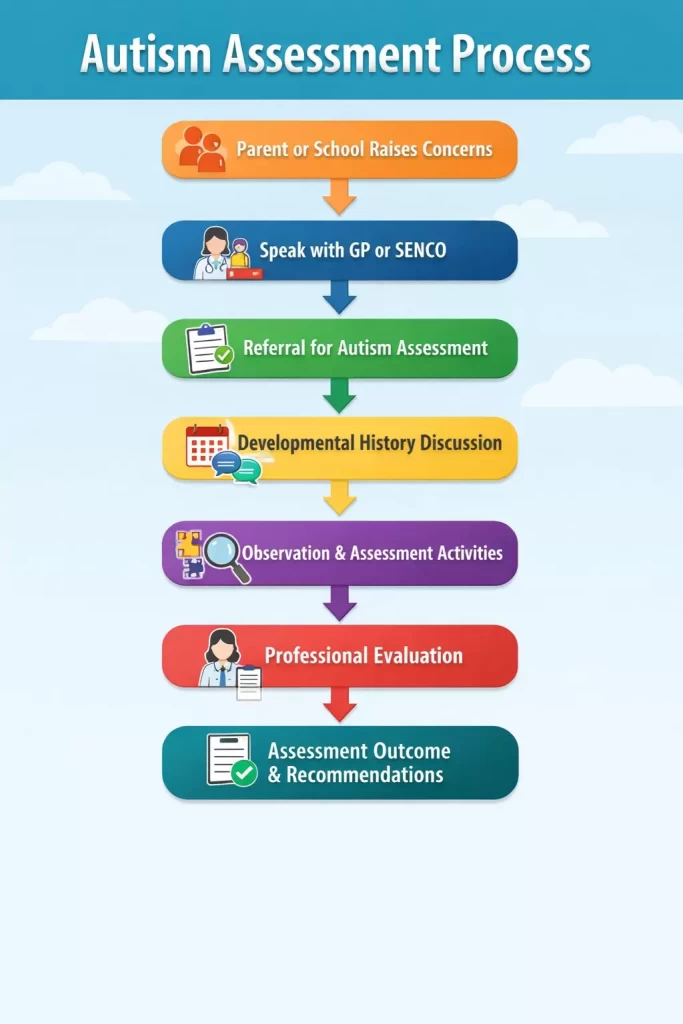
The process usually includes:
developmental history discussions
observation of communication and behaviour
evaluation by specialist professionals
The time between referral and assessment can vary depending on local services.
What Happens During an Autism Assessment?
Direct answer:
An autism assessment usually includes discussions with parents, observation of the child and evaluation by trained professionals.
The process may involve:
reviewing developmental history
observing communication and social behaviour
evaluating play and interaction
reviewing information from school or nursery
Different assessment tools may be used depending on the child’s age and needs.
What Happens After an Autism Diagnosis?
Direct answer:
After a diagnosis, families receive a report explaining the child’s developmental profile and recommendations for support.
Support may include:
guidance for parents
support strategies for school
specialist interventions
consideration of SEND support such as an EHCP if needed
Professionals Involved in Autism Assessments
Autism assessments are usually conducted by specialists trained in child development.
Professionals involved may include:
clinical psychologists
paediatric specialists
speech and language therapists
educational psychologists
In many cases, assessments involve a multidisciplinary team to ensure a full understanding of the child’s development.
How to Request an Autism Assessment
Parents who are concerned about their child’s development may seek guidance from:
their GP
health visitor
school SENCO
child development specialists
These professionals can help determine whether an autism assessment may be appropriate.
Private vs NHS Autism Assessments
Parents in the UK may access autism assessments through NHS services or private specialists.
Each pathway has different referral processes, waiting times and costs.
➡ Learn more in our guide: Private vs NHS Autism Assessment
What Happens After an Autism Assessment?
Direct answer:
After an autism assessment, professionals may provide feedback about whether the child meets diagnostic criteria for autism.
Following an assessment, families may receive:
a diagnostic report
recommendations for support
guidance for school support
strategies to support development
Many children receive support in school through SEN support or an EHCP depending on their needs.
Autism Assessments and School Support
An assessment can help schools better understand how to support a child.
Schools may use assessment information to:
adjust teaching strategies
provide additional support
develop SEN support plans
consider whether an EHCP may be appropriate
This helps ensure the child’s educational environment supports their needs.
Autism Assessments in the UK
In the UK, assessments may be accessed through:
NHS referral pathways
child development services
specialist clinics
Waiting times may vary depending on location and demand.
Signs That May Lead Parents to Seek an Assessment
Parents sometimes seek assessments after noticing patterns such as:
communication differences
social interaction challenges
sensory sensitivities
behavioural patterns that affect learning
Recognising these differences early can help families access appropriate support.
Private Autism Assessments
Direct answer:
Some parents explore private autism assessments when they want a quicker assessment pathway or additional professional evaluation.
Private assessments are usually carried out by qualified professionals such as:
clinical psychologists
paediatric specialists
multidisciplinary assessment teams
A private assessment typically includes developmental history discussions, observation of the child’s behaviour and communication, and a detailed diagnostic report.
Private assessments may also provide recommendations that can support discussions with schools about a child’s educational needs.
➡ Learn more: Private vs NHS Autism Assessment
How Much Does a Private Autism Assessment Cost?
Direct answer:
The cost of private autism assessments varies depending on the provider and the type of evaluation required.
Some assessments involve multiple professionals and several appointments, which can influence the overall cost.
Parents considering a private assessment may wish to research providers carefully and ensure the assessment includes a comprehensive evaluation and written report.
FAQ
What age can children be assessed for autism?
Some children are assessed in early childhood, while others are identified later when differences become clearer.
Do all children who show autism traits receive a diagnosis?
Not necessarily. Assessments help professionals understand development and determine whether diagnostic criteria are met.
Can schools request autism assessments?
Schools may discuss concerns with parents and suggest seeking professional guidance.
Does an autism diagnosis automatically mean a child needs an EHCP?
No. Some children receive support through SEN support, while others may require an EHCP depending on their needs.
Explore More Autism Guidance
If you are exploring autism support for your child, you may find these guides helpful:
You can also explore our Autism Support for Parents hub, which brings together guidance on autism signs, assessments and school support.