
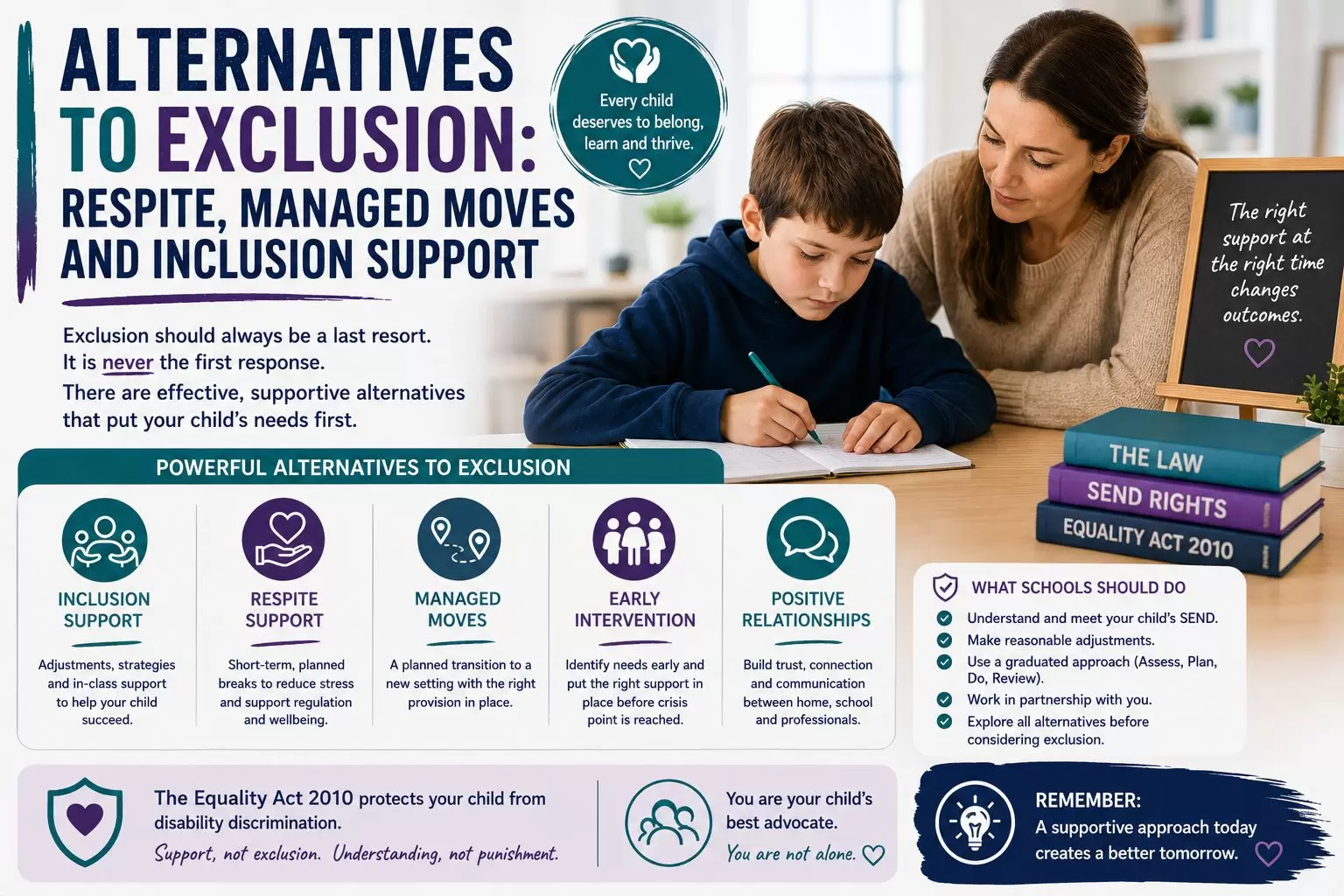
Alternatives to Exclusion: Respite, Managed Moves and Inclusion Support
For parents of children with special educational needs and disabilities (SEND), the prospect of school exclusion can be deeply worrying. When a child struggles to cope in a mainstream classroom, it can feel as though the school might turn to exclusion quickly rather than exploring other options first. Yet the law and statutory guidance set out clear alternatives that schools must consider before taking such a step. Understanding these alternatives to exclusion can help you stand up for your child’s rights and make sure the school meets its legal responsibilities. This article covers the key options available, including off-site direction, managed moves, elective home education, and the extra support duties that apply specifically to SEND pupils.
In England, only the headteacher or acting headteacher has the legal authority to exclude a pupil. Suspensions cannot exceed 45 school days in any single academic year, and a permanent exclusion means a final removal from the school roll. Both must be for disciplinary reasons only and must be formally recorded. Informal or unofficial exclusions, such as sending a child home to cool off, are unlawful. These legal limits exist to protect all pupils, particularly those with SEND, from being removed from education without proper process.
Understanding the Legal Context for SEND Pupils
Schools have specific legal duties towards children with SEND that can act as a barrier to exclusion. Mainstream schools must use their best endeavours to make appropriate SEN provision for any pupil who needs it. This duty extends to providing behaviour support where a child’s needs are affecting their conduct in school. Under the Equality Act 2010, schools must also make reasonable adjustments for disabled pupils to ensure they are not substantially disadvantaged compared to non-disabled peers. These duties mean a school cannot simply exclude a SEND pupil without first considering what additional support or adjustments could address the underlying difficulties.
It is also important for parents to know that students with Education, Health and Care (EHC) plans are five times more likely to be excluded than those without. Autistic students are the largest SEND group to be excluded. These figures highlight why early intervention and the use of alternatives to exclusion matter so much before a crisis point is reached. If your child has an EHCP or is being assessed for one, the school should contact the local authority early about any behavioural concerns and consider an early annual review of the plan before an exclusion is ever discussed.
Off-Site Direction: A Temporary Change of Setting
Off-site direction is a formal alternative to exclusion that involves placing a pupil temporarily at another school or alternative provision. The pupil remains on the original school roll and is expected to return after the directed period. This is a time-limited placement designed to provide a break and allow the school to reassess support strategies. Off-site direction is a decision made by the school, but the governing body must keep such placements under regular review, and parents must be invited to those review meetings.
This option can be particularly useful when a child’s needs are not being met in their current setting and a short period in a different environment may help reset their engagement with learning. It is not the same as a managed move or a permanent exclusion. The school retains responsibility for the pupil’s education and welfare throughout the placement, and the pupil is expected to return once the agreed period ends.
Managed Moves: A Voluntary Permanent Transfer
A managed move is a permanent transfer to another school, agreed voluntarily by all parties: the current school, the receiving school, the parents, and the pupil where appropriate. Because it is a permanent change, the pupil is removed from the roll of the original school and enrolled at the new one. Managed moves should be voluntary and schools should not pressure parents into agreeing. If you feel pressured to accept a managed move under threat of exclusion, you have the right to refuse and to ask the school to consider other alternatives first.
It is important to understand the distinction between off-site direction and a managed move. Off-site direction is temporary and the pupil returns to the original school. A managed move is a permanent transfer to another school. Managed moves can be a positive option when a fresh start in a different school environment is genuinely in the child’s best interest, but they must not be used as a way to bypass the formal exclusion process. If you are considering a managed move, be sure to discuss with the new school how they will meet your child’s SEND needs from the very beginning.
Elective Home Education
Elective home education, where parents choose to educate their child at home rather than at school, is another alternative to exclusion. In some circumstances, parents may feel that the school environment can no longer meet their child’s needs and that home education offers a more suitable pathway. It is important to note that elective home education should be a genuine parental choice, not something agreed to under pressure from the school. If a school suggests home education as an alternative to exclusion, consider carefully whether it is the right option for your child and your family. Local authorities have a duty to ensure that children receiving home education are receiving a suitable education, but the legal responsibility for providing that education rests with the parent.
Additional Support for SEND Pupils at Risk of Exclusion For Pupils Without an EHCP
If your child does not have an EHCP but is at risk of exclusion, the school can refer the case to the Vulnerable Pupil Panel. This panel considers what additional support and interventions might be put in place to prevent exclusion. It is a mechanism for bringing together professionals to problem-solve before a crisis point. If the school has not mentioned this option, you can ask them whether a referral to the panel is appropriate for your child.
For Pupils With an EHCP
For pupils who already have an EHCP and are at risk of exclusion, a joint working protocol between the school and the local authority may lead to a review of the EHCP. This can result in changes to the provision outlined in the plan, such as additional support hours, a different type of placement, or the involvement of specialist services. The school should contact the local authority early about any behavioural concerns and consider an early annual review before the situation escalates to exclusion. If your child has an EHCP and you are worried about their behaviour in school, requesting an early annual review is a sensible first step
Reintegration and Part-Time Timetables
After any suspension, the school should offer a reintegration meeting and strategy to help the pupil settle back into school. This meeting is an opportunity to discuss what support and adjustments are needed to prevent further incidents. Reintegration is a critical part of the process and should be treated with the same seriousness as the exclusion itself.
Part-time timetables are sometimes suggested by schools as a way of managing a pupil’s behaviour. However, part-time timetables should only be used for medical needs, not to manage behaviour. If your child is placed on a part-time timetable for reasons related to behaviour or SEND needs, this may be unlawful and you should seek advice. After a suspension of five days or more, the child is entitled to suitable full-time alternative education from the sixth day. For a permanent exclusion, the home local authority becomes responsible for arranging that full-time education from the sixth day onward.
How to Challenge Unlawful Practice
If you suspect your child’s school is using an informal exclusion, suggesting a part-time timetable to manage behaviour, or pressuring you into a managed move, there are steps you can take. Request a meeting with the headteacher to discuss your concerns and ask the school to put any arrangements in writing. You can also contact the local authority or the school’s governing body. The law is clear that informal exclusions are unlawful and that part-time timetables should not be used for behaviour management. Knowing these rules empowers you to advocate for your child’s right to full-time, suitable education.
Frequently Asked Questions
Can a child with an EHCP be excluded from school?
Yes, a child with an EHCP can be excluded, but schools have additional duties towards them. The school must use its best endeavours to make appropriate SEN provision and must consider reasonable adjustments under the Equality Act 2010. For pupils with an EHCP, the school should contact the local authority early about concerns and consider an early annual review before resorting to exclusion.
What is the difference between a suspension and a permanent exclusion?
A suspension is a temporary removal from school and cannot exceed 45 school days in a single academic year. A permanent exclusion is a final removal from the school roll. Both are lawful only for disciplinary reasons and must be formally recorded by the headteacher. After five days of suspension or permanent exclusion, the child is entitled to full-time alternative education.
What should I do if the school pressures me into a managed move?
Managed moves must be voluntary and schools should not pressure parents into agreeing. If you feel pressured, you have the right to refuse and to ask the school to consider other alternatives first. Request a meeting with the headteacher or contact the local authority to discuss your concerns. Do not agree to a managed move if you are not confident it is the right option for your child.
What is off-site direction and how is it different from a managed move?
Off-site direction is a temporary placement at another school or alternative provision, with the pupil expected to return to the original school. A managed move is a permanent transfer to another school that requires voluntary agreement from all parties. Off-site direction is a school decision, but the governing body must keep the placement under regular review and parents must be invited to those review meetings.
What should I do if my child is sent home from school informally?
Informal or unofficial exclusions, such as sending a child home to cool off, are unlawful. Ask the school to formally record any exclusion and explain the legal basis for it. If the school cannot provide a formal exclusion notice, challenge this by contacting the headteacher, the governing body, or the local authority. Keep a written record of all communications and conversations.
Final Thoughts
Before a child with SEND is excluded, schools should be exploring supportive alternatives that reduce risk, address unmet needs and keep the child connected to education wherever possible. Options such as respite, managed moves, inclusion support and early intervention are often most effective when they sit alongside strong SEN Support and a clear understanding of what the child needs to access learning. If your child already has an EHCP, it is important to check whether the provision in the plan is being delivered and whether it still reflects their needs by reviewing what support an EHCP should provide and using the EHCP annual review process where changes are needed. If you are unsure whether school-based support is enough, our guides on do I need an EHCP? and how to apply for an EHCP can help you understand the next steps.