
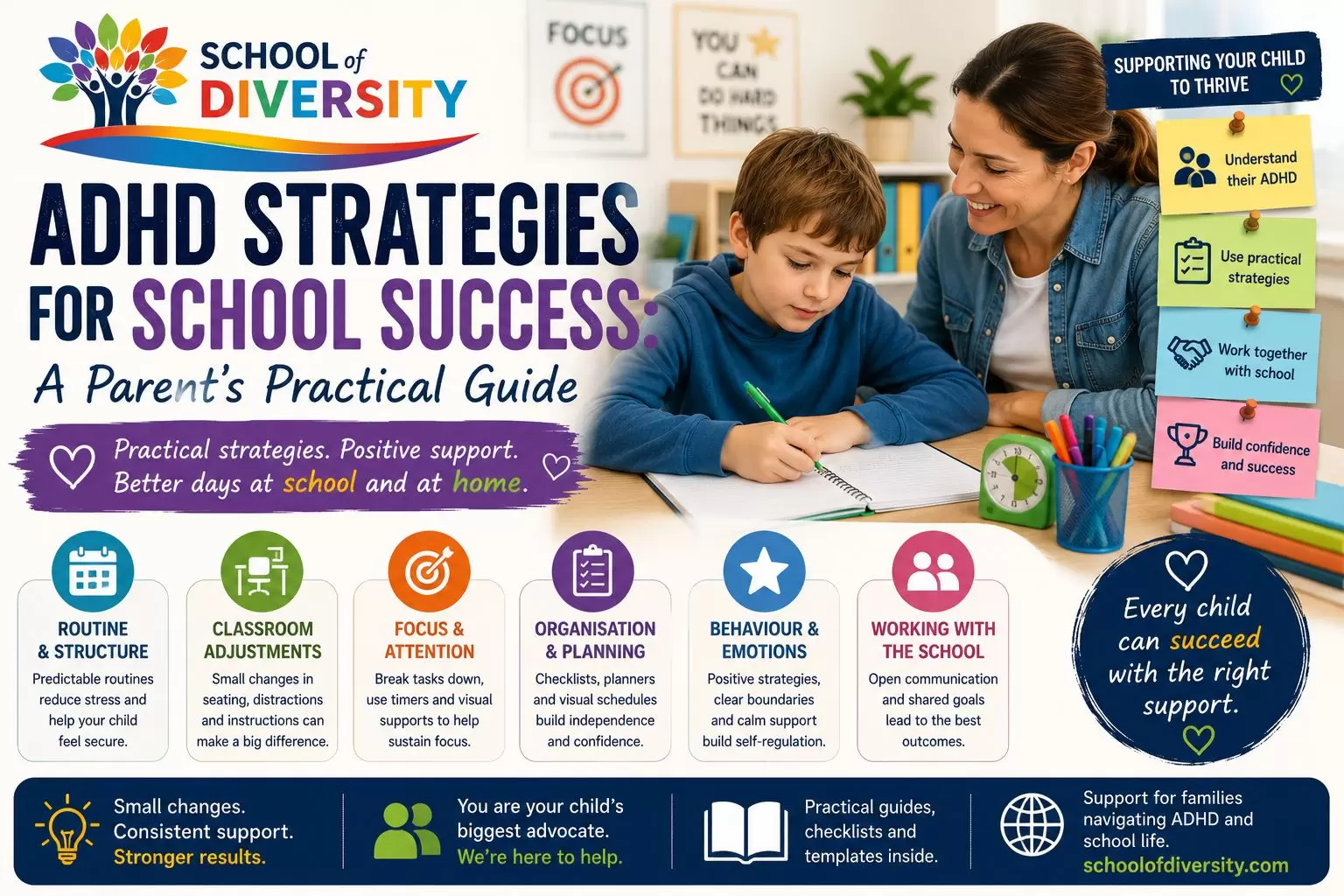
ADHD Strategies for School Success: A Parent's Practical Guide
Children with ADHD can be successfully supported in a mainstream setting. With the right strategies in place, your child can achieve their full potential. Many children with attention deficit hyperactivity disorder face difficulties with focus, organisation, and impulse control at school, but targeted approaches from both home and the classroom can make a significant difference. This guide offers practical steps you can take as a parent to create routines, collaborate with teachers, and implement accommodations that promote learning and confidence.
Understanding ADHD in the Classroom
ADHD affects a child’s ability to sustain attention, follow instructions, and manage restless impulses. The American Academy of Pediatrics recommends teacher-administered behaviour therapy as a treatment for school-aged children with ADHD. A good understanding of ADHD and its impact in the classroom is the first important step for both families and educators. The impact of ADHD symptoms on academic performance can be substantial, affecting reading comprehension, maths fluency, and written expression. When teachers and parents recognise these challenges early, they can put in place strategies that allow the child to engage fully with learning.
Building Effective Routines at Home
Home-based involvement in educational activities, including supervision of homework and studying, can be particularly challenging for parents of children with ADHD. Creating structured routines helps children know what to expect and reduces anxiety. The school success kit for kids with ADHD provides tools and strategies to help manage time, stay focused, and handle homework. The CHADD toolkit for parents also highlights how to create routines that support school success. Consistency is key: when the same sequence of events happens each day, the child’s brain learns to transition more smoothly between activities.
Establishing Morning and Evening Routines
Start with a visual schedule posted on the wall. Include pictures or icons for each step: wake up, get dressed, eat breakfast, pack school bag, brush teeth. Go through the list together each morning so the child feels involved. In the evening, set a fixed time for homework, followed by dinner, a relaxing activity, and bedtime preparation. Use a timer to signal transitions. This predictability reduces arguments and helps the child feel more in control of their day.
Homework and Study Strategies
Break homework into manageable chunks. The school success kit suggests using a timer for focused work periods, such as ten minutes of work followed by a two-minute movement break. Create a quiet, organised homework space with minimal distractions. The RCH fact sheet advises limiting over-activity and fatigue, so keep homework sessions short and schedule them when the child is most alert, often earlier in the evening. Praise effort and completion, not just correct answers, to build motivation.


Partnering with Teachers and the School
Engaging parents and teachers in the support of children with ADHD is essential for consistent progress. When families and educators share information about what works at home and in the classroom, the child receives a unified message. The CDC recommends that teachers partner with parents, focusing on the positive and using collaborative problem-solving. Regular communication, whether through a daily report card or a quick email, helps everyone stay aligned on strategies and goals.
Sharing Effective Strategies
Provide the school with a list of strategies that help your child. This might include preferential seating near the teacher, written instructions for multi-step tasks, or extra time for completing assessments. Teacher-administered behaviour therapy can be effective, especially when paired with consistent expectations. Focus on the positive: recognise small successes and effort, and ask the teacher to do the same. A collaborative approach builds trust and ensures that the child feels supported across all environments.
What to Ask in Parent-Teacher Meetings
Come prepared with specific questions. Ask how your child is managing focus, organisation, and social interactions. Inquire about the classroom accommodations already in place, such as how instructions are given, the seating arrangement, and whether there are opportunities for movement. The RCH fact sheet includes guidance on learning techniques and limiting over-activity. Discuss what adjustments might help, such as allowing the child to stand at their desk, using a fidget tool quietly, or having a designated calm-down corner.
Classroom Accommodations and Teacher Strategies
Effective classroom support combines structure with flexibility. Establish rules and routines for ADHD students, and offer accommodations that reduce barriers to learning. The AAP recommends teacher-administered behaviour therapy, which can include a token economy system or daily behaviour report cards. A bank of creative ideas that encourage learning in children with ADHD will benefit all students, making the classroom more inclusive for everyone.
Giving Clear Instructions
Teachers can use simple, direct language when giving instructions. Provide one instruction at a time and check for understanding by asking the child to repeat it back. The RCH fact sheet recommends using visual aids, such as a whiteboard or picture cues, to support verbal directions. This reduces confusion and helps the child start tasks more confidently.
Limiting Over-activity and Fatigue
Children with ADHD can become overwhelmed by long periods of seated work. The RCH fact sheet advises incorporating frequent movement breaks. Allow the child to stand at their desk, take a short walk, or run a classroom errand. Break larger assignments into smaller steps and provide clear checkpoints. Reducing overall fatigue helps maintain focus and prevents behavioural outbursts.
Maintaining a Positive Focus
Focus on the positive by praising effort, persistence, and improvement rather than only correct answers. Use a reward system that the child finds meaningful, such as extra free time or a special activity. The CDC emphasises that focusing on the positive builds the child’s self-esteem and strengthens the relationship with the teacher. A supportive classroom environment encourages the child to take academic risks and stay engaged.
Creating a School Success Kit
The Child Mind Institute’s school success kit for kids with ADHD includes a variety of practical tools. This kit can include a visual timer, a homework checklist, fidget toys, noise-cancelling headphones, and a special folder for completed assignments. Keep the kit in the child’s backpack or at their desk. Teach your child how to use each item and why it helps. For example, noise-cancelling headphones can reduce auditory distractions during independent work. The kit empowers the child to take ownership of their own focus and organisation.
Supporting Your Child’s Emotional Well-being
ADHD often comes with emotional challenges: frustration, anxiety, and low self-esteem can arise from repeated struggles at school. Provide a calm space at home where your child can decompress after school before starting homework. Teach simple calming strategies like deep breathing or squeezing a stress ball. Encourage open conversations about what went well and what was hard. Validate their feelings and brainstorm solutions together. Children with ADHD can be successfully supported in a mainstream setting, and emotional support is a vital part of that success. When children feel understood and capable, they are more willing to try new strategies.
Frequently Asked Questions
How can I help my child with ADHD focus on homework?
Break homework into short segments with frequent breaks. Use a timer for focused work periods, for example ten minutes of work followed by a two-minute movement break. Create a quiet, distraction-free workspace. The school success kit from Child Mind includes helpful time management tools that can make homework less overwhelming.
What should I do if my child’s teacher is not supportive?
Request a meeting to discuss your child’s needs and share strategies that work at home. Bring information about ADHD and classroom accommodations from reliable sources like the CDC or the RCH fact sheet. If support remains insufficient, consider asking the school for a formal SEN assessment. Guidance services, like those provided by the School of Diversity, can help you understand your options.
Can children with ADHD succeed in mainstream school?
Yes. With the right strategies in place, children with ADHD can achieve their full potential in a mainstream setting. Good understanding of ADHD and its impact, plus consistent support from both home and school, are key pillars for success. Many children thrive when routines, accommodations, and positive reinforcement are used consistently.
What are the best classroom accommodations for ADHD?
Common accommodations include preferential seating near the teacher, written instructions, extra time for tests, movement breaks, and a quiet area for focused work. Teachers can also use behaviour therapy techniques and focus on the positive. The CDC and RCH resources offer evidence-based ideas that can be adapted to any classroom.
By applying these strategies at home and working closely with your child’s school, you can create an environment where your child with ADHD can thrive academically and emotionally. Remember that every child is unique, so tailor approaches to what works best for your family. For more tailored support, explore the resources and guidance available through our SEND services.
Final Thoughts
ADHD strategies for school success work best when they are practical, consistent and understood by everyone supporting the child. Small adjustments such as visual routines, movement breaks, reduced distractions, chunked instructions, emotional regulation support and regular communication with school can make a meaningful difference. For many children, these strategies can begin through SEN Support, but if needs are significant, ongoing or not being met, parents may need to consider whether an EHCP is needed. You may also find our guide on EHCPs for ADHD helpful, especially if your child needs structured provision, clearer outcomes or support that goes beyond ordinary classroom adjustments.