
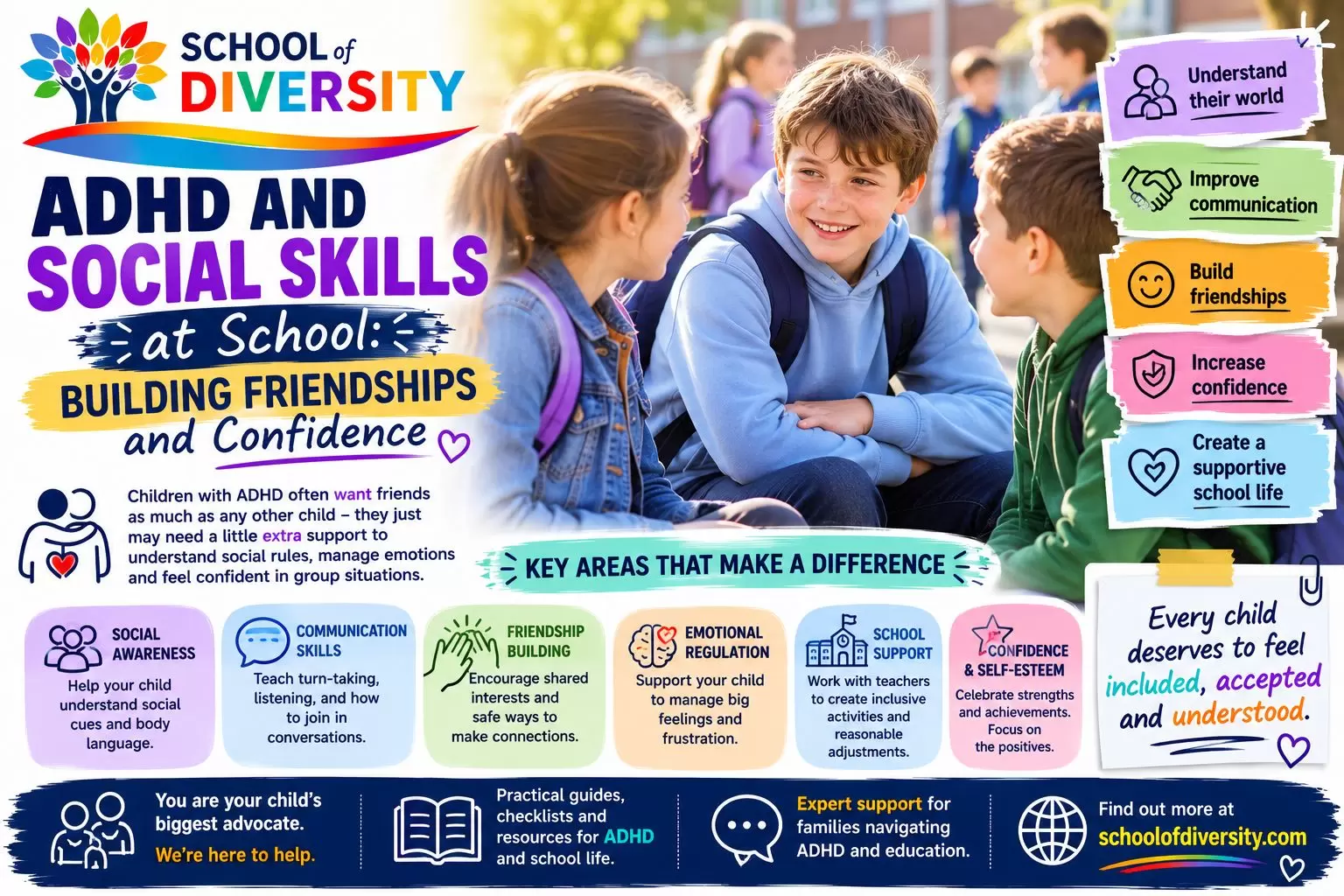
ADHD and Social Skills at School: Building Friendships and Confidence
For many children with ADHD, school is not just about lessons and homework. The social side of the classroom and playground can present real difficulties. Making friends, sharing, taking turns, and reading social cues do not come naturally when executive functions are delayed. As a parent, watching your child struggle with peer relationships can be distressing. The good news is that with the right understanding and support, children with ADHD can learn social skills and build lasting friendships. This article looks at why social skills are harder for children with ADHD, what common difficulties look like, and how you can help your child feel more confident and connected at school.
Why Social Skills Can Be a Challenge for Children with ADHD
Social skills rely heavily on executive functions: the brain processes that manage attention, planning, impulse control, and emotional regulation. Children with ADHD often have a delay in these executive functions. Research shows that executive functions in children with ADHD can be delayed up to 30 percent compared to their peers. This means a child may behave socially like a younger child, even though their intellectual abilities are age-appropriate. As same-aged peers become more socially sophisticated around age 7, the gap becomes more noticeable. A child with ADHD may struggle to pick up on non-verbal cues, understand others’ emotions, or respond appropriately in social situations. This is not a lack of effort or motivation. It is a neurological difference that affects social awareness and performance.
Common Social Difficulties Children with ADHD Face at School
Most children with ADHD have trouble with social skills and building friendships. Specific deficits include perspective-taking, situational awareness, responding appropriately to others’ emotions, initiation, cognitive flexibility, and using humour appropriately. On the playground or in group work, a child with ADHD may find it hard to share, take turns, listen, and pick up on social cues. They might interrupt frequently, miss subtle hints that someone is bored or upset, or struggle to adapt when a game changes. These behaviours can lead to peer rejection. Estimates suggest that between 50 and 60 percent of children with ADHD have difficulty with peer relationships. That is a significant number, and it underscores why targeted support is so important.
Another key area is reciprocity and flexibility in friendships. Children with ADHD may find it tough to give and take in conversation or to adjust their expectations when a friend wants to play something different. They might dominate play or, conversely, withdraw if they feel overwhelmed. Understanding these patterns helps parents and teachers respond with empathy rather than frustration.
The Role of Social Skills Training
Social skills training for ADHD is an evidence-based approach that seeks to improve and maintain social interaction and prevent interpersonal difficulties. The training usually involves teaching specific skills, role-playing, and practising in structured settings. For it to work well, parents and teachers are trained to prompt and reinforce children with ADHD to use newly acquired social skills both at home and in school. Consistency across settings is crucial. However, it is worth noting that some experts view ADHD social difficulties not solely as a skill deficit but as a performance deficit. Children may know what to do in theory but cannot reliably use the skill in the moment, especially when distracted or impulsive. In such cases, medication may help improve the consistent use of existing social skills. For many children, a combination of social skills training and appropriate medical support can be effective, though each child’s needs are different.
Practical Ways to Support Your Child's Social Development
You can make a real difference at home and by working with the school. Start by focusing on one or two social skills at a time. For example, work on perspective-taking by talking through stories or TV programmes: “How do you think that character felt when that happened?” Practice turn-taking during board games or family conversations. Coach your child on starting conversations, joining a game, or reading facial expressions. Role-play common school scenarios so your child feels more prepared. Praise and reinforce small successes. At school, ask teachers to use prompts and positive reinforcement when your child demonstrates good social skills. A simple sticker chart or verbal praise can encourage a child to keep trying. Also consider structured social activities like small group clubs for shared interests, where social demands are lower and interaction is guided.
Because children with ADHD often lag in social executive function skills, it helps to be explicit about rules of friendship. Talk about being a good listener, sharing, and apologising when mistakes happen. Keep instructions concrete. Instead of “be nice,” try “when you want to join the game, say ‘Can I play?’ and wait for an answer.” Patience and repetition are essential. Social skills do not develop overnight, but with consistent practice, many children improve.
Building Confidence Alongside Social Skills
Social difficulties can damage a child’s self-esteem. If a child feels rejected or left out, they may avoid social situations altogether. That is why building confidence must go hand-in-hand with teaching social skills. Celebrate your child’s strengths, whether in art, sport, or a special interest. Confident children are more likely to take social risks, like approaching a new classmate. Help your child find a niche where they can shine, which can provide a natural foundation for friendships. Emotional regulation is also part of the picture. Children with ADHD may have intense emotional reactions that confuse peers. Teaching calming strategies, such as deep breathing or taking a quiet break, helps your child manage feelings and stay regulated during social interactions.
When to Seek Extra Support
If social difficulties are significantly affecting your child’s wellbeing or progress at school, it may be time to consider additional support. An ADHD assessment, if not already completed, can clarify your child’s needs and open the door for tailored interventions. Your school’s special educational needs coordinator (SENCo) can discuss what SEN support is available. For some children, an Education, Health and Care Plan (EHCP) may be appropriate if social skill deficits require significant, ongoing help that goes beyond what the school can normally provide. The EHCP can specify social skills goals and the type of support needed, such as a teaching assistant to facilitate peer interaction or access to a social skills group. You do not have to navigate this alone. Organisations like the School of Diversity offer guidance on EHCP applications and strategies for securing legally enforceable school support.
Frequently Asked Questions
At what age do ADHD social difficulties become obvious?
Differences in social executive function skills often become noticeable to same-aged peers around age 7. Before that, social expectations are lower and differences may not stand out as much. By age 7, peer relationships become more complex, and children with ADHD may struggle to keep up with the social demands of friendships.
Can social skills training really help children with ADHD?
Social skills training is designed to improve and maintain social interaction and prevent interpersonal difficulties. Its effectiveness can vary by child. It works best when parents and teachers prompt and reinforce skills at home and school. Some children also benefit from medication that helps them use existing skills more consistently.
How can parents help their child with ADHD make friends at school?
Start by teaching one or two specific skills, like turn-taking or reading emotions. Practice through role-play and reinforce successes with praise. Work with the school to create a supportive environment. Encourage activities that match your child’s interests to build confidence and provide natural opportunities for friendship.
Should I consider an EHCP for my child’s social skills difficulties?
If social skill deficits are severe and your school’s SEN support is not enough, an Education, Health and Care Plan (EHCP) can help. It can legally require the school to provide specific social skills training, adult support, or therapy. An EHCP is assessed based on your child’s overall needs, not just social skills, so it is important to gather evidence from professionals and the school.
Social skills at school can be a struggle for children with ADHD, but they are not doomed to a lonely experience. With an understanding of the underlying executive function delays, targeted social skills training, and consistent support from parents and teachers, children can learn to navigate friendships more successfully. Building confidence alongside those skills is just as important. If you feel your child needs more help than the school currently offers, exploring an EHCP or ADHD assessment may be the next step. You have the right to advocate for your child to receive the support they need to thrive socially and academically.
Final Thoughts
ADHD and social skills at school are not about a child “not trying hard enough”; many children with ADHD want friendships but may need extra support with turn-taking, reading social cues, managing impulsive reactions and coping with big feelings. Parents can help by working closely with school, practising social situations gently at home and focusing on confidence as much as behaviour. You may find our wider guide on ADHD strategies for school success helpful, alongside our page on EHCPs for ADHD if your child needs more structured support. Where social difficulties are affecting learning, attendance or emotional wellbeing, our guide on SEN Support vs EHCPs can help you understand what support may be available through school and when an EHCP may need to be considered.