
Specialist SEND Support
Practical support focused specifically on SEND, EHCPs and education.
Evidence-Led
We look at what the evidence actually establishes — and what may still be missing.
Neurodiversity-Informed
Experienced in autism, ADHD, sensory needs, masking, anxiety and complex educational profiles.
Support Across England
Document review, consultation and case preparation can be provided remotely.
Draft EHCP Review and Amendment Support
Received a Draft EHCP? Make Sure It Properly Reflects Your Child’s Needs
Receiving a draft Education, Health and Care Plan can feel like a major step forward.
But receiving an EHCP is not the end of the process.
The wording of the plan matters.
A draft EHCP should accurately describe your child’s special educational needs, clearly set out the provision required to meet those needs and reflect the professional evidence gathered during the EHC needs assessment.
If important needs are missing, provision is vague or professional recommendations have been weakened, the draft stage gives you an important opportunity to raise those concerns before the plan is finalised.
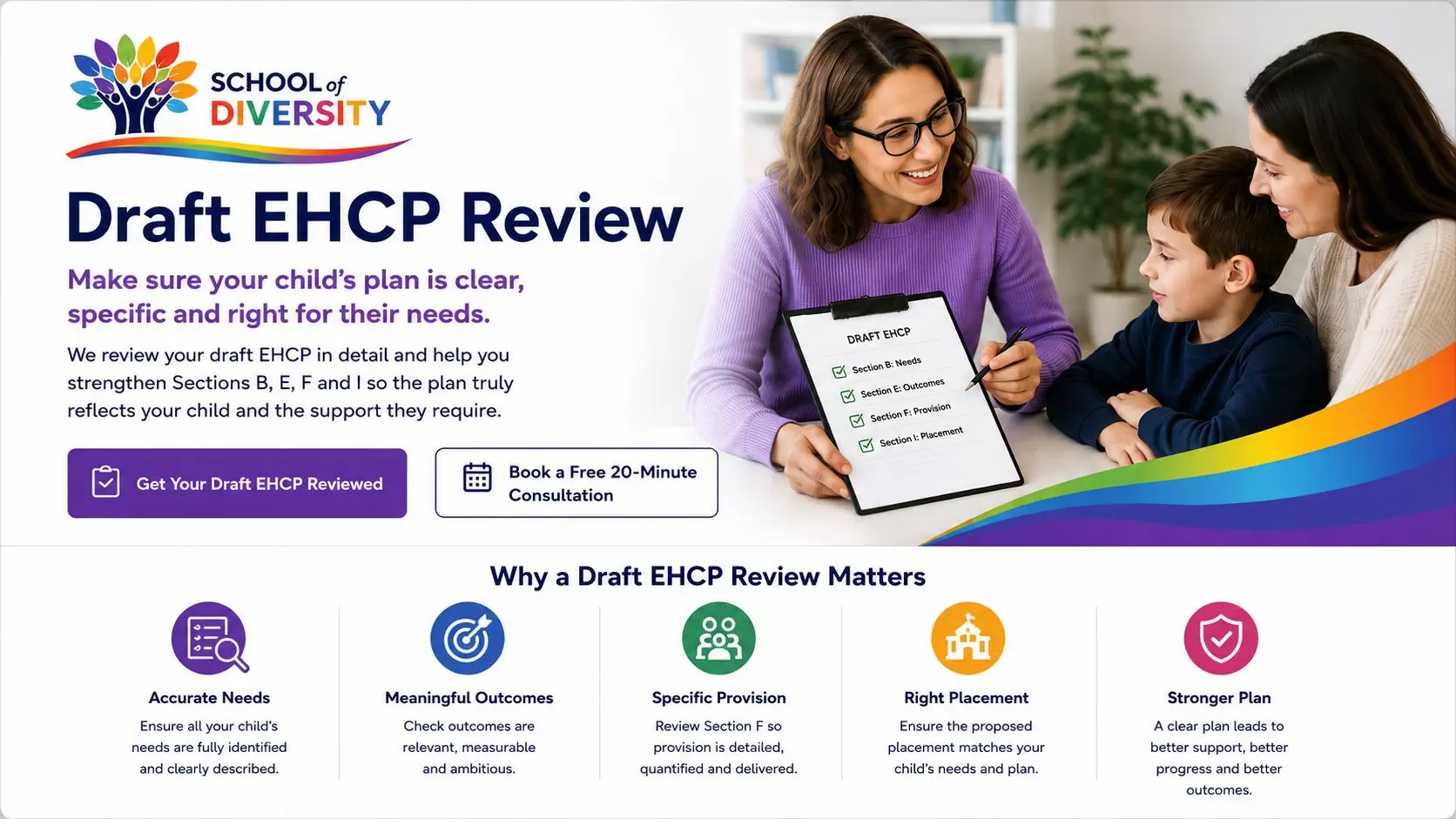
School of Diversity can provide an independent Draft EHCP Review, helping you understand what is strong, what may be missing and what amendments you may wish to request.
Why Reviewing a Draft EHCP Matters
It can be tempting to read a draft EHCP quickly, see that support has been included and assume everything is satisfactory.
Unfortunately, the difference between a strong EHCP and a weak one is often found in the detail.
For example, there can be an important difference between:
“Access to adult support when required.”
and:
“Individual adult support for 20 minutes at the beginning of each literacy lesson, delivered by a trained teaching assistant, five times each week.”
One sounds supportive.
The other explains much more clearly:
- what support will be provided;
- how often it will happen;
- how long it will last;
- who will deliver it;
- and when it will be provided.
Our review looks beyond whether support has simply been mentioned.
We examine whether the plan creates a clear connection between your child’s needs, outcomes and provision.
What Does Our Draft EHCP Review Include?
We can review the draft EHCP alongside the professional evidence used during the EHC needs assessment.
Depending on the documents available, this may include:
- Educational Psychologist reports;
- Speech and Language Therapy reports;
- Occupational Therapy reports;
- school SEN documentation;
- autism or ADHD assessments;
- paediatric reports;
- mental-health evidence;
- specialist-teacher assessments;
- parental representations;
- the child or young person’s views;
- previous support plans;
- and other relevant professional evidence.
We then compare the evidence against the wording of the draft plan.
Section A: Views, Interests and Aspirations
Section A should provide a meaningful picture of the child or young person rather than a short generic description.
We consider whether it accurately reflects:
- your child’s strengths and interests;
- what matters to them;
- their wishes and feelings;
- their experience of school;
- what helps them feel safe and regulated;
- what they find difficult;
- parental views and concerns;
- hopes for education and adulthood;
- the effect of their needs on daily life.
Although Section A is not itself the section that legally specifies educational provision, it provides important context for the rest of the plan.
Section B: Special Educational Needs
Section B should provide a sufficiently clear description of the child or young person’s identified special educational needs.
We look for potential issues such as:
- important needs being omitted;
- difficulties being minimised;
- professional findings being summarised too broadly;
- sensory needs being overlooked;
- communication needs being inadequately described;
- emotional-regulation needs being omitted;
- executive-function difficulties being missed;
- literacy or learning difficulties not being properly reflected;
- independence needs being overlooked;
- or the educational impact of a need not being explained.
This is important because the provision in Section F should respond to the special educational needs identified within the plan.
Section E: Outcomes
EHCP outcomes should describe meaningful areas of development for the child or young person.
We consider whether the outcomes:
- relate to the identified needs;
- are meaningful to the child or young person’s education and development;
- are sufficiently clear;
- support preparation for adulthood where appropriate;
- and connect logically with the provision contained within the plan.
We also look for important areas where an outcome may be missing.
Section F: Special Educational Provision
Section F is one of the most important parts of an EHCP.
It describes the special educational provision required to meet the child or young person’s special educational needs.
Our review looks carefully for vague wording such as:
- “access to support”;
- “regular opportunities”;
- “as required”;
- “when necessary”;
- “support when needed”;
- “opportunities for movement breaks”;
- “adult support available”;
- or “up to” a particular amount of support.
The problem with wording like this is that it may leave important practical questions unanswered.
For each significant area of provision, we consider questions such as:
What will actually be provided?
Is the intervention, strategy, therapy or support clearly identified?
How often will it happen?
Does the plan say daily, weekly, each lesson or another identifiable frequency?
For how long?
Does it specify the duration of individual sessions where this is relevant?
Who will provide it?
Does the plan identify the appropriate professional, specialist or suitably trained member of staff?
What level of support is required?
Does the evidence support individual support, small-group provision, specialist teaching or another defined level of intervention?
What training is required?
Where staff need specialist knowledge or training, is this adequately addressed?
How will specialist recommendations be implemented?
If an Educational Psychologist, Occupational Therapist, Speech and Language Therapist or other professional has recommended provision, has that recommendation been properly transferred into the EHCP?
What About Section I and School Placement?
The draft stage is also an important point in the process for considering educational placement.
Parents and eligible young people can express a preference for an appropriate school, college or other educational institution.
However, placement should not be considered in isolation.
The starting point should be understanding:
- What are the child or young person’s needs?
- What provision do they require?
- What type of educational environment is required for that provision to work?
- Can the proposed placement realistically deliver it?
We can help you examine the relationship between Sections B and F and the type of educational environment your child may require.
Where placement is likely to become disputed, further specialist advice or EHCP placement support may also be appropriate.
Section K: Advice and Evidence
Section K should list the reports and advice gathered during the EHC needs assessment.
We check whether:
- all relevant reports are listed;
- the dates are accurate;
- the advice has been reflected in the plan;
- important recommendations have been omitted;
- reports have been summarised inaccurately;
- professional recommendations appear only in appendices rather than in Sections B or F.
Attaching a professional report does not remove the need to incorporate relevant needs and provision into the main body of the EHCP.
Are Professional Recommendations Missing From the Draft EHCP?
This is something we check particularly carefully.
Professional reports may contain detailed recommendations that later appear in the draft EHCP in a much weaker form.
For example, a professional report might recommend:
“A structured literacy intervention delivered daily for 30 minutes.”
while the draft plan says:
“Access to literacy support.”
Those statements do not provide the same level of detail.
Our review compares the reports with the EHCP so you can identify where:
- recommendations have been omitted;
- frequency has disappeared;
- duration has been removed;
- staffing requirements have changed;
- specialist oversight has been lost;
- provision has been converted into general strategies;
- or important qualifications have been added that were not present in the professional advice.
Does the EHCP Properly Address Your Child's Environment?
Support is not always simply about the number of adult-support hours provided.
For some children and young people, the educational environment itself can have a substantial effect on whether they are able to access learning.
Relevant considerations may include:
- class size;
- sensory load;
- noise;
- movement around the site;
- number of transitions;
- predictability;
- availability of quieter environments;
- peer environment;
- social demands;
- access to regulation space;
- staff understanding;
- communication demands;
- and the ability to recover following periods of overload.
Where professional evidence identifies environmental requirements, we can consider whether those requirements have been properly reflected within the draft EHCP.
What Documents Do We Review?
A draft EHCP review is most effective when the draft can be compared with the evidence used to prepare it.
Relevant documents may include:
- the draft EHCP;
- educational psychology advice;
- speech and language therapy reports;
- occupational therapy reports;
- autism or ADHD assessment reports;
- school reports;
- SEN Support plans;
- assess, plan, do and review records;
- provision maps;
- attainment and progress information;
- attendance records;
- medical evidence;
- social care advice;
- parental evidence;
- child or young person statements;
- correspondence with the local authority.
The agreed package will state how many documents or pages are included. Large evidence bundles may require an enhanced review.
What You Receive From Our Draft EHCP Review
Depending on the level of support agreed, our review can provide you with a clear analysis of the draft plan identifying:
Strong Areas
Parts of the draft which already reflect the evidence appropriately.
Missing Needs
Important needs identified within professional evidence but absent or inadequately described in the EHCP.
Missing Provision
Recommendations that have not been transferred into Section F.
Vague or Weak Wording
Provision that may need greater specificity around frequency, duration, staffing or delivery.
Evidence Conflicts
Areas where the wording of the EHCP appears inconsistent with professional reports.
Suggested Amendments
Clear points you can raise with the local authority when providing your draft EHCP representations.
Priority Issues
We can help separate significant issues from minor drafting matters so you can focus on the changes most likely to affect your child’s provision.
Our Draft EHCP Review Process
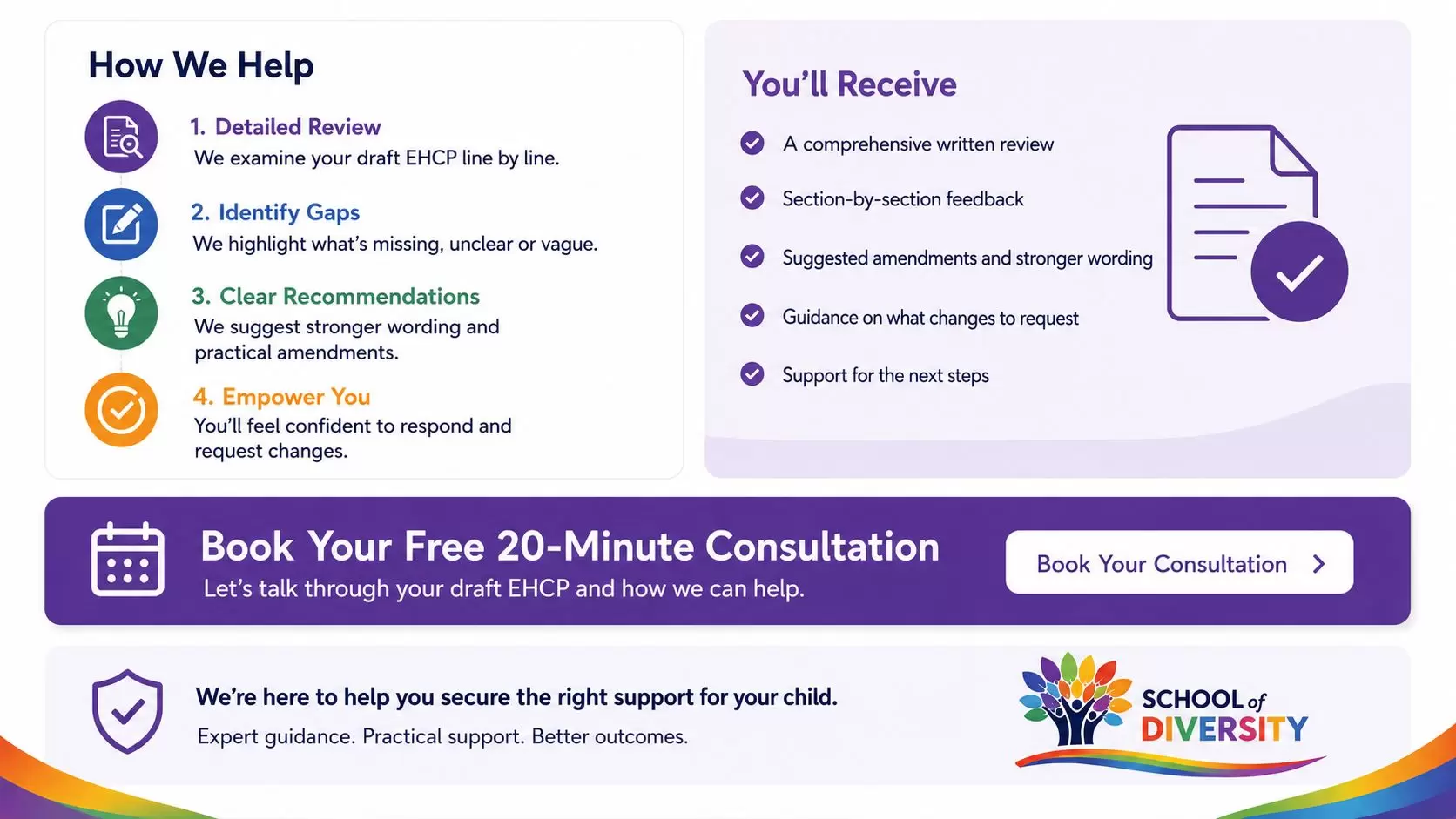
Step 1 – Send Us the Draft EHCP
Provide us with the draft plan and the main reports produced or considered during the EHC needs assessment.
Step 2 – We Review the Evidence
We compare the wording of the EHCP with the evidence and recommendations contained within the professional reports.
Step 3 – We Identify Gaps and Weaknesses
We look particularly at:
- Sections B, E and F;
- professional recommendations;
- specificity of provision;
- consistency between sections;
- environmental requirements;
- and relevant placement considerations.
Step 4 – You Receive Clear Feedback
We explain the important points in straightforward language and identify amendments you may wish to request.
Step 5 – Respond to the Local Authority
You can then use the review when preparing your representations on the draft EHCP.
If further support is required, we can also help with:
- reviewing amended drafts;
- preparing representations;
- discussing disputed wording;
- evidence preparation;
- mediation preparation;
- placement issues;
- or SEND Tribunal support where necessary.
When Should I Get My Draft EHCP Reviewed?
Ideally, as soon as you receive the draft.
You normally have a relatively short period in which to make representations, so leaving the review until the end of that period can make it harder to examine the professional evidence properly.
If possible, gather together:
- the draft EHCP;
- all professional reports;
- your original parental representations;
- school evidence;
- relevant correspondence;
- and any particular concerns you already have about the draft.
Common Draft EHCP Problems We Look For
A review may identify issues such as:
- diagnoses included but functional needs missing;
- professional recommendations omitted;
- provision described as strategies rather than actual support;
- frequency missing;
- duration missing;
- staffing level unclear;
- therapy provision insufficiently detailed;
- “access to” wording;
- “as required” wording;
- “up to” wording;
- responsibility for provision unclear;
- staff training unspecified;
- sensory provision inadequately described;
- social-communication support missing;
- emotional-regulation provision unclear;
- support dependent on resources being available;
- outcomes which do not match identified needs;
- important environmental requirements missing;
- internal contradictions between different EHCP sections;
- or placement being considered before the child’s provision has been properly defined.
What Happens if the Local Authority Rejects the Amendments?
Not every requested amendment will necessarily be accepted.
If disagreement remains, the appropriate next step depends on the stage of the process and the nature of the dispute.
This may involve:
- further discussion with the local authority;
- providing additional evidence;
- mediation;
- or, following a final appealable decision, considering an appeal to the SEND Tribunal.
School of Diversity can help you understand the outstanding issues and decide what evidence or next step may be appropriate.
Why Choose School of Diversity?
Parents often come to us because they do not simply want someone to tell them whether an EHCP “looks okay”.
They want to understand:
- whether their child’s needs have been properly described;
- whether the professional evidence has been followed;
- whether Section F is sufficiently clear;
- what amendments actually matter;
- and what they should ask the local authority to change.
Our approach is practical, evidence-led and focused on the individual child or young person.
We help you understand the plan so that you can make informed decisions about the next step.
Frequently Asked Questions
How Long Do I Have to Respond to a Draft EHCP?
Parents or the young person must normally be given at least 15 days to give their views and make representations on the draft plan.
Because the period can pass quickly, it is sensible to begin reviewing the plan and professional reports as soon as the draft arrives.
Can I ask the local authority to change a draft EHCP?
Yes.
The draft stage exists so that parents or the young person can review the proposed plan, provide comments and request changes before the plan is finalised.
Should I only check Section F?
No.
Section F is extremely important, but it should be read alongside the rest of the EHCP.
In particular, Sections B, E and F should connect logically:
Needs → Outcomes → Provision
If an important need is missing from Section B, the provision required to address it may also be weakened or omitted.
Can you compare the EHCP with an Educational Psychologist report?
Yes.
Comparing professional recommendations with the EHCP is an important part of our review.
We can also consider reports from Speech and Language Therapy, Occupational Therapy and other relevant professionals.
Can you review an amended draft?
Yes.
Where the local authority makes amendments following parental representations, we can review the revised wording and identify whether the significant concerns have been resolved.
Can you help with school placement?
We can help you consider whether the provision and environmental requirements described by the evidence are consistent with the proposed type of placement.
For more complex placement disputes, our dedicated EHCP Placement Support service may be more appropriate.
What happens once the EHCP is finalised?
Once the local authority issues a final EHCP, different rights and statutory duties apply.
If you disagree with relevant parts of the final plan, you may have a right of appeal.
It is therefore worth addressing significant concerns during the draft stage wherever possible rather than assuming they can easily be corrected later.
Get Help With Your Child's Draft EHCP
If you have received a draft EHCP and are unsure whether it properly reflects your child’s needs and professional evidence, we can help.
We can review the plan, identify important omissions or vague wording and help you understand what amendments you may wish to request before the EHCP is finalised.
Draft EHCP Review can help you identify:
- missing needs;
- missing professional recommendations;
- vague Section F wording;
- unquantified provision;
- inconsistencies between reports and the EHCP;
- environmental requirements;
- placement considerations;
- and priority amendments.
Don’t wait until the EHCP has been finalised to start examining the detail.
Important Information
School of Diversity provides SEND advocacy, evidence review, document preparation and practical EHCP support.
We do not guarantee that the local authority will accept proposed amendments or name a particular placement.
Unless expressly agreed otherwise, the service does not constitute representation by a solicitor or barrister and is not a substitute for regulated legal advice where required.
Parents and young people remain responsible for checking and meeting local-authority, mediation and tribunal deadlines. The precise documents, amendments, consultations and revisions included will be set out in the client agreement.