
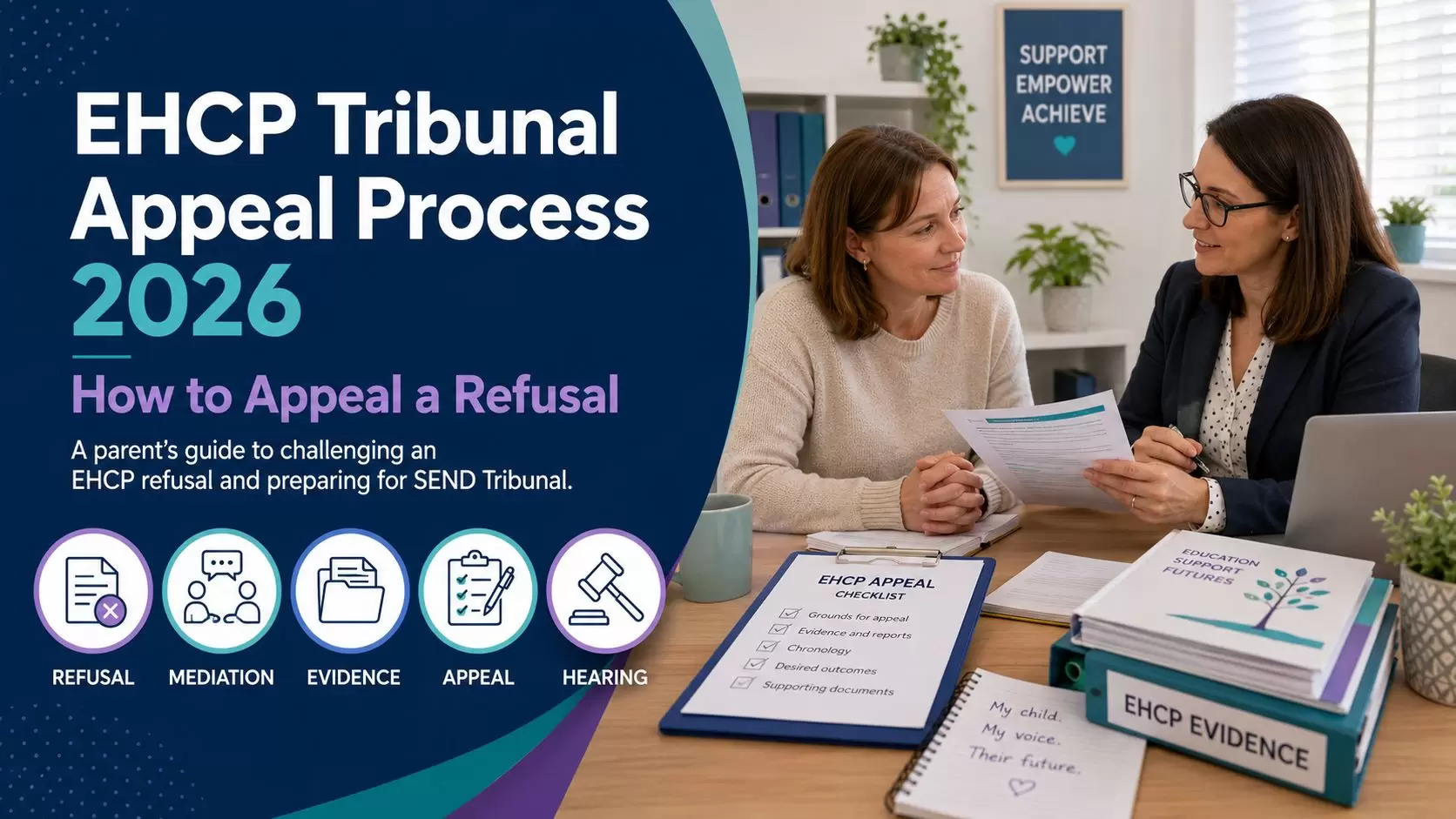
EHCP Tribunal Appeal Process 2026: How to Appeal a Refusal
Receiving a refusal from your local authority regarding an Education, Health and Care (EHC) plan can feel disheartening, but it is not the end of the road. In England, you have a legal right to challenge that decision through the SEND Tribunal. This guide explains the EHCP tribunal appeal process step by step, so you know what to expect and how to prepare. Whether you have been refused an assessment, refused a plan, or disagree with the contents of a plan, understanding your options is the first move towards securing the support your child needs.
When Can You Appeal to the SEND Tribunal?
You can appeal to the SEND Tribunal if you disagree with a local authority decision about an EHC plan. The decisions you can challenge include:
- a refusal to carry out an EHC needs assessment
- a refusal to issue an EHC plan after an assessment has been completed
- the contents of sections B (special educational needs), F (special educational provision), or I (placement) of an existing plan
- a decision to cease maintaining an existing EHC plan
Each of these grounds follows a similar process, though the forms and deadlines may differ slightly. The important thing to remember is that you have a right to challenge, and many parents do so successfully.
Mediation: The First Step for Most Appeals
Before you can lodge an appeal, you must contact a mediation adviser and obtain a mediation certificate in most cases. Mediation is free and does not affect your right to appeal. You do not have to attend a mediation meeting if you do not wish to; you only need to consider mediation and receive the certificate. The certificate is proof that you have fulfilled this requirement. There is one exception: if your appeal is solely about the name of the school or type of school (section I of the EHC plan), you do not need to consider mediation first. In that situation, you can go straight to the tribunal.
Understanding Appeal Deadlines
The deadline for most appeals is strict. Your appeal must be received by the SEND Tribunal within two months of the date on the local authority’s decision letter, or within one month of the date on the mediation certificate, whichever gives you more time. If your appeal is only about section I and you do not need a mediation certificate, you still have two months from the decision letter to submit your appeal. Missing this deadline can prevent your case from being heard, so it is wise to act promptly. If you are unsure about the exact date, contact a free advice service such as IPSEA or your local Information, Advice and Support Service (IASS) to clarify.
How to Prepare Your Appeal
Choosing the correct form
There are two main forms for appeals. Use form SEND 35 for appeals about an existing EHC plan or a refusal to issue a plan after assessment. Use form SEND 35a for appeals against a refusal to assess. Both forms are available from the government website, and there is no cost to lodge an appeal. You may be entitled to legal aid to help with the process, and free help and advice is available from IPSEA and your local IASS.
Gathering evidence
Strong evidence is the foundation of a successful appeal. While the tribunal considers all relevant information, typical evidence includes professional reports from educational psychologists, speech and language therapists, occupational therapists, or medical professionals. School records, your own written observations of your child’s needs, and any existing support plans can also be useful. The goal is to show why the local authority’s decision was wrong and what provision your child requires. If you are unsure what evidence to include, an advice service can help you identify gaps.
What Happens After You Lodge Your Appeal?
Once the SEND Tribunal receives your appeal, it typically registers it within 10 working days. After registration, the hearing date is usually set for about 12 weeks later. During this time, both sides exchange evidence and may have case management discussions. The tribunal will review your case based on the evidence submitted. You can attend the hearing yourself, or you may choose to have legal representation. If you decide to hire a lawyer or a witness charges a fee, those costs are your responsibility, but the appeal itself remains free to lodge.
Common Reasons Appeals Succeed
Although the research does not provide specific success rates, appeals tend to be stronger when parents can clearly demonstrate that the local authority failed to properly consider their child’s needs. This often happens when the authority relies on outdated or incomplete information, or when they have not fully applied the legal test for an EHC plan. Another common reason for success is new evidence that was not available at the time of the original decision. A well-prepared case, supported by professional reports and a clear narrative of your child’s difficulties, gives the tribunal the best basis to rule in your favour.
The 2026 Tribunal Landscape
The SEND system in England is constantly evolving. The core structure of appeals has remained stable for several years, but it is always worth checking for updated guidance on the government website. The deadline rules, mediation requirements, and appeal forms described in this article are based on current practice. Because the process in Wales uses Individual Development Plans (IDPs) instead of EHC plans, the appeals route there is different. For parents in England, the EHCP tribunal appeal process remains the same in 2026 as outlined here. Always verify any changes with official sources or a free advice service before proceeding.
Frequently Asked Questions
Do I have to attend a mediation meeting before I can appeal?
No. You only need to contact a mediation adviser and obtain a mediation certificate. You can choose to attend a meeting, but it is not compulsory. The process is designed to give you information without forcing you into an unwanted discussion. Mediation is free and does not affect your right to go to the tribunal.
How long do I have to file my appeal with the SEND Tribunal?
For most appeals, you have two months from the date of the local authority’s decision letter or one month from the date on your mediation certificate, whichever is later. If your appeal is only about the school named (section I), you do not need a mediation certificate and you have two months from the decision letter.
Is there a fee to make an appeal?
There is no cost to lodge an appeal to the SEND Tribunal. However, if you decide to hire a solicitor or you use a witness who charges a fee, those expenses are your own. You may also be entitled to legal aid, which can help cover professional costs if you qualify.
Can I appeal only part of an EHC plan?
Yes. You can appeal the contents of sections B (needs), F (provision), or I (placement) of an EHC plan. You can also appeal the entire plan if you disagree with the authority’s decision to issue it or refuse it. The form you use will depend on what you are challenging.
Where can I get free help with my appeal?
Free advice is available from IPSEA and your local Information, Advice and Support Service (IASS). These organisations specialise in special educational needs law and can guide you through the process. You may also check whether you qualify for legal aid, which is available in some cases.
Facing a refusal from your local authority can feel overwhelming, but the SEND Tribunal exists to give parents a fair chance to challenge decisions. By understanding the steps involved from mediation to the hearing, and by gathering the right evidence, you can approach the EHCP tribunal appeal process with more confidence. You do not have to do it alone. Free support is available, and taking that first step could make all the difference for your child’s education.
Final Thoughts
Appealing an EHCP refusal can feel daunting, but parents do not have to accept a decision they believe is wrong. The strongest appeals are built on clear evidence, a focused explanation of the child’s needs and a clear link between those needs and the support being requested. Before starting an appeal, it may help to review why an EHCP may have been refused and what to do next after an EHCP refusal. You may also find it useful to gather stronger supporting information using our EHCP evidence for parents guide and to understand the full EHCP appeal process before preparing your case for SEND Tribunal.