
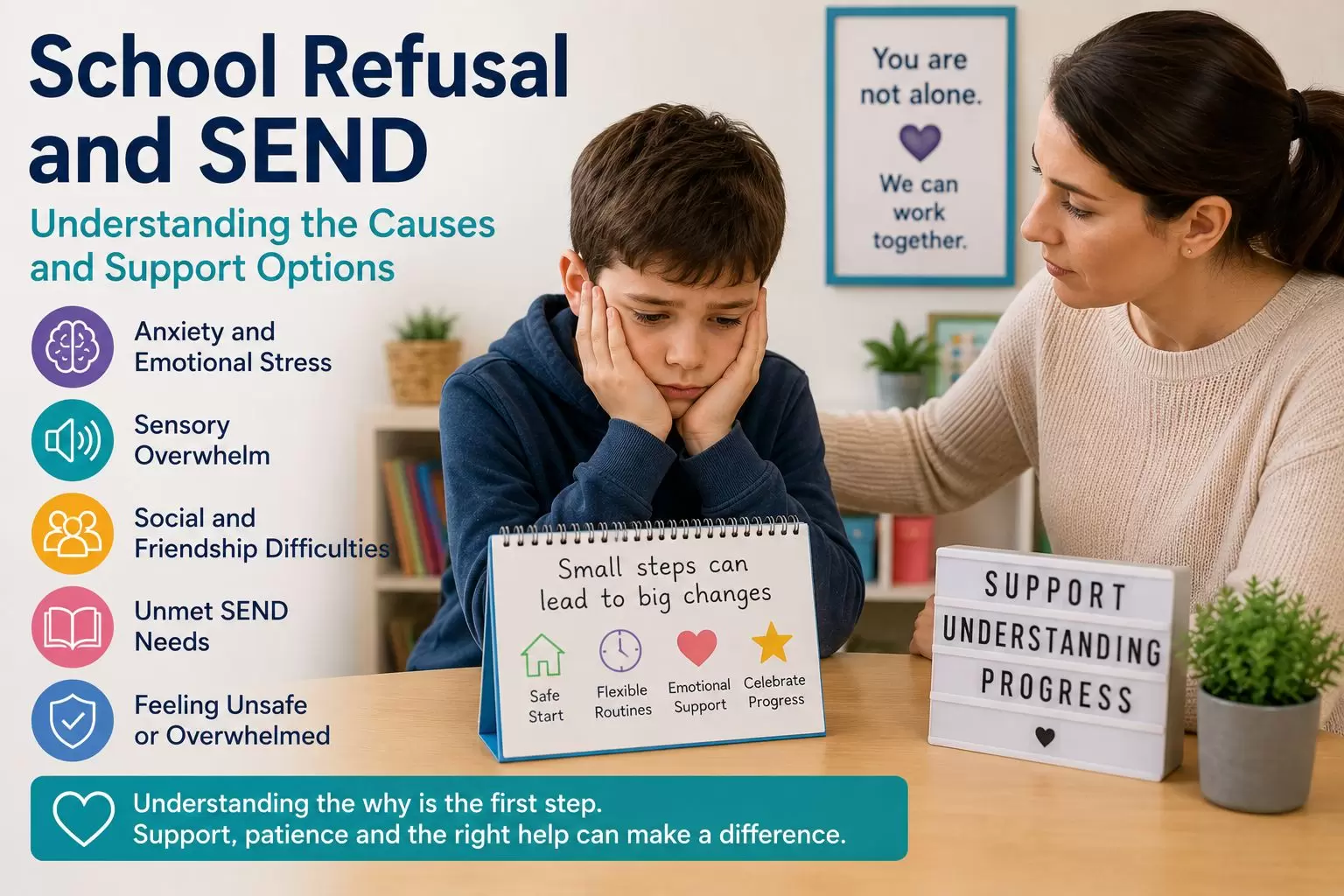
School Refusal and SEND: Understanding the Causes and Support Options
School refusal can be deeply distressing for both children and parents.
It is not the same as a child simply not wanting to go to school. For many children, school refusal is linked to anxiety, overwhelm, unmet needs, sensory difficulties, social challenges, or feeling unsafe in the school environment.
When a child repeatedly struggles to attend school, it is important to look beyond behaviour and ask what is making school feel unmanageable.
For children with SEND or neurodivergent learning profiles, school refusal can be a sign that support needs to change.
What Is School Refusal?
School refusal describes a pattern where a child finds it extremely difficult to attend school because of emotional distress.
This may look like:
- Crying before school
- Panic or anxiety in the morning
- Refusing to leave the house
- Physical symptoms such as stomach aches or headaches
- Meltdowns before or after school
- Becoming withdrawn or distressed
- Attending some days but not others
- Struggling to enter the classroom
School refusal is often a sign of distress, not defiance.
Why School Refusal Happens
There is rarely one simple reason.
School refusal may be linked to:
- Anxiety
- Sensory overwhelm
- Bullying
- Social difficulties
- Academic pressure
- Transitions
- Unmet SEND needs
- Communication difficulties
- Emotional regulation difficulties
- Feeling misunderstood or unsafe
For some children, school becomes associated with stress. Once that pattern develops, returning can feel even harder.
How SEND Can Contribute to School Refusal
Children with SEND may experience school as confusing, exhausting, or overwhelming.
For example:
- An autistic child may struggle with noise, change, or social demands
- A child with ADHD may feel constantly criticised for behaviour they cannot easily control
- A child with speech and language needs may struggle to understand instructions
- A child with sensory processing differences may find the environment unbearable
- A child with anxiety may feel unable to cope with expectations
If support is not in place, these pressures can build until school attendance becomes difficult.
You can explore related signs in signs your child may need an EHCP.
School Refusal Is Not “Bad Behaviour”
One of the biggest mistakes is treating school refusal as a discipline issue.
A child who refuses school may be overwhelmed, frightened, exhausted, or unable to explain what is wrong.
Punishment rarely solves the underlying issue. It can increase shame, anxiety, and avoidance.
Support should begin with understanding.
Adults need to ask:
- What is the child finding difficult?
- When does distress begin?
- Are there patterns?
- What support is already in place?
- What needs to change?
Common Signs That School Refusal Is Linked to Unmet Needs
School refusal may be linked to SEND or unmet needs if your child:
- Struggles most on certain days or after certain lessons
- Becomes distressed after busy or noisy environments
- Has meltdowns after school
- Says school feels too much
- Complains of physical symptoms before school
- Avoids specific subjects, spaces, or people
- Is falling behind academically
- Is exhausted after masking all day
- Has difficulty with transitions or changes
- Is not making progress despite support
These patterns can help identify what is driving the refusal.
What Support Can Help With School Refusal?
Support should be individual and gradual.
Helpful support may include:
- A trusted adult at school
- Reduced demands during reintegration
- A flexible timetable
- A quiet arrival routine
- Sensory adjustments
- Emotional check-ins
- Safe spaces
- Clear transition plans
- Support during unstructured times
- Regular communication between home and school
- Access to specialist support where needed
The goal is to make school feel safer and more manageable.
The Importance of Listening to the Child
Children may not always be able to explain why school feels difficult.
Some may say:
- “I feel sick”
- “I hate school”
- “It is too loud”
- “Nobody helps me”
- “I cannot do it”
- “I do not know”
These statements should be explored gently.
Adults should avoid dismissing the child’s distress, even when the reason is not immediately clear.
When SEN Support May Not Be Enough
SEN support may help if difficulties are identified early and the school responds consistently.
However, more formal support may be needed if:
- School refusal continues
- Attendance is worsening
- Anxiety is increasing
- Current support is inconsistent
- Your child is missing significant learning
- Specialist input is needed
- The school cannot meet needs through existing resources
In these cases, an EHCP assessment may be appropriate.
You can read more about the EHCP assessment process.
Can an EHCP Help With School Refusal?
An EHCP can help if school refusal is linked to unmet educational, emotional, communication, sensory, or social needs.
An EHCP may include:
- Specific support during the school day
- A named key adult
- Sensory adjustments
- Emotional regulation support
- Therapy input
- A structured reintegration plan
- Support during transitions
- Alternative arrangements where appropriate
- Clear responsibilities for school and local authority
The key is making sure support is specific, not vague.
You can also read what support should be included in an EHCP.
What Evidence Can Help?
If school refusal is becoming a concern, it is important to keep records.
Useful evidence may include:
- Attendance records
- Anxiety logs
- Notes of morning distress
- Medical information if relevant
- School communication
- SEN support plans
- Behaviour or incident records
- Parent observations
- Reports from professionals
- Notes about sensory or social triggers
Evidence helps show that school refusal is part of a wider pattern of need.
Questions to Ask Your Child’s School
If your child is refusing school, you may want to ask:
- What patterns has the school noticed?
- What support is currently in place?
- Is there a trusted adult my child can go to?
- Are sensory or social triggers being considered?
- Can arrival or transition times be adjusted?
- Is my child being supported during unstructured times?
- Is a reintegration plan needed?
- Should further assessment be considered?
These questions can help shift the focus from attendance alone to understanding and support.
Working Together Without Blame
School refusal can place families under huge pressure. Parents may feel judged, blamed, or stuck between the school and their child’s distress.
A joined-up approach is important.
This means:
- Listening to the child
- Sharing information between home and school
- Identifying triggers
- Agreeing small steps
- Reviewing what is working
- Avoiding blame
Progress may take time, especially if a child has experienced long-term stress.
Frequently Asked Questions: School Refusal and SEND
What is school refusal?
School refusal is when a child finds it very difficult to attend school because of emotional distress, anxiety, overwhelm, or unmet needs.
Is school refusal linked to SEND?
It can be. School refusal may be linked to autism, ADHD, anxiety, sensory needs, speech and language difficulties, emotional regulation challenges, or other SEND needs.
Is school refusal bad behaviour?
No. School refusal is usually a sign of distress. It should be treated as a support need, not simply a behaviour problem.
Can an EHCP help with school refusal?
Yes, if school refusal is linked to unmet needs, an EHCP can set out specific support to help the child access education.
What support helps children return to school?
Support may include a trusted adult, flexible timetable, quiet arrival routine, sensory adjustments, emotional support, and a gradual reintegration plan.
What evidence should I collect for school refusal?
Useful evidence includes attendance records, anxiety logs, parent notes, school communication, professional reports, and examples of distress linked to school.
When should I ask for an EHCP assessment?
You may want to request an assessment if school refusal is ongoing, your child is missing learning, current support is not working, or specialist input is needed.
Final Thoughts
School refusal is often a sign that something needs to change.
For children with SEND, refusal may be linked to anxiety, sensory overload, communication difficulties, unmet learning needs, or feeling unsupported in school.
The right support can help a child feel safer, more understood, and more able to re-engage with education.
If you want to understand how school refusal connects with SEND support and EHCPs, you can explore our comprehensive EHCP guide, which explains each stage in detail.
2 Responses